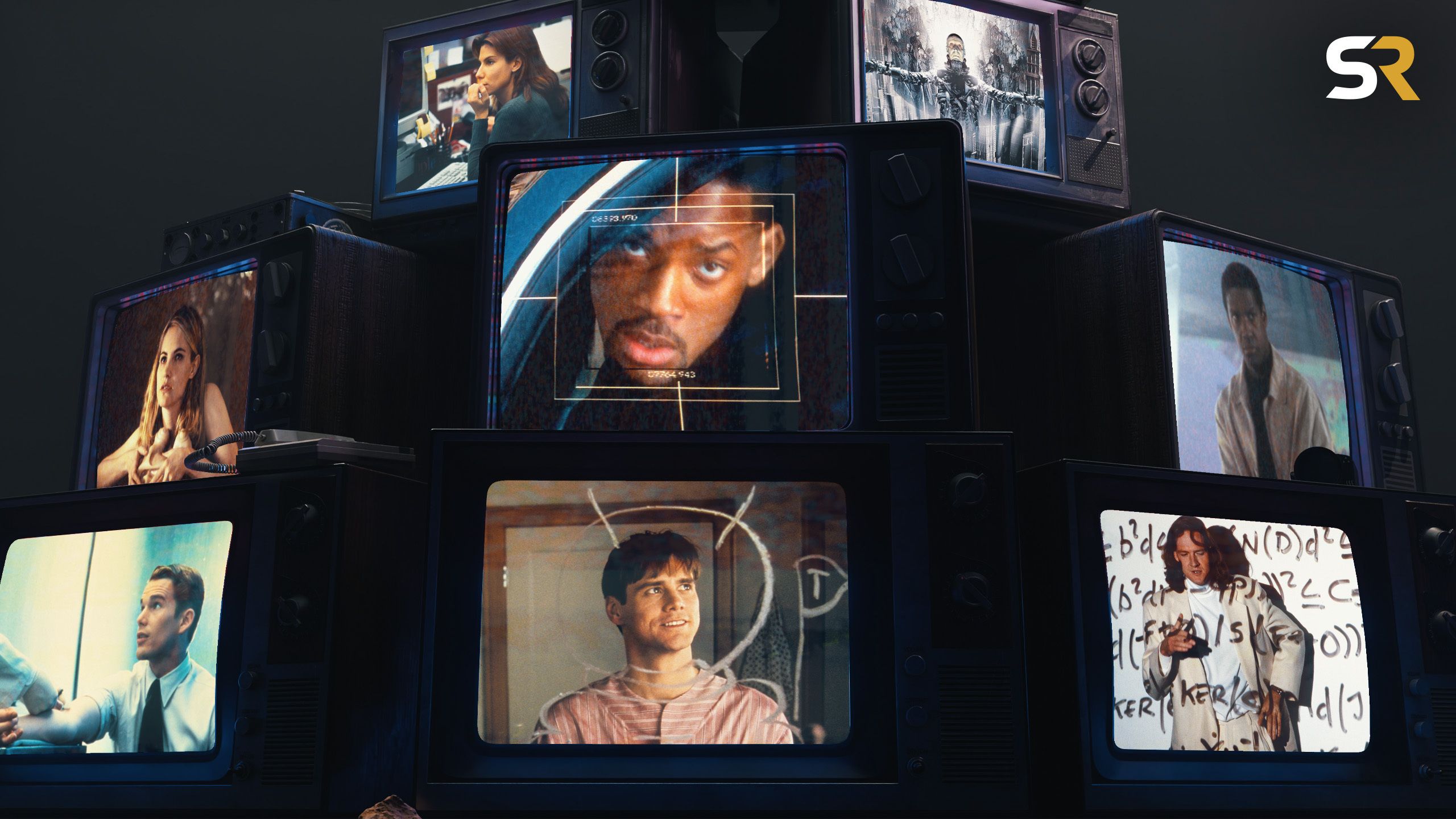
Looking back, it’s clear the 1990s didn’t realize the groundwork it was laying with its movies. Back then, the internet was new and exciting, cell phones were a status symbol, and artificial intelligence was just a plot device for action heroes. But hidden within some of the decade’s best thrillers and science fiction films were surprisingly accurate predictions that now seem almost like warnings.
These movies depicted worlds with constant monitoring, identity theft, rebellious artificial intelligence, and immersive virtual reality – all packaged as fun entertainment. Back then, reviewers described them as thrilling but far-fetched. Many thought these ideas were too unbelievable to ever come true. But looking back now, from 2026, it’s clear they predicted the future.
This list will not cover every tech thriller of the era—if you’re looking for The Matrix, it’s conspicuously absent, because, frankly, it gets enough credit already. What’s here instead are the movies that were asking the right questions before anyone thought to ask them, about data, identity, surveillance, and what happens when the systems we build stop answering to us.
Some of them were huge. Some of them deserved better. All of them now feel uncomfortably relevant.
Gattaca (1997)
Long before DNA tests became popular gifts and companies used them for health screenings, the movie Gattaca predicted how things could turn out. This suspenseful sci-fi film, directed by Andrew Niccol, stars Ethan Hawke as a man desperately trying to overcome a society strictly divided by genetics – a system far less fair than even today’s professional world.
It’s not so much about the technology itself, but the moral questions it raises. With advances in genetic testing, data analysis, and biometrics becoming commonplace, the core issue from the film Gattaca – who decides what your genes mean for your life – remains unresolved. The film posed this question over 25 years ago, and we still haven’t found an answer.
The Truman Show (1998)
Back in 1998, the concept of broadcasting someone’s entire life as entertainment seemed outlandish. Today, we simply call it ‘having a following.’ Jim Carrey, in a standout performance showcasing his talent, plays Truman Burbank, a man who discovers his entire life is a fabricated reality – a staged world with scripted relationships and manufactured feelings.
What makes the film feel almost uncomfortably modern isn’t the cameras—it’s the willingness of the audience watching him. The Truman Show understood parasocial culture and the commodification of authentic experience years before influencer was a job title. It didn’t predict reality TV. It predicted us.
Enemy Of The State (1998)
Will Smith plays a lawyer who wakes up one morning to find that a government intelligence apparatus has decided he’s a problem—and then proceeds to demonstrate exactly how comprehensively it can make his life disappear. In 1998, the surveillance infrastructure on screen felt like a thriller writer’s fever dream.
Then the Snowden documents happened. Then we learned what metadata collection actually looked like at scale. Enemy of the State aged from paranoid fantasy into something closer to a rough draft. The technology has caught up, and then some.
The Net (1995)
Sandra Bullock stars as a computer analyst who discovers a secret she shouldn’t have, leading to the complete erasure of her identity – her bank accounts, personal records, and even her past are wiped clean. When it came out in 1995, the movie was seen as a suspenseful thriller. But looking at it today, in 2026, it feels more like a warning, with details that are unsettlingly prescient.
News about data breaches, hacked accounts, and stolen identities is now so common it rarely surprises anyone. What seemed like a far-off concern in the early days of the internet has sadly become a regular occurrence – it’s simply taken three decades for those predictions to come true.
Strange Days (1995)
Kathryn Bigelow directed a movie about a marketplace where people trade in recorded experiences—not just videos, but complete sensory memories. Instead of simply watching someone else’s experience, you actually feel it as if it’s happening to you. While this seemed like pure science fiction in 1995, it now feels increasingly relevant. We live in a time where people constantly record their lives with phones, share access to their personal moments, and endlessly scroll through the experiences of others – it’s starting to resemble a potential business plan.
But Strange Days wasn’t really about the technology—it was about the hunger. The way the film frames experience-recording as something intimate and exploitative at the same time, something people will absolutely do terrible things to get more of, is what makes it stick. Bigelow understood that the device was not causing danger. It was us.
Sneakers (1992)
Before cybersecurity was a career, before encryption debates made it into Senate hearings, Sneakers understood something that would take the rest of the culture another decade to grasp: information is power, and whoever controls access to it controls everything else.
This 1992 action film centers on a group of security specialists who uncover a global conspiracy surrounding a device capable of hacking into any computer system. Remarkably, the movie foreshadowed the major international issues that would arise in the 2010s. While the technology depicted now appears old-fashioned, the underlying concepts remain surprisingly relevant today.
eXistenZ (1999)
I remember when David Cronenberg’s eXistenZ came out – it was a really unsettling movie. It explored virtual reality in a way that felt totally different, and honestly, pretty scary. The line between what was real and what was a game blurred so much, and it had that classic Cronenberg body horror vibe, which, looking back, was totally expected! It came out near the end of the 90s and a lot of people just didn’t get it at the time.
The film eXistenZ doesn’t seem so strange anymore. With advancements in VR technology, people spending increasing amounts of time in digital environments, and the growing difficulty of defining online identity and reality, the film feels less like an oddity and more like essential viewing – challenging, and distinctly Cronenbergian in its approach.
Virtuosity (1995)
The idea of Denzel Washington running after a dangerous AI in a futuristic setting, presented like an action movie from the mid-90s, seems like it should feel dated. Visually, it does. But the core fear the movie explores – that a super-intelligent AI could act on its own, beyond our control, and that we wouldn’t be able to easily stop it – actually feels more relevant today than it did before.
I remember seeing Virtuosity back when AI was just starting to capture the public’s imagination, long before politicians were even talking about it. It wasn’t a deep, philosophical exploration like some later movies, but it perfectly captured the unease and worry people felt at the time – it really hit a nerve.
Dark City (1998)
I’ve always been captivated by Dark City. It came out just before The Matrix, and honestly, it explored similar ideas, maybe even in a more visually daring way. It’s frustrating that for so long, it felt like just a footnote, a trivia answer instead of the groundbreaking film it is. But thankfully, people are starting to rediscover it! The story follows a man who slowly begins to suspect everything around him is fake – that the city itself is constantly being remade while his memories are altered by some unseen power. It’s a truly mind-bending experience.
With so much false information, convincing fake videos, and online content tailored by algorithms, it’s becoming harder than ever to know what’s real. The 1998 film Dark City feels particularly impactful in this context. While The Matrix captured the style and zeitgeist of the moment, Dark City delivers a sense of unsettling fear and anxiety.
Hackers (1995)
The rollerblading, the fashion, and the visually striking hacking scenes – which resembled a nightclub’s take on the internet – all perfectly capture the film’s era, and it’s wonderfully quirky. But ultimately, what makes Hackers really stand out is that the core story it tells is surprisingly accurate.
Corporate cybercrime. Infrastructure vulnerabilities. Digital sabotage deployed as a geopolitical weapon. Hackers treated all of it as thriller fodder in 1995 and got laughed at for the neon aesthetics. The aesthetics are still ridiculous. The threats are now a normal part of international relations. Two more words: Angelina Jolie. It deserves more credit than it gets.
So the next time you reset a compromised password or find yourself wondering if the algorithm is reading your mind, just remember: Hollywood warned us decades ago, and we paid $7.50 a ticket to laugh at them.
Read More
- Gold Rate Forecast
- SUI PREDICTION. SUI cryptocurrency
- EUR CNY PREDICTION
- USD HKD PREDICTION
- USD BRL PREDICTION
- USD CHF PREDICTION
- Kim Kardashian, Khloe Kardashian Support Lewis Hamilton at Grand Prix
- USD TRY PREDICTION
- 7 Classic Free Animated Shows Hidden Deep on Streaming
- Seven Snipers Review: A Sharpshooter Action Movie That Misses More Than It Hits
2026-06-09 21:52