
As a lifelong sci-fi fan, I’ve always thought the genre doesn’t really evolve so much as leap forward. It’s not a steady climb, but these amazing moments where one film completely changes what we think is possible. Usually, it happens when a movie brilliantly combines cool new technology with big questions about what it means to be human. We saw it with the digital worlds of The Matrix and the immersive experience of Avatar. Before those, films like 2001: A Space Odyssey and Interstellar really pushed the boundaries of how deep and thoughtful a big-budget movie could be. But honestly, the biggest shift, the one that really started it all, happened almost a hundred years ago. Long before CGI, a silent film laid the groundwork for pretty much every dark, futuristic world we’ve seen on screen since.
Fritz Lang’s Metropolis, which premiered in Berlin on January 10, 1927, is considered the high point of German Expressionist cinema. The film portrays a sharply divided future society: the wealthy live in luxury above ground, while the workers are forced to toil in the underground machinery. It’s a powerful criticism of the industrial era, highlighting the conflict between the creators and the builders of a society’s great achievements.
When Metropolis arrived in the United States, Paramount Pictures significantly cut the film, removing almost 25% of the original footage to make the story easier for American audiences to follow. Despite this initial editing, the film’s striking visuals captivated viewers and earned widespread praise. Metropolis became a worldwide hit, demonstrating that science fiction could explore serious themes like corporate corruption and class struggle. Ultimately, the film helped elevate science fiction from a simple genre to a respected art form.
Why Is Metropolis So Important for Sci-Fi History?
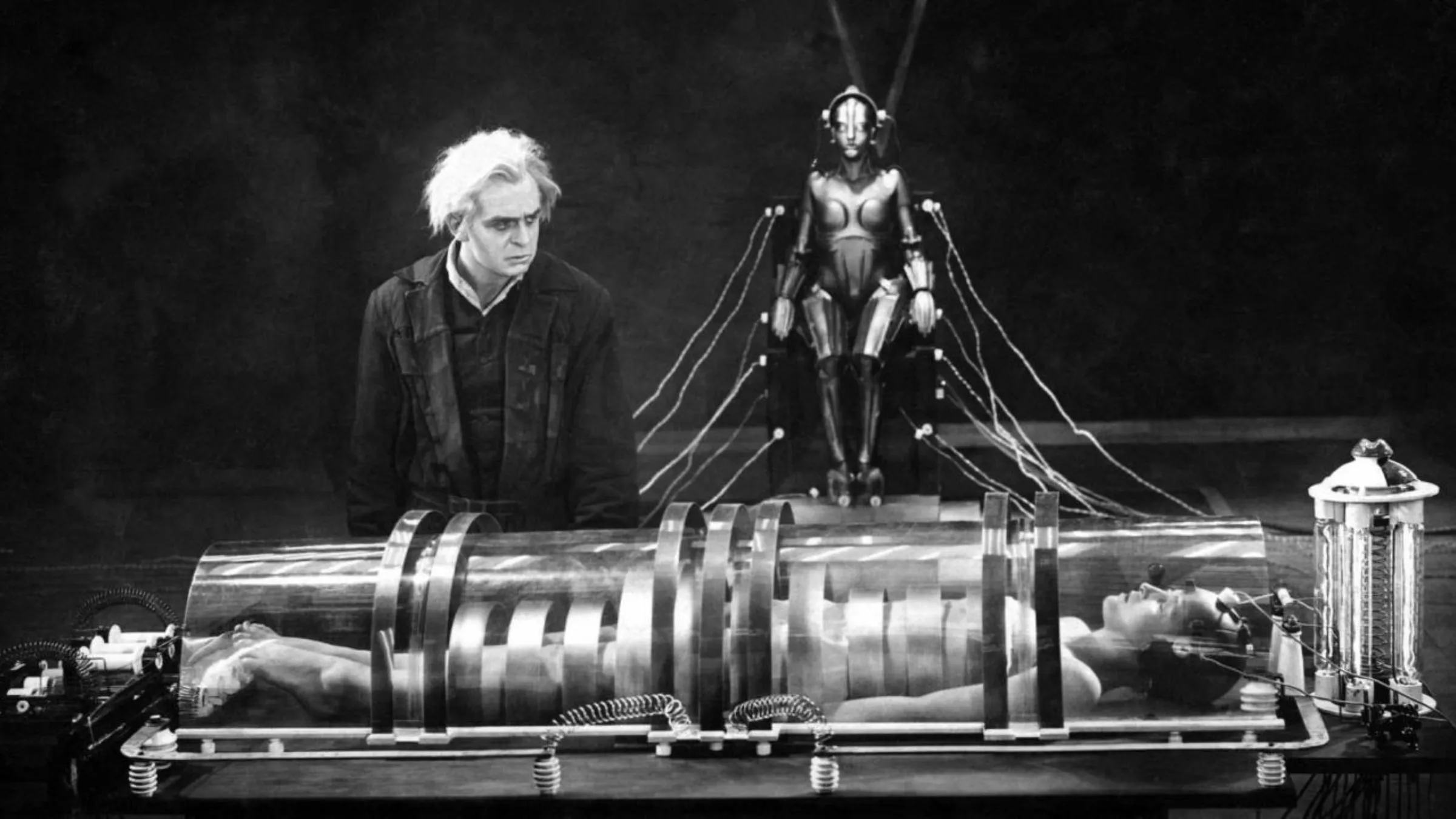
For over fifty years, the groundbreaking visual effects in Metropolis set the standard for the film industry. Director Fritz Lang and cinematographer Karl Freund used a clever technique called the Schüfftan process – using mirrors to seamlessly blend live actors with miniature sets. This allowed them to create a huge, realistic-looking city with multiple levels. Metropolis essentially invented the look of the “megacity,” a concept later perfected by Ridley Scott in Blade Runner and seen again in Luc Besson’s The Fifth Element. Lang’s decision to portray the city as a towering, vertical space emphasized the social divisions within it. Even today, the design of the film’s New Tower of Babel continues to inspire filmmakers when they depict the relationship between power and the built environment.
Beyond its impressive design, the film Metropolis gave us the most famous robot in movie history. The Maschinenmensch, a mechanical version of the character Maria (played by Brigitte Helm), directly inspired the look of C-3PO from Star Wars. The film also cemented the idea of robots being used to cause political trouble and social disruption. Additionally, the character of Rotwang (Rudolf Klein-Rogge) created the classic image of the “mad scientist.” His lab, with its sparking machines and bubbling chemicals, became the standard way to show advanced technology as a place of wild, unpredictable invention.
The film Metropolis was groundbreaking in its use of large crowds and enormous, real-life sets, achieving a sense of realism that even today’s digital effects often can’t match. By combining these technical innovations with a pessimistic outlook on technology, Lang established a visual style that continues to define dystopian films. That’s why, nearly a century later, Metropolis’s influence is still clearly visible in modern science fiction.
You can now watch Metropolis on streaming services like Plex and the Roku Channel.
What sci-fi movie do you think comes closest to matching the impact of Metropolis? Share your thoughts in the comments and join the discussion in the ComicBook Forum!
https://comicbook.com/movies/list/7-sci-fi-movies-that-aged-incredibly-well/embed/#
Read More
- Everything You Need To Know About Nikki Baxter In Stranger Things’ Animated Spinoff
- ‘The Bride!’ Review: Jessie Buckley Breathes Life into a Monstrous Mess
- Welcome to Demon School! Iruma-kun season 4 release schedule: When are new episodes on Crunchyroll?
- After 11 Years, Black Clover Officially Ends With Final Release (& Crowns a New Wizard King)
- Miranda Kerr Shares “Quick” Procedure She Got Before Met Gala 2026
- Former Love Island USA Host Tried to Sneak Garlic Into Met Gala
- Bitcoin Proxy Play: STRC 11.5% vs Pendle’s 19%-Unbelievable Yields Revealed!
- Coronation Street’s Gareth Pierce on Todd as murderer: “Maybe Theo really did push him that far”
- Balancing Act: Quantum and Thermal Noise in Superfluid Circuits
- Sega Game From 2024 Free for Millions Next 72 Hours
2026-01-10 20:17