Author: Denis Avetisyan
New research explores whether anomalies observed in the decay of B and K mesons could be explained by interactions with dark matter particles.

This review investigates the implications of Minimal Flavor Violation for dark matter emission in B and K meson decays at the Belle II and NA62 experiments.
Despite the Standard Model’s successes, persistent anomalies in flavor physics motivate exploration beyond its confines. This paper, ‘Dark Matter emission at Belle II and NA62 in Minimal Flavor Violation framework’, investigates whether these anomalies-specifically excesses in $K^+ \to π^+ ν\barν$ and $B^+ \to K^+ ν\barν$ decays-could be explained by a framework incorporating Minimal Flavor Violation and dark matter candidates. Our analysis reveals that while the framework naturally accommodates either anomaly, a unified explanation for both within a minimal dark matter multiplet proves challenging. Could more complex dark matter configurations or alternative theoretical frameworks ultimately resolve these intriguing discrepancies and illuminate the nature of dark matter itself?
Whispers from Decay: Hints of Physics Beyond Our Grasp
Recent investigations into the decay of rare subatomic particles, specifically kaons and B mesons, are hinting at physics beyond the established Standard Model. Analyses of K^+ \rightarrow \pi^+ \nu \bar{\nu} and B^+ \rightarrow K^+ \nu \bar{\nu} decays reveal an unexpected surplus of events – more decays occurring than predicted by current theoretical frameworks. These aren’t merely small discrepancies; the observed excesses suggest the potential influence of undiscovered particles or forces, prompting physicists to meticulously re-examine the fundamental building blocks of the universe and the interactions that govern them. While further confirmation is needed, these intriguing results offer a compelling avenue for exploring new physics and potentially revolutionizing understanding of the cosmos.
Recent analyses of exceedingly rare particle decays are hinting at physics beyond the Standard Model. The decay of B^+ mesons into K^+ mesons, accompanied by a neutrino and its antineutrino, exhibits a statistically significant excess-reaching 2.7σ-compared to predictions based on current understanding. More compelling is the observation in the decay of K^+ mesons into \pi^+ mesons and the same neutrino pair, where a 5σ excess has been measured, widely considered the gold standard for a discovery in particle physics. These discrepancies suggest the possible involvement of new, yet undiscovered particles or forces influencing these decays, potentially requiring a revision of the established framework describing fundamental interactions.
Unveiling the subtle deviations from established physics necessitates extraordinarily precise measurements of exceedingly rare particle decays. Experiments like NA62, situated at CERN, and Belle II, operating in Japan, are specifically designed to meticulously track and quantify these ephemeral events. These facilities employ cutting-edge detector technologies and intense particle beams to amass the large datasets required to distinguish genuine signals from background noise. The challenge lies in the inherent rarity of these decays – occurring only a few times in billions of particle interactions – demanding exceptional control over systematic uncertainties and unparalleled data analysis techniques. Successfully characterizing these rare processes not only tests the limits of the Standard Model but also provides a crucial pathway towards discovering potential new particles and interactions that could reshape our understanding of the universe.
Flavor’s Constraints: A Framework for the Unexpected
The Minimal Flavor Violation (MFV) framework addresses shortcomings of the Standard Model by postulating that any new physics must respect the flavor symmetries observed in the interactions of known particles. This is achieved by requiring new interactions to occur via the same Yukawa couplings that govern the masses and mixing of quarks and leptons. Consequently, MFV stabilizes new fields-preventing rapid decay into Standard Model particles-and constrains the possible forms of flavor-changing neutral currents. This approach significantly reduces the number of free parameters needed to describe potential extensions to the Standard Model, providing a predictive framework for experimental searches at colliders and in rare decay processes. The framework does not predict flavor, but rather constrains the ways in which new physics can manifest itself through flavor-violating processes.
MFV Couplings are a set of parameters that quantify the strength of interactions beyond the Standard Model, while adhering to the constraints imposed by the Minimal Flavor Violation framework. These couplings, typically denoted as y_{ij} , directly influence the rates of processes involving new particles and fields. Crucially, MFV dictates that these couplings are fundamentally linked to the Yukawa interactions of Standard Model fermions, ensuring that any new physics respects the observed flavor structure. The precise values of these MFV Couplings are free parameters determined by experimental measurements, and their magnitudes dictate the observability of beyond-the-Standard-Model effects in both direct and indirect searches.
The Minimal Flavor Violation (MFV) framework provides a theoretical structure wherein interactions between Standard Model particles and potential dark matter candidates are not arbitrarily suppressed. Because MFV dictates the permissible forms of new physics interactions based on established flavor symmetries, it predicts specific couplings between dark matter and visible sector particles. These predicted interactions can, in principle, account for observed anomalies in dark matter detection experiments – such as excesses in event rates or unexpected energy depositions – and potentially resolve discrepancies between theoretical predictions and experimental results. The framework doesn’t require dark matter interactions, but it provides a consistent mechanism for them, offering a testable pathway to explore dark matter’s properties within a well-defined theoretical context.
The Shadow of the Invisible: Dark Matter Emission in Rare Decays
The Minimal Flavor Violation (MFV) framework predicts specific patterns of interactions between Standard Model particles and potential dark matter candidates. Within MFV, rare meson decays – processes already suppressed in the Standard Model – can be further suppressed or altered by interactions involving dark matter particles in the final state. Observed excesses in certain decay channels, such as B \rightarrow K^* \ell^+ \ell^- and B_c \rightarrow \tau \nu , do not fully align with Standard Model predictions and could be explained by these dark matter-emitting decays. The MFV constraint restricts the possible forms of new interactions, linking the dark matter coupling to the same flavor structure governing Standard Model interactions, offering a testable framework for indirect dark matter detection through precise measurements of rare meson decay rates and kinematic distributions.
Within the Minimal Flavor Violation (MFV) framework, both scalar and fermionic dark matter candidates are theoretically permissible explanations for observed anomalies in rare meson decays. Scalar dark matter models posit a spin-0 particle mediating the interaction, while fermionic dark matter proposes a spin-1/2 particle. The viability of each depends on the specific interaction strengths and couplings to Standard Model particles, but the MFV framework does not inherently favor one over the other. Both candidates can accommodate the observed decay rates and final state particles, provided their mass and interaction parameters fall within acceptable ranges constrained by existing experimental data and theoretical consistency. Determining which, if either, is the correct dark matter candidate requires further experimental investigation and precise measurements of decay branching ratios and invariant mass distributions.
Precise modeling of dark matter emission in rare meson decays necessitates accurate determination of hadronic form factors, which describe the strong interaction dynamics of meson decay. Since direct calculation of these form factors is often impractical, effective field theory (EFT) is employed to parameterize the new interactions mediating the decay and dark matter emission. While observed excesses in specific decay channels can be explained by models incorporating a single dark matter multiplet and a limited number of EFT parameters, a consistent explanation of multiple, simultaneous excesses requires more complex models involving additional dark matter candidates or extended interaction structures beyond a single multiplet.
Beyond Confirmation: A Paradigm Shift in Understanding
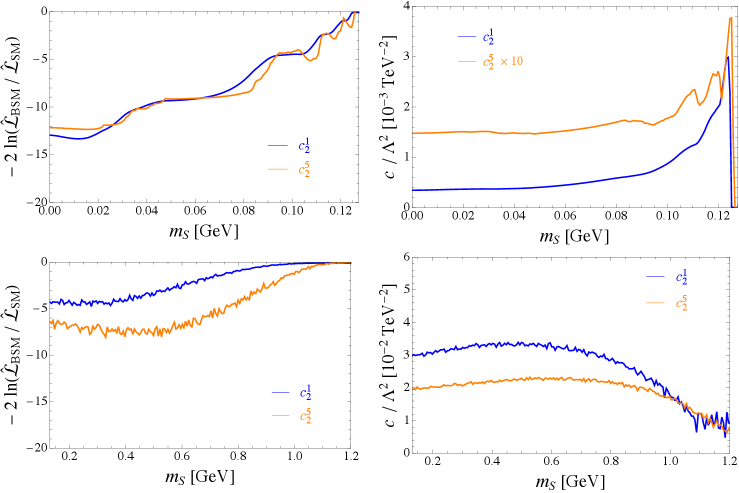
Establishing the reality of dark matter emission demands meticulous statistical rigor, particularly through techniques like Signal Likelihood analysis which assesses the probability of observing an excess of events beyond what standard models predict. Recent investigations have demonstrated a notable enhancement in likelihood – reaching up to 3σ – when considering individual excesses within the data, suggesting a potentially significant deviation from expected background fluctuations. This level of statistical improvement, while not yet definitive proof, provides compelling evidence that the observed anomalies may not be mere statistical flukes, and warrants continued, focused investigation to determine if they represent genuine signals of dark matter production. The significance is measured by how much the likelihood of the observed data increases when a dark matter signal is included in the model, offering a quantitative assessment of the evidence for new physics.
The pursuit of definitively identifying dark matter through rare decay signatures hinges on the continued advancement of experimental capabilities, particularly those offered by facilities like NA62 and Belle II. These experiments are not merely collecting data; they are establishing a foundation of precision measurement crucial for discerning subtle signals indicative of dark matter production. Future iterations and complementary experiments will build upon this groundwork, aiming to accumulate significantly larger datasets and implement refined analysis techniques. This increased statistical power will be essential for not only confirming the initial observations of excess events, but also for characterizing the properties of the potential dark matter particles themselves, including their mass and decay modes. Ultimately, these endeavors promise a more detailed understanding of the dark sector and its interaction with the visible universe.
The confirmation of dark matter originating from rare particle decays represents a potential paradigm shift in physics, extending beyond simply validating the Minimal Flavor Violation (MFV) framework. MFV posits that new physics should only subtly alter the patterns of flavor interactions observed in the Standard Model; detecting dark matter produced in these decays would strongly support this principle. However, the implications reach far beyond model confirmation. Such a discovery would establish a direct link between the visible and dark sectors, providing an unprecedented observational window into the composition and interactions of dark matter itself. This newfound access could unveil the properties of dark matter particles, shedding light on their mass, spin, and the forces governing their behavior – fundamentally reshaping understanding of the universe and its unseen constituents.
The study meticulously examines how subtle deviations in B meson decays might signal interactions with dark matter particles, a fascinating exploration of the universe’s hidden components. This approach mirrors a fundamental principle of complex systems: order doesn’t necessitate a grand design, but arises from the interplay of local rules. As Albert Einstein observed, “The intuitive mind is a sacred gift and the rational mind is a faithful servant. We must learn to trust the former and manage the latter.” The researchers, rather than imposing a top-down theoretical framework, allow the data from Belle II and NA62 to guide the search for minimal explanations, acknowledging that attempts at strict control over complex phenomena often suppress the creative adaptations necessary to truly understand them. The challenge lies in reconciling anomalies observed in different decay channels, highlighting the intricate connections within this system where every local interaction potentially influences the whole.
Where Do We Go From Here?
The attempt to reconcile anomalies in B and K meson decays through the lens of Minimal Flavor Violation and dark matter interactions reveals a familiar tension. The universe rarely offers a single, elegant solution. Instead, localized rules-the constraints of minimal flavor, the assumed properties of dark matter-give rise to global patterns, and these patterns don’t always align. This work demonstrates that forcing a unified explanation within a constrained framework proves difficult, suggesting the anomalies may not share a common origin, or that the imposed constraints are themselves too restrictive.
Future investigations will likely benefit from relaxing assumptions. Perhaps the dark matter sector is more complex than initially envisioned, necessitating additional mediators or interactions. Alternatively, the anomalies could necessitate a re-evaluation of the Standard Model itself, hinting at new physics beyond minimal flavor violation. The crucial point remains: attempts at broad, overarching control-seeking a single cause-often encounter resistance. A more fruitful approach may lie in accepting the inherent messiness of reality, focusing on localized influences and allowing larger-scale order to emerge organically.
The experiments at Belle II and NA62, continuing to accumulate data, will undoubtedly refine the picture. These observations are not merely tests of a specific model, but probes of the underlying principles governing particle interactions. The challenge isn’t to find control, but to understand the subtle interplay of local rules that collectively shape the observed universe.
Original article: https://arxiv.org/pdf/2601.08907.pdf
Contact the author: https://www.linkedin.com/in/avetisyan/
See also:
- Gold Rate Forecast
- 10 Most Powerful Versions of Superman, Ranked
- 10 Best Free Games on Steam in 2026, Ranked
- 10 Greatest Manga Endings of All Time
- GBP CNY PREDICTION
- Forza Horizon 6 Car List So Far: Confirmed Highlights, Cover Cars, DLC, and Rewards
- Forza Horizon 6 PC Issues: Fix Crashes, Stuttering, Steam Errors, and Game Pass Problems
- 38 Years Later, Murder, She Wrote’s Most Overlooked Episode Still Pulls Off TV’s Greatest Crossover
- Mark Zuckerberg & Wife Priscilla Chan Make Surprise Debut at Met Gala
- 007 First Light: Release Date, Story, Gameplay, Cast, Editions, and Platforms
2026-01-15 18:42