Author: Denis Avetisyan
A new holographic study reveals how the rotation and anisotropic expansion of the quark-gluon plasma impact the spectral signatures of heavy quarkonia, offering crucial insights into the extreme conditions created in heavy-ion collisions.
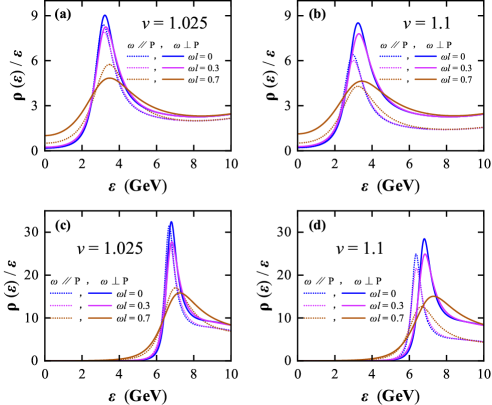
This research investigates the combined effects of rotation and anisotropy on heavy quarkonia spectral functions using holographic duality, providing a theoretical framework for interpreting experimental observations.
The suppression of heavy quarkonia in extreme environments remains a key probe of the quark-gluon plasma (QGP), yet a comprehensive understanding of anisotropic and rotating QGP dynamics is lacking. This work, ‘Spectral Signatures of Heavy Quarkonia in a Rotating and Anisotropic Quark-Gluon Plasma: A Holographic Study’, utilizes a holographic model to investigate the non-perturbative effects of both rotation and spatial anisotropy on the spectral functions and effective masses of charmonium and bottomonium. Our results demonstrate that these effects are directionally dependent and exhibit a competitive interplay, significantly reshaping the heavy quarkonium spectrum and influencing polarization-dependent observables. How do these findings refine our interpretation of heavy-ion collision data and improve our ability to characterize the complex dynamics of the QGP?
The Echo of Creation: Recreating the Universe’s First Moments
The collision of heavy ions at near-light speeds recreates conditions mimicking the universe mere microseconds after the Big Bang, briefly generating the Quark-Gluon Plasma (QGP) – a state of matter where quarks and gluons are no longer confined within hadrons. This extreme environment, characterized by temperatures exceeding trillions of degrees Celsius, behaves remarkably like a nearly perfect fluid, exhibiting incredibly low viscosity and minimal resistance to flow. This surprising fluidity challenges conventional understanding of the strong force, one of the four fundamental forces of nature, which normally dictates that quarks and gluons are permanently bound. The QGP’s properties suggest that the strong force operates very differently at these extreme energies and densities, demanding a re-evaluation of the theoretical models used to describe its behavior and the very fabric of matter itself.
The extreme conditions created in heavy-ion collisions – temperatures exceeding those found in the core of the Sun – briefly give rise to the Quark-Gluon Plasma (QGP), a state where quarks and gluons are no longer confined within hadrons. Directly observing this fleeting plasma is impossible, necessitating the use of ‘messenger’ particles that traverse its volume and carry information about its properties. Heavy mesons, such as the J/Psi and Upsilon, prove particularly valuable in this role; their production and decay are sensitive to the temperature and density of the QGP. By meticulously analyzing the suppression or enhancement of these mesons relative to expectations from proton-proton collisions, physicists can infer key characteristics of the plasma, including its temperature, viscosity, and even the color screening effects that alter the strong force within it. These heavy mesons, therefore, function as vital probes, allowing researchers to indirectly ‘see’ inside this extraordinary state of matter and refine theoretical models describing the strong nuclear interaction.
Despite being the established theory of the strong force, Quantum Chromodynamics (QCD) encounters significant challenges when applied to the Quark-Gluon Plasma (QGP). While perturbative QCD offers insights at high energies, it breaks down under the extreme conditions-high density and temperature-present in the QGP. Lattice QCD, a non-perturbative approach, provides a powerful tool for studying QCD, but it faces computational hurdles when dealing with finite chemical potential-a measure of the baryon asymmetry present in heavy-ion collisions. This asymmetry introduces a complex phase problem, hindering the ability of Lattice QCD to accurately model the QGP created in experiments. Consequently, a complete theoretical description of the QGP remains elusive, necessitating the development of novel theoretical approaches and continued experimental investigation to refine and validate existing models.
Beyond Perturbation: Mapping Complexity with Duality
Gauge/Gravity Duality, also known as the AdS/CFT correspondence, extends Quantum Chromodynamics (QCD) by providing a framework for studying strongly coupled systems like the Quark-Gluon Plasma (QGP) where perturbative calculations fail. This duality posits a relationship between a gravitational theory in a higher-dimensional Anti-de Sitter (AdS) space and a conformal field theory (CFT), which in this case, represents the QGP. The ‘holographic’ aspect arises because the QGP, a strongly coupled many-body system, can be described by classical gravity in the AdS space, effectively reducing the complexity of the problem. This allows researchers to calculate properties of the QGP – such as shear viscosity, energy density, and thermalization rates – by solving gravitational equations, offering a non-perturbative approach to understanding the QGP’s behavior.
Holographic Models, specifically implementations of the gauge/gravity duality – often utilizing Anti-de Sitter (AdS) space as the gravitational dual – provide a calculational framework for studying the Quark-Gluon Plasma (QGP). These models map strongly coupled quantum field theories, like Quantum Chromodynamics (QCD), to classical gravitational theories, circumventing the perturbative limitations encountered in traditional QCD calculations at high temperatures and densities. Consequently, properties such as the shear viscosity to entropy density ratio \eta/s , thermal conductivity, and heavy-ion jet quenching – which are analytically intractable using conventional methods – become accessible through the computation of corresponding gravitational observables in the AdS spacetime. Different model constructions, incorporating varying degrees of complexity and specific background geometries, allow for systematic investigation of QGP behavior under different conditions.
Holographic models facilitate the investigation of quark-gluon plasma (QGP) states exhibiting anisotropy, meaning their properties differ depending on the direction of measurement. This capability is vital because experimental data from heavy-ion collisions indicates the QGP created is far from isotropic; it displays significant momentum anisotropy, often characterized by elliptic flow. Furthermore, these models allow the incorporation of rotation and angular momentum, features arising from the initial conditions of the collisions and the subsequent hydrodynamic evolution of the plasma. Accurately modeling these effects is crucial for interpreting experimental observables and achieving a comprehensive understanding of the QGP’s behavior in non-central heavy-ion collisions, where substantial angular momentum is imparted to the system.
Decoding the Plasma: Heavy Mesons as Dynamic Messengers
The spectral function, derived from calculations within the holographic AdS/CFT correspondence, establishes a quantitative relationship between the properties of the Quark-Gluon Plasma (QGP) and the observed characteristics of heavy mesons. Specifically, this function describes the energy loss and momentum transfer experienced by heavy quarkonia as they propagate through the QGP medium. By comparing the calculated spectral function – which details the distribution of decay modes and energies – with experimental data obtained from heavy-ion collisions, researchers can infer key QGP parameters such as temperature, chemical potential, and transport coefficients. This approach allows for a rigorous test of theoretical models predicting the behavior of matter under extreme conditions, linking theoretical predictions of the QGP to observable changes in heavy meson spectra, including peak positions, widths, and overall suppression.
Holographic models predict that the effective mass of heavy mesons is modified as they propagate through the Quark-Gluon Plasma (QGP). This modification arises from interactions with the QGP’s constituents, leading to a decrease in the observed production rate of these mesons, a phenomenon known as quenching. The effective mass, m_{eff} , is not simply the meson’s rest mass but includes terms accounting for the energy lost due to interactions with the medium. Calculations within these models demonstrate that the magnitude of this effective mass reduction correlates directly with the density and temperature of the QGP, providing a quantifiable link between theoretical predictions and experimental observations of heavy meson suppression in heavy-ion collisions. Specifically, a diminished m_{eff} indicates stronger interactions and a more substantial quenching effect.
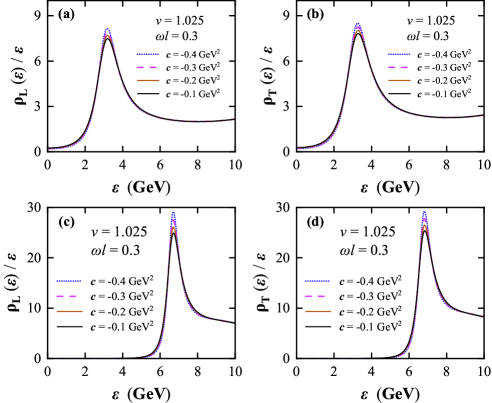
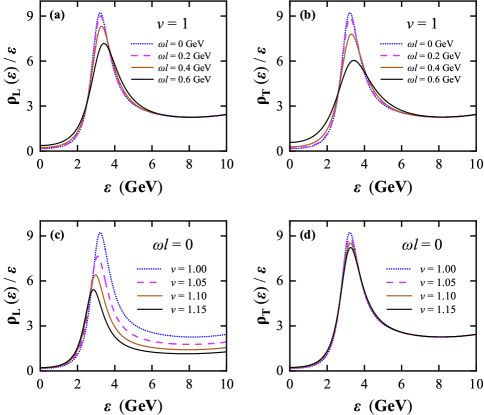
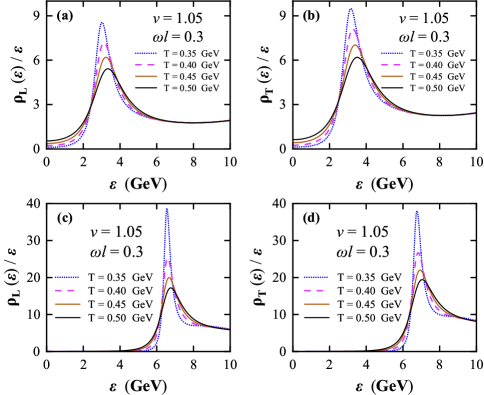
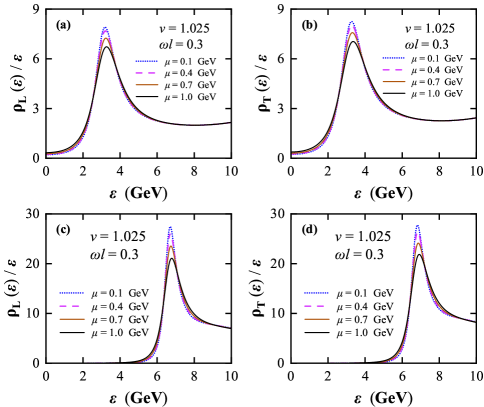
Holographic models utilized in the study of the Quark-Gluon Plasma (QGP) incorporate adjustable parameters – Temperature, Chemical Potential, and the Warp Factor – to replicate the extreme conditions generated in heavy-ion collisions. Analysis of spectral functions derived from these models reveals a strong correlation between parameter tuning and observed phenomena; specifically, simulations demonstrate significant suppression of longitudinal spectral peaks and a measurable modification of heavy meson effective masses. Quantitative results indicate an anisotropy parameter of 1.1 accurately reflects the observed degree of asymmetry in the QGP, influencing the behavior of propagating heavy mesons and providing a crucial validation of the model’s predictive capabilities.
Analysis of heavy quarkonia dissociation within the quark-gluon plasma (QGP) indicates a combined influence of both rotational dynamics and anisotropic pressure gradients. Simulations reveal that angular velocities up to 0.3 GeV significantly enhance quarkonia dissociation rates. This effect is particularly pronounced in the transverse direction, correlating with modifications to the effective mass of the heavy mesons. The observed alterations to effective mass, coupled with increased dissociation, suggest that the QGP’s rotational profile and non-isotropic expansion directly contribute to the suppression of heavy quarkonia signals in heavy-ion collision experiments.
Towards Precision: Mapping the QGP’s Complex Landscape
The behavior of heavy quarkonia-specifically the J/Psi and Upsilon particles-within the quark-gluon plasma (QGP) is being illuminated through analysis of their spectral functions using a holographic framework. This approach leverages the AdS/CFT correspondence, allowing researchers to model the strongly coupled QGP as a gravitational system and subsequently predict the in-medium modification of quarkonia properties. By meticulously examining the peaks and shapes within these spectral functions, it becomes possible to discern the influence of key QGP parameters-such as temperature, density, and anisotropy-on quarkonium melting and reformation. This detailed analysis doesn’t simply confirm theoretical predictions, but provides a pathway to quantitatively connect the observed suppression or enhancement of these particles in heavy-ion collision experiments to the precise characteristics of the QGP itself, offering an unprecedented window into this extreme state of matter.
The holographic framework, when applied to the spectral functions of heavy quarkonia like J/Psi and Upsilon, offers a unique avenue for extracting quantitative information from the intensely hot and dense matter created in heavy-ion collisions. By meticulously comparing theoretical predictions with experimental data – specifically the suppression and modification of quarkonia yields – researchers can move beyond qualitative descriptions of the Quark-Gluon Plasma (QGP). This methodology enables a precise determination of crucial QGP parameters, notably its temperature and energy density, providing constraints on the equation of state and transport properties of this exotic state of matter. The ability to reliably ascertain these parameters represents a significant step towards a deeper, more nuanced understanding of the QGP and the strong force that governs its behavior, ultimately bridging the gap between theoretical models and experimental observations.
Analysis reveals a surprising complexity in the behavior of J/Psi mesons within the quark-gluon plasma (QGP). Specifically, the effective mass of the J/Psi doesn’t simply increase or decrease with changes in the QGP environment; instead, it exhibits a non-monotonic relationship with both the degree of anisotropy – the difference in pressure along different directions – and the local angular velocity of the plasma. This means the J/Psi effective mass initially changes in one direction as anisotropy or angular velocity increases, then reverses course, reaching a peak or trough before changing direction again. This observation underscores that the QGP isn’t a static or uniform medium; rather, it’s a dynamic fluid where these parameters intricately interact, significantly influencing the properties of particles moving through it. The interplay suggests that accurately characterizing the QGP requires considering these factors not in isolation, but as interconnected variables shaping the observed behavior of heavy quarkonia like the J/Psi.
Investigations are now shifting towards incorporating more nuanced characteristics of the quark-gluon plasma (QGP) into theoretical models. Current research endeavors prioritize the inclusion of shear viscosity, a measure of the fluid’s resistance to flow, and collective flow, the correlated motion of particles produced in heavy-ion collisions. By accurately representing these complex dynamics, scientists aim to move beyond simplistic QGP descriptions and create a more realistic portrayal of this extreme state of matter. This advancement will enable more precise comparisons between theoretical predictions and experimental observations, ultimately allowing for a deeper understanding of the QGP’s properties and its behavior under the intense conditions created in heavy-ion collisions – a crucial step in unraveling the fundamental nature of strong interactions.
The study of quark-gluon plasma, as presented in this work, isn’t merely a calculation of spectral functions; it’s a mapping of emergent behavior from complex interactions. The investigation into anisotropy and rotation reveals that the plasma isn’t a static medium, but a dynamic system responding to internal forces – a collective oscillation of fundamental constituents. This echoes a sentiment articulated by Georg Wilhelm Friedrich Hegel: “We are not born rational; we become rational.” The progression from initial conditions – the collision of heavy ions – to the observed modifications of heavy quarkonia mirrors the development of rationality, a process shaped by external stimuli and internal dynamics. The effective mass shifts observed aren’t simply numbers; they’re signifiers of this emergent ‘rationality’ within the plasma itself.
Where Do We Go From Here?
This exploration of quark-gluon plasma, viewed through the lens of holographic duality, delivers what one might call a qualified success. It demonstrates that rotation and anisotropy aren’t merely additive effects; they conspire to reshape the spectral signatures of heavy quarkonia in ways that, while theoretically predictable, remain frustratingly difficult to disentangle from the noise of actual collisions. The model itself, elegant as it is, assumes a degree of control over initial conditions that exists solely within the simulation. It’s a human need, this desire for control-a pattern recognition engine mistaking the map for the territory.
The lingering question isn’t whether the model matches experiment-all models are, at best, approximations of reality-but whether it reveals the relevant distortions. The effective mass shifts observed are compelling, but they presuppose a complete understanding of the plasma’s viscosity – a parameter stubbornly resistant to precise determination. Future work will inevitably focus on refining this parameter, yet the true challenge lies in acknowledging the inherent limitations of any attempt to map a fundamentally chaotic system onto a static framework.
One anticipates further refinements, more complex geometries, perhaps even attempts to incorporate non-equilibrium effects. But the deepest insight may not lie in what is added to the model, but in what is deliberately left out. The human tendency to overcomplicate, to seek answers where ambiguity reigns, will always be the most potent force shaping the questions asked – and, ultimately, the narratives constructed from the data.
Original article: https://arxiv.org/pdf/2601.11064.pdf
Contact the author: https://www.linkedin.com/in/avetisyan/
See also:
- Everything You Need To Know About Nikki Baxter In Stranger Things’ Animated Spinoff
- Jujutsu Kaisen Creator Confirms the Story is Over: “It Won’t Continue!”
- ‘The Bride!’ Review: Jessie Buckley Breathes Life into a Monstrous Mess
- After 11 Years, Black Clover Officially Ends With Final Release (& Crowns a New Wizard King)
- Out of Nowhere, 4-Year-Old King of Fighters 15 Gets Surprise 2026 Patch
- The Boys Season 5, Episode 5 Ending Explained: Why Homelander Does THAT
- Miranda Kerr Shares “Quick” Procedure She Got Before Met Gala 2026
- HBO’s Harry Potter Set Increases Security After Criminal Threat Revealed
- USD JPY PREDICTION
- Kellogg’s Pokémon cereal explained: Full list of packs to collect
2026-01-20 12:28