Author: Denis Avetisyan
A new analysis of data from the Large Hadron Collider reveals stringent constraints on potential extensions to the Standard Model involving the heaviest known fundamental particle.
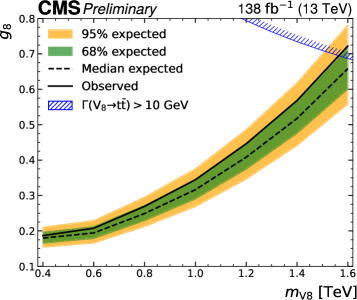
This paper presents a search for four- and three-top quark production using 13 TeV proton-proton collision data from the CMS experiment, setting improved limits on new physics scenarios including heavy resonances and modified Yukawa couplings.
Despite the remarkable success of the Standard Model, fundamental questions regarding the origin of mass and the nature of dark matter remain unanswered. This motivates searches for new physics beyond our current understanding, as undertaken in the study ‘Search for Physics beyond the Standard Model in four- and three-top quark production’, which reinterprets data from the CMS experiment at the LHC. By analyzing 138~\text{fb}^{-1} of proton-proton collision data, this analysis finds no significant evidence for deviations from Standard Model predictions in multi-top quark final states, thereby establishing competitive limits on effective field theory operators, heavy resonances, and modifications to the top-Yukawa coupling. Could precision measurements of top quark production ultimately reveal subtle hints of the new physics awaiting discovery at the energy frontier?
The Shadows Beyond the Standard Model
Despite its remarkable predictive power and consistent validation through decades of experimentation, the Standard Model of particle physics remains incomplete. This foundational theory, which describes the fundamental forces and particles of the universe, fails to account for several key observations, including the existence of dark matter and dark energy, the observed mass of neutrinos, and the matter-antimatter asymmetry in the cosmos. Furthermore, the Standard Model offers no explanation for gravity, remaining fundamentally incompatible with general relativity. These unresolved puzzles strongly suggest the existence of physics beyond the Standard Model, driving ongoing research at facilities like the Large Hadron Collider to uncover new particles, interactions, and theoretical frameworks that can address these profound mysteries and provide a more complete understanding of the universe.
The persistent inability of the Standard Model to account for all observed phenomena fuels the search for new theoretical frameworks. Anomalous particle decays – instances where particles break down in ways not predicted by current theory – offer tantalizing clues that additional forces or particles might be at play. Furthermore, the existence of dark matter, inferred from its gravitational effects on galaxies but undetectable by conventional means, represents a significant gap in understanding. These observations, alongside others, strongly suggest that the Standard Model is an incomplete description of reality, motivating physicists to explore extensions such as supersymmetry, extra dimensions, and other novel concepts in an attempt to build a more comprehensive and accurate picture of the universe.
The search for physics beyond the Standard Model receives compelling input from studies of rare particle production, with recent results from the CMS experiment focusing on the challenging observation of four top quarks. Analyzing an impressive dataset equivalent to 138 fb-1 of proton-proton collisions, researchers meticulously examined events potentially indicative of this exceedingly rare process. While the Standard Model predicts a specific rate for four-top production, any significant deviation could signal the presence of new, undiscovered particles or interactions. This demands incredibly precise theoretical calculations – going beyond current approximations – to accurately predict the expected rate and distinguish it from potential background noise, thereby providing a rigorous test of the Standard Model and a potential window into the fundamental nature of reality.
A Framework for the Unknown
The Standard Model Effective Field Theory (SMEFT) constructs a theoretical framework where potential effects of new physics beyond the Standard Model are introduced through the addition of higher-dimensional operators to the Standard Model Lagrangian. Specifically, SMEFT focuses on dimension-6 operators, as these represent the lowest-order deviations while still being sufficiently sensitive to new physics scales. These operators are constructed from the Standard Model fields and derivatives, and their coefficients, when determined through experimental measurements, parameterize the strength of the new physics interactions. By systematically including these dimension-6 operators, SMEFT provides a model-independent approach to analyze experimental data and constrain the possible properties of new particles or interactions, without needing to specify a particular new physics model a priori. The number of independent dimension-6 operators is finite, approximately 59 in the Warsaw basis, facilitating a structured analysis of potential deviations from the Standard Model predictions.
Dimension-6 operators within the Standard Model Effective Field Theory (SMEFT) alter the strengths and forms of interactions between Standard Model particles. These modifications manifest as deviations from predictions based solely on the Standard Model, providing an indirect method to search for new physics. Specifically, these operators introduce higher-order terms in the Lagrangian, changing the interaction vertices of fermions and bosons, and potentially leading to measurable effects in scattering cross-sections and decay rates. The magnitude of these deviations is inversely proportional to the scale of the new physics; thus, precise measurements of Standard Model parameters can constrain the coefficients of these operators and provide limits on the energy scale where new particles or interactions might reside. By analyzing these altered interactions, experiments at colliders like the LHC can probe for signatures of physics beyond the Standard Model without directly producing new particles.
The connection between theoretical predictions and observable signatures in particle collisions, facilitated by the Standard Model Effective Field Theory (SMEFT), proceeds by calculating deviations from Standard Model predictions arising from the dimension-6 operators. These calculations yield modified cross-sections and decay rates for various processes, such as Higgs boson production and decay, or the scattering of vector bosons. Experimental searches at colliders like the Large Hadron Collider (LHC) then focus on precisely measuring these rates and comparing them to Standard Model expectations. Any statistically significant discrepancy can be interpreted as evidence for new physics, with the magnitude of the effect related to the coefficients of the dimension-6 operators and therefore providing constraints on potential new physics models. This approach allows experiments to indirectly probe physics beyond the Standard Model without needing to directly produce new particles.
Simulating the Echoes of New Physics
Monte Carlo event generators, such as MadGraph5_aMC@NLO, are fundamental to simulating high-energy particle collisions within the Standard Model Effective Field Theory (SMEFT) framework. These tools calculate the probability and characteristics of particle interactions, including those modified by the inclusion of dimension-6 operators representing new physics. SMEFTsim, specifically, interfaces with these generators to systematically incorporate and evaluate the effects of these operators on collision observables. The process involves generating numerous pseudo-random events, each representing a potential collision outcome, allowing physicists to predict event rates and kinematic distributions for comparison with experimental data from facilities like the Large Hadron Collider. Accurate simulation is critical for distinguishing potential new physics signals from background processes and for precisely measuring the parameters of the dimension-6 operators.
Within the Standard Model Effective Field Theory (SMEFT) framework, Monte Carlo event generators predict particle production and decay rates by incorporating the effects of dimension-6 operators which parameterize new physics. These operators modify the interactions of Standard Model particles, altering predicted cross-sections and kinematic distributions. The tools calculate probabilities for specific final states, accounting for both the Standard Model contributions and the interference and direct production of new physics signals arising from the dimension-6 terms. This necessitates calculating Feynman diagrams with the added operator terms and integrating over the appropriate phase space to yield observable event rates, which are crucial for comparison with experimental data from colliders like the LHC.
The interpretation of four-top quark production signals at the Large Hadron Collider requires precise theoretical modeling of top quark interactions. Standard Model predictions for this process are sensitive to the values of parameters governing top quark couplings, and new physics effects can manifest as deviations from these predictions. Tools like MADSPIN provide next-to-leading-order (NLO) calculations for top quark pair production, including spin correlations and off-shell effects, which are crucial for accurately simulating the four-top process. These simulations account for the complex decay chains of four top quarks, and the resultant final state particles, allowing for the development of robust signal selection and background estimation strategies. Accurate modeling is essential to differentiate potential new physics signals from the substantial multi-jet background and to constrain the parameter space of beyond-the-Standard-Model scenarios.
Discrimination between signal and background events is a fundamental challenge in high-energy physics data analysis, and Boosted Decision Trees (BDTs) provide a powerful multivariate classification technique to address this. BDTs function by iteratively combining simpler decision trees, weighting each tree based on its performance in separating signal from background. This ensemble approach enhances the classification accuracy and robustness compared to single decision trees. Input variables to the BDT are typically kinematic properties of detected particles, designed to maximize the separation between the expected signal and the overwhelming background processes. Optimization of BDT performance requires careful selection of input variables and tuning of algorithm parameters, often achieved through techniques like cross-validation to prevent overfitting the training data. The resulting BDT output serves as a discriminant variable, allowing for statistically significant extraction of signal events from the experimental data.
The Horizon of Top Quark Interactions
The CMS experiment has, through meticulous analysis of 138 fb-1 of proton-proton collision data, presented compelling evidence for the production of four top quarks – a remarkably rare process predicted by the Standard Model but sensitive to physics beyond it. Detecting this event requires identifying the decay products of these fleeting particles amidst a vast background of more common interactions, a feat accomplished with sophisticated event reconstruction and selection techniques. The observation doesn’t merely confirm a Standard Model prediction; it opens a pathway to precisely measure the strength of top quark interactions and, crucially, to search for deviations that could signal the presence of new particles or forces influencing these interactions. This measurement serves as a powerful probe for beyond-the-Standard-Model phenomena, offering insights into the fundamental nature of matter and the universe.
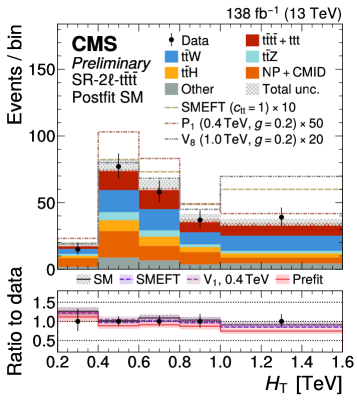
The identification of rare processes, such as four-top quark production, relies heavily on discerning subtle signals from overwhelming background noise. To achieve this, the CMS experiment employs sophisticated analysis techniques centered around event characteristics, notably a variable called hadronic transverse energy, or HT. HT represents the sum of the energies of all particles within an event that travel perpendicular to the beam direction; events containing multiple massive top quarks naturally exhibit significantly higher HT values than common background processes. By carefully analyzing the distribution of HT, physicists can effectively isolate potential signal events, creating a clearer picture of the four-top quark interaction and increasing the sensitivity to new physics beyond the Standard Model. This approach allows researchers to sift through vast amounts of data, focusing on the most promising candidates for further investigation and ultimately enhancing the precision of their measurements.
The precise measurement of four-top quark production provides a unique opportunity to scrutinize the fundamental interactions of these massive particles. Beyond simply confirming the Standard Model prediction, detailed analysis allows physicists to place stringent limits on the influence of dimension-6 operators – theoretical extensions to the Standard Model that could manifest as subtle modifications to top quark couplings. These operators, representing new physics at higher energy scales, can alter how top quarks interact with the Higgs boson and other particles. By comparing observed four-top production rates and characteristics with theoretical predictions incorporating these modified interactions, researchers can constrain the parameters governing these operators, effectively narrowing the range of possible new physics scenarios and providing insights into potential deviations from the Standard Model’s established framework.
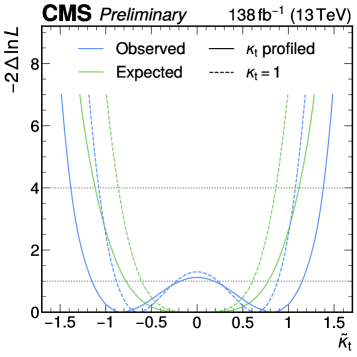
The precise measurement of top quark interactions offers a unique avenue for investigating potential deviations from the Standard Model, particularly in the top quark’s Yukawa coupling – the strength with which it binds to the Higgs boson. Recent analyses scrutinize modifications to this coupling through the lens of both CP-even and CP-odd Yukawa modifiers, which could manifest as subtle changes in decay rates or angular distributions. Furthermore, this research extends to the search for top-philic heavy resonances – hypothetical particles that interact preferentially with top quarks. Through the analysis of 138 fb-1 of data, constraints have been established on the existence of such resonances, effectively excluding their presence within a mass range of 400 to 1600 GeV, assuming a fixed decay width of 10 GeV; these limitations provide crucial guidance for theoretical models and shape the direction of future searches for new physics beyond the Standard Model.
The search for physics beyond the Standard Model, as detailed in this analysis of top-quark production, resembles a descent into the abyss. The meticulous work conducted by the CMS experiment, probing for deviations from established theory, highlights the inherent fragility of any model constructed to explain the universe. Sometimes matter behaves as if laughing at our laws, and the lack of observed new physics doesn’t invalidate the pursuit, but rather underscores the depth of the challenge. As Confucius observed, “To know what you know and what you do not know, that is true knowledge.” This study, while finding no immediate resonance beyond the Standard Model, refines the boundaries of what is known, illuminating the vastness of what remains to be discovered.
What Lies Beyond the Horizon?
The continued absence of signals in multi-top quark production, as this analysis demonstrates, is not a triumph, but a reiteration of a fundamental truth. Each null result is merely a refinement of the boundaries of ignorance, a more precise mapping of the darkness surrounding the light of the Standard Model. The search for heavy resonances or modified Yukawa couplings feels, increasingly, like attempting to chart a sea with a map that dissolves in the spray. Every calculation is an attempt to hold light in hands, and it slips away.
The focus on effective field theory, while pragmatic, skirts the deeper question. To posit new parameters within the Standard Model Effective Field Theory (SMEFT) is to acknowledge a lack of understanding, to replace a potentially elegant, underlying principle with a series of increasingly complex adjustments. When someone declares ‘we solved quantum gravity,’ it is worth remembering that they have only found another approximation that will be wrong tomorrow.
The true path forward may not lie in simply accumulating more collisions, but in a fundamental re-evaluation of the questions being asked. Perhaps the top quark, with its substantial mass, is not a window into new physics, but a symptom of a deeper, more pervasive inadequacy in the theoretical framework itself. The horizon remains, and beyond it, lies not necessarily a new particle, but the possibility that the entire landscape is illusory.
Original article: https://arxiv.org/pdf/2601.13089.pdf
Contact the author: https://www.linkedin.com/in/avetisyan/
See also:
- Best Controller Settings for ARC Raiders
- Review: Final Fantasy Tactics: The Ivalice Chronicles (PS5) – Still the Benchmark for Turn-Based Tactics
- Nippon Sangoku Is The Best New Post-Apocalyptic Anime of Spring 2026
- Mark Zuckerberg & Wife Priscilla Chan Make Surprise Debut at Met Gala
- 10 Greatest Manga Endings of All Time
- The Witcher 3 Officially Reveals Stunning New Ciri Figure Coming 2026
- The WONDERfools ending explained: What happened to the Child of Eternity?
- 7 Great Marvel Villains Who Are Currently Dead
- FRONT MISSION 3: Remake coming to PS5, Xbox Series, PS4, Xbox One, and PC on January 30, 2026
- Elon Musk’s Mom Maye Musk Shares Her Parenting Philosophy
2026-01-22 03:51