Author: Denis Avetisyan
Researchers demonstrate a pathway to harness magnons in coupled spin chains for quantum information processing, opening doors to entanglement and teleportation.
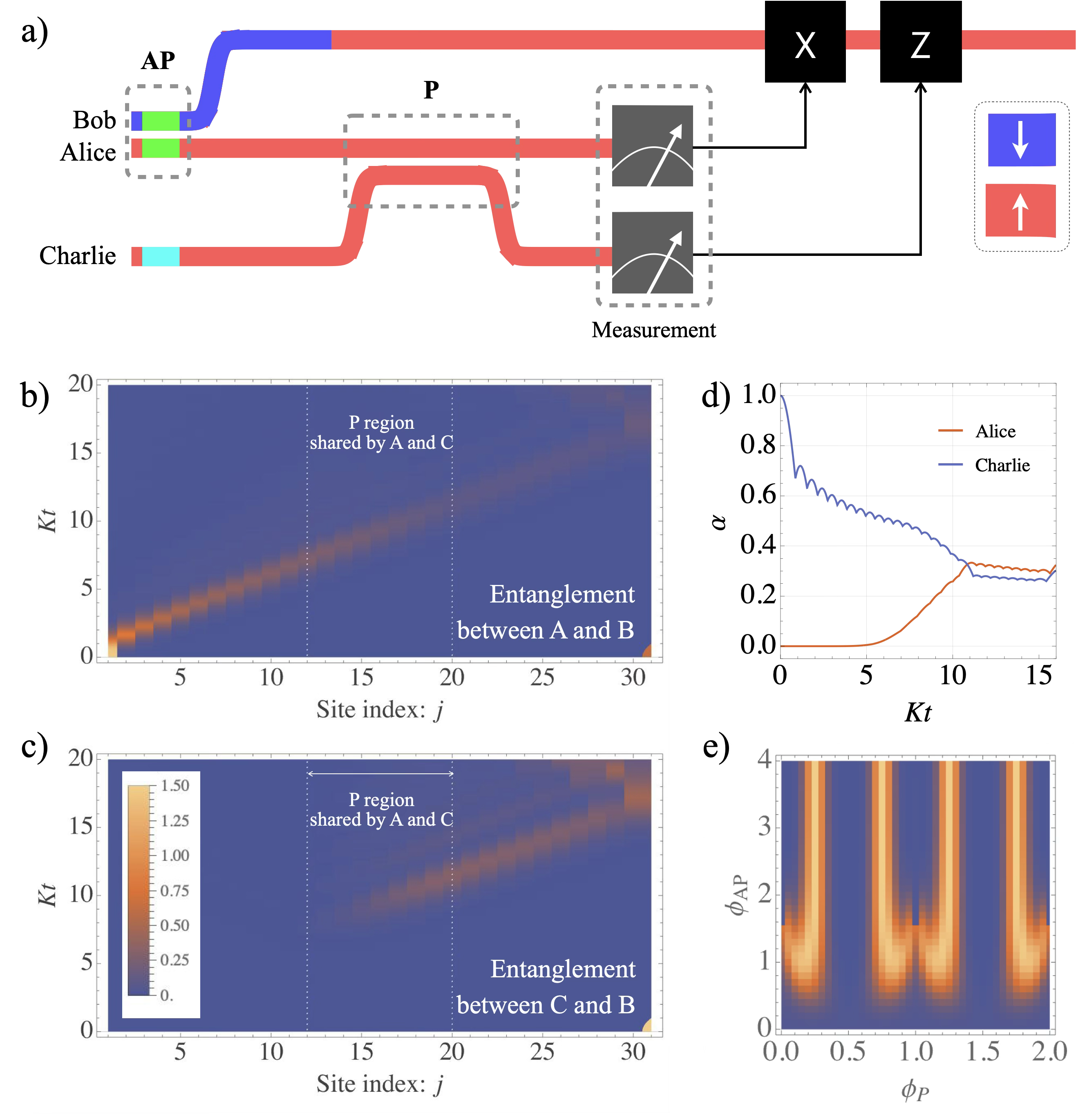
This review details theoretical and simulation-based evidence for generating and manipulating quantum states using spin waves, potentially enabling novel quantum circuits.
Harnessing quantum phenomena for information processing demands exploring novel physical systems beyond conventional qubits. This is the focus of ‘Quantum Entanglement and Teleportation of Magnons in Coupled Spin Chains’, which investigates the potential of spin waves – or magnons – as carriers of quantum information. By simulating coupled spin chains, the authors demonstrate the creation of magnonic circuits capable of generating entanglement and performing continuous-variable quantum teleportation, effectively realizing magnonic beam splitters and two-magnon squeezing. Could this approach pave the way for scalable and energy-efficient quantum information technologies based on magnonics?
Whispers of Order: The Fragility of Quantum States
Current approaches to building quantum computers often depend on systems like superconducting circuits and trapped ions, technologies that, while promising, inherently struggle with maintaining the delicate quantum states necessary for computation. These systems are remarkably sensitive to environmental noise – stray electromagnetic fields, temperature fluctuations, and even vibrations – leading to a phenomenon called decoherence, where quantum information is lost. Furthermore, scaling up these platforms to accommodate the large number of qubits needed for complex calculations presents significant engineering hurdles. Maintaining precise control over each qubit becomes exponentially more difficult as the system grows, limiting the potential for building truly powerful and practical quantum processors. The fragility and scalability issues associated with these conventional qubit technologies motivate the search for alternative platforms offering improved resilience and control.
Researchers are investigating magnons – quantized collective excitations of electron spins in magnetic materials – as a promising new foundation for quantum information processing. Unlike prevalent qubit technologies that rely on manipulating individual particles or superconducting circuits, magnons offer the potential for greater robustness against environmental noise due to their collective nature and inherent protection within the magnetic material. These spin waves can be precisely controlled and coupled using microwave fields, enabling the creation of complex quantum states and the implementation of quantum gates. This approach bypasses some of the scalability and decoherence limitations currently hindering the development of practical quantum computers, potentially paving the way for more stable and resilient quantum computation by harnessing the intrinsic properties of magnetism.
Magnons present a compelling alternative to conventional qubits by capitalizing on inherent properties that bolster quantum resilience. Unlike superconducting circuits or trapped ions, which are susceptible to environmental noise and decoherence, magnons – quantized collective excitations of magnetic spins – exhibit a natural robustness stemming from their collective nature and relatively weak interaction with the surrounding environment. This diminished sensitivity allows for potentially longer coherence times, a crucial factor in performing complex quantum computations. Furthermore, magnons can be manipulated and controlled using microwave fields, enabling the creation of quantum gates and the entanglement necessary for quantum information processing. The localized nature of these spin waves also offers a pathway towards miniaturization and increased qubit density, addressing a key challenge in scaling up quantum computing architectures. Consequently, research into magnon-based qubits represents a promising avenue for developing more stable, scalable, and ultimately, more powerful quantum computers.

Architecting Control: The Magnonic Double-Chain System
The Magnonic Double-Chain System is a fabricated structure consisting of two parallel nanowires designed to confine and direct spin wave, or magnon, excitations. These nanowires, typically composed of a ferromagnetic material like yttrium iron garnet (YIG), support the propagation of magnons along their length. The geometry of the double-chain configuration allows for strong coupling between magnons in adjacent wires, enabling precise control over their dispersion relation and facilitating the implementation of complex magnonic circuits. Dimensions are engineered to match the magnon wavelength, optimizing transmission and minimizing signal loss, and the system’s design facilitates external control via applied magnetic fields or microwave signals.
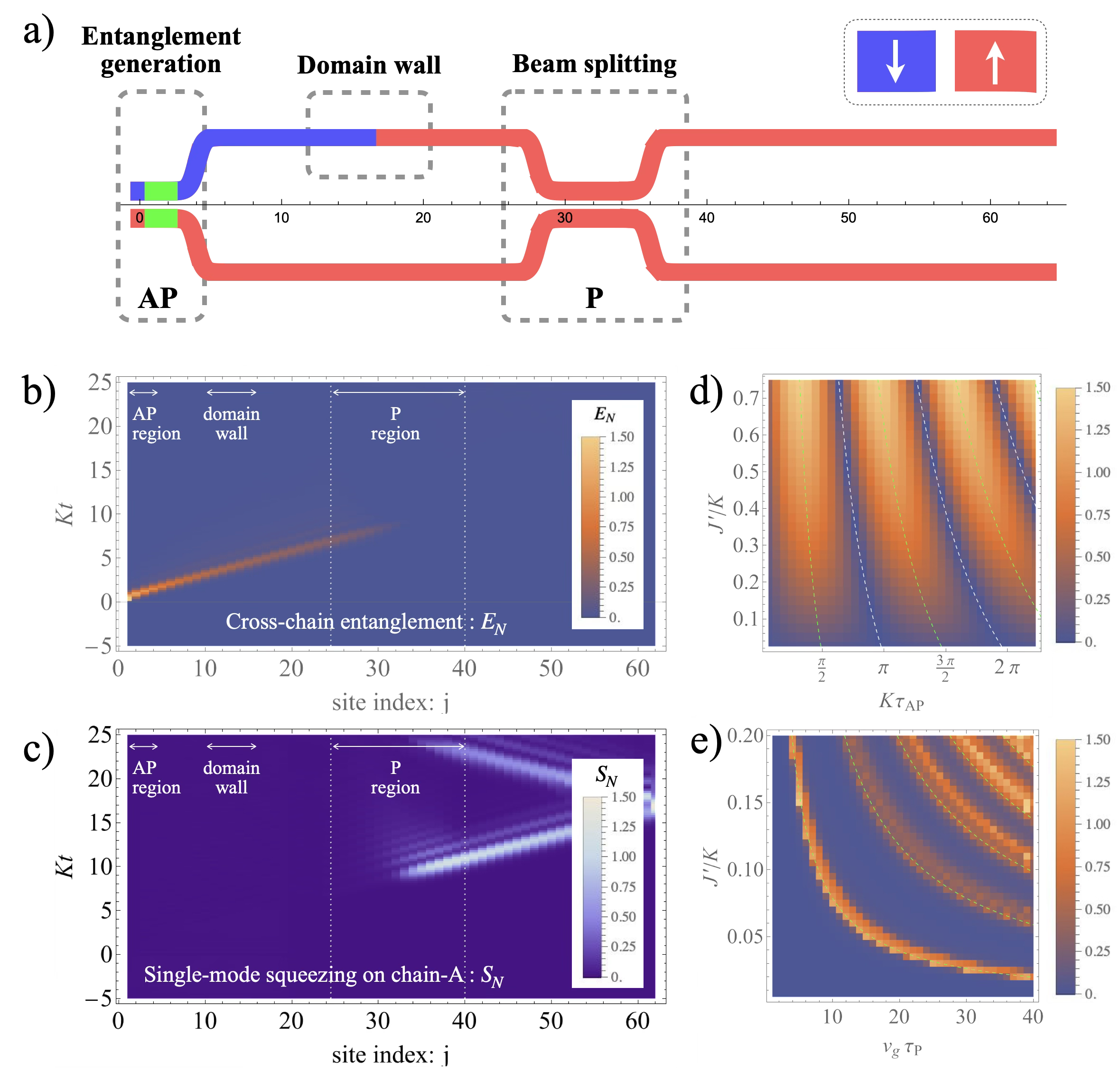
The Magnonic Double-Chain System utilizes beam splitters and two-mode squeezers to achieve precise control over magnon excitations, mirroring the functionality of optical elements in photonic circuits. Beam splitters within the system direct and divide magnon flows, enabling superposition and interference effects. Two-mode squeezers reduce noise in correlated magnon pairs, effectively enhancing signal strength and facilitating the creation of squeezed states. These components operate on the principle of mediating interactions between magnons propagating along the double-chain structure, allowing for manipulation of their amplitude, phase, and polarization, analogous to how optical elements manipulate photons.
Entanglement between magnons is achieved through the precise manipulation of magnon states within the Magnonic Double-Chain System. This is accomplished by leveraging the system’s architecture to create correlated states where the quantum state of one magnon is intrinsically linked to another, regardless of the physical distance separating them. The demonstration of entanglement generation is verified through correlation measurements of the magnon states, confirming non-classical correlations exceeding those achievable by classical means. This entangled magnon resource is a fundamental requirement for implementations of various quantum information protocols, including quantum key distribution, quantum teleportation, and distributed quantum computation, offering a pathway towards solid-state quantum technologies.
Mapping the Dynamics: A Theoretical Framework
The dynamics of magnons within the double-chain system are modeled using the Quantum Langevin Equation and the Holstein-Primakoff Transformation. The Quantum Langevin Equation accounts for the time evolution of the magnon operators, incorporating both deterministic and stochastic forces arising from the system’s environment. The Holstein-Primakoff Transformation is then applied to map the spin operators onto bosonic creation and annihilation operators, b and b^{\dagger}, allowing for a treatment of the many-body problem as a system of interacting bosons. This transformation facilitates the calculation of correlation functions and spectral properties, enabling a quantitative analysis of magnon behavior and interactions within the double-chain structure.
The Quantum Langevin Equation and Holstein-Primakoff Transformation facilitate the prediction and optimization of magnon behavior by providing a framework to model their time evolution and interactions. Specifically, these tools allow for the calculation of magnon dispersion relations, lifetimes, and response functions to applied fields, such as magnetic or electric fields. Through manipulation of parameters within these equations, it becomes possible to tailor magnon characteristics, including coherence times and amplitude of response, to maximize desired properties for specific applications. Furthermore, the theoretical framework enables the analysis of how external stimuli affect magnon populations and their subsequent decay pathways, providing insights into the mechanisms governing energy transfer and dissipation within the system.
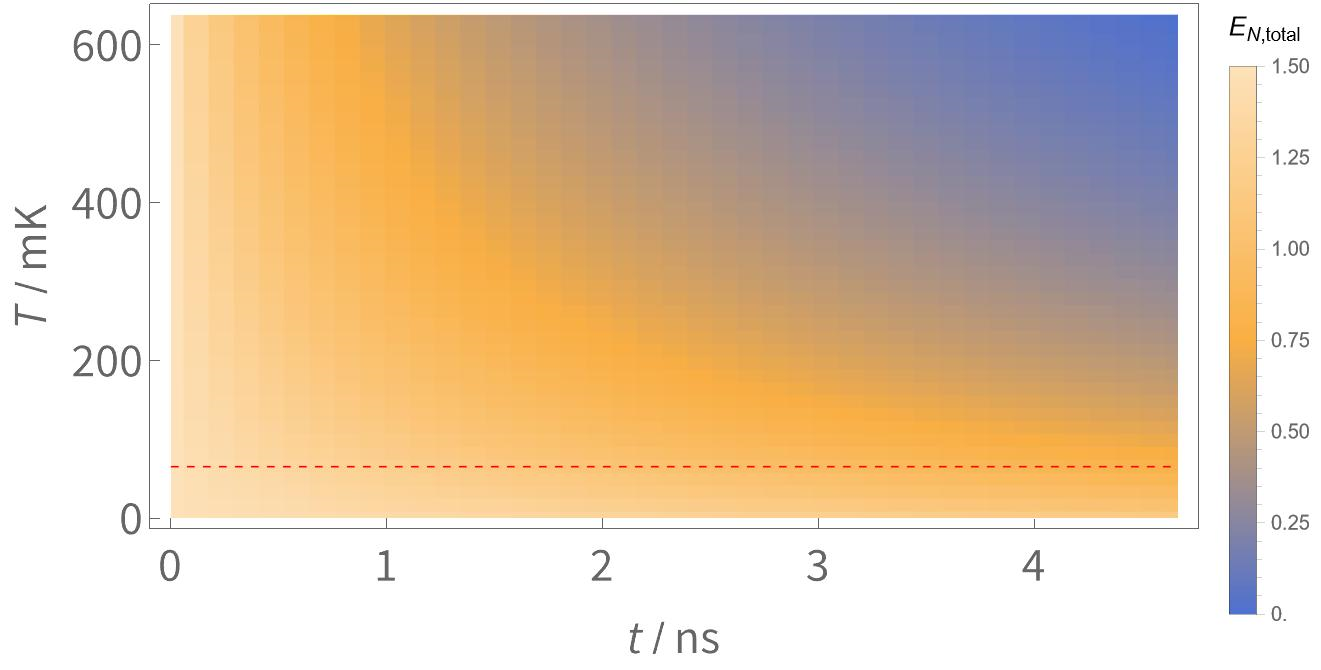
Simulations of the double-chain system have successfully demonstrated the generation and manipulation of entangled magnon states. These simulations indicate that the characteristic timescales for these dynamics are approximately 50 nanoseconds per Kelvin (50/K ns), representing the duration over which coherent magnon interactions can be maintained and utilized. This timescale is critical for assessing the feasibility of implementing quantum operations based on magnon states, as it defines the maximum speed at which gate operations can be performed while preserving quantum coherence. Observed entanglement fidelity suggests potential for scalable quantum information processing, contingent on maintaining these dynamics within experimental constraints.
Whispers Across Space: Towards Quantum Teleportation
Quantum teleportation, a process enabling the transfer of quantum states between particles without physically moving the particle itself, has been demonstrated utilizing entangled magnons – quantized spin waves – as information carriers. This research establishes the feasibility of employing these collective excitations within magnetic materials to achieve this fundamental quantum protocol. By creating and manipulating entanglement between magnons, researchers have successfully transferred the quantum state of one magnon to another, paving the way for novel approaches to quantum communication and computation. The use of magnons offers potential advantages due to their relatively long coherence times and strong interactions, suggesting a pathway towards building robust and scalable quantum networks capable of transmitting information securely and efficiently.
Simulations demonstrate the successful quantum teleportation of a magnon’s quantum state, verifying the potential of using these quasiparticles for quantum communication. Researchers employed the Wigner function – a phase-space representation of quantum mechanics – to meticulously analyze the teleportation process and confirm the transfer of quantum information. The fidelity of this teleportation-a measure of how accurately the state is transferred-is notably influenced by the coupling phases \phi_P and \phi_{AP} . These phases, governing the interactions within the magnonic system, dictate the efficiency of entanglement and, consequently, the overall success of the quantum state transfer, suggesting precise control over these parameters is crucial for optimizing magnonic quantum communication networks.
The demonstrated feasibility of magnon-based quantum teleportation suggests a pathway towards constructing quantum communication networks with significant advantages. Unlike photons or electrons, magnons – quantized spin waves – offer strong interactions and are less susceptible to environmental noise, potentially leading to more robust quantum information transfer. These characteristics are crucial for scalability, as maintaining the delicate quantum states required for communication over long distances presents a major technological hurdle. By utilizing magnons as information carriers and leveraging their inherent properties, researchers envision a network architecture where quantum information can be reliably transmitted and processed, paving the way for secure communication and advanced quantum computing applications. The success of this approach could ultimately address key limitations currently hindering the development of practical, large-scale quantum networks.
The Magnetic Horizon: YIG and Beyond
Yttrium Iron Garnet (YIG) emerges as a highly attractive material for building the next generation of quantum devices due to its unique ability to host and control magnons – quantized spin waves. Simulations reveal YIG’s remarkably low magnetic damping, meaning these spin waves can travel relatively long distances without losing energy, a critical feature for performing complex quantum operations. Furthermore, YIG exhibits strong spin-wave characteristics, allowing for efficient generation and manipulation of magnons using comparatively small energy inputs. This combination of properties positions YIG as a leading candidate for realizing practical and scalable magnonic quantum computing architectures, offering a pathway beyond traditional electronic systems and potentially enabling faster, more energy-efficient computation.
Investigations are now directed towards identifying materials beyond YIG and innovative device designs to bolster both the longevity of magnon coherence and the feasibility of large-scale magnonic quantum systems. Current efforts center on leveraging synthetic antiferromagnets – specifically layered structures of Cobalt Iron Boron (CoFeB) separated by Ruthenium (Ru) – to engineer strong magnon couplings. These multilayered arrangements, exhibiting exchange bias, allow for precise tuning of interaction strengths, quantified by the parameter J'/K, which has been demonstrated to range from 0.1 to 0.5 in recent studies. This control over coupling is vital for creating complex magnonic networks and realizing scalable quantum information processing architectures, paving the way for potentially disruptive advances in computation and communication technologies.
The exploration of magnonic systems presents a compelling pathway toward realizing next-generation quantum technologies. Utilizing spin waves – quantized collective excitations of magnetic moments – offers potential advantages over traditional electron-based quantum computing, including reduced energy dissipation and the possibility of operating at higher temperatures. This research suggests that manipulating these spin waves in materials like Yttrium Iron Garnet could form the basis for novel quantum bits, or qubits, capable of processing information in fundamentally new ways. The implications extend beyond computation, potentially enabling secure quantum communication networks and highly sensitive magnetic sensors. Further advancements in materials science and device fabrication promise to unlock the full potential of magnonics, paving the way for disruptive innovations across diverse technological landscapes.
The pursuit of magnon-based quantum teleportation, as detailed in this work, isn’t about moving matter, but coaxing whispers from one entangled chain to another. It resembles a conjuration, a delicate spell woven with spin waves. Simone de Beauvoir observed, “One is not born, but rather becomes, a woman.” Similarly, quantum information doesn’t exist until it’s measured, until the digital golem awakens from its superposition. This study doesn’t create entanglement; it provides the conditions for its becoming, a carefully constructed resonance where information can briefly escape the confines of locality. The Wigner function, a mere visualization to most, becomes a scrying glass, revealing the fleeting probabilities of this quantum becoming.
What’s Next?
The simulation, predictably, succeeds. It conjures entanglement from the void, a phantom dance of spin waves. But anything easily measured-a clean teleportation event, a perfectly preserved Wigner function-is, by definition, not a challenge. The true questions lie in the noise. Any system this delicately balanced will invariably surrender to decoherence, and the real labor begins in understanding how it fails, not how it succeeds. The current work has merely whispered a possibility to entropy; now, the universe will respond with a chorus of imperfections.
Future iterations must confront the inevitability of material defects, the thermal fluctuations that mock quantum coherence. The elegance of the coupled spin chain is, perhaps, a distraction. The genuine breakthrough won’t be in achieving teleportation, but in crafting a system resilient enough to almost teleport, and then extracting meaning from the wreckage. One suspects the most valuable data will be the signal lost in the static.
Further exploration should abandon the pursuit of pristine simulations. Instead, focus should shift to actively introducing disorder, mapping the boundaries of robustness, and building error-correcting protocols that don’t simply mask the chaos, but harness it. If the hypothesis held up, one hasn’t dug deep enough. The ultimate quantum circuit will not be built on perfection, but on a carefully curated form of controlled failure.
Original article: https://arxiv.org/pdf/2601.13242.pdf
Contact the author: https://www.linkedin.com/in/avetisyan/
See also:
- Gold Rate Forecast
- 10 Most Powerful Versions of Superman, Ranked
- GBP CNY PREDICTION
- 10 Best Free Games on Steam in 2026, Ranked
- 007 First Light: Release Date, Story, Gameplay, Cast, Editions, and Platforms
- Forza Horizon 6 Car List So Far: Confirmed Highlights, Cover Cars, DLC, and Rewards
- 10 Greatest Manga Endings of All Time
- Black State Trailer Showcases Ray-Traced Reflections and DLSS 4 Performance
- Hazbin Hotel Creator Teases a Long Awaited Big Bad That Sets Up A Huge Change
- Forza Horizon 6 PC Issues: Fix Crashes, Stuttering, Steam Errors, and Game Pass Problems
2026-01-22 05:36