Author: Denis Avetisyan
A new review explores the complex fate of antimatter domains in the early universe and their potential link to the observed matter-antimatter imbalance.
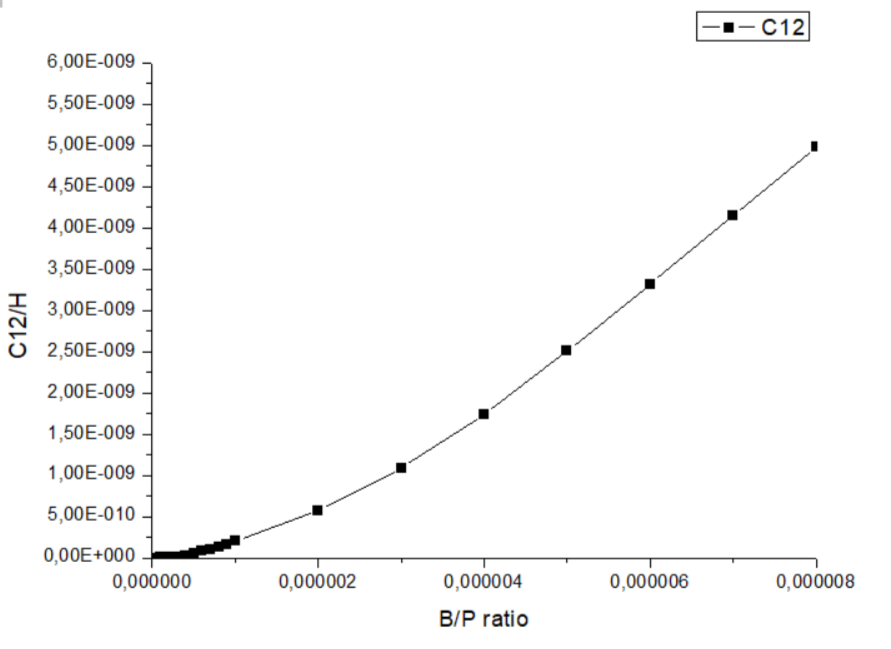
This article details the chemical and physical processes governing the evolution of antimatter domains, including annihilation, diffusion, and scattering, and their implications for understanding the baryon asymmetry of the universe.
The observed baryon asymmetry in the Universe remains a fundamental challenge to the Standard Model of particle physics. This motivates exploration of scenarios permitting localized antimatter domains within a predominantly baryonic cosmos, a topic investigated in ‘Chemical evolution of antimatter domains in early Universe’. Our research details the chemical processes-including annihilation, diffusion, Compton scattering, and nucleosynthesis-governing the evolution and size limitations of such domains, accounting for interactions at their boundaries. Understanding these dynamics is crucial for assessing the viability of antimatter domain formation and its potential contribution to explaining the matter-antimatter imbalance – but what constraints do these processes impose on the longevity and detectability of these exotic regions?
The Universe’s Asymmetry: A Prophecy of Imbalance
The universe, as it currently exists, is overwhelmingly composed of matter, despite theoretical predictions suggesting equal creation of matter and its counterpart, antimatter, during the Big Bang. This disparity, known as the Baryon Asymmetry, represents a profound challenge to our understanding of fundamental physics and cosmology. If matter and antimatter were truly created in equal measure, they should have largely annihilated each other, leaving a universe filled with only energy; the continued existence of galaxies, stars, and ultimately, life, indicates a crucial imbalance. Researchers posit that some unknown process, occurring in the incredibly early universe, must have subtly favored the creation of matter over antimatter, leaving a residual surplus that constitutes everything visible today. Determining the nature of this process remains one of the most significant open questions in modern science, demanding exploration beyond the established Standard Model of particle physics and potentially revealing new laws governing the cosmos.
Current cosmological models, while remarkably successful in many respects, falter when attempting to account for the observed dominance of matter over antimatter in the universe. The Standard Model of particle physics predicts that matter and antimatter should have been created in nearly equal amounts during the Big Bang, leading to complete annihilation and a universe filled only with radiation. However, this clearly isn’t the case, indicating the presence of physics beyond our current understanding. Scientists theorize that some process, or set of processes, must have subtly favored the creation of matter particles over antimatter ones – a phenomenon known as baryogenesis. Identifying these mechanisms requires exploring potential violations of fundamental symmetries, such as Charge-Parity (CP) symmetry, and examining the conditions prevalent in the extremely early universe where these asymmetries could have originated. The precise nature of these matter-favoring processes remains a central puzzle, driving ongoing research into particle physics and cosmology.
The persistent imbalance between matter and antimatter in the observable universe has led to the intriguing hypothesis of spatially separated ‘Antimatter Domains’. This concept suggests that, rather than complete annihilation, antimatter coalesced into vast regions distinct from our matter-dominated cosmos. These domains, potentially mirroring our own in size and complexity, would explain the observed scarcity of antimatter without requiring a complete revision of fundamental physical laws. While direct observation remains a significant challenge, theoretical models explore how such domains could have formed in the extremely energetic conditions of the early universe, potentially arising from subtle asymmetries in the distribution of matter and antimatter shortly after the Big Bang. The existence of these domains isn’t about creating antimatter, but rather explaining how it could survive, segregated from matter and thus avoiding complete mutual destruction.
Reconstructing the conditions of the early universe is paramount to evaluating the plausibility of spatially separated antimatter domains. The universe’s initial moments were characterized by extreme temperatures and densities, a state where the laws of physics operated very differently than they do today. Investigating these primordial conditions – focusing on the rate of expansion, the types of particles present, and the strength of fundamental forces – allows researchers to model how antimatter domains might have formed through processes like symmetry breaking or phase transitions. Crucially, understanding the survival of these domains necessitates accounting for interactions with ordinary matter and the effects of cosmic expansion, as these forces could have led to annihilation or dispersal. Simulations and theoretical calculations, grounded in the physics of the early universe, are therefore essential tools for determining whether antimatter domains represent a viable solution to the observed matter-antimatter imbalance.
Domain Persistence: A Delicate Equilibrium
Antimatter domain survival is fundamentally linked to its initial size; smaller domains experience rapid annihilation due to increased surface area relative to volume, leading to efficient interaction with surrounding baryonic matter. To persist from the early universe to the present day, an antimatter domain must possess a minimum mass of 10^3 M_{\odot} (approximately three times the mass of the Sun). This mass threshold ensures a sufficiently low surface-to-volume ratio, reducing the annihilation rate to a level where a remnant domain can theoretically survive for billions of years. Domains below this limit would have completely annihilated through interactions with photons, cosmic rays, and interstellar gas.
Antimatter domain size is critically dependent on the η (Antibaryon-Photon Ratio) and the expansion rate dictated by the Hubble Parameter. The ratio η represents the number density of antibaryons relative to photons and is constrained to the range of 3 x 10⁻¹² ≤ η ≤ 1 x 10⁻⁶ for domain survival. This limited range directly impacts domain density and resultant chemical composition; values outside this range lead to either rapid annihilation due to insufficient antimatter or insufficient energy density to maintain domain coherence against expansion and matter-antimatter interaction. The Hubble Parameter governs the expansion rate of the universe, influencing the overall volume available to the domain and thus affecting its long-term stability.
Photon penetration depth, λ, is a critical factor in determining the survival of antimatter domains. This depth represents the distance radiation can travel within the domain before its energy is attenuated through interactions with the antimatter plasma. A shorter penetration depth indicates a higher opacity to radiation, limiting energy transport and reducing the rate of annihilation with surrounding matter. For a nonhomogeneous, gravitationally bound region to develop from the initial conditions of the early universe, the photon penetration depth must be smaller than the characteristic radius, R, of the forming domain. This condition, \lambda < R, ensures that radiation is effectively trapped within the domain, preventing rapid energy loss and facilitating the conditions necessary for domain survival and potential growth.
Elastic scattering of particles within an antimatter domain contributes to a reduction in the annihilation rate at the domain boundary, effectively increasing its lifespan. However, the impact of elastic scattering is inversely proportional to the energy density of the domain; higher energy densities reduce the mean free path of particles, lessening the opportunity for scattering events to deflect particles away from matter-antimatter interactions. Consequently, while scattering can temporarily slow annihilation, its influence becomes negligible in domains with sufficiently high energy densities, where the rate of direct annihilation dominates.
Spontaneous Symmetry Breaking: A Potential Genesis
Spontaneous Baryogenesis proposes a mechanism for generating the observed baryon asymmetry in the universe, addressing the imbalance between matter and antimatter. This process posits that, in the early universe, a scalar field-specifically a Pseudo-Nambu-Goldstone Boson-developed an asymmetry in its potential, driving a phase transition. This transition generated localized regions, or domains, where either matter or antimatter became dominant. Crucially, this is not a standard electroweak baryogenesis scenario requiring CP violation from beyond the Standard Model, but a mechanism inherent to the field dynamics. The resulting domains, consisting of excess antimatter, would then evolve under cosmological conditions, potentially impacting Big Bang Nucleosynthesis and providing a testable signature for this baryogenesis scenario.
The generation of antimatter excess is theorized to occur through the dynamics of a Pseudo-Nambu-Goldstone Boson (PNGB) field. This field, arising from the spontaneous breaking of a global symmetry, possesses low-energy excitations that can induce charge-parity (CP) violating interactions. These interactions facilitate the localized production of antimatter regions, as the PNGB field’s evolution creates spatial variations in the baryon-to-photon ratio. The amplitude and gradient of the PNGB field determine the scale and distribution of these antimatter domains; regions where the field takes on negative values correspond to areas of antimatter concentration. The process is sensitive to the initial conditions and the specific parameters of the PNGB potential, influencing both the size and abundance of the resulting antimatter excesses.
The evolution of antimatter domains created through spontaneous baryogenesis is significantly impacted by cosmological epoch transitions. During the Radiation Era, the high photon density inhibits domain growth, while the subsequent Matter Dominated Era allows for expansion and potential gravitational collapse. Observed gamma ray backgrounds place constraints on the permissible mass range for these domains, limiting them to between 10³ and 10⁵ solar masses (10^3 M_\odot \leq M \leq 10^5 M_\odot). Domains outside this mass range are either quickly disrupted by radiation pressure or become unstable due to gravitational effects, preventing their long-term existence.
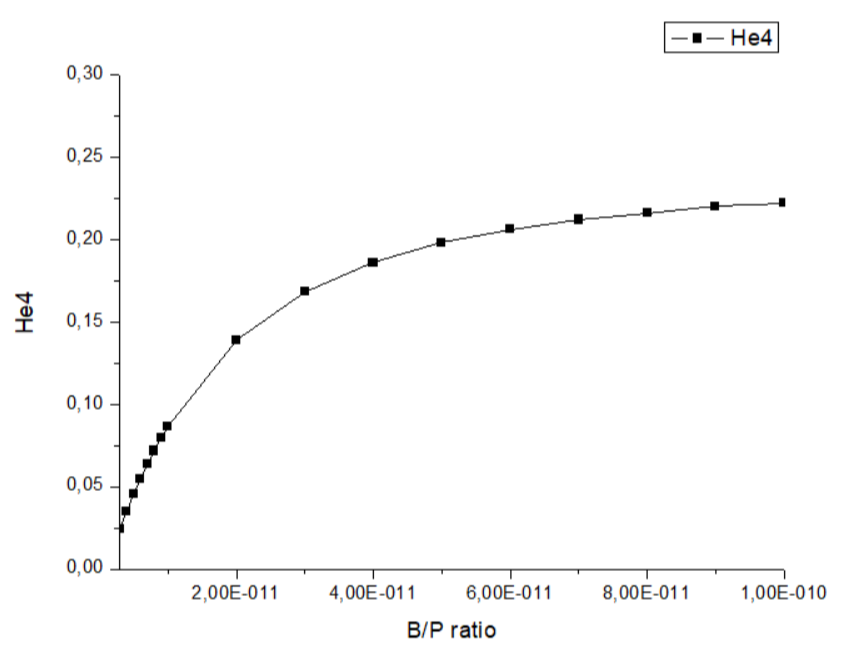
Accurate modeling of antimatter domain formation requires numerical simulations such as the AlterBBN Program, which allows for the determination of mass fraction dependencies on the initial antibaryon-to-photon ratio. Calculations indicate a minimum stability time for these domains of t ≥ (M/(c³mpη10³⁰))^(2/3), where M is the domain mass, c is the speed of light, mp is the proton mass, and η is a parameter quantifying the asymmetry. Based on these parameters, the minimum domain lifetime is estimated to be 1.25 x 10³ c, providing a lower bound on the duration for which these structures can persist and potentially contribute to observable effects.
Annihilation’s Echo: Observable Signatures and the Gamma Background
The boundary between a region dominated by matter and a hypothetical domain of antimatter would be a site of intense particle annihilation. This process, where matter and antimatter collide, converts mass directly into energy, primarily in the form of high-energy photons – gamma rays. The resulting flux of these photons constitutes a potential ‘Gamma Background’ that, if detectable, would serve as a key signature of antimatter’s existence. The intensity and spectral characteristics of this gamma ray emission are directly linked to the size and density of the antimatter domain, as well as the rate of annihilation at its edge. Distinguishing this annihilation-generated background from other astrophysical sources of gamma radiation, however, presents a significant observational challenge, requiring precise measurements of energy, direction, and polarization to confirm its origin.
The annihilation of antimatter isn’t simply a direct conversion to energy; it’s intricately linked to the surrounding thermal environment. High-energy photons produced during annihilation interact with this thermal radiation, triggering the creation of electron-positron pairs – a process known as pair production. This secondary particle generation dramatically alters the annihilation cascade, effectively multiplying the number of photons and charged particles. Consequently, the initial, clean signal from antimatter destruction becomes diffused and more complex, shifting the energy spectrum and potentially masking the original annihilation event. The rate of pair production is directly proportional to the intensity of the thermal background, meaning hotter environments significantly amplify this effect and influence the observable signatures of antimatter domains. This interplay between annihilation and pair production presents a substantial challenge for detecting and characterizing these exotic regions of spacetime.
The detection of an antimatter domain’s boundary relies heavily on observing the high-energy photons released during annihilation, but this signal is significantly weakened by a process known as Compton scattering. This phenomenon describes the energy loss of photons when they collide with charged particles, like electrons, effectively diminishing the photons’ initial energy and altering their trajectory. Consequently, the observed gamma ray background-the key indicator of annihilation-becomes diffused and less intense, making precise localization and characterization of the antimatter domain substantially more challenging. The extent of this energy loss is directly related to the density and temperature of the intervening plasma, meaning that a substantial portion of the initial annihilation signal can be obscured before reaching detectors, necessitating advanced signal processing techniques and careful consideration of the surrounding astrophysical environment.
The boundary between matter and antimatter isn’t necessarily a smooth transition; instead, the formation of topological defects – specifically, domain walls – is predicted by some theoretical models. These walls, representing regions of abrupt change in the antimatter density, arise due to imperfections in the initial conditions of the universe and are fundamentally linked to the expansion rate, quantified by the Hubble parameter. The Hubble parameter dictates the size and evolution of these domain walls, influencing their stability and potential for decay. Importantly, the decay of these walls, or even their continued presence, would generate unique and potentially observable signatures beyond the gamma background produced by direct annihilation. These signatures could manifest as specific energy distributions of emitted particles or subtle fluctuations in the cosmic microwave background, offering a novel pathway to probe the existence and properties of antimatter domains and the physics governing their formation in the early universe.
The study of antimatter domains reveals a universe perpetually tending toward dissolution, a principle echoed across all complex systems. This research, detailing the delicate balance between annihilation, diffusion, and scattering at the boundaries of these domains, demonstrates that order is, indeed, merely cache between two outages. As Francis Bacon observed, “There is no pleasure in having done that which is easy.” The difficulty here lies not in modeling these processes, but in accepting that any ‘solution’ is provisional, a temporary reprieve from the inevitable decay. The observed baryon asymmetry, a lingering question, is less a puzzle to solve and more a boundary condition – a survivor in a sea of annihilation.
The Horizon of Absence
This work, charting the tentative borders of early antimatter domains, reveals less a solution than a sharpening of the question. The universe, it seems, isn’t defined by what is, but by the precise geometry of what isn’t. Modeling annihilation boundaries, diffusion rates, and scattering events is akin to tending a garden of absences – one anticipates the inevitable overgrowth of uncertainty. Each refined parameter, each elegant equation, merely illuminates the contours of the unknown with greater precision.
The greatest limitation isn’t computational power, but the inherent difficulty of extrapolating from the observed to the unobservable. The baryon asymmetry, that slight preference for matter, remains a whisper across vast epochs. Future work will likely not focus on finding a single, definitive mechanism, but on understanding the forgiveness within the system. Resilience doesn’t lie in perfect isolation of domains, but in the subtle leakage, the imperfect boundaries that allowed a sliver of matter to endure.
Perhaps the true frontier lies not in refining the physics within these domains, but in accepting that any complete description will always be a map drawn after the territory has shifted. The universe isn’t a machine to be understood, but an ecosystem to be observed – a delicate balance of creation and annihilation, perpetually rewriting its own history.
Original article: https://arxiv.org/pdf/2601.15147.pdf
Contact the author: https://www.linkedin.com/in/avetisyan/
See also:
- Best Controller Settings for ARC Raiders
- Review: Final Fantasy Tactics: The Ivalice Chronicles (PS5) – Still the Benchmark for Turn-Based Tactics
- Nippon Sangoku Is The Best New Post-Apocalyptic Anime of Spring 2026
- Mark Zuckerberg & Wife Priscilla Chan Make Surprise Debut at Met Gala
- 10 Greatest Manga Endings of All Time
- The Witcher 3 Officially Reveals Stunning New Ciri Figure Coming 2026
- The WONDERfools ending explained: What happened to the Child of Eternity?
- 7 Great Marvel Villains Who Are Currently Dead
- FRONT MISSION 3: Remake coming to PS5, Xbox Series, PS4, Xbox One, and PC on January 30, 2026
- Elon Musk’s Mom Maye Musk Shares Her Parenting Philosophy
2026-01-23 03:31