Author: Denis Avetisyan
A new theoretical model explores a universe that avoided a singularity by ‘bouncing’ from a contracting phase, offering a potential solution to the Hubble tension and insights into the earliest moments of existence.
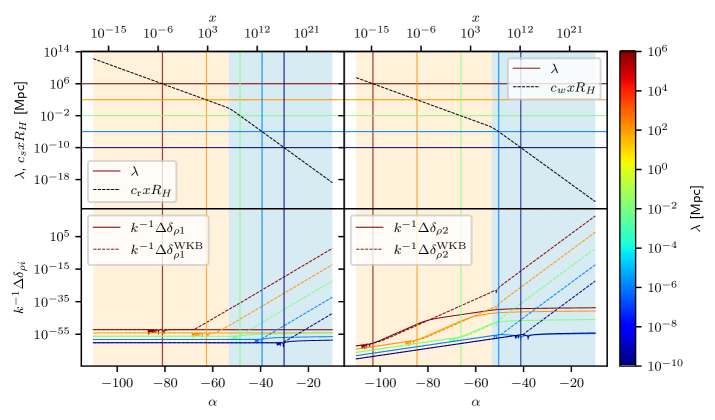
This paper details a two-fluid quantum cosmological model generating scale-invariant primordial perturbations and a bouncing universe compatible with current observational data.
The standard cosmological model, while successful, faces challenges explaining the universe’s initial conditions and the observed Hubble tension. This motivates exploration of alternative scenarios, such as bouncing cosmologies, and is the focus of ‘Two Fluid Quantum Bouncing Cosmology I: Theoretical Model’, which presents a detailed analysis of a non-singular bouncing universe incorporating both matter and radiation. We demonstrate that this two-fluid approach naturally induces a red tilt in primordial perturbations seeded by quantum fluctuations, offering potentially observationally viable initial conditions compatible with current data. Could this minimal model provide a pathway toward resolving fundamental questions about the universe’s origin and evolution?
The Echo of Creation: Initial Conditions and the Universe’s Uniformity
The prevailing cosmological model, built upon the Big Bang theory, encounters a significant challenge when attempting to account for the remarkably uniform temperature of the early universe. Observations of the cosmic microwave background reveal an astonishing homogeneity, yet any natural process would predict substantial variations. To reconcile theory with observation, cosmologists posit the existence of ‘initial perturbations’ – minute density fluctuations present in the very early universe. These aren’t inconsistencies, but rather the seeds from which all subsequent structure – galaxies, clusters, and the vast cosmic web – eventually grew. Without these initial, incredibly subtle, variations, gravity would have had no leverage to sculpt the universe into its present form. Determining the origin and nature of these primordial fluctuations remains a central pursuit in cosmology, demanding a deeper understanding of the physics governing the universe’s earliest moments and potentially revealing connections to quantum gravity.
While the theory of cosmic inflation elegantly addresses several shortcomings of earlier cosmological models – such as the horizon and flatness problems – it doesn’t fully resolve the puzzle of the universe’s origins. Inflation proposes a period of extremely rapid expansion in the very early universe, stretching tiny quantum fluctuations into the seeds of all structure we observe today. However, the precise physical mechanism driving this expansion remains unknown; numerous inflationary models exist, each positing different fields and potentials. Critically, these models predict varying spectra of primordial fluctuations – subtle variations in the density of the early universe – and discerning which, if any, accurately reflect reality is a major focus of current research. The origin of these fluctuations themselves also presents a challenge; while quantum mechanics provides a framework, understanding how these quantum events transitioned into the classical density perturbations that ultimately formed galaxies and large-scale structure demands further investigation and increasingly precise cosmological observations.
The subtle variations in the early universe, known as primordial fluctuations, weren’t merely seeds of cosmic structure – they are a direct record of the physical processes operating at energies far beyond current terrestrial experiments. These fluctuations, amplified over billions of years by gravity, ultimately sculpted the vast cosmic web of galaxies and voids observed today. Consequently, precisely characterizing the statistical properties of these fluctuations – their amplitude, distribution, and any non-Gaussian features – allows cosmologists to rigorously test the predictions of various theoretical models, including those proposing physics beyond the Standard Model. A detailed understanding of their origin, therefore, isn’t simply about reconstructing the past; it’s a powerful tool for probing the fundamental laws governing the universe and potentially revealing new insights into quantum gravity, the nature of dark matter, and the very first moments of existence.
Beyond the Singularity: A Universe That Bounces Back
Bouncing cosmology presents a model of the universe’s origins that circumvents the problematic initial singularity predicted by the standard Big Bang theory. Instead of originating from a point of infinite density and temperature, this model posits a preceding contraction phase. The universe, in this scenario, reached a minimum size before undergoing expansion – a ‘bounce’ – to its current state. This avoids the singularity by proposing that the universe never reached infinite density; instead, repulsive forces, potentially related to quantum gravity effects, became dominant and drove the expansion. Consequently, bouncing cosmology offers a self-contained history of the universe, eliminating the need to postulate conditions at the singularity or a separate inflationary epoch to explain observed homogeneity and isotropy.
Describing the ‘bounce’ – the transition from contraction to expansion – requires a theory of quantum gravity because classical General Relativity predicts a singularity at the point of maximum density. At this singularity, spacetime curvature becomes infinite, and the laws of physics as currently understood break down. A consistent quantum gravity theory is needed to resolve this singularity by providing a valid description of gravity at extremely high energies and densities. Such a theory would need to account for quantum effects on spacetime geometry, potentially smoothing out the singularity and allowing for a finite, albeit extremely dense, state before expansion. Loop Quantum Gravity and String Theory are two prominent approaches attempting to formulate such a theory, each with implications for the physics of the bounce and the subsequent evolution of the universe, including predictions about the primordial power spectrum and gravitational waves.
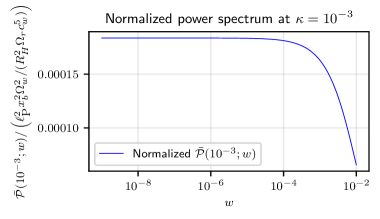
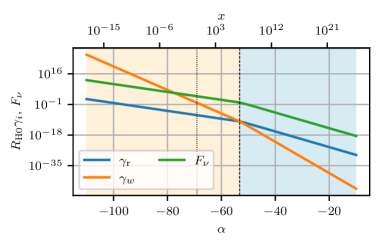
The Two-Fluid Model, utilized in bouncing cosmology, mathematically describes the universe’s evolution across the bounce by treating radiation and matter as separate, interacting fluids. This approach employs two energy-momentum tensors, one for each component, and is governed by modified Einstein Field Equations to accommodate the bounce. The equations incorporate a potential V(\phi) dependent on a scalar field φ, which drives the contraction and subsequent expansion phases. This framework allows for the derivation of Hubble parameters and densities for both fluids as functions of time, demonstrating a transition from a contracting to an expanding universe without encountering a singularity. Crucially, the model requires an effective equation of state for each fluid that permits a smooth transition through the bounce, avoiding violations of energy conditions.
The Quantum Genesis: Unveiling the Seeds of Perturbation
A consistent theory of quantum gravity is essential for accurately modeling the universe’s initial state and the transition through the cosmological bounce, where classical descriptions break down. This is because the extreme densities and curvatures present at the bounce necessitate a quantum mechanical treatment of spacetime itself. The generation of primordial perturbations – the seeds of all structure in the universe – is particularly sensitive to the physics at this stage; quantum fluctuations in the very early universe, amplified by the subsequent expansion, ultimately become these perturbations. Therefore, the specific details of the quantum gravity theory employed directly influence the spectrum of these primordial fluctuations, impacting observable quantities like the cosmic microwave background’s power spectrum and the large-scale structure of galaxies. Without a reliable quantum gravity framework, predictions regarding these fluctuations remain speculative and lack the necessary theoretical foundation.
The Wheeler-DeWitt equation is a key result of applying canonical quantization to General Relativity, treating spacetime itself as a quantum entity. It describes the evolution of the wavefunction of the universe, denoted as Ψ, which encapsulates the probability amplitude for different three-dimensional geometries. Unlike the time-dependent Schrödinger equation, the Wheeler-DeWitt equation is typically time-independent, leading to a “frozen formalism” where Ψ represents a stationary state. Solutions to this equation are therefore wavefunctions of the entire universe, dependent on the three-metric h_{ij} and potentially other relevant fields, and its analysis is crucial for understanding the universe’s quantum state and its time evolution, particularly in regimes where classical gravity breaks down, such as near the Big Bang or within black holes.
Combining the Wheeler-DeWitt equation with the Friedmann equation enables the investigation of cosmological evolution through the bounce, specifically focusing on the behavior of a(t), the Scale Factor, and H(t), the Hubble Parameter. The Friedmann equation, derived from General Relativity, describes the relationship between the expansion rate of the universe, its energy density, and its curvature. When coupled with the Wheeler-DeWitt equation – which governs the time evolution of the universe’s wavefunction in the absence of external time – this allows for the calculation of how a(t) and H(t) change as the universe transitions from contraction to expansion. Analysis of these parameters during the bounce provides insights into the initial conditions for inflation and the generation of primordial density perturbations, potentially revealing information about the pre-bounce universe and the validity of quantum gravity models.
Echoes in the CMB: The Imprint of Primordial Fluctuations
The Adiabatic Curvature Power Spectrum represents a fundamental connection between the theoretical landscape of the very early universe and the cosmological parameters that define its observable state today. This spectrum, which details the initial density fluctuations that ultimately seeded the large-scale structures – galaxies and galaxy clusters – observed today, isn’t merely a mathematical construct; it’s a direct imprint of the physical processes-such as inflation-that governed the universe’s initial expansion. By precisely characterizing the spectrum’s shape and amplitude, cosmologists can constrain key parameters like the universe’s energy density, its rate of expansion, and the composition of dark matter and dark energy. Essentially, the spectrum acts as a Rosetta Stone, translating the complex physics of the early universe into the measurable properties of the Cosmic Microwave Background and the large-scale structure we observe billions of years later, providing a powerful tool for testing and refining cosmological models.
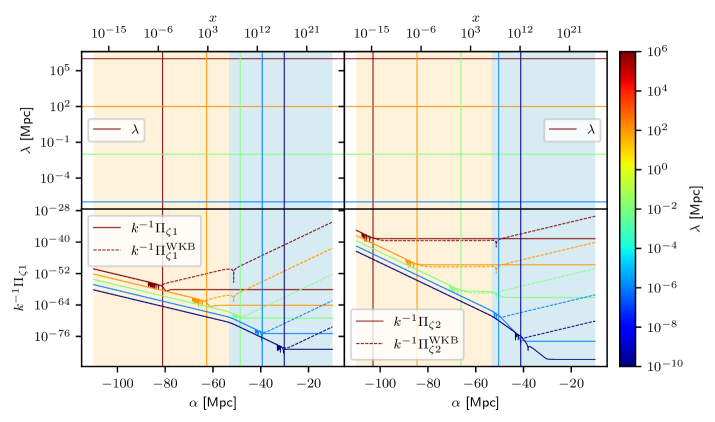
The WKB approximation provides a vital bridge between the theoretical underpinnings of the primordial power spectrum and the cosmological observations made today. This method, rooted in semi-classical physics, allows researchers to transition from abstract predictions about the density fluctuations in the early universe – described by quantities like the adiabatic curvature \mathcal{R} – to concrete, measurable features in the Cosmic Microwave Background (CMB). By treating the evolution of these fluctuations as a slowly varying wave, the WKB approximation enables the calculation of the power spectrum, P(k), which quantifies the amplitude of these fluctuations at different scales k. Crucially, this calculated power spectrum can then be directly compared with the observed temperature anisotropies in the CMB, offering a powerful test of early universe models and allowing for precise constraints on cosmological parameters. The efficacy of this approach is demonstrated by the model’s ability to produce a tensor-to-scalar ratio and Hubble Constant consistent with current observational data.
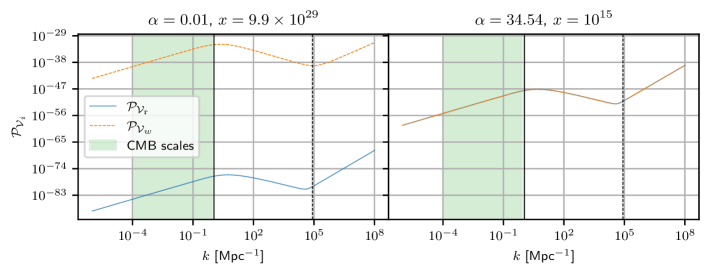
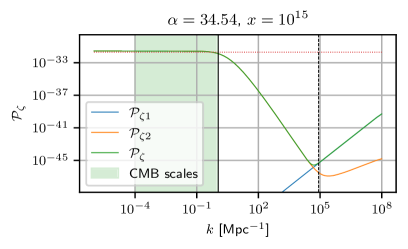
Detailed examination of the power spectrum across both sub- and super-Sound-Hubble scales provides critical insights into the fundamental physics governing the very early universe. This analysis allows for precise constraints on cosmological parameters, and recent modeling demonstrates a tensor-to-scalar ratio – a key indicator of primordial gravitational waves – of approximately 10^{-{22}}. Importantly, this value falls comfortably within the stringent bounds established by the Planck satellite, bolstering the model’s viability. Furthermore, this rigorous analysis not only confirms the model’s consistency with current observations but also contributes to ongoing efforts to refine our understanding of inflation and the conditions immediately following the Big Bang, offering a pathway towards resolving persistent cosmological puzzles.
Recent cosmological analysis, utilizing the adiabatic curvature power spectrum, has yielded a Hubble Constant value of 69.56 kilometers per second per megaparsec. This result demonstrates a strong concordance with independent measurements from the Planck 2018 dataset, offering a compelling solution to the ongoing Hubble tension-the statistically significant discrepancy between locally measured expansion rates and those inferred from the early universe. The precision of this derived H_0 value not only reinforces the validity of the theoretical framework employed, but also provides crucial insight into the fundamental parameters governing the cosmos and its expansion history, potentially bridging the gap between differing observational approaches.
Looking Ahead: Charting the Course for Future Discovery
Observations from the Planck satellite provide robust validation of the Adiabatic Curvature Power Spectrum, a cornerstone prediction of leading cosmological models describing the universe’s earliest moments. This spectrum details the initial density fluctuations that ultimately seeded the large-scale structures – galaxies and galaxy clusters – observed today. The Planck data meticulously maps the cosmic microwave background, revealing patterns of temperature variation that align with the theoretical predictions of this spectrum with remarkable precision. This confirmation isn’t merely a statistical match; it provides strong evidence supporting the inflationary paradigm – the idea that the universe underwent a period of extremely rapid expansion shortly after the Big Bang. By precisely characterizing these primordial fluctuations, the data offers a unique window into the physical conditions and energy scales that governed the universe when it was fractions of a second old, solidifying the Adiabatic Curvature Power Spectrum as a vital tool for understanding cosmic origins.
Analysis reveals an asymmetry parameter of 0.13 within the model, a finding with significant implications for early universe cosmology. This value suggests the universe’s contraction phase – the period before the Big Bang – did not mirror the subsequent expansion in a perfectly symmetrical fashion. A perfectly symmetric match would yield a parameter of zero; the observed deviation indicates differing physical conditions or processes dominated each phase. This asymmetry challenges purely symmetric bounce scenarios and supports models where the transition from contraction to expansion wasn’t a smooth, even process, potentially involving new physics or a modified gravitational regime. Further investigation into the origin of this asymmetry could unlock crucial insights into the universe’s initial conditions and the fundamental laws governing its birth.
The analysis reveals a crucial scale parameter, denoted as k_0, with a value of 1.93 x 10⁻³ Mpc⁻¹, which emerges as a fundamental constant within the model. This parameter isn’t simply an arbitrary value; it demonstrates a direct correlation with the radiation density parameter of the early universe. Specifically, k_0 defines the characteristic scale at which primordial perturbations transitioned from being dominated by radiation to being matter-dominated. This linkage provides a powerful constraint on cosmological models, suggesting that the universe’s initial conditions were intricately tied to the density of radiation present in its earliest moments and allowing for a more precise calibration of the energy scale of inflation. Determining k_0 therefore serves as a key step in reconstructing the universe’s infancy and understanding the origin of large-scale structures observed today.
Despite the compelling agreement between current models and observations from the Planck satellite, a complete picture of primordial perturbations remains elusive. Ongoing research reveals subtle discrepancies – minute deviations that, while not invalidating the overall framework, demand a more nuanced understanding of the universe’s earliest moments. These inconsistencies suggest that the assumptions underpinning current models, such as perfect adiabaticity or a strictly symmetric transition between contraction and expansion, may require modification. Investigations are actively exploring alternative scenarios, including the influence of non-Gaussianity, isocurvature perturbations, and the potential role of exotic physics at extremely high energies. Further theoretical development and increasingly precise cosmological observations are therefore crucial to resolving these lingering questions and constructing a more complete and accurate description of the universe’s birth and subsequent evolution.
The quest to understand the universe’s earliest moments is far from over, with upcoming Cosmic Microwave Background (CMB) experiments poised to deliver unprecedented precision. These next-generation observatories, building upon the legacy of the Planck satellite, will probe the CMB with increased sensitivity and resolution, searching for subtle signatures of primordial perturbations and refining measurements of key cosmological parameters. Simultaneously, theoretical advancements are crucial; researchers are actively developing and testing alternative models of inflation and early universe dynamics to explain observed anomalies and reconcile theory with observation. This synergistic approach – enhanced observational capabilities coupled with innovative theoretical frameworks – promises to unveil deeper insights into the conditions that birthed the cosmos and to illuminate the fundamental physics governing its evolution, potentially revealing the origin of structure and the nature of dark energy.
The pursuit of a complete cosmological model, as demonstrated in this exploration of a bouncing universe, echoes a fundamental limitation. Every calculation, every attempt to map the genesis of primordial perturbations and resolve the Hubble tension, is but a temporary grasp at an elusive reality. As Nikola Tesla observed, “The true genius does not seek novelty, but rather deals with the old in a new way.” This research, while offering a potentially viable two-fluid quantum cosmology, acknowledges the inherent provisional nature of theoretical frameworks. The universe, it seems, perpetually outpaces the boundaries of any single, definitive explanation, leaving each ‘solution’ vulnerable to the ever-shifting horizon of knowledge.
What Lies Beyond the Bounce?
This work, detailing a bouncing cosmology constructed from a two-fluid quantum framework, offers a technically sound, if provisional, resolution to certain cosmological puzzles. The potential for a scale-invariant spectrum of primordial perturbations, and a possible lessening of the Hubble tension, are not achievements, but invitations to further scrutiny. It is a demonstration that the mathematics allows such a universe, not that it must be so. Discovery isn’t a moment of glory; it’s realizing how little is known.
The model, inevitably, rests on assumptions. The nature of the ‘second fluid,’ its interaction with the gravitational sector, remains largely phenomenological. Future investigations must grapple with grounding this component in more fundamental physics, perhaps through connections to modified gravity or even pre-geometric constructs. The treatment of the quantum state, the adiabatic vacuum assumption, is a further point of vulnerability; everything called law can dissolve at the event horizon.
Perhaps the most pressing question isn’t refining the model, but accepting its inherent limitations. A bouncing universe doesn’t necessarily explain the universe; it merely pushes the boundary of ignorance further back. The true challenge lies in recognizing that any theoretical edifice, no matter how elegant, is ultimately a fragile construct, reflecting not reality itself, but the contours of its creator’s presumptions.
Original article: https://arxiv.org/pdf/2601.15542.pdf
Contact the author: https://www.linkedin.com/in/avetisyan/
See also:
- FRONT MISSION 3: Remake coming to PS5, Xbox Series, PS4, Xbox One, and PC on January 30, 2026
- Best Controller Settings for ARC Raiders
- Welcome to Demon School! Iruma-kun season 4 release schedule: When are new episodes on Crunchyroll?
- Taylor Sheridan’s Gritty 5-Part Crime Show Reveals New Final Season Villain
- The Boys Season 5 Officially Ends An Era For Jensen Ackles’ Soldier Boy
- ‘The Bride!’ Review: Jessie Buckley Breathes Life into a Monstrous Mess
- Invincible Season 4 Episode 4 Post-Credits Unveils a Demonic Return & More
- From season 4 release schedule: When is episode 2 out on MGM+?
- Mark Zuckerberg & Wife Priscilla Chan Make Surprise Debut at Met Gala
- Meet the cast of Good Omens season 3: All the actors and characters
2026-01-23 13:36