Author: Denis Avetisyan
New research suggests that the turbulent plasma around black holes and neutron stars could dramatically amplify the detection of elusive dark photons, potentially exceeding the sensitivity of laboratory experiments.
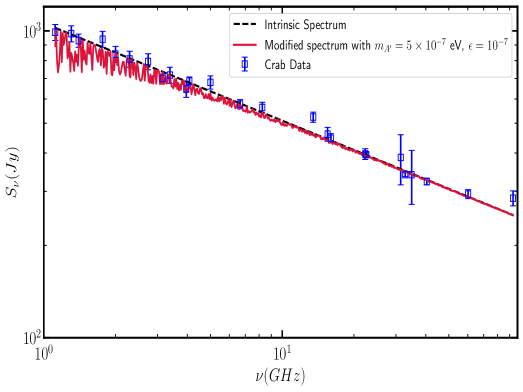
Resonant photon-dark photon oscillation in non-monotonic astrophysical plasmas offers a promising avenue for constraining dark photon parameter space.
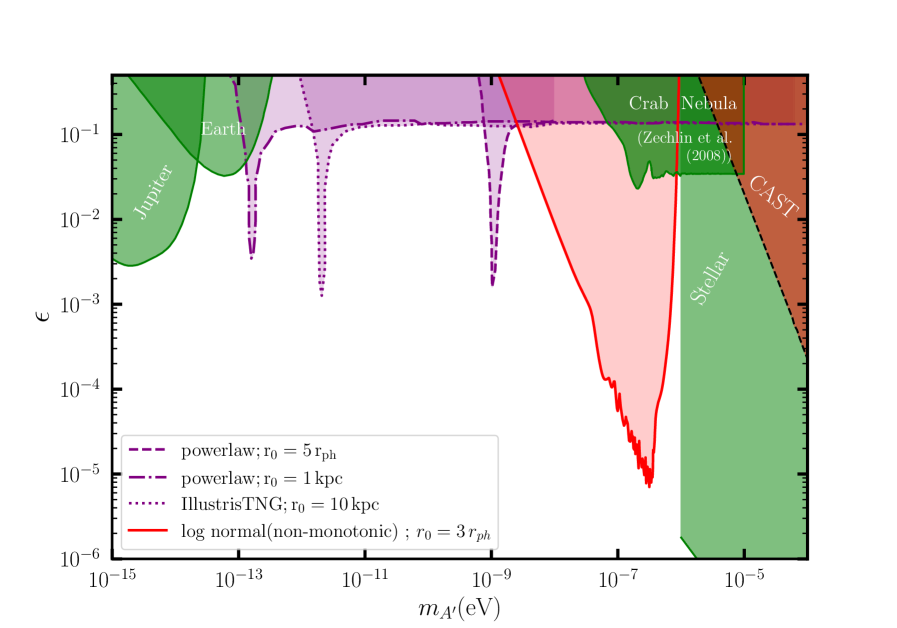
The search for dark matter remains one of the most compelling puzzles in modern physics, motivating explorations of diverse, potentially detectable dark sector particles. This work, ‘Photon-dark photon oscillation in M87 and Crab Nebula environments’, investigates resonant photon-A' conversion-a potential detection channel for feebly coupled dark photons-within the magnetized plasma environments surrounding compact astrophysical objects. We demonstrate that non-monotonic plasma density profiles significantly enhance the expected signal, yielding new constraints on the photon-A' kinetic mixing parameter, reaching ε \sim eq 7 \times 10^{-6} for m_{A'} \sim eq 5 \times 10^{-7} \mathrm{eV} in M87* and even stronger limits from the Crab Nebula. Could future observations with extended frequency coverage and from objects with even stronger magnetic fields further close the parameter space for these elusive particles?
The Whispers of the Unseen: Probing the Dark Universe
The composition of dark matter represents a fundamental challenge to contemporary physics, accounting for roughly 85% of the universe’s mass yet remaining stubbornly invisible to direct observation. This unseen substance doesn’t interact with light, making traditional detection methods impossible, and its gravitational effects are the primary evidence for its existence. Consequently, physicists are actively pursuing theoretical candidates, particularly weakly interacting massive particles (WIMPs), that could explain dark matter’s properties. These hypothetical particles are predicted to interact with ordinary matter at an extremely low rate, necessitating highly sensitive detectors and innovative experimental strategies. The ongoing search isn’t merely about identifying a new particle; it’s about refining the Standard Model of particle physics and gaining a deeper understanding of the universe’s underlying structure and evolution.
The persistent mystery of dark matter has led physicists to explore a range of theoretical particles, among the most intriguing being the ‘dark photon’. This hypothetical particle isn’t simply another form of dark matter, but rather a potential messenger – a force carrier – between the dark and visible universes. Unlike the familiar photons that mediate the electromagnetic force we experience daily, dark photons would interact very weakly with ordinary matter, explaining why they’ve remained undetected. The concept arises from extending the Standard Model of particle physics, suggesting a hidden sector of particles with its own forces, and the dark photon acts as a portal, enabling a subtle connection and potential interaction with the particles we already know. This framework offers a compelling avenue for explaining dark matter’s existence and properties, and fuels ongoing experiments designed to capture the faint signal of these elusive particles.
The quest to unveil dark photons necessitates a departure from conventional detection methods, prompting scientists to creatively utilize established physical principles and the cosmos itself as a vast laboratory. Researchers are exploring diverse avenues, including repurposing high-intensity laser systems traditionally used in other fields to search for the faint signature of dark photon production. Furthermore, astrophysical environments – such as the intense magnetic fields surrounding magnetars or the core of the sun – are being modeled as potential dark photon ‘beamlines,’ where these particles could be generated and potentially detected through their subtle interactions with standard model particles. These innovative strategies, combining terrestrial experiments with astronomical observations, represent a powerful approach to probing the hidden sector and deciphering the nature of dark matter, capitalizing on the predictable behaviors of known physics to reveal the elusive presence of something entirely new.
The potential detectability of dark matter hinges on the subtle interplay between the visible world and the hidden sector, and ‘kinetic mixing’ offers a promising avenue for observation. This phenomenon suggests that dark photons, the hypothetical force carriers of dark matter interactions, can weakly oscillate into ordinary photons – and vice versa. This mixing doesn’t create or destroy particles, but rather allows a small probability for a dark photon to momentarily behave as a visible photon, or for a visible photon to transform into its dark counterpart. Consequently, experiments searching for dark photons don’t necessarily look for entirely new particles appearing from nothing; instead, they focus on anomalies in the behavior of ordinary photons – such as unexpected fluctuations in light intensity or slight deviations in electromagnetic fields – that could indicate the fleeting presence of a mixed dark photon. This indirect detection method circumvents the difficulty of directly observing dark matter and provides a tangible pathway for probing the nature of this elusive substance.
Cosmic Laboratories: Where Magnetism and Plasma Reveal the Hidden
Compact objects, specifically neutron stars and black holes, generate intense magnetic fields ranging from 10^8 to 10^{15} Gauss. These fields are orders of magnitude stronger than those achievable terrestrially and significantly influence the propagation of photons in their vicinity. The strong magnetic field alters the photon’s polarization and energy through processes like vacuum birefringence and magnetic Compton scattering. Furthermore, the geometry of these fields – often dipolar or multipolar – can channel photons along magnetic field lines, creating observable features such as pulsed emission. The extreme field strengths also lead to significant modifications of the quantum electrodynamic vacuum, altering the expected behavior of photons and enabling the observation of phenomena not readily accessible in weaker field environments.
The plasma frequency, denoted as \omega_p , represents the natural frequency of oscillation of electrons within a plasma. This frequency is determined by the electron density ( n_e ) and elementary charge ( e ) according to the equation \omega_p = \sqrt{n_e e^2 / (\epsilon_0 m_e)} , where \epsilon_0 is the vacuum permittivity and m_e is the electron mass. Photons with frequencies below \omega_p are unable to propagate through the plasma, effectively being reflected or absorbed, while those with frequencies above can propagate, though with dispersion. Consequently, the plasma frequency dictates the transparency of the environment to electromagnetic radiation and significantly influences photon scattering, refraction, and absorption rates, impacting observed signals from compact objects.
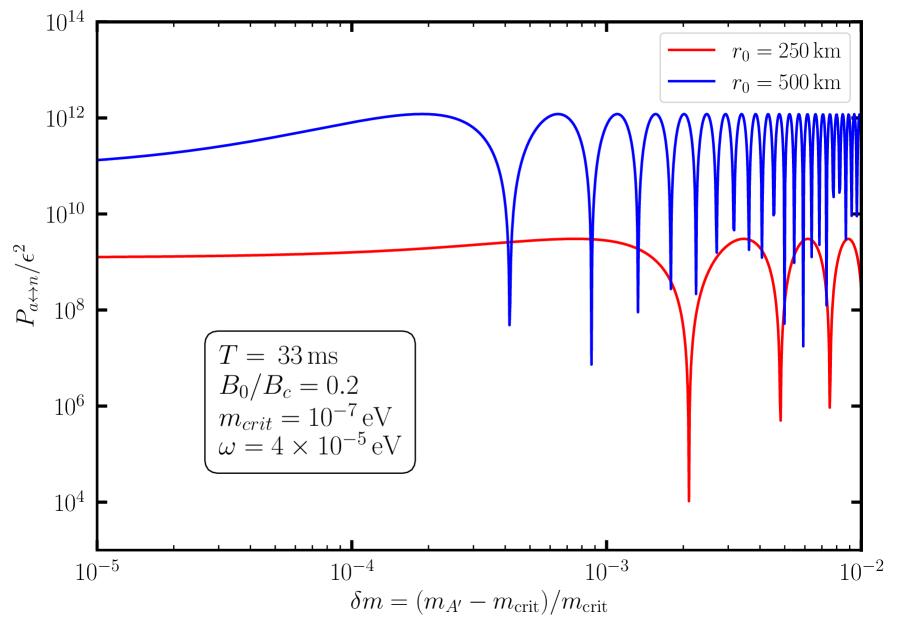
Non-monotonic plasma profiles, characterized by changes in plasma density with distance, significantly enhance resonant conversion processes involving photons and charged particles. Unlike uniform density plasmas, these varying profiles create multiple locations where the photon frequency matches the plasma frequency \omega_p. This results in repeated instances of level crossings, effectively increasing the probability of photon conversion into other forms of radiation or particle interactions. The cumulative effect of these multiple resonances overcomes the limitations of single-resonance scenarios, offering a substantial advantage for observing and studying weak signals originating from these astrophysical environments.
Non-monotonic plasma profiles, characterized by gradients in particle density, facilitate enhanced photon conversion probability through multiple level crossings. In these environments, as a photon propagates, its interaction with the plasma can induce transitions between different polarization states or particle species. Each change in density within the non-monotonic profile represents a potential level crossing, where the conditions for conversion are met. The cumulative effect of several such crossings significantly increases the overall conversion probability compared to a uniform plasma, resulting in a measurable increase in signal strength. This effect is particularly relevant in astrophysical settings where strong magnetic fields and complex plasma distributions are common, allowing for the detection of otherwise faint signals.

The Mechanics of Conversion: A Theoretical Framework
The Landau-Zener (LZ) approximation is a semi-analytical method used to calculate the probability of non-adiabatic transitions between energy levels in a system subject to a slowly varying perturbation. In the context of photon-dark photon conversion, this perturbation arises from the external magnetic field and plasma density variations. The LZ approximation determines the transition probability, P, based on the system’s parameters; specifically, P is proportional to exp(-2\pi \frac{\Delta^2}{v_{rel} \frac{d}{dx}n_e}), where Δ represents the energy difference between the photon and dark photon, v_{rel} is their relative velocity, and \frac{d}{dx}n_e denotes the plasma density gradient. This allows estimation of the conversion probability from photons to dark photons, or vice versa, based on measurable plasma characteristics and magnetic field strengths.
Within the framework of resonant conversion, the Landau-Zener (LZ) approximation provides a calculable relationship between plasma parameters and the photon-to-dark photon conversion rate. The conversion probability is directly proportional to the strength of the applied magnetic field and inversely proportional to the scale length of the plasma density gradient; specifically, the conversion rate scales as \propto B^2 / (\nabla n)^2 , where B is the magnetic field strength and \nabla n represents the density gradient. This dependence allows for the prediction of conversion efficiencies based on experimentally controlled plasma conditions, facilitating targeted searches for dark photons by optimizing parameter space based on predicted signal strengths.
The Landau-Zener (LZ) approximation establishes a quantitative relationship between the probability of photon-dark photon conversion and the characteristics of the surrounding plasma. Specifically, the conversion probability scales with the strength of the applied magnetic field, B, and is directly proportional to the gradient of the plasma density, \frac{dN}{dx}. A stronger magnetic field increases the coupling between the photon and dark photon states, enhancing the conversion probability. Similarly, a steeper density gradient provides a greater driving force for the non-adiabatic transition, leading to a higher conversion rate. This dependence allows for predictive modeling of conversion efficiencies based on experimentally controllable plasma parameters.
Optimizing searches for photon-dark photon conversion relies on predicting conversion efficiencies based on established relationships between key plasma parameters and conversion probability. Specifically, the strength of the applied magnetic field and the plasma density gradient directly influence the likelihood of successful conversion; higher magnetic field strengths and steeper density gradients generally lead to increased conversion rates. By accurately modeling these relationships using the LZ approximation and incorporating them into search strategies, experiments can focus on parameter spaces where conversion is most probable, improving sensitivity and maximizing the potential for detection. This predictive capability is crucial for designing efficient searches and interpreting experimental results, allowing for targeted investigations of specific regions within the parameter space defined by magnetic field strength, plasma density, and photon energies.
The Radio Echo of Hidden Particles: Constraining Dark Photons with Observation
Observations with the Low-Frequency Array (LOFAR) offer a unique pathway to investigate the elusive dark photon, a hypothetical particle potentially mediating interactions between the visible sector and dark matter. LOFAR’s sensitivity to low-frequency radio waves allows astronomers to probe the environments surrounding powerful sources like the M87 galaxy for telltale signs of dark photon conversion – a process where these particles transform into detectable photons within strong magnetic fields. Specifically, the search focuses on anomalous radio emissions; a detected excess could indicate the presence of dark photons created through this conversion process. By meticulously analyzing the radio spectrum, researchers aim to constrain the properties of dark photons, including their mass and the strength of their interaction with standard model particles, effectively using astronomical observations to explore the frontiers of particle physics.
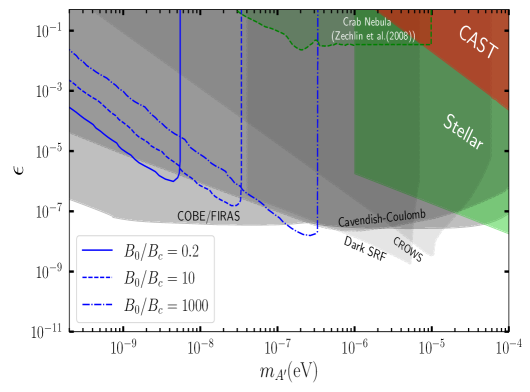
The Crab Nebula, a supernova remnant exhibiting a broad spectrum of electromagnetic radiation, serves as a unique laboratory for probing the existence of dark photons. Researchers analyze the nebula’s Spectral Energy Distribution – a plot of energy versus the intensity of emitted radiation – seeking subtle deviations from expected behavior. Dark photons, hypothetical particles interacting weakly with ordinary matter, could be produced in the extreme magnetic fields surrounding the Crab Nebula. These particles would then convert into detectable photons, potentially creating an anomalous excess in the radio spectrum. The search focuses on identifying such irregularities, as their characteristics – frequency and intensity – would reveal information about the dark photon’s mass and its strength of interaction with standard model particles, providing crucial evidence for, or against, its existence.
Recent radio astronomy observations, particularly those leveraging the Low-Frequency Array (LOFAR), have significantly narrowed the potential parameter space for dark photons – hypothetical particles that could comprise dark matter. Analysis of emissions from sources like the Crab Nebula and the M87 galaxy has allowed researchers to place tight constraints on the kinetic mixing parameter, denoted as ϵ. This parameter dictates the strength of interaction between dark photons and standard model photons; a smaller ϵ value suggests a weaker interaction, and thus, a more elusive dark photon. Current findings establish an upper limit of 8 \times 10^{-7} for ϵ at a dark photon mass of 4 \times 10^{-9} \text{ eV}, representing a substantial improvement in sensitivity and pushing the boundaries of dark photon detection capabilities. These stringent limits are crucial for refining theoretical models and guiding future searches for this elusive component of the universe.
Recent investigations utilizing spectral data from the M87 galaxy have significantly refined the search for dark photons, hypothetical particles that interact weakly with ordinary matter. Analysis has established a kinetic mixing parameter – a measure of how strongly dark photons mix with photons – of 7 \times 10^{-6} at a dark photon mass of 5 \times 10^{-7} \text{ eV}. This represents an improvement in constraints achieved through the implementation of non-monotonic plasma modeling, a technique that accounts for the complex and varying density of plasma surrounding M87. By accurately modeling this plasma environment, researchers were able to more precisely isolate potential dark photon signatures and push the boundaries of sensitivity in the search for this elusive component of the dark sector.
The study of photon-dark photon oscillation within astrophysical plasmas reveals a universe perpetually reshaping itself, much like a garden overgrown with possibilities. It’s observed that non-monotonic plasma structures dramatically alter the landscape for detection, opening avenues previously obscured. This echoes a fundamental truth: systems aren’t static constructions, but evolving ecosystems. As John Stuart Mill noted, “It is better to be a dissatisfied Socrates than a satisfied fool.” The pursuit of these subtle interactions-the conversion of photons in the presence of dark matter-is not about achieving a final answer, but about perpetually questioning the foundations of what is known, even when the answers shift with each observation. Every refinement of the model, every new constraint, begins as a hopeful inquiry and ends in a humble reassessment of the whole.
The Horizon Recedes
This exploration of photon-dark photon oscillation around astrophysical beacons does not so much answer questions as refine them. The paper illuminates how complex plasma structures-those far from simple gradients-act as amplifiers for conversion, and yet, it simultaneously reveals the profound difficulty in truly knowing those structures. Each resonance identified is a fleeting alignment, dependent on a precise, and likely transient, arrangement of fields. A system isn’t a machine, it’s a garden-attempting to force a detection through pre-defined models risks overlooking the subtle, emergent phenomena that might truly reveal the dark sector.
The implication isn’t simply that more precise plasma maps are needed. It’s that the very notion of a ‘map’ is a simplification. These environments aren’t static canvases; they breathe, they churn, they evolve. Resilience lies not in isolation, but in forgiveness between components-a detector that can adapt to uncertainty, that can find signal in the noise of a living system, will ultimately prove more fruitful than one predicated on perfect knowledge.
The boundary between ‘signal’ and ‘noise’ itself begins to blur. Perhaps the most compelling direction isn’t to search for a distinct dark photon signature, but to consider the subtle, unexplained variations in astrophysical spectra-the anomalies that currently fall into the category of ‘unknown unknowns’. Those might not be errors to be corrected, but whispers of a hidden reality, patiently waiting to be heard.
Original article: https://arxiv.org/pdf/2601.15985.pdf
Contact the author: https://www.linkedin.com/in/avetisyan/
See also:
- 10 Most Powerful Versions of Superman, Ranked
- Gold Rate Forecast
- GBP CNY PREDICTION
- 007 First Light: Release Date, Story, Gameplay, Cast, Editions, and Platforms
- 10 Greatest Wii U Games of All Time, Ranked
- Superman’s 7 Best Power-Ups, Ranked
- DOGE PREDICTION. DOGE cryptocurrency
- Kingdom Come Deliverance Update 1.002 Enables Trophies to Be Transferred
- The 10 Greatest Spy Thriller Movies Of All Time, Ranked
- Forza Horizon 6 Car List So Far: Confirmed Highlights, Cover Cars, DLC, and Rewards
2026-01-24 06:23