Author: Denis Avetisyan
A new study explores the potential for observing subtle signs of physics beyond the Standard Model through rare decays of B and K mesons.

This review examines the interplay between lepton number violating interactions, effective field theory calculations, and constraints from cosmology and neutrinoless double beta decay experiments.
The Standard Model, while remarkably successful, offers no inherent explanation for the observed baryon asymmetry or the absolute neutrino mass scale. This motivates explorations beyond its framework, as undertaken in ‘Feasibility Study of Lepton Number Violation in Rare $B$ and $K$ Meson Decays’, which investigates dimension-seven operators within the Standard Model Effective Field Theory contributing to lepton number violation (LNV) in rare meson decays. We demonstrate that observable excesses in B \to K νν and K \to πνν rates are possible under specific conditions, while simultaneously satisfying constraints from neutrinoless double beta decay and cosmological considerations related to leptogenesis. Could precision measurements of these rare decays provide a crucial window into the fundamental origins of neutrino mass and the matter-antimatter imbalance in the Universe?
Unveiling the Standard Model’s Limits: A Quest for Symmetry’s Breakdown
The Standard Model of particle physics, despite its predictive power and numerous experimental confirmations, presents a significant challenge when attempting to incorporate the observed properties of neutrinos. These elusive particles are known to possess mass – a characteristic not originally predicted by the model – and exhibit a peculiar behavior called mixing, where they oscillate between different “flavors”. This phenomenon demands an extension to the Standard Model, as the original framework assumes neutrinos are massless and do not mix. The observation of neutrino oscillations, confirmed through experiments like Super-Kamiokande and SNO, necessitates a deeper understanding of neutrino properties and points towards the existence of new physics beyond the current theoretical description. Understanding the origin of neutrino mass and mixing is therefore a central pursuit in contemporary particle physics, driving searches for new particles and interactions that could account for these discrepancies.
The persistent anomalies surrounding neutrino mass and mixing demand a re-evaluation of the Standard Model, and exploration of Lepton Number Violation (LNV) represents a pivotal avenue for progress. Current theoretical frameworks strictly conserve lepton number, yet experimental observations suggest this symmetry may be broken in nature, hinting at physics beyond the established model. Investigating LNV isn’t merely about identifying a flaw; it’s about charting a course toward a more complete understanding of fundamental particles and forces. Sensitive experiments designed to detect rare decays – such as neutrinoless double beta decay – and searches for subtle deviations in high-energy collisions offer the most promising routes to confirm or refute LNV, potentially unveiling new particles and interactions that could resolve the mysteries surrounding these elusive neutrinos and redefine the landscape of particle physics.
The quest to detect Lepton Number Violation (LNV) demands a multifaceted approach, employing highly sensitive experiments designed to observe exceedingly rare decay processes. Researchers are actively pursuing several avenues, including searches for neutrinoless double-beta decay – a hypothetical process where two neutrons decay simultaneously, emitting only electrons – and examining the decay of muons into electrons and positrons. These investigations aren’t solely experimental; theoretical frameworks play a vital role, predicting the signatures of LNV within various extensions of the Standard Model, such as seesaw mechanisms and models incorporating extra dimensions. The challenge lies in distinguishing these subtle signals from background noise, requiring innovative detector technologies and sophisticated data analysis techniques to push the boundaries of precision and uncover potential evidence for physics beyond \Delta L = 2 processes.
Although the Cabibbo-Kobayashi-Maskawa (CKM) matrix successfully accounts for observed quark mixing and CP violation within the Standard Model, its existence does not inherently forbid contributions from new physics phenomena that could induce Lepton Number Violation (LNV). The CKM matrix operates solely within the quark sector; it provides a complete description of quark flavor changes but remains silent regarding lepton flavor. Consequently, LNV, which isn’t predicted by the Standard Model’s minimal form, could arise from interactions beyond the CKM matrix, potentially mediated by new particles or forces. This means that even with a fully understood CKM matrix, searches for LNV remain vital, as deviations from Standard Model predictions could signal the presence of these novel contributions and unlock a deeper understanding of fundamental particle interactions and the nature of neutrino masses.
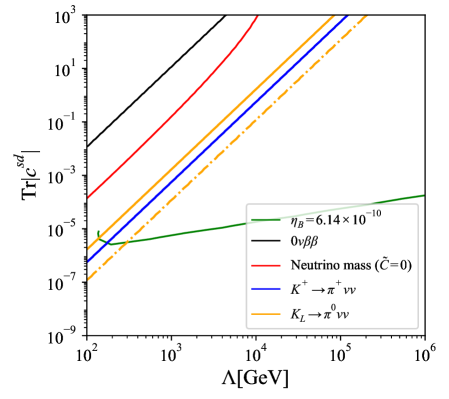
Effective Field Theory: A Framework for Mapping the Unknown
The Standard Model Effective Field Theory (SMEFT) is a framework built upon the premise that any new physics beyond the Standard Model will manifest at energies much higher than those currently accessible. Instead of postulating specific new particles and interactions, SMEFT utilizes the Standard Model Lagrangian and adds higher-dimensional operators, suppressed by powers of a high energy scale Λ. These operators, constructed from Standard Model fields and derivatives, parameterize the effects of the unknown high-energy physics in a model-independent way. The coefficients of these operators, representing the strength of the new interactions, become the free parameters of the theory, allowing physicists to systematically analyze deviations from Standard Model predictions and constrain the possible scales of new physics.
The Standard Model Effective Field Theory (SMEFT) extends the Standard Model Lagrangian by including higher-dimensional operators suppressed by powers of a new mass scale Λ. These operators, with dimensions greater than four, are constructed from Standard Model fields and their derivatives, and their coefficients represent the strength of new physics interactions. By systematically including these operators, SMEFT provides a framework to parameterize a vast number of possible Beyond the Standard Model (BSM) scenarios without committing to a specific UV completion. The number of independent operators grows rapidly with dimension; for example, there are 59 dimension-6 operators. Analysis of these operators allows physicists to explore the effects of new physics on observables and constrain the scale Λ at which these new interactions might become significant, providing a model-independent approach to searches for BSM physics.
The Weinberg operator, denoted as \mathcal{O}_{5} = (\bar{l}^c \gamma^\mu l)(\bar{l} \gamma_\mu l) , is a non-renormalizable, dimension-5 operator included in the Standard Model Effective Field Theory (SMEFT) framework. This operator directly generates Majorana neutrino masses upon electroweak symmetry breaking, with the mass term proportional to the vacuum expectation value of the Higgs field. Consequently, the presence of this operator allows for neutrinoless double beta decay, a rare nuclear process that violates lepton number conservation. The half-life of this decay is inversely proportional to the square of the neutrino mass and the phase space factor, making it a sensitive probe for the scale of new physics associated with the Weinberg operator and providing a potential avenue for determining the absolute neutrino mass scale and the nature of neutrino mass ordering.
Dimension-7 Lepton Number Violating (LNV) operators within the Standard Model Effective Field Theory (SMEFT) contribute to the generation of neutrino masses through two-loop quantum corrections. While dimension-5 operators directly induce neutrino mass at the tree level, the higher dimensionality of these dimension-7 operators necessitates a more complex calculation involving virtual particles in the loop. The resulting neutrino mass scales with the inverse square of a characteristic energy scale associated with the new physics responsible for these operators; specifically, m_{\nu} \sim \frac{C_7}{Λ^2}, where C_7 represents the Wilson coefficient of the dimension-7 operator and Λ is the energy scale of new physics. This two-loop suppression means that constraints on dimension-7 LNV operators are weaker than those on dimension-5 operators for comparable Wilson coefficients, but they still provide a valuable probe of new physics beyond the Standard Model.
Probing Lepton Number Violation Through Rare Decay Signatures
Rare meson decays, specifically those involving the emission of two neutrinos like B \rightarrow K \nu \nu and K \rightarrow \pi \nu \nu, are highly sensitive indicators of Lepton Number Violation (LNV) interactions. These decays proceed via processes forbidden, or heavily suppressed, within the Standard Model, meaning any observed signal would strongly suggest the presence of new physics. The final state neutrinos are not directly detectable, necessitating the reconstruction of the decay via missing energy and momentum; however, this reconstruction is feasible with current detector technologies. The sensitivity arises because LNV effects contribute directly to the decay amplitude, making these channels ideal for searching for and constraining models beyond the Standard Model that predict LNV.
The Standard Model predicts exceedingly low branching ratios for rare meson decays, such as B \rightarrow K \nu \overline{\nu} and K \rightarrow \pi \nu \overline{\nu}, due to the constraints imposed by established physics and the requirement of multiple kinematic factors. These suppressed rates mean that even small contributions from beyond-the-Standard-Model (BSM) physics are potentially observable, offering enhanced sensitivity to new particles and interactions. Consequently, these decay channels serve as particularly effective probes for investigating Lepton Number Violation (LNV) and other novel phenomena, as any observed signal would strongly indicate the presence of BSM contributions not accounted for within the Standard Model framework.
Dimension-7 Lepton Number Violating (LNV) operators represent the lowest-order effective interactions contributing to rare meson decays such as B \to K + \nu\nu and K \to \pi + \nu\nu. These operators, arising from beyond the Standard Model physics, directly enter the calculation of the decay amplitudes, establishing a quantifiable link between theoretical predictions and experimental measurements. The contribution is direct in the sense that the operator coefficients scale linearly with the decay rate, simplifying the extraction of these coefficients from observed branching ratios. This direct connection allows for a precise mapping of experimental limits on branching ratios to upper bounds on the corresponding dimension-7 operator coefficients, facilitating tests of various new physics models.
Current experimental searches for the rare decay B^+ \rightarrow K^+ \nu \nu place an upper limit on the branching ratio of less than 2.9 x 10⁻⁵ at the 90% confidence level. This constraint is primarily derived from analyses conducted by the Belle II collaboration, which utilizes a projected integrated luminosity to achieve this sensitivity. The branching ratio represents the fraction of B^+\ mesons that decay via this specific channel, and the low value observed is consistent with Standard Model predictions, but still allows for potential contributions from Lepton Number Violating (LNV) new physics. Continued data collection and analysis by Belle II, along with complementary searches at other experiments, aim to further refine this limit and probe for deviations indicative of beyond-the-Standard-Model interactions.
Leptoquarks are hypothetical particles predicted by several beyond-the-Standard-Model theories, and they mediate interactions between leptons and quarks. Their contribution to Lepton Number Violation (LNV) processes occurs through dimension-7 effective operators generated upon integrating out these particles. Specifically, leptoquark exchange introduces new terms into the Hamiltonian that couple lepton and quark fields, directly affecting the amplitudes of rare decays such as B \rightarrow K \nu \nu and K \rightarrow \pi \nu \nu. The strength of these contributions is inversely proportional to the square of the leptoquark mass, meaning that higher mass leptoquarks lead to smaller effects and vice-versa. Current experimental searches for these rare decays therefore place constraints on the allowed parameter space for leptoquark masses and coupling strengths, providing a potential pathway to observe or exclude these particles.
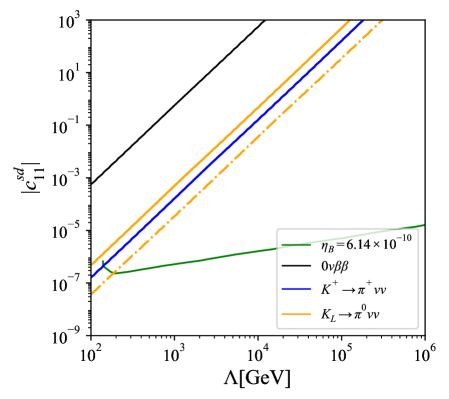
Beyond Decays: The Implications for Understanding Baryogenesis
The universe, as currently observed, exhibits a profound imbalance: a significant surplus of matter over antimatter. This disparity, known as the baryon asymmetry, is fundamental to existence, as complete annihilation would have left a universe devoid of structure and, ultimately, life. The standard model of particle physics, however, fails to adequately explain this asymmetry, predicting nearly equal amounts of both. Therefore, a mechanism must exist that preferentially generates baryons – protons and neutrons – over antibaryons in the early universe. This generation requires violations of certain conservation laws, specifically baryon number conservation and charge-parity (CP) symmetry, alongside a departure from thermal equilibrium. Understanding the precise nature of this baryogenesis – the process creating the imbalance – remains one of the most compelling challenges in modern physics, driving research into extensions of the standard model and novel particle interactions.
Leptogenesis proposes a compelling explanation for the observed matter-antimatter imbalance in the universe, positing that an initial asymmetry in lepton number-the difference between leptons and antileptons-was ultimately transferred to a baryon asymmetry through electroweak sphaleron processes. These non-perturbative effects, inherent to the Standard Model at high energies, violate both baryon and lepton number conservation, effectively converting lepton asymmetry into baryon asymmetry. This mechanism elegantly circumvents the Sakharov conditions for baryogenesis-baryon number violation, C and CP violation, and departure from thermal equilibrium-by leveraging the Standard Model’s sphaleron processes in conjunction with new physics that violates lepton number. Crucially, the resulting baryon asymmetry is directly linked to the scale of new physics responsible for lepton number violation, offering a potential window into physics beyond the Standard Model and a pathway to understanding the origin of matter itself.
The establishment of matter dominance in the universe hinges on an initial asymmetry between matter and antimatter, but maintaining this asymmetry is a delicate process. A pre-existing baryon asymmetry is constantly challenged by interactions that tend to equalize matter and antimatter, a phenomenon known as washout. This washout isn’t driven by a single mechanism, however; it’s profoundly influenced by both Lepton Number Violating (LNV) operators and electroweak sphalerons. LNV operators directly alter the lepton-to-baryon ratio, potentially eroding the asymmetry, while electroweak sphalerons – non-perturbative effects inherent to the Standard Model – can convert lepton number into baryon number and vice versa. Consequently, both processes contribute to the overall rate at which the asymmetry is diminished, necessitating a careful balance between asymmetry generation and these washout mechanisms to explain the observed matter-antimatter imbalance in the cosmos.
Cosmological observations indicate a significant imbalance between matter and antimatter in the universe, demanding an explanation for the observed baryon asymmetry. Current models exploring this asymmetry, particularly those invoking new physics beyond the Standard Model, are heavily constrained by the need to avoid excessive ‘washout’ – the erasure of any pre-existing baryon asymmetry. Research demonstrates that the energy scale at which this new physics appears – represented by a ‘cutoff’ scale denoted as Λ – must be relatively low, specifically less than 200 GeV. A higher Λ would introduce interactions strong enough to efficiently reverse the asymmetry via processes mediated by electroweak sphalerons, effectively negating any attempt to generate a net baryon number and contradicting established cosmological constraints on the matter-antimatter imbalance. This stringent upper limit on Λ has significant implications for model building, guiding the search for new particles and interactions within the reach of current and near-future collider experiments.
Electroweak sphalerons represent a fascinating and complex aspect of the Standard Model, functioning as non-perturbative solutions that inherently violate both baryon and lepton number conservation. These topological configurations, arising from the structure of the electroweak vacuum, aren’t merely theoretical curiosities; they are dynamically active processes capable of both generating and erasing the asymmetry between matter and antimatter. Initially, sphaleron processes can create a baryon asymmetry from initially symmetric conditions, but if unchecked, these same processes can also wash it out, effectively reverting the universe towards equal amounts of matter and antimatter. The balance between these constructive and destructive roles is incredibly sensitive to parameters beyond the Standard Model, making the study of electroweak sphalerons crucial to understanding the origin of the observed matter dominance in the universe and constraining the energy scales of new physics.
The study meticulously charts the complex interplay between seemingly disparate areas of physics, mirroring the holistic approach to system design. It highlights how even subtle lepton number violating (LNV) interactions, modeled within the SMEFT framework, can propagate effects across meson decays and cosmological observations. This echoes the principle that structure dictates behavior; a perturbation in one area – such as the introduction of dim-7 operators – necessitates a re-evaluation of the entire system. As Karl Popper observed, “The more we learn about the universe, the more we realize how little we know.” This paper, rather than offering definitive answers, elegantly maps the boundaries of our current understanding, acknowledging the interconnectedness of these fundamental forces and the inherent limitations in our knowledge.
Future Directions
The exploration of lepton number violation (LNV), as framed by this work, quickly reveals the inherent difficulty in isolating signal from structure. The Standard Model Effective Field Theory provides a useful scaffolding, yet the sheer number of potential dimension-7 operators – and their interplay – suggests the observed baryon asymmetry may not be a simple consequence of a single, dominant interaction. A continued reliance on parameter counting risks obscuring the underlying elegance – or lack thereof – of the fundamental physics.
Future studies must prioritize a more holistic approach. Cosmological constraints, particularly those pertaining to the washout mechanisms responsible for generating the observed baryon asymmetry, should be integrated more tightly with searches for neutrinoless double beta decay. The current tendency to treat these as independent probes seems increasingly artificial. A compelling theory will necessitate a simultaneous explanation for both phenomena, demonstrating a cohesive structure rather than a patchwork of ad-hoc solutions.
Ultimately, the path forward demands a critical reassessment of the assumptions embedded within the SMEFT framework. While undeniably useful, the effective field theory approach may be inherently limited in its ability to reveal the true origin of LNV. The search for Majorana neutrinos, and a deeper understanding of their role in both terrestrial and cosmological processes, may well prove to be the necessary catalyst for a more complete, and perhaps more surprising, picture.
Original article: https://arxiv.org/pdf/2601.16422.pdf
Contact the author: https://www.linkedin.com/in/avetisyan/
See also:
- Gold Rate Forecast
- 10 Most Powerful Versions of Superman, Ranked
- GBP CNY PREDICTION
- 007 First Light: Release Date, Story, Gameplay, Cast, Editions, and Platforms
- Forza Horizon 6 Car List So Far: Confirmed Highlights, Cover Cars, DLC, and Rewards
- DOGE PREDICTION. DOGE cryptocurrency
- Superman’s 7 Best Power-Ups, Ranked
- 10 Greatest Wii U Games of All Time, Ranked
- What happened to Soldier Boy in The Boys?
- Kingdom Come Deliverance Update 1.002 Enables Trophies to Be Transferred
2026-01-27 06:48