Author: Denis Avetisyan
A new catalog classifies emergent phonon particles and chiral phonons, paving the way for materials with tailored acoustic and magnetic properties.
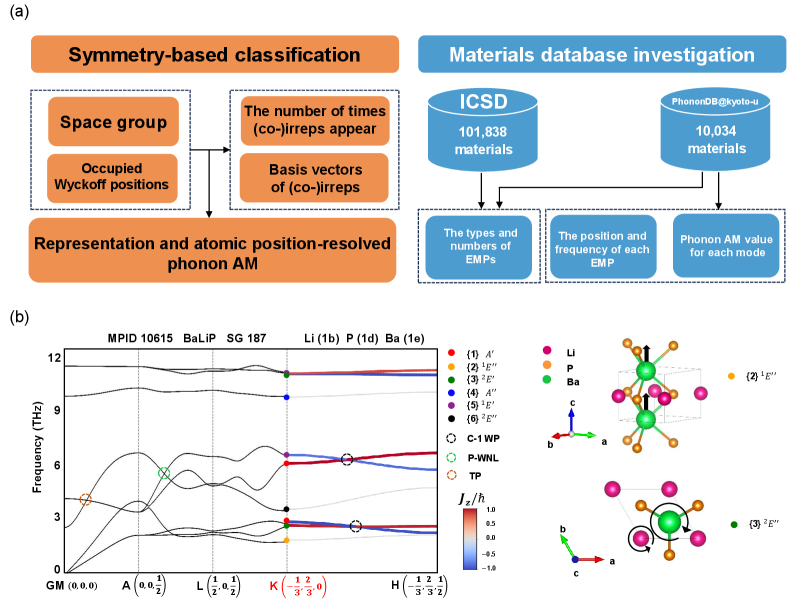
This review presents a symmetry-based classification of phonons and a materials database investigation focused on predicting enhanced phonon angular momentum and magnetic moments.
While symmetry is a powerful predictor of topological phonons, a systematic catalog linking symmetry to emergent particles and chiral phonons in material databases has remained elusive. This work, ‘Catalog of phonon emergent particles and chiral phonons: Symmetry-based classification and materials database investigation’, establishes a complete symmetry-based classification scheme allowing prediction of potential phonon emergent particles without computationally expensive calculations. By investigating over 25 million modes, we identify materials exhibiting strong phonon angular momentum and magnetic moments, compiling these data into a publicly accessible website. Could this resource accelerate the design of novel phononic devices leveraging these unique phonon properties?
The Symmetry of Vibration: Unlocking Material Behavior
The vibrational behavior of atoms within a crystalline solid, described by phonons, isn’t random; it’s fundamentally governed by the material’s symmetry. This symmetry is formally captured by the Space Group, a mathematical description of all the operations – rotations, reflections, and translations – that leave the crystal lattice unchanged. Knowing the Space Group allows physicists to predict which vibrational modes are allowed and which are forbidden, significantly narrowing the scope of possible phonon behaviors. Essentially, the symmetry dictates the ‘rules’ for how atoms can vibrate collectively; vibrations that don’t align with the symmetry are energetically unfavorable and won’t occur. This principle isn’t merely a theoretical convenience; it’s crucial for understanding a material’s thermal conductivity, heat capacity, and even its response to external stimuli, making the Space Group a cornerstone of solid-state physics and materials science.
The arrangement of atoms within a crystal’s repeating unit, known as the unit cell, profoundly impacts how it vibrates – and these vibrations manifest as phonons. Specific locations atoms can occupy within this unit cell are formally defined as Wyckoff positions, and each position dictates which vibrational modes are permitted. Atoms residing in higher symmetry Wyckoff positions typically exhibit more degenerate phonon modes – meaning multiple vibrational frequencies can arise from a single atomic displacement. Conversely, atoms in lower symmetry positions tend to have less degenerate, and often lower frequency, modes. This connection arises because symmetry operations inherent to the crystal lattice constrain the possible directions and types of atomic motion. Consequently, understanding Wyckoff positions isn’t merely about atomic coordinates; it’s fundamental to predicting a material’s thermal conductivity, optical properties, and even its stability, as certain phonon modes can either facilitate or hinder energy transport and structural rearrangements.
The vibrational behavior of atoms within a crystalline solid isn’t random; it’s profoundly shaped by the material’s inherent symmetry. These symmetries, stemming from the arrangement of atoms in the lattice, act as constraints, dictating which vibrational patterns – or phonon modes – are actually allowed. A crystal’s symmetry effectively selects from a vast number of potential vibrations, permitting only those that align with its structure. Consequently, classifying phonon behavior requires a thorough understanding of these underlying symmetries, as they determine the number of vibrational modes, their frequencies, and how they respond to external stimuli. This relationship is not merely descriptive; it allows scientists to predict and engineer material properties, leveraging symmetry as a powerful tool in materials science and solid-state physics.

Decoding Vibrational Fingerprints: A Symmetry-Based Approach
Symmetry-based classification relies on the crystallographic Space Group and the Wyckoff positions within that group to systematically determine the number of Irreducible Representations (IRs) for a given material. Each unique IR corresponds to a set of vibrational modes with distinct symmetry properties. The process involves identifying the symmetry operations of the Space Group and then analyzing how atomic displacements transform under these operations. By considering the Wyckoff positions – which define the symmetry-allowed locations for atoms within the unit cell – one can establish the dimensionality of each IR. Consequently, the number of IRs directly corresponds to the number of independent vibrational modes, providing a predictive framework for phonon behavior without requiring computationally expensive calculations of phonon dispersions.
The prediction of allowed vibrational modes and their associated Phonon Angular Momentum (PAM) relies on the material’s Space Group symmetry and the Wyckoff positions of its constituent atoms. The Space Group defines the symmetry operations that leave the crystal structure invariant, dictating which atomic displacements are permissible. Each Wyckoff position, representing a unique set of symmetry-equivalent atomic sites, further constrains the possible vibrational modes. By analyzing the symmetry properties of each atom in a given Wyckoff position under the Space Group operations, one can determine the irreducible representations to which the vibrational modes transform, thus predicting the number of allowed modes and their PAM characteristics based on the selection rules derived from the symmetry operations; this methodology allows for a systematic determination of phonon behavior without requiring explicit calculations of all possible vibrational displacements.
A systematic analysis utilizing symmetry-based methods has revealed a substantial number of Emergent Phonon Modes (EMPs) across a broad range of materials. Specifically, over 20,516,167 EMPs were identified within the 101,838 materials cataloged in the Inorganic Crystal Structure Database (ICSD), and an additional 10,034 materials from the PhononDB@Kyoto-u database contributed to the overall count. This large-scale identification demonstrates the prevalence of complex phonon behavior beyond traditionally considered vibrational modes and highlights the potential for further investigation into these emergent phenomena.

Unveiling Hidden Order: Data-Driven Discovery of Phonon Behavior
Extensive phonon databases, such as PhononDB@Kyoto-u and those constructed from the Inorganic Crystal Structure Database, are essential resources for materials discovery due to their comprehensive collection of calculated phonon properties. These databases typically contain information derived from density functional theory (DFT) calculations, including phonon frequencies, group velocities, and lifetimes for a large number of materials. The data is often organized by material space group and atomic positions, allowing researchers to systematically screen for specific phonon characteristics like high phonon velocities, flat bands near the Brillouin zone center, or the presence of topological features. The scale of these databases-containing data for thousands of materials-enables high-throughput computational screening that would be impractical using only experimental techniques or single-material calculations.
Topological phonons represent a class of vibrational modes in materials possessing non-trivial topological characteristics, analogous to electronic topological insulators. These characteristics arise from the band structure of phonons, leading to unique properties such as the existence of protected surface states. Unlike conventional surface states which are susceptible to scattering from imperfections, these topologically protected surface states are robust and immune to backscattering from non-magnetic impurities or defects. The presence of these states is guaranteed by topological invariants, making them potentially useful for applications in phononic devices and thermal management, and distinct from materials exhibiting trivial phonon behavior.
A systematic screening of 2,564 materials revealed 24 compounds exhibiting significant phonon magnetic moments (AM). This identification was based on a threshold of maximum phonon AM exceeding 0.5ℏ. The discovery of these 24 materials demonstrates the efficacy of employing large-scale materials databases and computational screening techniques to predict and identify materials with potentially novel phononic properties. The relatively high number of identified compounds suggests that giant phonon magnetic moments may be more prevalent than previously understood, and warrants further investigation into their potential applications.
Directional Vibrations: The Impact of Chirality and Momentum Locking
Certain crystal structures give rise to chiral phonons – vibrational modes lacking mirror symmetry – which exhibit a fascinating property known as chirality momentum locking. This phenomenon constrains the direction of surface phonon propagation to align with their inherent chirality, effectively linking a phonon’s angular momentum to its linear momentum. Instead of freely propagating in all directions, these surface vibrations become highly directional, their movement dictated by their ‘handedness’. This locking isn’t merely a geometrical constraint; it arises from fundamental properties of the crystal lattice and represents a robust mechanism for controlling phonon transport at material surfaces, potentially enabling novel applications in thermal management and phonon-based devices.
The phenomenon of chirality momentum locking isn’t merely a geometric constraint, but a direct consequence of ℏ – the phonon angular momentum. When a phonon’s momentum is locked to its chirality, it restricts the directions in which heat can flow, effectively creating a one-way street for vibrational energy. This robust directional transport is particularly valuable in nanoscale devices, where controlling heat dissipation is critical; unlike conventional diffusion, which scatters energy randomly, locked phonons travel with a defined trajectory. Consequently, materials exhibiting strong chirality momentum locking offer the potential for highly efficient thermal management, enabling the creation of more reliable and powerful technologies by preventing localized hotspots and optimizing energy flow along desired pathways.
Recent investigations into phonon angular momentum (AM) have revealed significant material-dependent variations. Measurements conducted on SiGeN2O demonstrate a relatively low surface state phonon AM of 0.07 ℏ, indicating limited rotational character of these vibrational modes within the material. In stark contrast, the compound ZnAgPS4 (Material Project ID 558807, space group 33) exhibits a dramatically enhanced phonon AM, reaching a maximum observed value of 2.249 ℏ. This substantial difference underscores the crucial role of material composition and crystalline structure in dictating phonon AM and suggests potential for manipulating phonon transport through careful material design, potentially leading to novel applications in thermal management and phonon-based technologies.
Beyond Conventional Wisdom: Accidental Dirac Points and the Future of Phonon Engineering
The exploration of Accidental Dirac Points (ADPs) represents a significant advancement in characterizing surface states and their unique properties. These points, arising from the specific symmetry of a material’s band structure, dictate the behavior of electrons at surfaces and interfaces, potentially hosting topologically protected states with exceptional conductivity. Research indicates that the presence of ADPs dramatically alters the density of states near the surface, influencing phenomena like surface reactivity and the creation of novel quantum effects. Further investigation into the relationship between ADP symmetry and the resulting surface state characteristics promises to refine materials design, enabling the creation of materials with tailored electronic and thermal transport properties, and potentially leading to breakthroughs in areas like catalysis and energy conversion. Understanding how these points influence surface phonon behavior also offers new avenues for controlling heat dissipation and enhancing device performance.
The pace of materials discovery is fundamentally limited by the ability to predict and characterize phonon behavior, necessitating the continued development of robust computational tools and extensive phonon databases. Current methods often struggle with the complexity of real materials, hindering the identification of compounds with desired thermal and acoustic properties. A concerted effort to build comprehensive databases-containing experimentally verified and computationally predicted phonon spectra for a vast range of materials-would allow researchers to rapidly screen candidates in silico. Simultaneously, advancements in computational methods, such as those incorporating machine learning algorithms and improved interatomic potentials, are vital for accurately modeling phonon dispersion relations and predicting the emergence of novel phenomena, ultimately accelerating the design of materials with tailored functionalities and pushing the boundaries of phonon engineering.
The emerging field of phonon topology reveals a fascinating connection between vibrational modes and material properties, hinting at revolutionary possibilities in materials science. Investigations are increasingly focused on topological phonons – quantized vibrations exhibiting robust, symmetry-protected characteristics analogous to those found in electronic band structures. Crucially, the interplay of chirality – the ‘handedness’ of these vibrations – and momentum locking, where phonon direction is intrinsically linked to its polarization, dictates unique heat transport and thermal expansion behaviors. Exploiting these principles allows for the design of materials with tailored thermal conductivity, potentially leading to more efficient thermoelectric devices or materials with near-perfect thermal insulation. Further research promises to move beyond passive manipulation of heat flow, potentially enabling the creation of novel phononic devices and fundamentally reshaping approaches to energy management and materials engineering.
The pursuit of classifying emergent particles, as detailed in this work regarding topological and chiral phonons, reveals a fundamental truth about human modeling: everyone calls systems rational until they lose money-or, in this case, until the predicted phonon behavior deviates from expectation. The article meticulously attempts to impose order on a complex physical reality, building a database to predict phonon angular momentum and magnetic moments. This echoes a broader tendency to quantify and categorize, believing that a complete inventory will yield control. Yet, the very act of classification inherently simplifies, potentially obscuring the unpredictable emotional reactions-the ‘habits translated into numbers’-that govern material behavior at the nanoscale. As Simone de Beauvoir observed, “One is not born, but rather becomes,” and these phonons, defined by their symmetry and momentum, similarly become defined through observation and categorization – a constructed reality, not a pre-ordained one.
Where Do We Go From Here?
This catalog of emergent phonon particles, while elegant in its symmetry-based approach, merely formalizes the inevitable. Nature, it seems, doesn’t need topological phonons; humans want them. The database is a useful artifact, certainly, but one suspects its primary value will be in providing targets for materials scientists already convinced of a desired outcome. The real challenge isn’t finding materials with these properties, but understanding why anyone would believe those properties will solve a problem in the first place.
The prediction of enhanced phonon angular momentum and magnetic moments is, predictably, pitched towards “phononic devices.” One anticipates a flurry of proposals for things that will, inevitably, be slightly less efficient and significantly more expensive than existing technologies. Human behavior is just rounding error between desire and reality, and the desire for novelty is a powerful force. The limitations of this approach-the sheer difficulty of fabricating and controlling these structures at scale-are, conveniently, future problems.
The next step, then, isn’t more materials science. It’s a deeper consideration of the fundamental assumptions. What, precisely, is the cost of all this exquisite control? Is there a point at which manipulating phonons becomes an exercise in aesthetic satisfaction, divorced from practical application? The answer, one suspects, is already known, but admitting it would require a level of intellectual honesty rarely observed in the pursuit of “innovation.”
Original article: https://arxiv.org/pdf/2601.17353.pdf
Contact the author: https://www.linkedin.com/in/avetisyan/
See also:
- Gold Rate Forecast
- 10 Most Powerful Versions of Superman, Ranked
- GBP CNY PREDICTION
- 007 First Light: Release Date, Story, Gameplay, Cast, Editions, and Platforms
- Superman’s 7 Best Power-Ups, Ranked
- DOGE PREDICTION. DOGE cryptocurrency
- 10 Best Free Games on Steam in 2026, Ranked
- 10 Greatest Wii U Games of All Time, Ranked
- Forza Horizon 6 Car List So Far: Confirmed Highlights, Cover Cars, DLC, and Rewards
- What happened to Soldier Boy in The Boys?
2026-01-27 21:54