Author: Denis Avetisyan
New theoretical work explores the complex interactions within protons and neutrons, revealing a deeper understanding of their excited states.
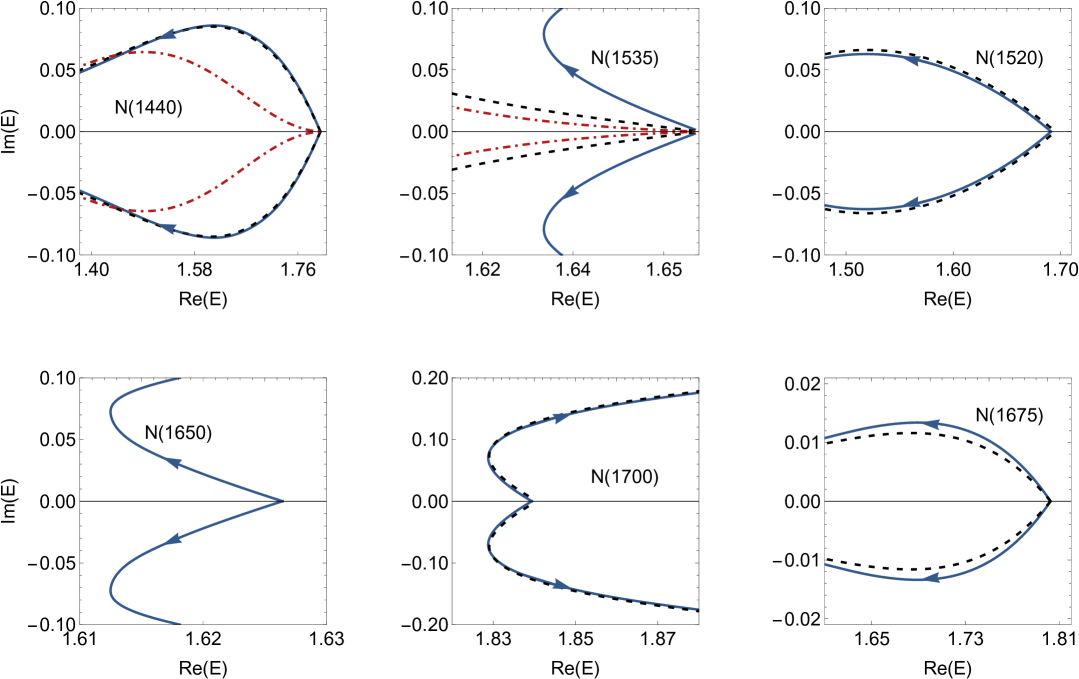
This review combines the Lee-Friedrichs model with coupled-channel dynamics and quark pair creation to investigate the structure of low-lying 1P- and 2S-wave baryon resonances.
The longstanding level-inversion problem in nucleon spectroscopy highlights inconsistencies in predicting the mass ordering of excited states. This is addressed in ‘Understanding the 1P- and 2S-wave nucleon resonances within the extended Lee-Friedrichs Model’, which presents a unified description of low-lying nucleon resonances by extending the Lee-Friedrichs model with coupled-channel dynamics and quark-pair creation. The analysis reveals that incorporating meson-baryon interactions naturally shifts the bare 2S state to match the physical Roper resonance, while simultaneously reproducing the properties of five 1P-wave resonances, suggesting a significant composite structure for these states. Does this framework offer a pathway towards a more complete understanding of hadron structure and the interplay between internal quark degrees of freedom and external hadronic fields?
The Echo of Instability: Probing the Limits of Nuclear Definition
Nucleon resonances, fleeting excited states of protons and neutrons, represent a crucial link in understanding the very fabric of nuclear matter. These resonances aren’t stable particles; they rapidly decay into other particles, making their direct observation exceptionally difficult. Consequently, theoretical predictions of their properties – mass, spin, and how they interact – are paramount, yet stubbornly elusive. The challenge lies in the complex interplay of the strong nuclear force, which governs interactions within the nucleus, and the quantum mechanical nature of these particles. Accurately modeling these resonances isn’t merely an academic exercise; it’s vital for deciphering the behavior of atomic nuclei, the processes powering stars, and even the origins of elements in the universe. Despite decades of research, a complete and consistent description of nucleon resonances remains one of the most significant open problems in nuclear physics, demanding innovative theoretical approaches and increasingly precise experimental investigations.
The foundation of many calculations in nuclear physics rests upon defining a ‘bare state’ – a theoretical snapshot of a nucleon resonance isolated before it interacts and couples with other particles. However, establishing an accurate bare state proves remarkably challenging. This isn’t simply a matter of mathematical precision; the very concept of isolation is an approximation, as nucleons inherently exist within a complex, dynamic environment. Theoretical models must account for the resonance’s propensity to immediately connect to a ‘continuum’ of possible particle arrangements – essentially, all the ways it can decay or scatter. Capturing this coupling – where the resonance isn’t a single, defined entity but a doorway to a multitude of interactions – necessitates advanced theoretical frameworks and computational power, turning what seems like a simple starting point into a considerable hurdle in understanding nuclear forces.
The difficulty in precisely defining nucleon resonances isn’t simply a matter of computational power, but arises from the fundamental way these particles interact. Nucleons, such as protons and neutrons, aren’t isolated entities; they readily couple to a vast ‘continuum’ of states involving multiple particles – meaning an excited nucleon can almost instantaneously decay into a proton and a pion, or even more complex arrangements. Accurately modeling this coupling requires theoretical frameworks that move beyond simple, static pictures and embrace the dynamic, many-body nature of nuclear interactions. These frameworks, often based on integral equations or advanced lattice simulations, must effectively describe how the nucleon ‘mixes’ with these continuum states, a process that dramatically complicates the calculation of its properties and necessitates a holistic understanding of the strong nuclear force. The challenge lies in untangling this complex web of interactions to isolate the ‘bare’ resonance state – a crucial step towards predicting and understanding the behavior of atomic nuclei.
A Framework of Impermanence: The Lee-Friedrichs Solution
The Lee-Friedrichs scheme is a theoretical model that provides an analytically solvable description of resonance behavior. It achieves this by explicitly connecting a set of discrete, isolated energy states – termed ‘bare’ states – to a continuous spectrum of energies representing unbound states. This coupling is mathematically defined, allowing for the precise calculation of resonance parameters without relying on approximations typically required in scattering theory. The framework treats the resonance as a superposition of these bare states interacting with the continuum, enabling the determination of resonant pole positions and the associated decay characteristics. This exact solvability distinguishes it from perturbative approaches and allows for rigorous validation against experimental data.
The Lee-Friedrichs scheme mathematically defines the interaction between an initial quantum state and a continuous energy spectrum by explicitly treating resonance formation as a coupling between discrete ‘bare’ states and the continuum. This allows for a precise determination of resonance poles – singularities in the scattering matrix – and their associated properties, including resonant energy E_R and decay width Γ. The scheme provides a rigorous framework for analyzing the complex-valued pole positions, which directly relate to the lifetime and decay modes of the resonance. Consequently, the scheme avoids ambiguities inherent in defining resonances as peaks in cross-sections and instead defines them as analytic properties of the scattering amplitude.
The Lee-Friedrichs scheme allows for the quantitative determination of resonance parameters through a precise definition of the coupling strength between discrete, ‘bare’ states and the continuous energy spectrum. This methodology successfully predicts the pole positions – representing the complex energy of the resonance – and the associated composition of six well-established low-lying nucleon resonances: N(1535), N(1520), N(1650), N(1700), N(1675), and N(1440). Crucially, the calculated pole positions directly correspond to the resonance mass and width, providing a rigorous framework for understanding the observed spectral features and internal structure of these excited nucleon states.
The Dance of Creation: A Model of Quark Pair Interactions
The quark pair creation model calculates the coupling vertices that define the interaction strength between bare baryons and the meson-baryon continuum, offering a more nuanced description of resonance formation than simpler models. This calculation involves treating the interaction not as a direct exchange of single particles, but as mediated by the creation of quark-antiquark pairs. These virtual pairs act as intermediaries, establishing a coupling strength that directly influences the observed properties of resonances. The resulting coupling vertices are essential parameters in determining resonance energies, widths, and decay modes, allowing for quantitative comparisons with experimental data and refinement of theoretical predictions regarding baryon structure.
The quark pair creation model posits that interactions between baryons are not solely attributable to direct quark exchange, but are significantly mediated by the temporary creation of quark-antiquark pairs from the vacuum. These virtual q\overline{q} pairs act as constituent components of the interaction, effectively screening the bare baryon-baryon interaction and contributing to the overall coupling strength. The creation of these pairs introduces additional degrees of freedom into the interaction, modifying the effective potential and impacting the observed strength of the coupling between the baryons and any resulting resonance states. The contribution to coupling strength is directly related to the probability of q\overline{q} pair creation and subsequent interaction within the system.
The quark pair creation model enhances the precision of resonance property predictions by accounting for interactions that contribute to the internal structure of baryons. Specifically, analysis of the Roper resonance, N(1440), using this model indicates a bare-state fraction of less than 40%. This low fraction signifies that the Roper resonance is predominantly a composite state, formed through strong interactions rather than being a simple excitation of a fundamental bare nucleon. Furthermore, the model predicts a mass shift of approximately 320 MeV for the Roper resonance, attributable to the coupling with the meson-baryon continuum states facilitated by quark-antiquark pair creation.
The Weight of Expectation: Confronting the Mass Inversion Puzzle
The perplexing ‘mass inversion problem’ arises from a consistent discrepancy between theoretical predictions and experimental observations concerning the masses of nucleon resonances – excited states of protons and neutrons. Many established theoretical models, built upon understandings of the strong force governing interactions within the nucleus, predict these resonances should be significantly heavier than what experiments consistently reveal. This isn’t merely a matter of minor adjustments; certain resonances appear demonstrably lighter than anticipated, suggesting a fundamental gap in current theoretical frameworks. The phenomenon implies that the complex interplay of quarks and gluons within nucleons, and how these interactions give rise to mass, isn’t fully captured by existing models, prompting researchers to explore new approaches to understanding the strong force and the very structure of matter.
The persistent mismatch between predicted and experimentally observed nucleon resonance masses indicates a fundamental gap in the current understanding of the strong force. This force, responsible for binding quarks into protons and neutrons, and subsequently holding atomic nuclei together, appears to behave in ways not fully captured by existing theoretical frameworks. The discrepancies aren’t merely quantitative adjustments; they suggest a need to re-evaluate the core mechanisms governing how quarks interact and how these interactions give rise to the mass and properties of composite particles like nucleons. Consequently, physicists are actively pursuing refinements to models of the strong force, exploring phenomena such as dynamical symmetry breaking and the role of multi-quark states, hoping to bridge the gap between theory and experiment and achieve a more complete description of nuclear matter.
The persistent discrepancy between predicted and observed nucleon resonance masses – the ‘mass inversion problem’ – isn’t merely a technical refinement, but a potential key to unlocking deeper truths about the fundamental forces governing matter. Recent modeling efforts demonstrate a capacity to accurately predict the masses of key resonances, notably N(1440) at 1.4 GeV and N(1520) at 1.52 GeV, aligning with experimental data. This success stems from identifying a dynamically generated state pole position at 1.468 GeV, and accurately characterizing the broad width of N(1700), suggesting a more nuanced understanding of strong force interactions. Consequently, resolving this puzzle promises insights extending far beyond nuclear physics, potentially reshaping models of matter under extreme densities – as found in neutron stars – and even informing our understanding of the conditions and evolution of the universe in its earliest moments.
The pursuit of understanding nucleon resonances, as detailed within this work, echoes a fundamental truth about complex systems. Stability, even in theoretical constructs, is a fleeting illusion. The extended Lee-Friedrichs model, coupled with considerations of quark pair creation and coupled-channel dynamics, doesn’t solve the problem of baryon resonances; it reveals the intricate web of interactions that define their evolving nature. As René Descartes observed, “It is not enough to be merely good; one must be good for something.” This research isn’t about finding static solutions, but about mapping the pathways of these resonances-understanding what they become, not merely what they are. Long-lived resonances are merely those where the path to transformation is temporarily obscured.
The Horizon Beckons
The exploration of nucleon resonances, framed within the extended Lee-Friedrichs model, reveals less a path to definitive answers and more a deepening of the questions. Each refinement of the theoretical framework – the inclusion of coupled-channel dynamics, the allowance for quark pair creation – feels less like construction and more like careful tending of a garden, where the most vigorous growth invariably occurs in unexpected directions. The model, as it stands, offers a glimpse of composite nature, but the boundaries of these states remain frustratingly ill-defined – a reminder that simplicity is often a mirage in the landscape of strong interactions.
Future iterations will inevitably confront the limitations of the truncation schemes employed. Every attempt to streamline the infinite complexity of coupled channels is a prophecy of the physics left uncounted. The true test lies not in reproducing existing data, but in predicting the properties of unobserved resonances – states that may prove to be mere shadows or, conversely, herald a new, unforeseen order.
One suspects the ultimate understanding will not be a precise mapping of resonance parameters, but an acceptance of the inherent fluidity of hadron structure. Order is just a temporary cache between failures, and the quest for perfect knowledge may be less about building a complete picture and more about learning to navigate the inevitable decay.
Original article: https://arxiv.org/pdf/2601.21697.pdf
Contact the author: https://www.linkedin.com/in/avetisyan/
See also:
- Best Controller Settings for ARC Raiders
- The Boys Season 5 Officially Ends An Era For Jensen Ackles’ Soldier Boy
- Review: Final Fantasy Tactics: The Ivalice Chronicles (PS5) – Still the Benchmark for Turn-Based Tactics
- Nippon Sangoku Is The Best New Post-Apocalyptic Anime of Spring 2026
- Mark Zuckerberg & Wife Priscilla Chan Make Surprise Debut at Met Gala
- Elon Musk’s Mom Maye Musk Shares Her Parenting Philosophy
- 10 Greatest Manga Endings of All Time
- The Witcher 3 Officially Reveals Stunning New Ciri Figure Coming 2026
- The WONDERfools ending explained: What happened to the Child of Eternity?
- 7 Great Marvel Villains Who Are Currently Dead
2026-02-01 11:14