Author: Denis Avetisyan
A new analysis of nearly a decade of IceCube DeepCore data tightens the constraints on non-standard neutrino interactions within the Earth, shedding light on potential solutions to longstanding discrepancies in neutrino oscillation measurements.
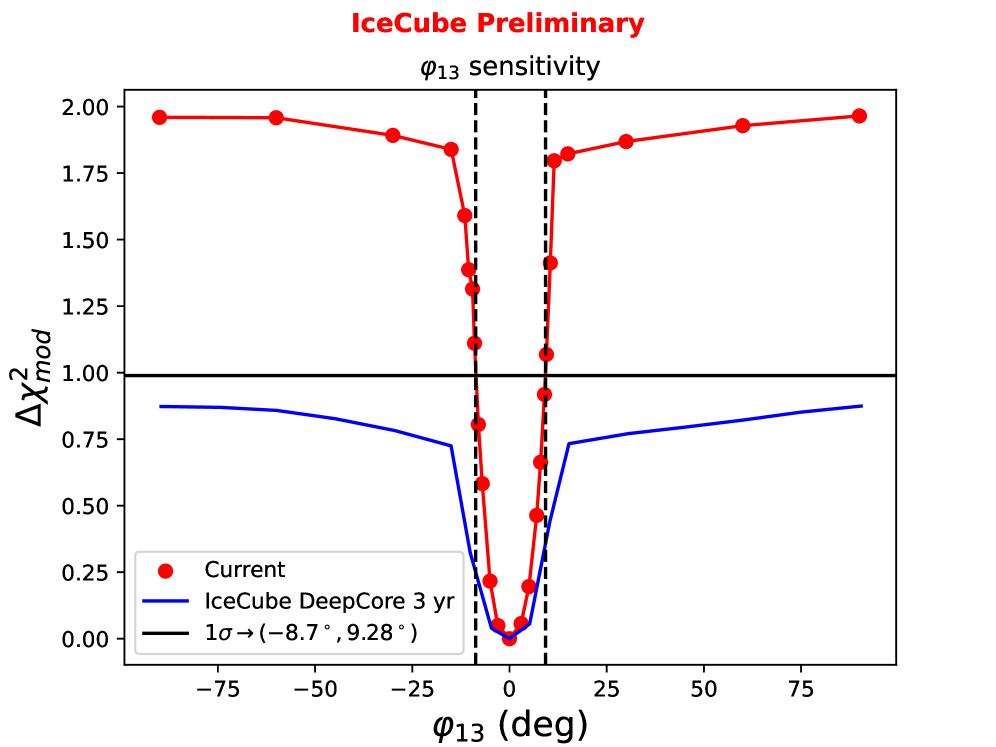
This study presents improved constraints on Non-Standard Interactions using IceCube DeepCore data, achieving 2-3 times greater sensitivity than previous analyses and finding no evidence for NSI resolving the T2K-NOvA δCP tension.
The persistent tension between leading neutrino oscillation experiments, such as T2K and NOvA, hints at potential physics beyond the Standard Model, motivating searches for novel neutrino interactions. This paper, ‘IceCube DeepCore’s sensitivity to Non-Standard neutrino Interactions in the Earth’, investigates the capacity of the IceCube DeepCore detector to constrain Non-Standard Interactions (NSI) within the Earth’s matter, employing a model-independent parameterization. Utilizing 9.28 years of data, the analysis reveals no evidence for NSI resolving the observed \delta_{\text{CP}} discrepancy, while achieving sensitivities 2-3 times greater than previous studies. Could improved constraints on NSI from IceCube DeepCore, combined with future data from other experiments, ultimately illuminate the underlying cause of this persistent oscillation anomaly?
The Standard Model’s Echo: Seeking Resonance Beyond Current Limits
Despite its remarkable predictive power and consistent validation through experiments like those at the Large Hadron Collider, the Standard Model of particle physics remains incomplete. Fundamental observations simply cannot be explained within its current framework; notably, the model predicts that neutrinos should be massless, yet experiments demonstrate they possess a small, but non-zero, mass. Furthermore, the Standard Model accounts for only about 5% of the universe’s energy density, leaving the vast majority – roughly 27% – attributed to the enigmatic dark matter. This unseen substance interacts gravitationally but remains undetectable through conventional means, suggesting physics beyond the Standard Model is required to fully understand the composition and behavior of the cosmos. The search for solutions to these discrepancies – neutrino mass and the nature of dark matter – drives much of the ongoing research in particle physics, prompting investigations into new particles, forces, and theoretical frameworks.
Understanding the precise values of neutrino oscillation parameters, particularly the \delta_{CP} phase, represents a pivotal pursuit in modern particle physics. This phase governs charge-parity (CP) violation in the lepton sector, a crucial ingredient for explaining the observed matter-antimatter asymmetry in the universe-a puzzle the Standard Model cannot fully resolve. Deviations from the Standard Model’s predictions for \delta_{CP} would signal the presence of new physics, potentially revealing undiscovered particles or interactions. Therefore, experiments meticulously measure neutrino oscillation frequencies to constrain this phase and other parameters, searching for subtle discrepancies that could unlock a more complete understanding of the fundamental building blocks of reality and the forces that govern them. The precision with which this phase is known directly impacts the ability to validate or refute extensions to the Standard Model, making it a central focus of ongoing and future neutrino research.
Existing long-baseline neutrino experiments, including T2K and NOvA, are actively investigating fundamental neutrino properties, yet limitations in statistical power and the presence of subtle discrepancies demand innovative investigative techniques. Recent analysis of 9.28 years of data collected by the IceCube DeepCore detector represents a substantial advancement in this pursuit. This extended dataset has enabled a significant enhancement in the sensitivity to Non-Standard Interaction (NSI) parameters-those that signal physics beyond the Standard Model-achieving an improvement of a factor of 2-3 over previous analyses based on only 3 years of data. This increased precision allows for a more thorough examination of potential deviations from established neutrino behavior and opens new avenues for uncovering the elusive nature of these fundamental particles.

Beyond the Standard Interactions: A New Framework for Neutrino Behavior
Non-Standard Interactions (NSI) propose modifications to the Standard Model by introducing new forces that directly couple neutrinos to quarks and leptons. Unlike Standard Model interactions which proceed via the exchange of W and Z bosons, NSI postulate direct interactions, potentially altering neutrino propagation through matter. These interactions are characterized by effective couplings, independent of the underlying new physics model, and are parameterized to quantify the strength and form of these new forces. The inclusion of NSI modifies the standard neutrino oscillation framework, impacting both oscillation probabilities and energy spectra, and offering a potential explanation for anomalies observed in neutrino experiments that cannot be accommodated within the Standard Model.
Non-Standard Interactions (NSI) are quantified using effective field theory, resulting in parameters that describe the strength of new interactions between neutrinos and Standard Model fermions. These parameters are typically expressed as ε_{αβ}, where α and β denote the flavor of the interacting neutrinos and quarks. Commonly investigated couplings include ε_{eμ} and ε_{eτ}, representing interactions between electron neutrinos and muon/tau leptons, respectively. These parameters are model-independent, meaning they don’t rely on a specific underlying new physics model, and characterize the deviation from Standard Model neutrino-matter interactions within the Hamiltonian formalism. Constraints on these parameters are derived from neutrino oscillation experiments and provide insights into potential new physics beyond the Standard Model.
A comprehensive understanding of Non-Standard Interactions (NSI) necessitates a theoretical framework built upon the Matter Hamiltonian, which describes neutrino propagation through matter and incorporates potential new interactions. This Hamiltonian, when combined with the Pontecorvo-Maki-Nakagawa-Sakata (PMNS) matrix – representing the mixing of neutrino flavors – allows for the calculation of neutrino oscillation probabilities in the presence of NSI. The PMNS matrix, U_{PMNS}, transforms flavor eigenstates into mass eigenstates, and any modification to these mixing parameters due to NSI significantly alters the observed oscillation patterns. Consequently, precise determination of NSI effects relies on accurately modeling neutrino propagation within the Matter Hamiltonian and a thorough understanding of the parameters defining the PMNS matrix.
Analysis of Non-Standard Interactions (NSI) provides constraints on parameters beyond the Standard Model, specifically those governing neutrino interactions with matter. Current results place leading 1σ constraints on the ε parameter, indicating a value between 0.36 and 2.64 for neutrinos assuming a Normal Mass Ordering. Conversely, for neutrinos exhibiting an Inverted Mass Ordering, the 1σ constraint on ε falls within the range of -1.67 to -0.39. These ranges represent statistically derived limits based on observational data and theoretical modeling of neutrino propagation and interaction probabilities.
IceCube-DeepCore: Probing NSI with Atmospheric Neutrinos
IceCube-DeepCore is a cubic-kilometer neutrino detector located at the South Pole, designed to detect high-energy neutrinos. Atmospheric neutrinos, created when cosmic rays interact with Earth’s atmosphere, constitute a significant component of the neutrino flux reaching the detector. These neutrinos are produced through both hadronic and leptonic decay processes, resulting in all three neutrino flavors – electron, muon, and tau neutrinos. The high energy range, extending to several TeV, allows for detailed studies of neutrino oscillation parameters and potential new physics beyond the Standard Model. The detector’s instrumentation, consisting of digital optical modules (DOMs) embedded in ice, captures the Cherenkov radiation emitted by charged particles produced in neutrino interactions, enabling reconstruction of the neutrino’s energy and direction of origin.
Analysis of atmospheric neutrino energy and zenith angle distributions provides a method for detecting Non-Standard Interactions (NSI). Standard neutrino oscillation models predict specific patterns in these distributions based on known mixing parameters. Deviations from these predictions, particularly alterations in oscillation probability as a function of zenith angle – reflecting path length through the Earth – can indicate NSI. The sensitivity of this approach relies on the Earth matter effect, which modifies neutrino oscillation probabilities, and NSI can mimic or enhance these modifications. Therefore, precise measurements of these distributions allow for statistical tests to determine if observed oscillation patterns are consistent with standard oscillations or require the inclusion of NSI parameters.
Hadronic cascades, initiated by charged current interactions of neutrinos within the IceCube detector, provide a primary method for reconstructing neutrino events. These cascades manifest as a diffuse Cherenkov light signal, the characteristics of which-specifically, the amplitude, duration, and spatial distribution-are used to estimate the energy and interaction vertex of the initiating neutrino. The sensitivity to Non-Standard Interactions (NSI) arises because NSI can modify the cross-section for these charged current interactions, altering both the rate and the observable characteristics of the hadronic cascade. Precise measurement of these cascade properties, combined with statistical analysis of a large neutrino sample, allows for constraints to be placed on the strength and type of potential NSI parameters, effectively probing physics beyond the Standard Model.
Accurate determination of neutrino Non-Standard Interaction (NSI) parameters relies heavily on precise neutrino energy reconstruction and sufficient event statistics. Analysis of atmospheric neutrino data collected by IceCube-DeepCore has yielded constraints on the φ_{12} and φ_{13} NSI parameters. Specifically, the φ_{12} parameter is constrained to the range of (-4.15°, 4.72°) and φ_{13} to (-8.7°, 9.28°) at the 1σ confidence level. These limits are derived from statistical analysis of observed neutrino events, accounting for systematic uncertainties in energy estimation and detector response.
Statistical Rigor and the Path Forward: Echoes of New Physics
The search for Non-Standard Interactions (NSIs) in the neutrino sector necessitates the development of robust statistical methods to discern subtle signals amidst considerable background noise. Atmospheric neutrino data, while abundant, presents a complex landscape requiring techniques sensitive enough to isolate potential NSI signatures. Researchers employ the Modified Chi-Squared (χ²mod) test statistic, a powerful tool designed to account for the intricacies of neutrino propagation and detection. This method goes beyond traditional chi-squared analysis by incorporating features that address low-statistics scenarios and the influence of systematic uncertainties, crucial when probing beyond the Standard Model. By carefully calibrating the \chi^2_{mod} statistic and applying it to observed neutrino events, scientists can establish the statistical significance of any deviations from expected behavior, paving the way for potential discoveries in neutrino physics and a deeper understanding of fundamental interactions.
The pursuit of precise neutrino interaction physics necessitates a robust approach to handling both the inherent limitations of data collection – finite statistics – and the unavoidable imperfections in experimental measurement, termed systematic uncertainties. To address these challenges, researchers rely heavily on extensive Monte Carlo simulations. These simulations generate vast numbers of hypothetical events, mirroring the experimental conditions but built upon theoretical models. By meticulously comparing the simulated results with observed data, scientists can quantify the impact of statistical fluctuations and systematically assess the influence of various uncertainties. This process allows for a rigorous determination of neutrino properties, refining theoretical predictions, and ultimately bolstering the reliability of experimental findings in the challenging field of neutrino physics. The accuracy of these simulations is paramount, requiring careful validation and continuous refinement to ensure the resulting conclusions are statistically sound and free from biases.
The pursuit of a comprehensive understanding of neutrino interactions necessitates a synergistic approach, combining data from diverse sources. Analyses leveraging IceCube-DeepCore, a high-energy neutrino observatory embedded in Antarctic ice, are significantly enhanced when paired with results from long-baseline neutrino experiments. This combined methodology allows researchers to place stringent constraints on Non-Standard Interaction (NSI) parameters – deviations from the predictions of the Standard Model – and rigorously assess their potential influence on fundamental neutrino properties. By comparing observations across these distinct experimental setups, scientists can effectively disentangle genuine NSI signals from systematic uncertainties, ultimately refining models of neutrino oscillation and probing the potential connections between neutrino physics, the origin of neutrino masses, and the enigmatic nature of dark matter.
Recent analyses combining IceCube-DeepCore data with findings from long-baseline experiments are beginning to illuminate the fundamental origins of neutrino mass and potentially reveal connections to the elusive nature of dark matter. These investigations focus on Non-Standard Interactions (NSIs), deviations from the predicted behavior of neutrinos that could indicate new physics beyond the Standard Model. Statistical rigor applied to these combined datasets has allowed researchers to place increasingly stringent constraints on NSI parameters; notably, the analyses currently rule out the best-fit values for the εeμ parameter at a 2.13σ level and the εeτ parameter at a compelling 4.15σ, establishing 2σ upper limits of |εeμ| < 0.11 and |εeτ| < 0.175. These results not only refine the search for new physics but also highlight the power of combining diverse datasets in the quest to understand the universe’s most enigmatic particles.
The pursuit of increasingly precise measurements, as demonstrated by the IceCube DeepCore analysis, echoes a fundamental principle of all systems: their eventual revelation of underlying truths through accumulated data. This study, achieving sensitivities two to three times greater than previous analyses in the search for Non-Standard Interactions, exemplifies a graceful aging of methodology. It is a dialogue with the past, refining existing frameworks rather than demanding wholesale replacement. As John Locke observed, “All mankind… being all equal and independent, no one ought to harm another in his life, health, liberty, or possessions.” This echoes in the scientific endeavor-a careful, respectful probing of natural laws, seeking not to dominate, but to understand the inherent properties of existence, even those as elusive as neutrino interactions.
The Long View
The pursuit of neutrino properties, as evidenced by this analysis of IceCube DeepCore data, invariably runs into the limits of observation. Improved sensitivity to Non-Standard Interactions, while valuable, does not resolve the underlying discord-the delta_CP tension-suggesting that the problem may not lie solely within the parameters readily probed. Systems learn to age gracefully; perhaps the resolution isn’t a dramatic shift in understanding, but an acceptance of inherent ambiguity.
Future iterations will undoubtedly refine the search, pushing the boundaries of what is detectable. Yet, a crucial question remains: at what point does the marginal gain from increased sensitivity diminish against the complexities of modeling the Earth’s matter Hamiltonian? The challenge isn’t merely to ‘see’ further, but to accurately interpret what is observed within a system inherently resistant to perfect knowledge.
Sometimes observing the process-the subtle interplay of statistical fluctuations and systematic uncertainties-is better than trying to speed it up. The value of this work may ultimately reside not in a definitive answer, but in the increasingly precise map of the questions that remain, a testament to the enduring mysteries embedded within the fabric of reality.
Original article: https://arxiv.org/pdf/2601.22374.pdf
Contact the author: https://www.linkedin.com/in/avetisyan/
See also:
- What Song Is In The New Supergirl Trailer (& What It Means For The DC Movie)
- Why is Tech Jacket gender-swapped in Invincible season 4 and who voices her?
- Highly Anticipated Strategy RPG Finally Sets Release Date (And It’s Soon)
- TV legend Carol Kirkwood reveals the reasons why she decided to retire after 28 years with BBC
- Dune 3 Gets the Huge Update Fans Have Been Waiting For
- Palworld! More Than Just Pals ‘Special Video’, characters detailed
- Supergirl Director Breaks Down Kara Zor-El & Superman’s ‘Older-Sibling Dynamic’
- Dragon Ball: Sparking! Zero Is Still Stupidly Popular, Reels in 1 Million Monthly Players
- Jaleco Sports: Bases Loaded II announced for PS5, Switch; now available
- Digimon Is Getting a New RPG in 2026 (And You Probably Missed It)
2026-02-03 00:20