Author: Denis Avetisyan
A new era of gravitational wave astronomy is dawning, focusing on the elusive signals at deci-Hz frequencies and the innovative technologies needed to detect them.
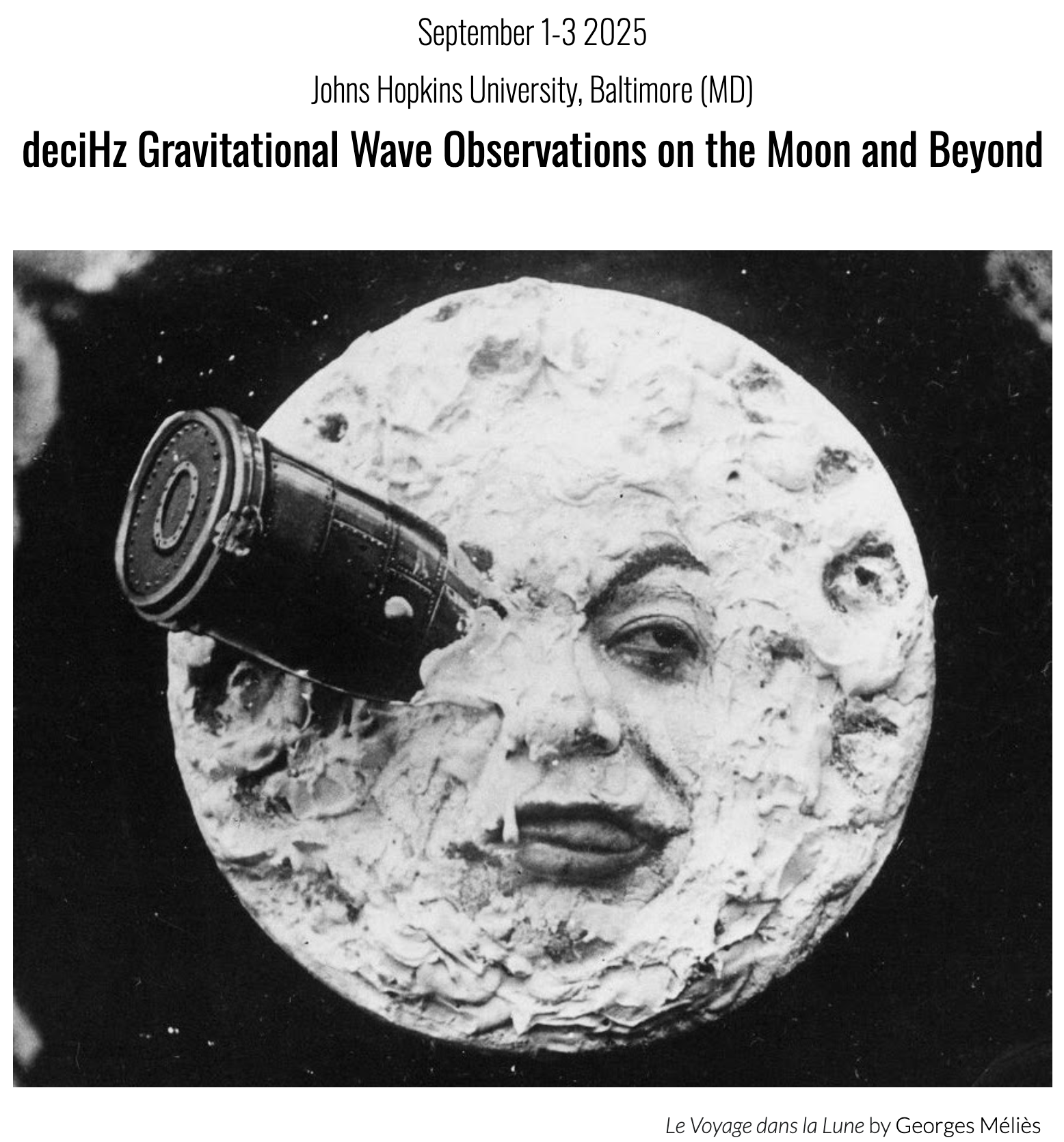
This review summarizes recent progress and future challenges in detecting low-frequency gravitational waves from space-based and lunar observatories, potentially unlocking new insights into compact binaries and the early universe.
Despite the successes of current gravitational wave detectors, a significant portion of the gravitational wave spectrum, particularly in the deci-Hz band, remains largely unexplored. This document summarizes discussions from the workshop ‘deci-Hz Gravitational Wave Observations on the Moon and Beyond’, which focused on innovative approaches to observing this crucial frequency range. Proposals ranged from lunar-based detectors and space-borne laser interferometers to atom interferometry, all aimed at characterizing sources like compact binary systems and potentially even primordial gravitational waves. Could these next-generation observatories unlock a new era of multi-messenger astronomy and reveal fundamental insights into the universe’s earliest moments?
Unveiling the Low-Frequency Cosmos
Existing gravitational wave observatories, like LIGO and Virgo, excel at detecting ripples in spacetime generated by relatively high-frequency events – the collision of stellar-mass black holes and neutron stars. However, a significant portion of the gravitational wave spectrum remains largely unexplored; the low-frequency regime, below 10 Hertz, is a frontier ripe with potential discoveries. This limitation isn’t a matter of technological inability, but rather a consequence of detector design – current instruments are most sensitive to the higher-pitched signals. Consequently, phenomena generating these lower frequencies, such as the merging of supermassive black holes at the centers of galaxies and the subtle echoes of the universe’s inflationary epoch, remain obscured, representing a substantial gap in humanity’s understanding of the cosmos. Addressing this necessitates the development of new detection methods and observatories specifically tailored to capture these elusive, low-frequency gravitational waves.
The universe emits a subtle chorus of gravitational waves, but current detectors primarily capture the high-pitched notes, obscuring a wealth of information residing in the low-frequency range. This ‘low-frequency universe’ is theorized to contain crucial evidence regarding the most energetic events in the cosmos, notably the mergers of supermassive black holes – behemoths millions to billions of times the mass of our sun. Capturing these faint signals, and discerning the universe’s stochastic gravitational wave background – a relic whisper from the earliest moments after the Big Bang – demands unprecedented sensitivity. Scientists are striving for a target sensitivity of 10^{-{24}}/\sqrt{Hz}, a threshold that would allow the detection of these individual binary systems and the subtle fluctuations of the background, ultimately revealing details about the formation and evolution of galaxies and the very fabric of spacetime.
The pursuit of low-frequency gravitational waves necessitates a departure from existing detection methods and a new wave of observatories. Current ground-based instruments, like LIGO and Virgo, are limited by terrestrial noise at frequencies below 10 Hz, hindering their ability to observe crucial events. To overcome this, researchers are developing innovative technologies, including space-based detectors such as LISA, designed to operate free from Earth’s vibrations. Simultaneously, projects are underway to utilize pulsar timing arrays – leveraging the precise radio signals from rapidly rotating neutron stars – as galactic-scale gravitational wave detectors. These complementary approaches, bridging the gap between terrestrial sensitivity and the vastness of space, promise to unlock a new window onto the universe, revealing the dynamics of supermassive black hole systems and potentially, the faint echoes of the Big Bang itself.
The universe’s infancy, a period of rapid expansion known as inflation, is theorized to have generated a faint, pervasive ripple in spacetime – the stochastic gravitational wave background. This relic, unlike the distinct signals from individual black hole mergers, represents a superposition of gravitational waves from countless primordial events, effectively a fossilized echo of the Big Bang. Currently largely uncharacterized, detecting this background requires extraordinary sensitivity in gravitational wave observatories. Its successful measurement promises a revolutionary shift in cosmological understanding, offering a unique probe of physics at energy scales inaccessible to particle colliders and potentially validating or refining models of inflation, the very beginning of time, and the conditions that birthed the cosmos. The characteristics of this background – its amplitude and spectral shape – would reveal fundamental details about the universe less than a second after its creation.
A Multi-Pronged Approach to Next-Generation Observatories
The Gravitational Wave International Committee (GWIC) coordinates the global effort to advance gravitational wave detection beyond current capabilities. This includes facilitating international partnerships for the design, development, and deployment of next-generation ground-based detectors – such as the Einstein Telescope and Cosmic Explorer – and space-based observatories like the Laser Interferometer Space Antenna (LISA). GWIC’s role extends to defining technical standards, sharing data and analysis techniques, and coordinating observing schedules to maximize scientific output. The committee also addresses the logistical and financial challenges inherent in these large-scale, multi-national projects, ensuring effective resource allocation and collaboration among participating institutions and countries.
The Laser Interferometer Space Antenna (LISA) is critical to the development of the Decihertz Interferometric Gravitational wave Observatory (DECIGO) as it serves as a technology demonstrator for key components and operational concepts. Specifically, LISA validates the feasibility of drag-free satellite control, precision laser metrology over millions of kilometers, and data analysis techniques required to isolate gravitational wave signals from noise. These technologies are directly scalable to the more demanding requirements of DECIGO, which aims to detect lower frequency gravitational waves than LISA, necessitating a larger baseline and increased sensitivity. Successful operation of LISA will de-risk significant technical challenges associated with DECIGO, paving the way for a more efficient and focused development process for the ambitious project.
Lunar-based gravitational wave observatories, exemplified by the Lunar Gravitational-Wave Antenna (LGWA), are designed to detect low-frequency gravitational waves inaccessible to ground-based detectors. The Moon offers a seismically quiet environment, significantly reducing noise interference compared to Earth. Achieving the necessary sensitivity requires a large baseline – several kilometers – for the interferometer arms. This scale is crucial for detecting the subtle spacetime distortions caused by low-frequency sources. LGWA’s location and scale are intended to complement existing and planned detectors, expanding the observable gravitational wave spectrum and providing unique insights into astrophysical phenomena.
The success of the Lunar Gravitational-Wave Antenna (LGWA) is contingent upon a thorough understanding of lunar seismic activity to effectively minimize noise interference. LGWA’s sensitivity, designed for low-frequency gravitational wave detection, is particularly vulnerable to vibrations originating from moonquakes and other lunar seismic events. Detailed characterization of these events – their frequency, amplitude, and spatial distribution – is crucial for developing noise mitigation strategies and optimizing data analysis pipelines. Current projections, based on anticipated sensitivity levels following noise reduction, estimate that LGWA could detect between 1 and 10 gravitational wave events per year originating from sources within a 50 Megaparsec radius.
Multi-Messenger Astronomy: Connecting Waves to Light
Multi-messenger astronomy integrates data from gravitational waves and electromagnetic radiation – including gamma rays, X-rays, optical light, and radio waves – to provide a more comprehensive understanding of astrophysical phenomena. Traditionally, astronomy relied almost exclusively on electromagnetic observations, offering limited information about certain events and often requiring inferences about underlying physical processes. Gravitational waves, ripples in spacetime, provide a complementary signal directly related to the acceleration of massive objects, offering insights into strong-field gravity and the dynamics of cataclysmic events. Combining these distinct data streams allows for cross-validation of models, improved source localization, and the ability to probe aspects of cosmic events inaccessible through single-messenger observations, such as the equation of state of neutron stars or the mechanisms driving short-duration gamma-ray bursts.
Binary Neutron Star Mergers (BNSMergers) are particularly valuable for multi-messenger astronomy due to the distinct signals they generate. These events produce detectable gravitational waves during the inspiral, merger, and post-merger phases, allowing for initial detection and source localization. Simultaneously, the radioactive decay of the heavy elements synthesized during the merger – a process known as a kilonova – emits electromagnetic radiation across the spectrum, from ultraviolet and optical wavelengths to infrared and potentially even radio waves. The coincident detection of both gravitational waves and electromagnetic counterparts from a BNSMerger – as first observed with GW170817 – provides a wealth of information about the merger process, the equation of state of neutron star matter, and the origin of heavy elements like gold and platinum through the r-process.
Precise localization of gravitational wave events is essential for effective follow-up observations across the electromagnetic spectrum. Gravitational wave detectors provide initial estimations of event location, but these typically have large uncertainties – often covering thousands of square degrees. Techniques like GWPrelocalization refine these estimations by analyzing the gravitational wave signal and incorporating detector network geometry, reducing the potential search area for electromagnetic counterparts. This reduction in uncertainty is critical because electromagnetic telescopes have limited fields of view and finite observing time; without accurate gravitational wave localization, identifying the source of the signal in optical, radio, or X-ray wavelengths becomes significantly more difficult or impossible. The speed of this localization is also vital, enabling prompt targeting of transient events like kilonovae before they fade from visibility.
Beyond binary neutron star mergers, the principles of multi-messenger astronomy are applicable to a wider range of high-energy astrophysical events. Tidal Disruption Events (TDEs), where a star is torn apart by a supermassive black hole, are predicted to emit both gravitational waves and electromagnetic radiation, though detection remains challenging. Similarly, the study of Intermediate-Mass Black Hole Mergers (IMBHMergers) – black holes with masses between 100 and 100,000 solar masses – benefits from a multi-messenger approach. Detecting gravitational waves from these mergers, coupled with potential electromagnetic counterparts, can provide crucial data for determining their masses, spins, and merger rates, filling a significant gap in our understanding of black hole populations and their evolution.
Probing the Cosmos: From Early Universe to Exotic Sources
The universe’s earliest moments remain shrouded in mystery, but the detection of a gravitational wave background offers a potential glimpse into this epoch. This faint, persistent hum of gravitational waves, a relic of the Big Bang, carries information about the universe when it was a fraction of a second old – a time when rapid expansion known as cosmic inflation may have occurred. Analyzing the statistical properties of this background could reveal evidence supporting or refuting inflationary models, and even pinpoint the energy scale at which inflation happened. Furthermore, the gravitational wave background is predicted to contain signals from phase transitions – dramatic shifts in the fundamental forces of nature – that occurred in the early universe, providing a unique probe of physics beyond the Standard Model. By meticulously characterizing this background, scientists hope to peel back the layers of cosmic history and unlock the secrets of the universe’s birth.
Gravitational wave observations are poised to significantly refine cosmological parameters, offering a new avenue to understand the universe’s evolution. By precisely measuring the distances to, and properties of, gravitational wave sources – such as binary black hole mergers – astronomers can independently determine the Hubble constant, a key value describing the universe’s expansion rate. Current measurements of the Hubble constant, derived from different methods, exhibit a persistent tension, and gravitational wave data promises a resolution. Furthermore, analyses of gravitational wave events can constrain the matter density of the universe and the equation of state of dark energy, providing tighter bounds on \Omega_m and w respectively. This enhanced precision will not only test the standard ΛCDM cosmological model but also potentially reveal evidence for new physics beyond it, deepening our comprehension of the cosmos’ past, present, and future.
The observation of merging double white dwarf systems is poised to illuminate the origins of Type Ia supernovae, powerful cosmic events crucial for measuring distances in the universe. Current models suggest these supernovae arise from the thermonuclear explosion of a carbon-oxygen white dwarf that accretes material from a companion star, but the precise nature of that companion remains debated. Detailed study of double white dwarf mergers-systems where two white dwarfs spiral inward and coalesce-provides a direct analogue to the final stages of this accretion process. By analyzing the gravitational waves emitted during these mergers and the resulting electromagnetic signatures, astronomers can test different progenitor scenarios and constrain the mass and composition of the merging stars. This research will refine supernova models, improve the accuracy of cosmological distance measurements, and ultimately provide a clearer understanding of the lifecycle of stellar remnants and their role in shaping the universe.
A new epoch in astronomy is dawning, fueled by advancements in gravitational wave detection capable of characterizing binary systems with unprecedented accuracy. Future observations aim for a precision of δh < 10^{-5} in mass measurements, a level of detail that will fundamentally reshape astrophysical understanding. This enhanced capability allows for rigorous tests of general relativity in extreme gravity regimes, detailed mapping of stellar populations through binary evolution studies, and precise determination of cosmological distances independent of traditional methods. Ultimately, this leap in precision promises not only to confirm existing theories but also to unveil previously hidden phenomena and refine the standard cosmological model, offering a deeper and more nuanced view of the universe’s structure and history.
The workshop detailed in this paper emphasizes a cyclical approach to understanding the universe, mirroring the scientific method. Researchers propose detector concepts-lunar observatories and space-based interferometers-then analyze feasibility and potential data yields, informing subsequent iterations of design. This mirrors a process of continuous observation and refinement. As Simone de Beauvoir stated, “One is not born, but rather becomes, a woman.” Similarly, our understanding of the cosmos isn’t a fixed state, but a becoming-shaped by persistent investigation and evolving technologies capable of detecting phenomena like deci-Hz gravitational waves and unlocking insights into compact binaries and even primordial gravitational waves. The pursuit of multi-messenger astronomy, highlighted in the paper, necessitates this constant state of becoming, adapting interpretation as new signals are observed.
What Lies Ahead?
The workshop detailed within these pages reveals a clear ambition: to extend the reach of gravitational wave astronomy into the deci-Hz regime. While technological hurdles remain substantial – the sheer scale of space-based detectors, the demanding precision of lunar observatories – the potential rewards are commensurately large. A truly comprehensive multi-messenger picture demands sensitivity across the entire spectrum, and the deci-Hz band promises access to compact binary systems currently hidden from view, and perhaps even the faintest echoes of the universe’s inflationary epoch.
However, the proliferation of proposed detector concepts also introduces a critical need for rigorous comparative analysis. Theoretical predictions, while compelling, require constant refinement against increasingly precise observational constraints. The identification of definitive signals will necessitate sophisticated data analysis techniques capable of disentangling astrophysical sources from instrumental noise, and separating genuine detections from statistical flukes.
Ultimately, the field’s progression hinges on a simple principle: if a pattern cannot be reproduced or explained, it doesn’t exist. The pursuit of deci-Hz gravitational waves is not merely an exercise in technological advancement, but a testament to the enduring human quest to understand the fundamental laws governing the cosmos.
Original article: https://arxiv.org/pdf/2602.05923.pdf
Contact the author: https://www.linkedin.com/in/avetisyan/
See also:
- The Super Mario Galaxy Movie: 50 Easter Eggs, References & Major Cameos Explained
- Surprise Isekai Anime Confirms Season 2 With New Crunchyroll Streaming Release
- 10 Best Free Games on Steam in 2026, Ranked
- Sydney Sweeney’s The Housemaid 2 Sets Streaming Release Date
- Skate 4 – Manny Go Round Goals Guide | All of the Above Sequence
- Preview: Sword Art Online Returns to PS5 as a Darker Open World Action RPG This Summer
- Welcome to Demon School! Iruma-kun season 4 release schedule: When are new episodes on Crunchyroll?
- Why is Tech Jacket gender-swapped in Invincible season 4 and who voices her?
- PS5’s Ace Combat 8 Will Be the Most Ambitious Game in the Series Yet, and We Can’t Wait
- Dune 3 Gets the Huge Update Fans Have Been Waiting For
2026-02-08 01:23