Author: Denis Avetisyan
Researchers explore how the High-Luminosity Large Hadron Collider can reveal evidence for extended Higgs sectors beyond the Standard Model.
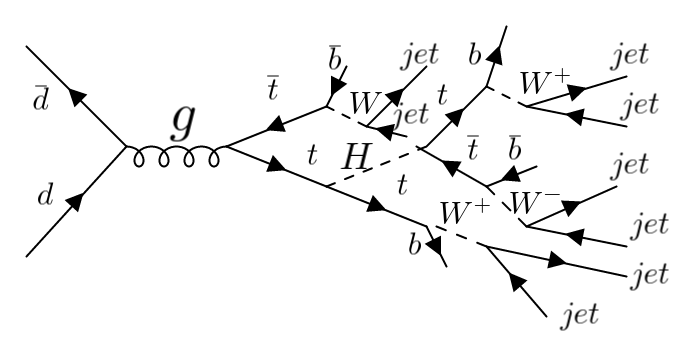
This review details a search for multi-top quark production arising from Higgs pair decays in the Two Higgs Doublet Model Type-I, demonstrating the potential for discovery with future LHC data.
The Standard Model, despite its successes, leaves open the possibility of extended Higgs sectors that could address fundamental questions in particle physics. This study, ‘Probing Extended Higgs Sectors via Multi-Top Events from Higgs Pair Decays in 2HDM Type-I at the HL-LHC’, investigates the potential of the High-Luminosity LHC to discover or constrain such extensions via the observation of multi-top quark final states arising from Higgs pair production within the Two Higgs Doublet Model (2HDM) Type-I. Simulations demonstrate that, with sufficient integrated luminosity, several production channels-including pp \to t\bar{t}H and pp \to HH^{\pm}-can exceed the 5\sigma discovery threshold. Will these high-multiplicity final states provide a definitive window into physics beyond the Standard Model, and what precise parameter space of the 2HDM can be effectively probed with the HL-LHC?
Beyond the Known: Probing the Boundaries of Particle Physics
Despite its extraordinary predictive power, the Standard Model of particle physics remains incomplete, leaving several fundamental questions unanswered about the universe. Phenomena like dark matter, dark energy, and the observed matter-antimatter asymmetry cannot be explained within its framework. Furthermore, the model offers no insight into the origin of neutrino masses or the hierarchy problem – the vast discrepancy between the weak force and gravity. These limitations motivate the development of Beyond Standard Model (BSM) theories, which aim to extend the Standard Model with new particles and interactions. Researchers are actively pursuing various BSM scenarios, hoping to uncover new physics that can address these outstanding puzzles and provide a more complete understanding of the fundamental laws governing reality. This quest for new physics drives experimental efforts at particle colliders and underground detectors, searching for deviations from Standard Model predictions and evidence of previously unknown particles and forces.
The Two Higgs Doublet Model (2HDM) represents a significant departure from the established Standard Model by proposing not one, but two fundamental scalar fields with weak isospin, effectively doubling the Higgs sector. This extension isn’t merely a mathematical exercise; it naturally predicts the existence of additional Higgs bosons beyond the single particle discovered in 2012. These new particles, including charged Higgs bosons H^{\pm}, neutral scalars H, A, and a second neutral CP-even scalar, offer potential explanations for phenomena the Standard Model cannot address, such as the observed matter-antimatter asymmetry in the universe and the nature of dark matter. Crucially, the properties of these additional Higgs bosons – their masses, decay modes, and coupling strengths – would serve as a unique fingerprint, allowing physicists to differentiate between various 2HDM scenarios and ultimately validate or refute this compelling extension of the Standard Model.
The extension of the Higgs sector, as proposed in models beyond the Standard Model, dramatically alters the landscape of potential particle interactions and offers compelling avenues for resolving long-standing puzzles. A single Higgs boson, while sufficient to explain current observations, struggles to account for phenomena like the observed mass of neutrinos or the matter-antimatter asymmetry in the universe. Introducing additional Higgs bosons-particles mediating the same fundamental force but with different properties-creates a more versatile framework capable of accommodating these complexities. This richer phenomenology manifests in altered decay patterns of known particles, the potential for new decay channels, and the possibility of direct detection of these additional bosons at high-energy colliders. Consequently, investigating these expanded Higgs sectors isn’t merely an exercise in theoretical refinement; it represents a crucial step towards a more complete and accurate understanding of the universe’s fundamental building blocks and the forces governing their behavior.
The search for physics beyond the Standard Model heavily relies on characterizing potential new particles, and among these, the Charged Higgs boson stands out as a key indicator. Unlike the neutral Higgs boson discovered in 2012, a Charged Higgs carries an electric charge and doesn’t decay into photons directly, presenting unique detection challenges and opportunities. Precise measurements of its mass, coupling strengths to other particles – particularly fermions like top and bottom quarks – and decay modes could definitively confirm or refute models like the Two Higgs Doublet Model. These properties aren’t just theoretical curiosities; they directly address shortcomings of the Standard Model, such as the origin of neutrino mass and the matter-antimatter asymmetry in the universe. Consequently, experiments at the Large Hadron Collider and future colliders are meticulously designed to probe the existence and characteristics of the Charged Higgs, seeking subtle deviations from Standard Model predictions that would signal the dawn of a new era in particle physics.
Simulating Reality: The Power of Monte Carlo Techniques
The High-Luminosity LHC is designed to increase the collision rate and thus the volume of data collected, necessitating reliance on Monte Carlo simulation to interpret experimental results. These simulations are crucial because directly calculating the outcomes of particle interactions at the LHC is computationally intractable due to the complexity of quantum chromodynamics and the Standard Model. Monte Carlo methods allow physicists to generate a large number of simulated events, statistically representing the expected particle interactions and providing a basis for comparison with observed data. The sheer scale of data production – on the order of petabytes per year – makes complete analytical calculation impossible, rendering these simulations indispensable for event reconstruction, particle identification, and ultimately, the search for new physics beyond the Standard Model.
MadGraph5_aMC@NLO and Pythia 8 constitute a standard simulation chain employed in high-energy physics to model particle interactions. MadGraph5_aMC@NLO generates hard-scattering events, calculating the probabilities of initial particle collisions and the resulting outgoing particles at leading order and next-to-leading order precision, utilizing the Standard Model and beyond-the-Standard-Model physics. The output of MadGraph5_aMC@NLO, representing the hard process, is then passed to Pythia 8, which simulates the subsequent evolution of the event, including parton showering, hadronization, and the modeling of underlying event activity. This combination is frequently used to simulate complex final states, such as those containing multiple top quarks, allowing for the estimation of signal and background contributions in LHC analyses.
Accurate prediction of signal rates and background event counts is fundamental to high-energy physics data analysis at experiments like the LHC. Signal rates represent the expected number of events arising from hypothesized new physics processes, while background events comprise those produced by known Standard Model interactions. Monte Carlo simulations, utilizing programs like MadGraph5_aMC@NLO and Pythia 8, allow physicists to model these processes and estimate their respective contributions. By precisely characterizing both signal and background, researchers can establish the statistical significance of any observed excess or deviation, providing evidence for or against the existence of new particles or interactions beyond the Standard Model. The ability to reliably predict these rates is therefore crucial for interpreting experimental results and driving the search for new physics.
Maintaining the validity of Monte Carlo simulations within the Two-Higgs-Doublet Model (2HDM) necessitates adherence to several theoretical constraints. Perturbativity requires that coupling constants remain sufficiently small to allow for reliable application of perturbative calculations; exceeding these limits introduces significant theoretical uncertainties. Unitarity ensures that probabilities remain less than or equal to one, preventing non-physical amplitudes and requiring the introduction of counterterms or alternative approaches when unitarity is violated. Finally, vacuum stability demands that the potential energy of the Higgs field remains bounded from below, preventing spontaneous decay to lower energy states and ensuring a physically realistic model; this condition imposes constraints on the parameter space of the 2HDM, particularly concerning the masses of the Higgs bosons and the coupling strengths.
Hunting for Excess: Multi-Top Quark Production as a New Physics Signal
The production of four top quarks (4t) represents a rare process within the Standard Model and, crucially, is significantly enhanced in the Two-Higgs-Doublet Model (2HDM). This heightened production rate in the 2HDM arises due to the coupling of the additional Higgs bosons to top quarks, effectively increasing the probability of producing multiple top quark pairs. Consequently, observing an excess of 4t events over the Standard Model prediction provides a strong indication of physics beyond the Standard Model, specifically supporting the 2HDM framework. The rarity of the process necessitates high luminosity data collection and sophisticated analysis techniques to isolate the signal from overwhelming background processes.
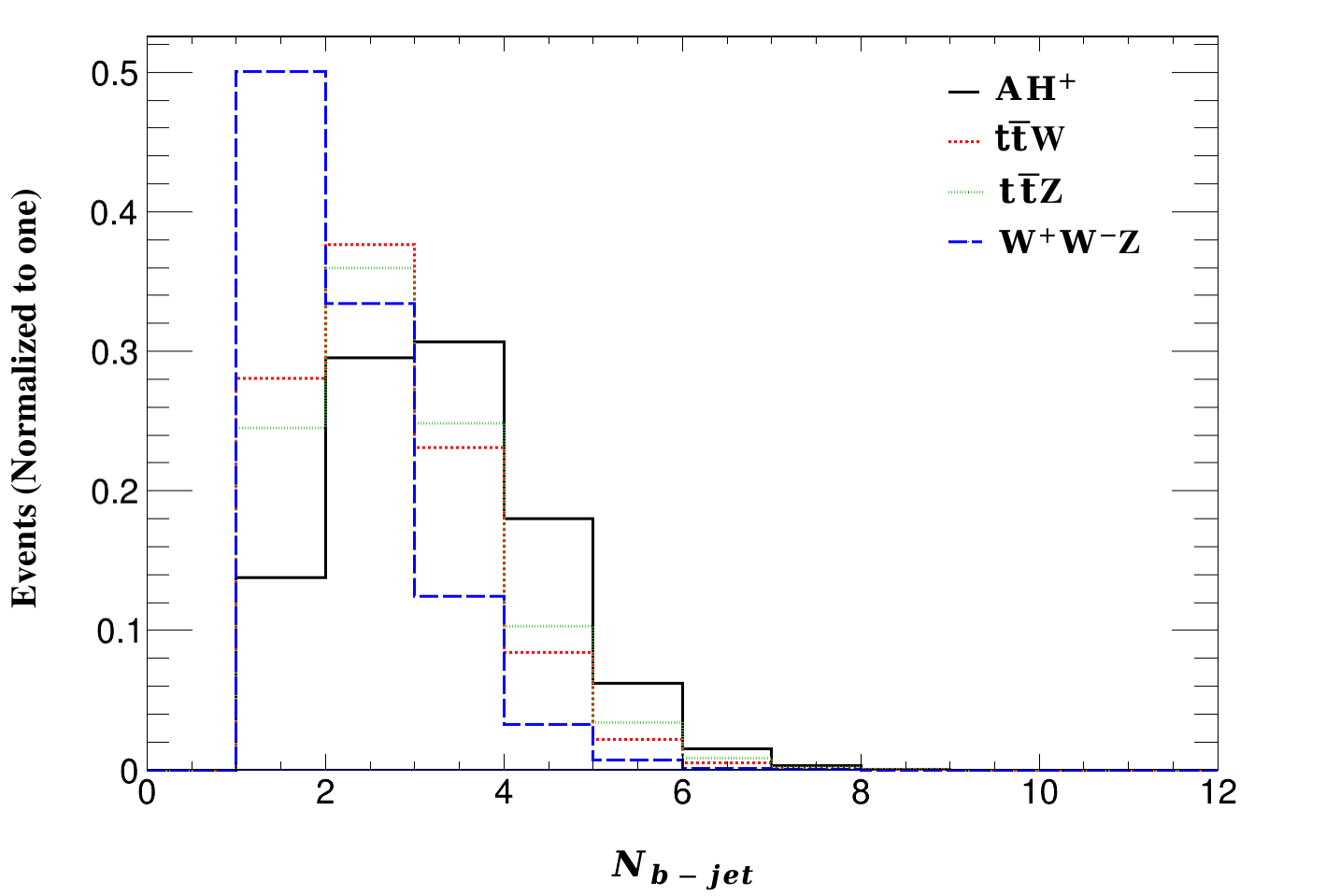
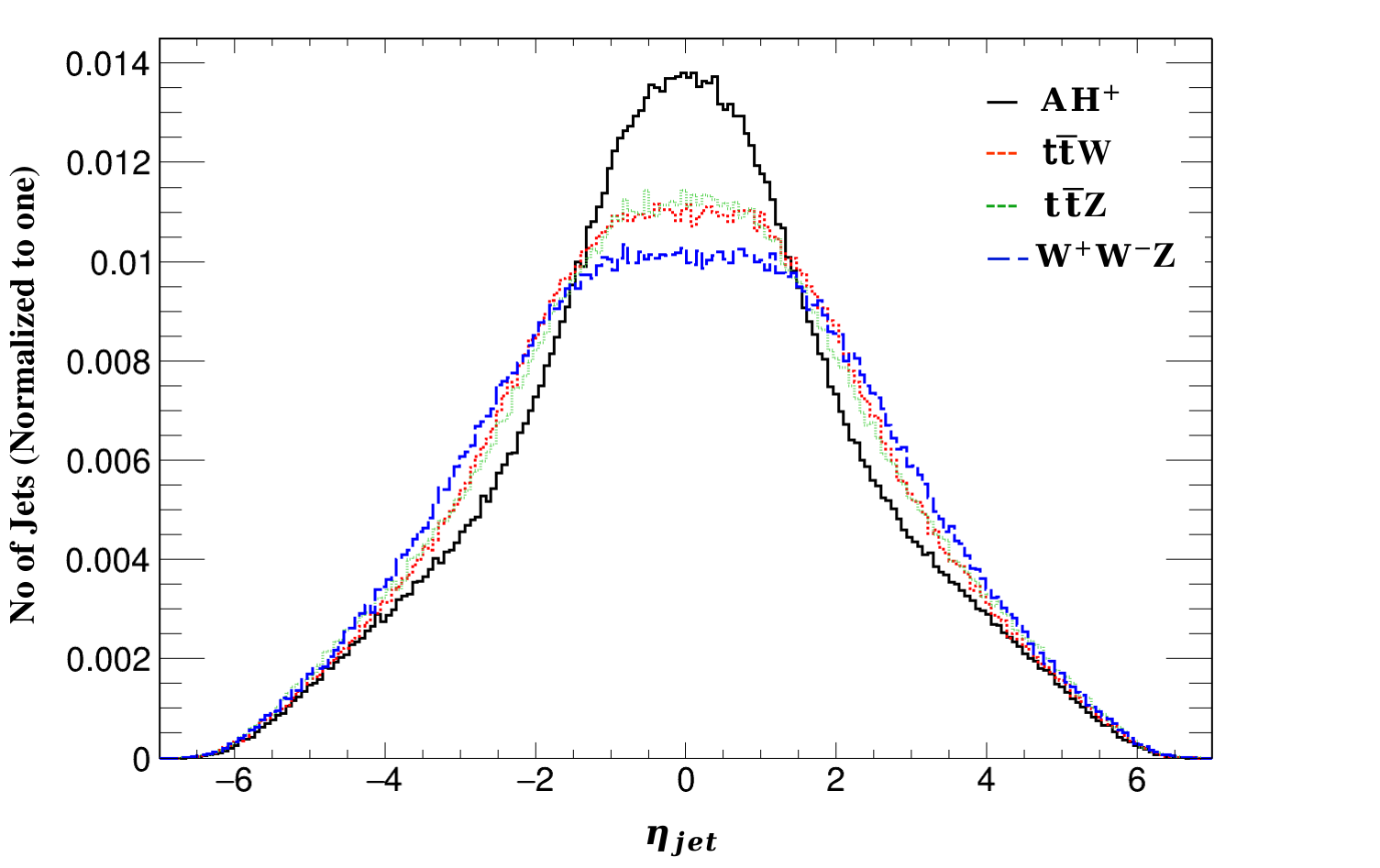
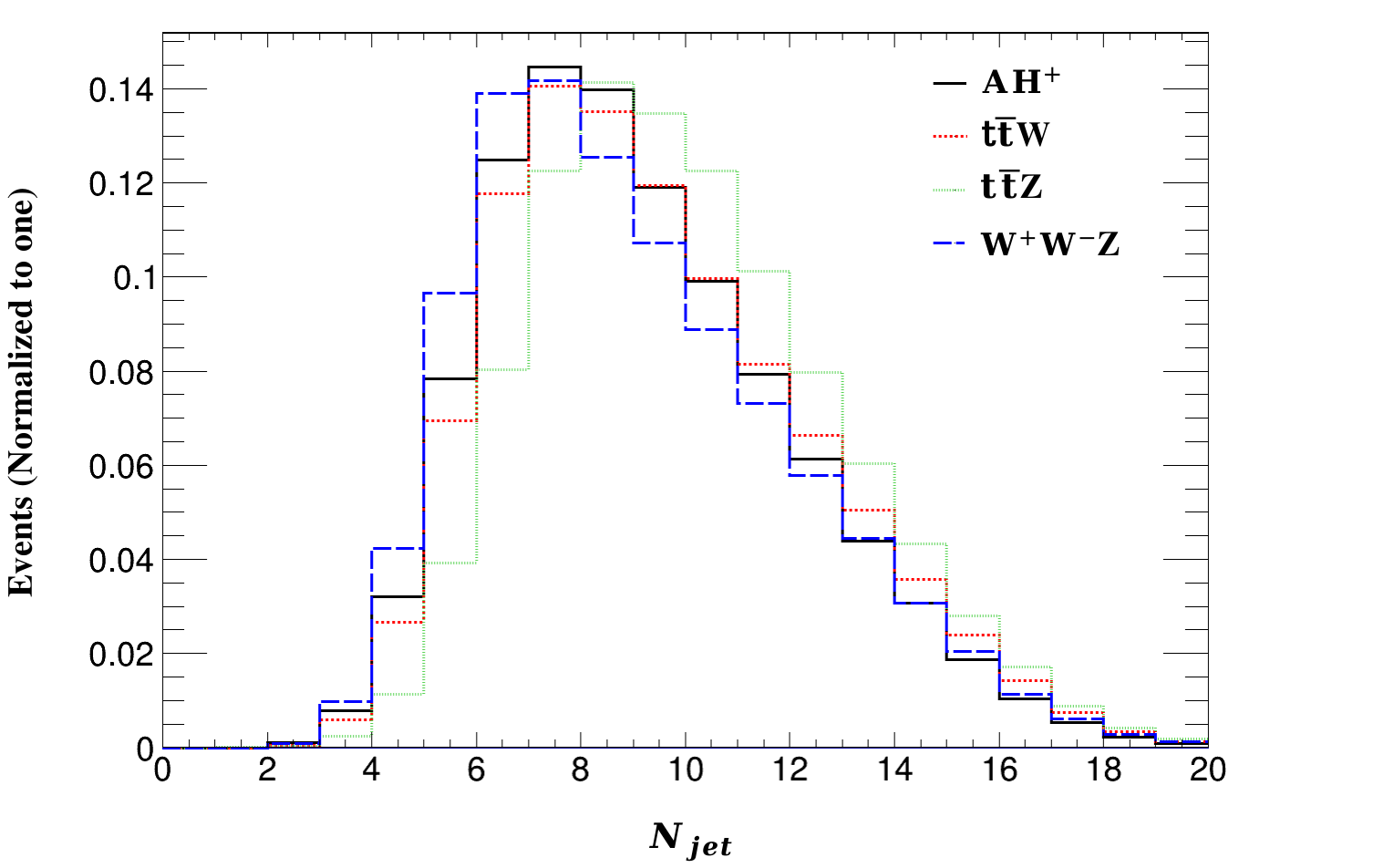
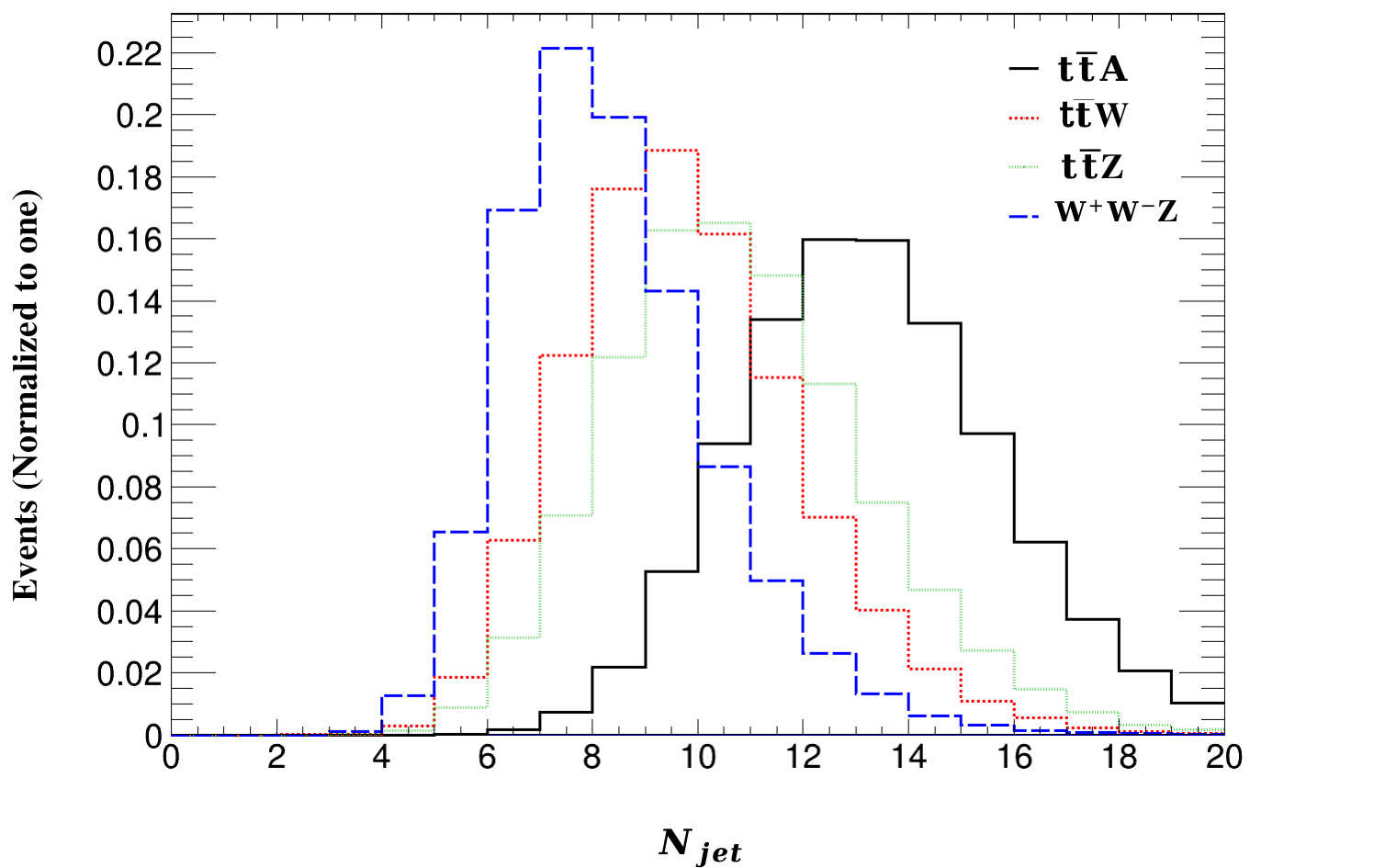
Isolating multi-top quark production requires meticulous analysis of jet multiplicity and the implementation of b-quark tagging (bb-tagging) techniques due to the substantial Standard Model background processes that mimic the final state. Multi-top quark events produce a characteristic high number of jets, necessitating a detailed count and categorization. Bb-tagging is essential as top quarks decay into b-quarks, and identifying these b-jets significantly reduces backgrounds from lighter quarks and gluons. Algorithms are employed to identify b-jets based on their decay length and the presence of secondary vertices created by b-hadron decays, enhancing the signal-to-noise ratio and allowing for a statistically significant observation of the rare multi-top quark process.
Precise jet reconstruction is fundamental in high-energy physics analyses, and relies on dedicated tools and algorithms. FastJet is a widely used package providing a framework for jet definition and implementation of various jet algorithms. Among these, the Anti-kt clustering algorithm is particularly prominent due to its infrared and collinear safety, and its ability to effectively resolve jets even in dense hadronic environments. This algorithm iteratively combines the closest particles based on a distance metric, resulting in jets that are less sensitive to the underlying event and providing improved jet energy resolution, which is critical for accurately measuring the momentum of the produced top quarks and distinguishing signal from background.
The statistical significance of observing multi-top quark production is directly correlated with the specific parameters defining the Two-Higgs-Doublet Model (2HDM). At the High-Luminosity LHC, projected to collect 3000-4000 fb⁻¹ of integrated luminosity, several 2HDM parameter space configurations are predicted to yield signal significances exceeding 5σ. This threshold is the standard for claiming a discovery in particle physics, indicating that the High-Luminosity LHC possesses the capability to either confirm or refute specific 2HDM hypotheses through observation of multi-top quark final states, contingent on the underlying model parameters.
Beyond the Standard: Implications for the Future of Particle Physics
A departure from predictions established by the Standard Model in the production of multiple top quarks would strongly suggest the existence of physics beyond what is currently understood, with the Two-Higgs-Doublet Model (2HDM) being a prominent candidate. The current Standard Model accurately describes fundamental particles and forces, but leaves several phenomena unexplained; the 2HDM proposes an extension to this model by introducing an additional Higgs boson. Observing an excess of multi-top quark events-more than the Standard Model predicts-could be a signature of this new boson interacting with top quarks, providing direct evidence for the 2HDM and opening a pathway to explore a more complete understanding of particle interactions and the origin of mass. This discovery wouldn’t simply confirm a new particle, but would initiate a revolution in how physicists approach the Higgs sector and the fundamental building blocks of the universe.
A confirmed deviation from the Standard Model in Higgs boson interactions wouldn’t simply add another particle to the catalog; it would fundamentally reshape the understanding of the Higgs field and its role in generating mass. The current model, while remarkably successful, leaves questions unanswered regarding the hierarchy problem and the origin of fermion masses. New discoveries in multi-top quark production, potentially signaling physics beyond the Standard Model like the Two-Higgs-Doublet Model, would provide a crucial entry point to explore a more complex ‘Higgs landscape’. This exploration could reveal additional Higgs bosons and their couplings, offering insights into the mechanism by which elementary particles acquire mass and potentially unifying the forces of nature at higher energy scales. Such advancements promise to move beyond simply measuring the properties of the known Higgs boson, towards a complete characterization of the entire Higgs sector and its implications for the very fabric of reality.
Analysis reveals that observation of the AH± decay channel, with a projected integrated luminosity of 4000 fb⁻¹, promises an extraordinary level of statistical significance – reaching 1161.04σ. This compelling result underscores the channel’s remarkable potential for definitively identifying new physics beyond the Standard Model. Such a high degree of certainty would not merely confirm theoretical predictions, but would also initiate a detailed exploration of the properties of this new particle and its implications for understanding the fundamental forces governing the universe.
Investigations into specific iterations of the Two-Higgs-Doublet Model (2HDM) represent a crucial next step in understanding potential extensions to the Standard Model. While the general 2HDM framework predicts additional Higgs bosons, different ‘types’ – such as the Type-I 2HDM where the additional Higgs couples primarily to fermions – exhibit distinct phenomenological signatures. Detailed analyses focusing on these specific models allow physicists to refine search strategies and predict correlations with other observable phenomena, like modifications to h \rightarrow \gamma \gamma decay rates or altered production cross-sections for top quarks. Such focused studies not only enhance the sensitivity of experiments but also provide a more nuanced understanding of the Higgs sector and its role in electroweak symmetry breaking, potentially revealing subtle deviations from Standard Model predictions that would otherwise remain hidden within broader searches.
The pursuit detailed within meticulously dissects the boundaries of established physics, seeking deviations from the Standard Model through the observation of multi-top quark events. It’s a systematic dismantling, really, probing for cracks in the current framework. This resonates with Kant’s assertion: “All our knowledge begins with the senses, but does not end with them.” The experiment doesn’t simply accept sensory data from the HL-LHC; it actively seeks what lies beyond that initial input, attempting to reconstruct a more complete reality. The signal significance calculations, the bb-tagging requirements-these are not affirmations of existing theory, but rather tools for reverse-engineering the potential truths hidden within the data, testing the limits of what is known and acknowledged.
Pushing the Boundaries
The pursuit of physics beyond the Standard Model rarely yields immediate answers; instead, it systematically reveals the limitations of current questions. This work, focusing on multi-top signatures from Higgs pair production, does not offer a guaranteed path to discovery, but rather a refined method for stressing the Model’s seams. The HL-LHC’s potential, as demonstrated, lies not simply in accumulating data, but in constructing increasingly sensitive probes designed to exploit theoretical loopholes-areas where the elegant simplicity of the Standard Model begins to fray.
A reliance on bb-tagging and associated production, while pragmatic, inherently introduces systematic uncertainties. Future explorations must consider alternative decay channels and production mechanisms, perhaps venturing into less conventional topologies. The true test will not be finding evidence for a Two Higgs Doublet Model, but in decisively mapping the parameter space where it cannot exist-a process of elimination as crucial as any direct detection.
Ultimately, this research serves as a reminder that the most profound insights often emerge from deliberately attempting to break the rules. The HL-LHC, then, is not merely a machine for confirming expectations, but an instrument for challenging them-a means of reverse-engineering the universe, one meticulously analyzed collision at a time.
Original article: https://arxiv.org/pdf/2602.06217.pdf
Contact the author: https://www.linkedin.com/in/avetisyan/
See also:
- Trails in the Sky 2nd Chapter launches September 17
- HBO Max Just Added the Final Episodes of a Modern Adult Swim Classic
- Paradox codes (April 2026): Full list of codes and how to redeem them
- Crimson Desert’s Momentum Continues With 10 Incredible New Changes
- Pragmata Shows Off Even More Gorgeous RTX Path Tracing Ahead of Launch
- PRAGMATA ‘Eight’ trailer
- How Could We Forget About SOL Shogunate, the PS5 Action RPG About Samurai on the Moon?
- Solo Leveling’s New Character Gets a New Story Amid Season 3 Delay
- Hulu Just Added One of the Most Quotable Movies Ever Made (But It’s Sequel Is Impossible To Stream)
- Dragon Quest Smash/Grow launches April 21
2026-02-10 07:24