Author: Denis Avetisyan
A new approach explores the aesthetic dimensions of quantum mechanics, not as depictions of nature, but as cultural artifacts shaped by computation and language.
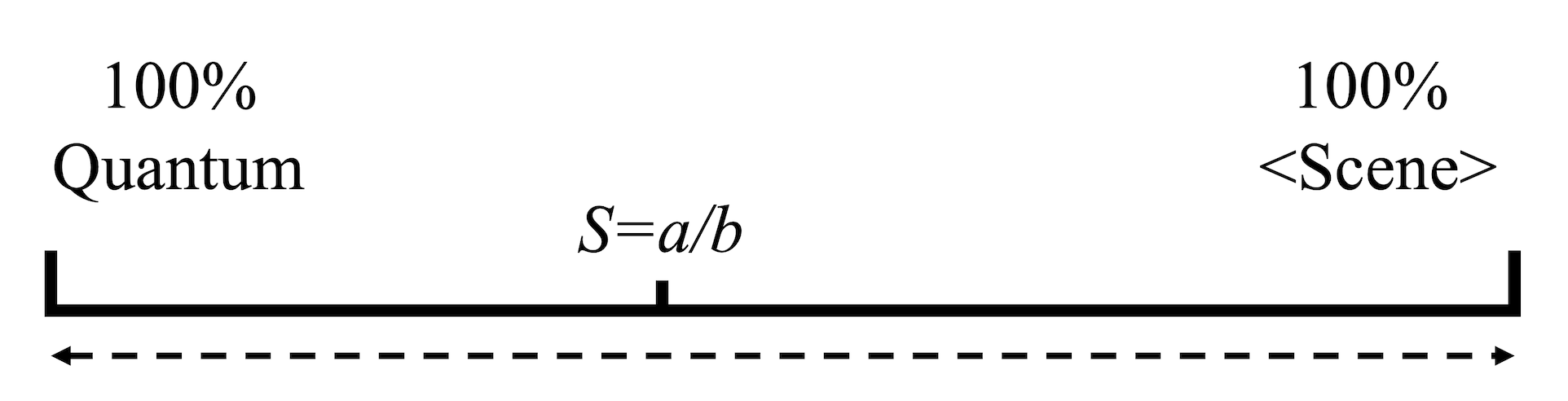
This review proposes a dual framework-generative AI and direct quantum data visualization-to investigate quantum aesthetics as a computationally mediated cultural construct.
Quantum mechanics, while foundational to contemporary science, remains largely divorced from direct sensory experience, creating a challenge for aesthetic engagement. This paper, ‘Roadmap to Quantum Aesthetics’, proposes a dual methodological framework-employing both text-prompt-based generative AI and the direct visualization of quantum data, such as solutions to the \text{Schrödinger equation}-to explore quantum aesthetics not as a representation of physical reality, but as a culturally mediated phenomenon shaped by language, computation, and mathematical constraint. By examining how quantum concepts circulate within visual culture and emerge from computational processes, this work positions quantum aesthetics as an emergent field of artistic research. What new avenues for artistic practice and pedagogy open when we consider the intersection of art, data, artificial intelligence, and quantum science?
Revealing the Quantum Aesthetic: Beyond Classical Visualization
The established principles of aesthetics, honed through centuries of representing the macroscopic world, frequently struggle when applied to quantum mechanics. Conventional visualization techniques, predicated on defined forms and predictable trajectories, falter when depicting phenomena governed by probability waves and superposition. Attempts to illustrate concepts like quantum entanglement or the uncertainty principle using traditional artistic methods often result in misleading or incomplete representations, obscuring the very essence of these counterintuitive realities. Consequently, a shift toward novel aesthetic approaches is essential – ones that embrace abstraction, utilize dynamic data visualization, and prioritize conveying the probabilistic nature of quantum states over static, deterministic imagery. This demands a reimagining of visual language, moving beyond mere depiction to evoke an experience of the quantum realm, acknowledging its inherent strangeness and beauty.
The very nature of quantum phenomena poses a significant hurdle to both artistic and scientific depiction. Unlike classical systems with definite properties, quantum entities are described by wave functions, which represent probabilities rather than fixed states. This means a particle doesn’t have a specific location until measured; instead, it exists as a superposition of possibilities, spread out as a probability distribution. Visualizing this inherent uncertainty, and the transition from superposition to a definite state upon observation – known as wave function collapse – requires moving beyond representational approaches traditionally used for tangible objects. Attempts to depict quantum states with familiar imagery often fall short, creating misleading or incomplete pictures of a reality where Ψ – the wave function – fundamentally defines existence, and where observation itself alters the observed.
The visualization of quantum mechanics demands a departure from established aesthetic principles, prompting researchers to investigate novel frameworks for representing its counterintuitive realities. Conventional artistic and scientific depictions often struggle to capture the probabilistic nature of quantum phenomena, where particles exist as wave functions and observation fundamentally alters reality. This pursuit isn’t merely about creating visually striking images; it’s about developing a visual language capable of conveying the inherent beauty and complexity of the quantum realm-a realm governed by ψ functions and characterized by superposition and entanglement. Consequently, explorations extend beyond traditional representational art, incorporating computational methods, data sonification, and abstract forms to evoke the elusive qualities of quantum states and processes, ultimately aiming to make the invisible universe accessible through compelling aesthetic experiences.
AI-Driven Quantum Imagery: A Top-Down Approach
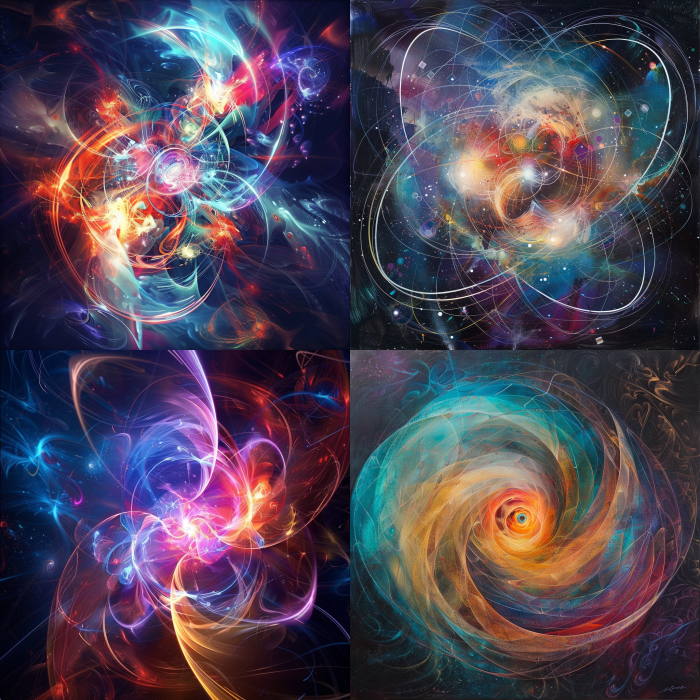
The top-down approach to visualizing quantum concepts utilizes generative artificial intelligence platforms, specifically Midjourney, as a primary tool for image creation. This method circumvents traditional computational limitations by translating abstract quantum phenomena into textual prompts that guide the AI’s image synthesis process. Rather than directly simulating quantum systems, researchers describe desired visual characteristics – relating to wave functions, superposition, or entanglement – in natural language. Midjourney then interprets these prompts, leveraging its internal algorithms to generate imagery reflecting the described concepts. This allows for the exploration of visual representations of quantum mechanics that would be otherwise computationally intractable or impossible to directly observe.
The generation of quantum-inspired imagery using tools like Midjourney relies fundamentally on text-prompting as the primary interface for communicating desired visual characteristics to the AI. Researchers formulate textual descriptions detailing both the abstract quantum phenomena they wish to represent – such as superposition or entanglement – and specific visual elements or scenes to ground the imagery. The AI then interprets these prompts and leverages its diffusion-based synthesis capabilities to construct an image aligning with the provided instructions. Effective prompt engineering, including the strategic use of keywords and descriptive language, is therefore critical for translating complex scientific concepts into visually interpretable representations. The precision of the textual input directly influences the AI’s ability to accurately and meaningfully depict these abstract ideas.
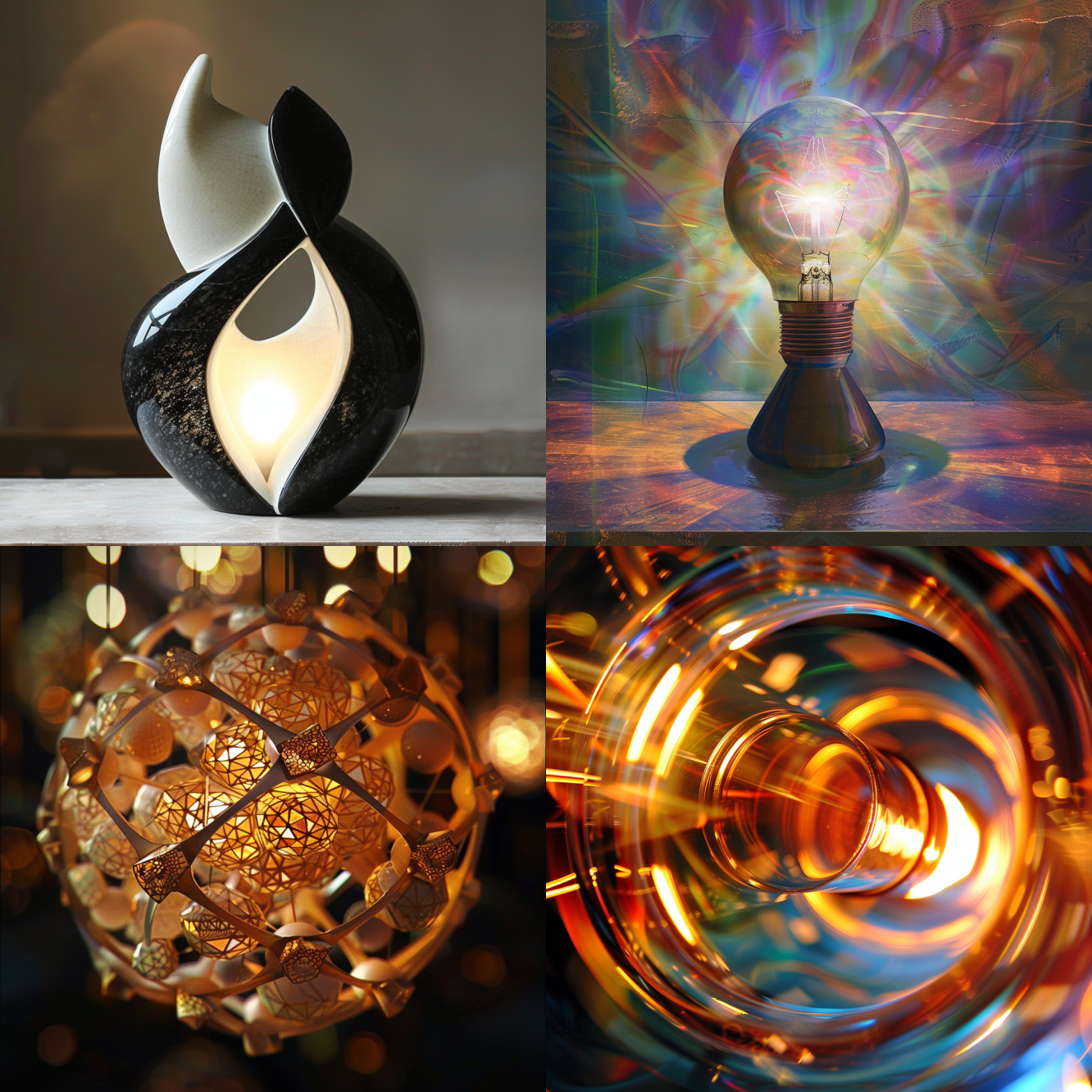
Prompt weighting and the utilization of ‘Raw Mode’ within generative AI tools like Midjourney enable refined control over image synthesis, exceeding purely aesthetic outcomes. The Prompt Weighting Ratio, expressed as S=a/b, was a key experimental variable; ‘a’ represents the weight assigned to prompts describing abstract quantum characteristics, while ‘b’ defines the weight for prompts relating to scene recognition and concrete objects. By systematically varying this ratio, researchers were able to modulate the degree to which generated images emphasized either quantum abstraction or recognizable visual elements. Investigations into ‘lamp’ scenes, for instance, identified an optimal blend ratio (SB) of 0.5, indicating a balanced contribution from both abstract and concrete prompt components to achieve a desired aesthetic.
Midjourney utilizes Diffusion-Based Image Synthesis, a process where noise is iteratively refined into coherent imagery guided by textual prompts. This technique relies on a forward diffusion process that progressively adds noise to training data, followed by a reverse process learned by a neural network to denoise and generate images from random noise. In experiments focused on generating imagery of ‘lamp’ scenes, a blend ratio denoted as SB of 0.5 was determined to be optimal. This SB value represents the balance between the influence of the text prompt and the inherent stylistic biases of the diffusion model, resulting in visually compelling and contextually relevant outputs; deviations from this ratio led to either overly abstract or poorly defined imagery.
From Equations to Visuals: A Bottom-Up Approach
The bottom-up approach to visualizing quantum phenomena begins with the Schrödinger Equation, a fundamental equation in quantum mechanics that describes the time evolution of a physical system. This equation, expressed as i\hbar \frac{\partial}{\partial t} \Psi = \hat{H} \Psi, where Ψ represents the wave function of the system and \hat{H} is the Hamiltonian operator, is directly solved for specific quantum systems. The solutions to the Schrödinger Equation yield wave functions, which are then used to calculate probability distributions. These distributions, representing the likelihood of finding a particle at a given point in space, serve as the basis for generating visual representations, effectively translating mathematical results into directly observable forms.
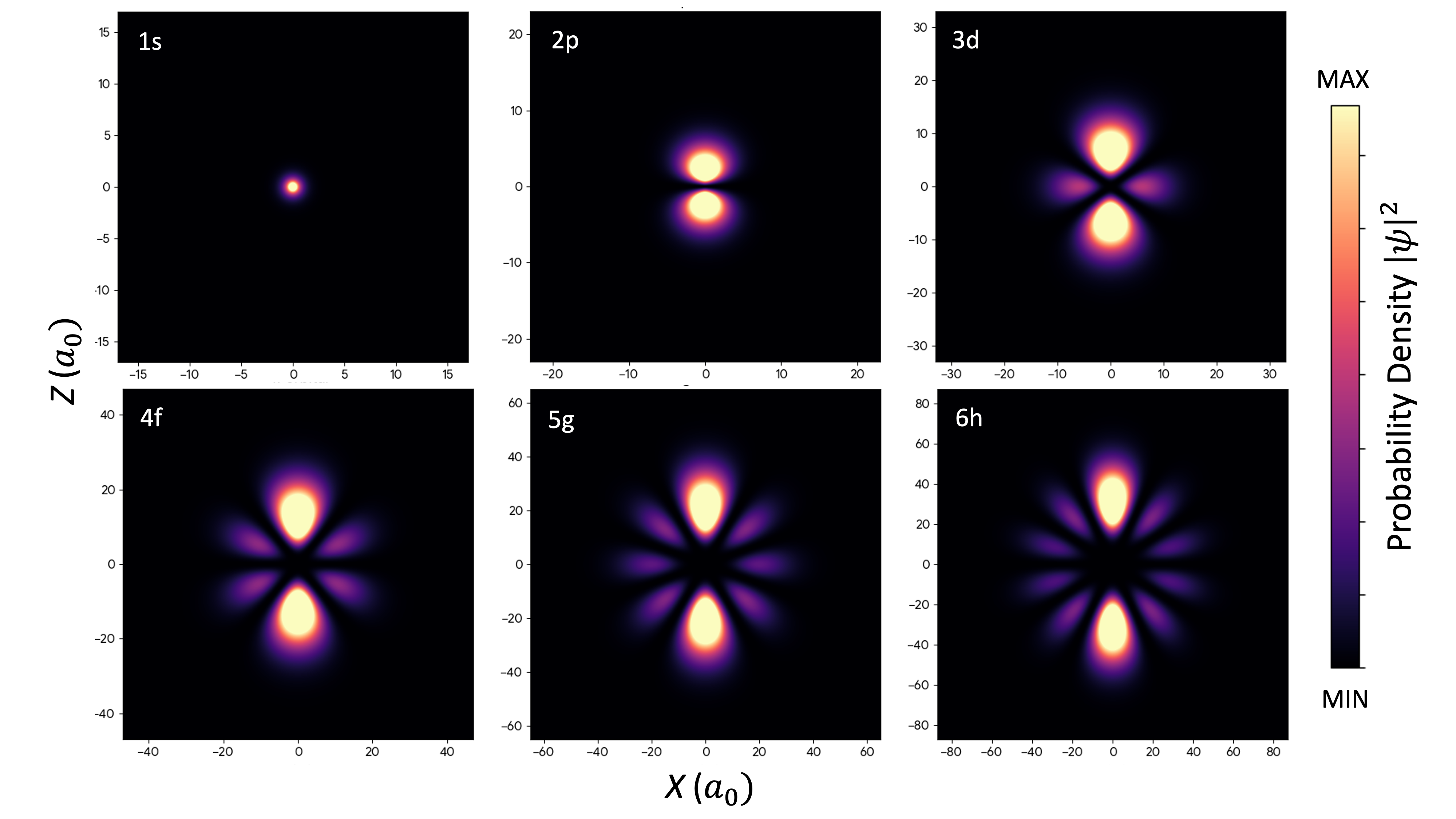
The application of the Schrödinger Equation to the hydrogen atom allows for the calculation of atomic orbitals, which represent the probability distribution of an electron within that atom. Solving the equation for the hydrogen atom yields a set of wave functions, Ψ, that describe the electron’s quantum state. The square of this wave function, |\Psi|^2, provides the probability density of finding the electron at a specific point in space. These probability distributions are not fixed paths, but rather regions of high probability, visualized as three-dimensional shapes defining the electron’s orbital. Different solutions to the Schrödinger equation result in distinct orbitals, characterized by quantum numbers and exhibiting varying shapes – spherical s-orbitals, dumbbell-shaped p-orbitals, and more complex d- and f-orbitals – that depict the spatial distribution of electrons around the nucleus.
The translation of mathematical solutions of the Schrödinger equation into visual representations relies on established techniques in scientific visualization. These methods map the calculated wave functions – which describe the probability amplitude of an electron at a given point in space – onto a three-dimensional coordinate system. The resulting visualizations typically employ isosurface rendering to display regions of constant probability density, often colored to differentiate between positive and negative phases of the wave function. Furthermore, density plots and contour maps are used to represent the probability distribution, effectively revealing the shape and spatial extent of atomic orbitals. These visualizations, derived directly from the mathematical output, demonstrate the inherent symmetry and complexity of quantum structures, providing a visual interpretation of the abstract mathematical results.
The generation of visual representations directly from solutions to the Schrödinger Equation minimizes subjective interpretation by establishing a one-to-one correspondence between mathematical results and graphical output. Specifically, quantum numbers – principal quantum number n ranging from 1 to 6, angular momentum quantum number l from 0 to 5, and magnetic quantum number m equal to 0 – were systematically implemented as parameters within the equation. This parameterization demonstrated a clear relationship between these quantum numbers and the complexity of the resulting visualizations; increasing values of n and l consistently produced more spatially complex probability distributions, directly reflecting the theoretical underpinnings of atomic structure.
Information Aesthetics and the Quantum Realm: A Convergence
The translation of quantum data into visual forms – be it through simulations designed to illustrate theoretical models or through direct mappings of experimental results – inherently aligns with the core tenets of information aesthetics. This connection arises because both quantum systems and aesthetically pleasing visuals rely on principles of pattern, complexity, and organization. Data generated ‘top-down’ – where researchers impose structure onto quantum phenomena for clarity – and data generated ‘bottom-up’ – arising directly from observation without preconceived notions – both reveal underlying structures when visualized. These structures, whether representing wave functions, particle interactions, or entanglement, possess quantifiable properties like information density and entropy, qualities that directly correspond to principles of visual balance, harmony, and compelling design. Consequently, the very act of rendering quantum information visually exposes an inherent beauty, revealing that the universe, at its most fundamental level, may be intrinsically aesthetic.
Quantum visualizations, whether representing wave functions or entanglement patterns, consistently exhibit aesthetic qualities stemming from their underlying information structure. Analyses demonstrate that visual complexity isn’t random; instead, it correlates directly with information density – regions packed with data often manifest as intricate, compelling forms. The organization of these visual elements, dictated by the mathematical relationships governing quantum phenomena, further contributes to aesthetic appeal. Patterns emerge not merely as decoration, but as representations of fundamental relationships, with symmetry, repetition, and hierarchical structures frequently observed. This suggests that the inherent beauty in these visualizations isn’t accidental, but a natural consequence of the efficient encoding and presentation of complex quantum information, appealing to the human visual system’s preference for order and meaningful patterns.
The confluence of quantum mechanics and information aesthetics offers a surprisingly powerful lens through which to perceive the inherent beauty of the quantum realm. Traditionally, quantum phenomena have been understood through complex mathematical formalisms, often obscuring the visually striking patterns and organizational principles at play. However, when viewed through the framework of information aesthetics – considering qualities like complexity, symmetry, and information density – these same phenomena reveal an unexpected elegance. Visualizations of quantum data, whether derived from simulations or experiments, consistently exhibit aesthetic properties analogous to those found in natural patterns and artistic compositions. This suggests that the fundamental laws governing the universe may not only be mathematically sound but also intrinsically beautiful, offering a new pathway for both scientific understanding and artistic inspiration. By recognizing the aesthetic dimensions of quantum mechanics, a deeper, more intuitive appreciation of its profound implications becomes possible.
The exploration of aesthetic dimensions within scientific visualization serves as a powerful bridge between complex data and human understanding. When abstract concepts like quantum mechanics are presented through visually compelling patterns, symmetry, and information density, they move beyond purely intellectual exercises and engage intuitive modes of perception. This approach doesn’t simplify the underlying science, but rather offers an alternative pathway for grasping its intricacies – one rooted in the same principles that govern artistic appreciation. By leveraging the innate human sensitivity to visual harmony and order, researchers and communicators can cultivate a deeper, more accessible connection with challenging subjects, ultimately fostering both engagement and a more profound comprehension of the natural world.
The exploration of quantum aesthetics, as detailed in this paper, isn’t merely about representing the quantum realm, but actively constructing it through computational mediation. This process inherently encodes a worldview, shaping how these fundamental principles are perceived and interpreted. As Nikola Tesla observed, “The true mysteries of the universe are revealed not to those who seek answers, but to those who ask the right questions.” The paper’s dual methodology – generative AI and direct visualization – embodies this principle. By questioning the assumptions baked into both algorithmic representation and visual depiction, the research moves beyond passive observation toward a deliberate crafting of aesthetic experience, acknowledging the inherent subjectivity within seemingly objective data. It is a potent reminder that efficiency in computation, without a parallel concern for the values it embodies, is a fleeting illusion.
Where to From Here?
The exploration detailed within necessitates a reckoning with the inherent limitations of computational mediation. It demonstrates that quantum aesthetics is not discovered, but created – a consequence of algorithmic choices and the representational constraints imposed by both generative AI and direct data visualization. This is not a technical problem to be solved, but a philosophical one to be acknowledged: each rendered hydrogen orbital, each AI-generated “aesthetic” of quantum phenomena, encodes a particular worldview, often unknowingly. The field must move beyond seeking objective beauty in quantum mechanics, and towards a critical examination of the values embedded within its aesthetic representations.
Future work should prioritize transparency, not as a mere methodological virtue, but as minimal morality. The algorithms employed, the parameters chosen, and the underlying assumptions must be laid bare, allowing for a deconstruction of the aesthetic choices made. Furthermore, investigation into the cultural biases inherent in these systems is critical; the aesthetics of quantum mechanics, as constructed through computation, are unlikely to be universal, and may reflect the priorities of those who create the tools themselves.
Ultimately, the study suggests a shift in focus: from “what does quantum mechanics look like?” to “what does it mean to make it look a certain way?” This demands a move beyond technical refinement and towards a rigorous ethical framework for computational aesthetics, acknowledging that creation, even of abstract visualisations, is never neutral.
Original article: https://arxiv.org/pdf/2602.08363.pdf
Contact the author: https://www.linkedin.com/in/avetisyan/
See also:
- Trails in the Sky 2nd Chapter launches September 17
- HBO Max Just Added the Final Episodes of a Modern Adult Swim Classic
- Paradox codes (April 2026): Full list of codes and how to redeem them
- PRAGMATA ‘Eight’ trailer
- Crimson Desert’s Momentum Continues With 10 Incredible New Changes
- Pragmata Shows Off Even More Gorgeous RTX Path Tracing Ahead of Launch
- Solo Leveling’s New Character Gets a New Story Amid Season 3 Delay
- Hulu Just Added One of the Most Quotable Movies Ever Made (But It’s Sequel Is Impossible To Stream)
- Dragon Quest Smash/Grow launches April 21
- How Could We Forget About SOL Shogunate, the PS5 Action RPG About Samurai on the Moon?
2026-02-10 09:12