Author: Denis Avetisyan
New research demonstrates that tracking how structures form in the universe is crucial to understanding the evolving nature of dark energy, going beyond simple measurements of cosmic expansion.
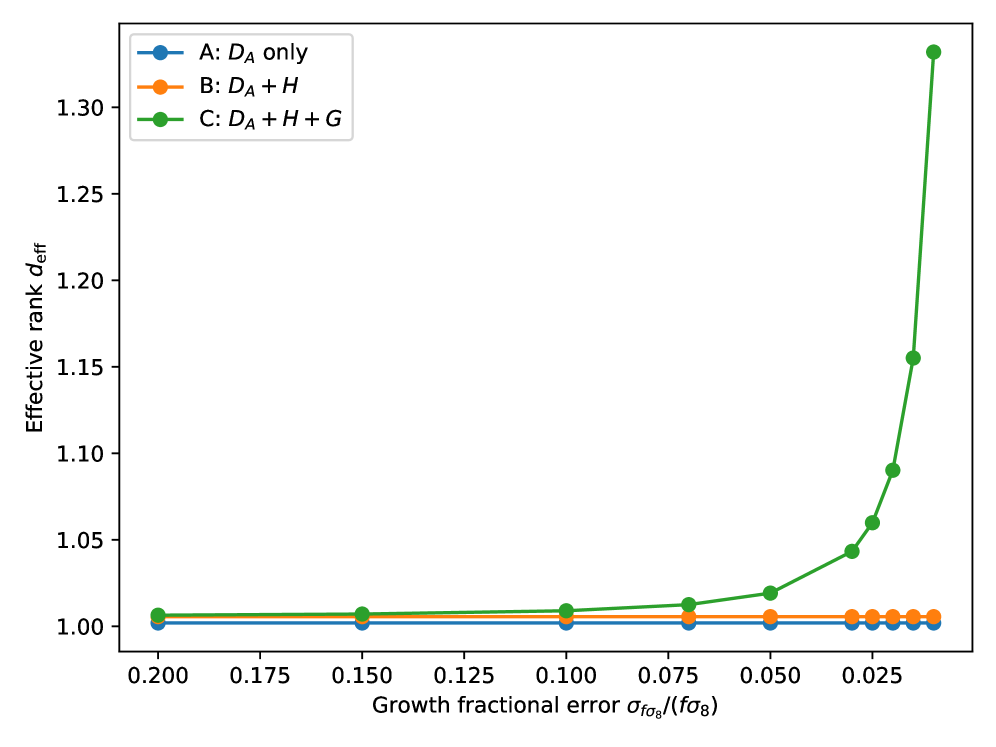
Combining distance and growth probes is essential to constrain the time-varying equation of state of dark energy.
Constraining the evolution of dark energy remains a central challenge in cosmology, yet traditional distance measurements inherently limit our ability to probe its time-varying nature. This limitation is explored in ‘Complementary Roles of Distance and Growth Probes in Testing Time-Varying Dark Energy’, which utilizes the Fisher information matrix to demonstrate that distance and expansion rate data alone produce a severely restricted sensitivity to changes in the dark energy equation of state w(z). The analysis reveals that measurements of the growth of cosmic structure – responding to differential dynamics – offer complementary information, potentially unlocking additional constraints on w(z). Under what conditions, and with what precision, will future surveys effectively leverage growth probes to overcome the inherent limitations of distance measurements and fully characterize the nature of dark energy?
The Shifting Sands of Cosmic Expansion
The prevailing cosmological model indicates the universe’s expansion isn’t simply continuing – it’s accelerating, a phenomenon attributed to a mysterious force dubbed dark energy. This presents a profound challenge to contemporary physics, as the standard model of particle physics offers no adequate explanation for such a pervasive and repulsive gravitational effect. Observations of distant supernovae and the cosmic microwave background consistently point to dark energy comprising approximately 68% of the universe’s total energy density, yet its fundamental nature remains elusive. Is it a cosmological constant, representing an inherent energy of space itself, or a dynamic field, perhaps ‘quintessence’, whose density changes over time? Determining the true identity of dark energy is paramount, as its behavior will ultimately dictate the universe’s long-term fate – whether it continues to expand indefinitely, eventually succumbs to a ‘Big Rip’, or undergoes a contraction.
The ultimate destiny of the universe hinges on the precise nature of dark energy, a mysterious force responsible for its accelerating expansion. Cosmologists strive to define dark energy’s ‘equation of state’ – a ratio relating its pressure to its density – as this parameter dictates whether expansion will continue indefinitely, eventually rip apart all matter, or even reverse into a ‘Big Crunch’. A slightly different equation of state can dramatically alter predictions for the universe’s future, shifting it from a scenario of perpetual, albeit increasingly diluted, existence to one of catastrophic disintegration. Determining this equation isn’t merely an academic exercise; it’s a quest to understand if the cosmos is destined for a cold, empty future, a violent demise, or a cyclical rebirth, all governed by the subtle properties of this dominant, yet elusive, energy component.
Current cosmological observations, such as those measuring the cosmic microwave background or the distribution of galaxies, rely on averaging signals over vast volumes of space. While necessary for obtaining detectable data, these averaging processes introduce smoothing effects that can obscure crucial details about dark energy. This presents a significant hurdle in precisely determining dark energy’s equation of state – a key parameter that dictates the universe’s expansion rate. The smoothing can mimic a constant dark energy density even if the true nature is more complex, potentially leading to inaccurate conclusions about the ultimate fate of the cosmos. Researchers are therefore actively developing novel techniques – including those focusing on smaller, more localized observations and advanced statistical methods – to mitigate these smoothing effects and unveil the true properties of this enigmatic force.
Mapping the Shadows: Kernels and Response Functions
The relationship between dark energy parameters and resulting changes in cosmological observables is quantified by a ‘kernel’ function, denoted generally as K(z; \mathbf{p}, \mathbf{q}), where z represents redshift and \mathbf{p} and \mathbf{q} are parameter vectors defining different cosmological models. This kernel effectively maps variations in dark energy’s equation of state or other parameters to the corresponding shifts in observed quantities like the cosmic microwave background anisotropy, baryon acoustic oscillations, or the growth of large-scale structure. Specifically, a change in a dark energy parameter \delta p_i induces a corresponding change in an observable O given by \delta O = \sum_i K_i(z) \delta p_i, where K_i(z) represents the kernel function for the i-th parameter at redshift z. Therefore, the kernel’s form and magnitude dictate the sensitivity of a given observation to variations in dark energy properties, and accurately determining these kernels is essential for precise cosmological parameter estimation.
The kernel structure, mathematically represented as K(z, z'), defines the sensitivity of observed quantities at redshift z to parameter variations at redshift z'. This function encapsulates the integrated effect of perturbations in the early universe on the later-time observables, such as the cosmic microwave background or galaxy clustering. A well-defined kernel structure allows for the precise calculation of the Fisher information matrix, which quantifies the achievable precision in estimating cosmological parameters from a given dataset. Variations in the kernel’s shape and amplitude directly correspond to differing sensitivities to specific cosmological models; a broader kernel indicates sensitivity to a wider range of scales and parameters, while a narrower kernel implies greater sensitivity to specific parameter combinations. Therefore, accurate determination and characterization of the kernel structure are essential for robust cosmological parameter estimation and model selection.
The evolution of cosmic structure is accurately described by a second-order differential equation, specifically the perturbed Friedmann equation coupled with the Poisson equation. This framework allows for a localized analysis of the response of observables to variations in dark energy parameters because it relates the growth rate of density perturbations to the underlying gravitational potential and the expansion history of the universe. The equation, typically expressed in Fourier space as \ddot{\delta}_k + \mathcal{H}\dot{\delta}_k + k^2\sigma(a)\delta_k = 0 , where \delta_k represents the density contrast at wavenumber k , \mathcal{H} is the Hubble parameter, and \sigma(a) is a scale-dependent growth factor, enables calculation of the time-dependent response function without requiring full N-body simulations. This localized approach is vital for accurately predicting how changes in dark energy affect the distribution of matter and, consequently, observable quantities like the cosmic microwave background and galaxy clustering.
Decoding the Signal: Fisher Matrix and Eigenvalue Spectrum
The Fisher Information Matrix (FIM) is a central tool in cosmological parameter estimation, providing a quantitative measure of the information present in observational data regarding dark energy properties. Constructed from the derivatives of the likelihood function with respect to the parameters of interest, the FIM effectively assesses the sensitivity of data to changes in those parameters; larger values in the matrix indicate greater sensitivity and thus, a higher information content. Specifically, the FIM allows for the calculation of parameter uncertainties and covariances, providing a rigorous statistical framework for evaluating the power of different observational probes to constrain dark energy models. The matrix is a N \times N symmetric, positive-definite matrix, where N is the number of parameters being estimated, and its inverse directly provides estimates of the parameter covariance matrix.
The Eigenvalue Spectrum of the Fisher Information Matrix directly corresponds to the number of effectively independent parameters within a cosmological model that can be constrained by a given dataset. Each eigenvalue represents the variance of the estimated parameter in a specific direction in parameter space; larger eigenvalues indicate better constrained parameters, while smaller eigenvalues signify weaker constraints or strong correlations. Consequently, the number of eigenvalues significantly greater than zero indicates the dimensionality of the constrained parameter space – a spectrum with a single dominant eigenvalue suggests limited constraining power, while a broader spectrum with multiple substantial eigenvalues implies the ability to independently determine a larger number of parameters. The ratio between successive eigenvalues, often termed the Fisher Eigenvalue Ratio \lambda_1/\lambda_2, quantifies the degree of hierarchy within the spectrum and provides a metric for assessing the severity of parameter degeneracies.
Analysis of the Fisher Information Matrix for distance-based observations reveals a strongly hierarchical eigenvalue spectrum, quantified by a ratio of the largest to second-largest eigenvalue (λ_1/λ_2) exceeding 10. This significant disparity indicates that the primary direction in parameter space is far more strongly constrained than all others. Consequently, the effective dimensionality of the constrained parameter space is limited, hindering the ability to robustly constrain models of time-dependent dark energy, which require multiple independent parameter constraints to differentiate between competing theories.
An Effective Information Dimension (deff) of approximately 1.0 for distance-only observations indicates that these measurements effectively constrain only one independent direction in the dark energy parameter space. This value is derived from analyzing the eigenvalue spectrum of the Fisher Information Matrix, where deff is calculated as the inverse of the largest eigenvalue. A value close to 1.0 signifies strong degeneracy in the parameters, meaning that multiple combinations of parameter values can fit the observational data equally well, and thus limits the precision with which time-varying dark energy components can be determined using distance measurements alone. This limitation arises from the inherent difficulty in breaking these degeneracies without complementary information from alternative probes.
The incorporation of growth measurements – those derived from observations of structure formation like galaxy clustering or weak lensing – demonstrably improves the constraining power of cosmological parameter estimation. Specifically, these measurements reduce the Fisher Eigenvalue Ratio λ_1/λ_2 from values exceeding 10, characteristic of distance-based observations alone, to significantly lower values. This decrease is directly correlated with an increase in the Effective Information Dimension d_{eff} from approximately 1.0 to values greater than 1.0. An d_{eff} greater than 1.0 indicates that the observational data now contains information along multiple, largely independent directions in parameter space, allowing for the simultaneous and reliable estimation of additional cosmological parameters beyond what is achievable with distance measurements alone.
Peering into the Abyss: Future Surveys and Their Promise
The forthcoming Euclid and Legacy Survey of Space and Time (LSST) represent a monumental leap in cosmological observation, specifically engineered to unravel the mysteries of dark energy and dark matter. These ambitious projects will scan vast swaths of the night sky, meticulously measuring the positions and shapes of billions of galaxies. This unprecedented data collection isn’t simply about quantity; the surveys employ cutting-edge technology to achieve unparalleled precision in measuring subtle distortions in spacetime caused by the distribution of matter. By mapping the large-scale structure of the universe with vastly improved accuracy, these surveys aim to determine the nature of dark energy – the enigmatic force driving the accelerated expansion of the universe – and to further constrain the properties of dark matter, the invisible substance that makes up a significant portion of the universe’s mass. The combined power of Euclid and LSST promises to refine cosmological models and potentially reveal new physics beyond our current understanding.
The forthcoming Euclid and LSST surveys are poised to revolutionize cosmology through a dual approach to understanding the universe. These ambitious projects will employ both ‘Distance Observables’ – measurements that reveal how far away objects are – and ‘Growth Observables’, which track how structures in the universe have evolved over cosmic time. Distance measurements, such as those derived from supernovae or baryon acoustic oscillations, establish a timeline of the universe’s expansion. Simultaneously, Growth Observables, including the clustering of galaxies and the weak gravitational lensing of distant objects, provide insights into the rate at which dark matter and dark energy have shaped the large-scale structure of the cosmos. By combining these complementary datasets, astronomers aim to construct a detailed map of the universe’s expansion history and the growth of cosmic structures, ultimately refining models of dark energy and dark matter and testing the foundations of modern cosmology.
Recent analyses reveal a critical precision threshold for upcoming large-scale surveys like Euclid and LSST regarding their ability to probe the mysteries of dark energy and dark matter. The studies demonstrate that measurements of cosmic growth – how structures in the universe evolve over time – must achieve an uncertainty below approximately 2% to substantially enhance the amount of new information obtained. Beyond this level of precision, a marked increase in accessible data is observed, allowing for more robust constraints on cosmological parameters and a deeper understanding of the accelerating expansion of the universe. This finding highlights the importance of prioritizing accurate growth measurements in the design and analysis of these ambitious projects, ensuring they deliver on their promise to revolutionize cosmology.
The forthcoming Euclid and LSST surveys aren’t simply collecting more data; they represent a paradigm shift in cosmological analysis through the sophisticated application of statistical methodologies. These surveys will employ advanced techniques – including optimized weighting schemes and robust error estimation – to extract subtle signals indicative of dark energy’s influence on the universe. Crucially, a detailed understanding of the ‘kernel’ – the mathematical function that relates observed data to underlying cosmological parameters – is paramount. By carefully characterizing this kernel’s behavior, and accounting for its inherent complexities, researchers can minimize biases and unlock the full information content within the data. This meticulous approach promises to dramatically reduce uncertainties in dark energy measurements, potentially revealing the fundamental nature of this mysterious force driving the accelerated expansion of the universe and distinguishing between competing theoretical models.
The pursuit of understanding dark energy, as detailed in this study of cosmological expansion and structure growth, reveals a humbling truth about the limits of observation. It is not enough to simply measure distances; a complete picture demands probing how structures grow within the cosmos. This mirrors a deeper reality: any attempt to define the universe is inherently incomplete. As Pierre Curie observed, “One never notices what has been done; one can only see what remains to be done.” The article highlights this beautifully; the constraints on the dark energy equation of state are refined with growth probes, yet it simultaneously reveals how much remains unknown, pushing the boundaries of what can be observed and understood. The cosmos generously shows its secrets to those willing to accept that not everything is explainable.
Where Do the Shadows Fall?
The exercise, as it invariably is, reveals the limits of interrogation. This work demonstrates, with predictable elegance, that mapping the expansion of the universe-measuring the light that has reached us-is insufficient. To truly trace the evolution of dark energy, one must also chart the formation of structure, the whispers of gravity as matter coalesces. It is a familiar story: the map is not the territory, and a single perspective-even one spanning billions of light-years-is always incomplete.
The Fisher information matrix, a tidy construct, highlights where future observations should concentrate. But let it not be mistaken for a prophecy. Every precision measurement is, at its heart, a temporary reprieve from ignorance. The true nature of dark energy-whether a cosmological constant, a phantom energy, or something else entirely-remains shrouded. Models exist until they collide with data, and even then, the collision doesn’t necessarily reveal truth, only inconsistency.
The pursuit continues, of course. More surveys, more refined instruments, more parameters to be estimated. Every theory is just light that hasn’t yet vanished. The question isn’t whether the current framework will ultimately fail-it will-but when, and what faint signal will herald its passing. The shadows lengthen, and the event horizon awaits.
Original article: https://arxiv.org/pdf/2602.08207.pdf
Contact the author: https://www.linkedin.com/in/avetisyan/
See also:
- Trails in the Sky 2nd Chapter launches September 17
- Paradox codes (April 2026): Full list of codes and how to redeem them
- HBO Max Just Added the Final Episodes of a Modern Adult Swim Classic
- Pragmata Shows Off Even More Gorgeous RTX Path Tracing Ahead of Launch
- Crimson Desert’s Momentum Continues With 10 Incredible New Changes
- PRAGMATA ‘Eight’ trailer
- How Could We Forget About SOL Shogunate, the PS5 Action RPG About Samurai on the Moon?
- Hulu Just Added One of the Most Quotable Movies Ever Made (But It’s Sequel Is Impossible To Stream)
- Solo Leveling’s New Character Gets a New Story Amid Season 3 Delay
- Dragon Quest Smash/Grow launches April 21
2026-02-11 01:55