Author: Denis Avetisyan
A decades-old puzzle involving helium’s ionization energy continues to challenge our understanding of fundamental physics and is narrowing the possibilities for exotic interactions beyond the Standard Model.
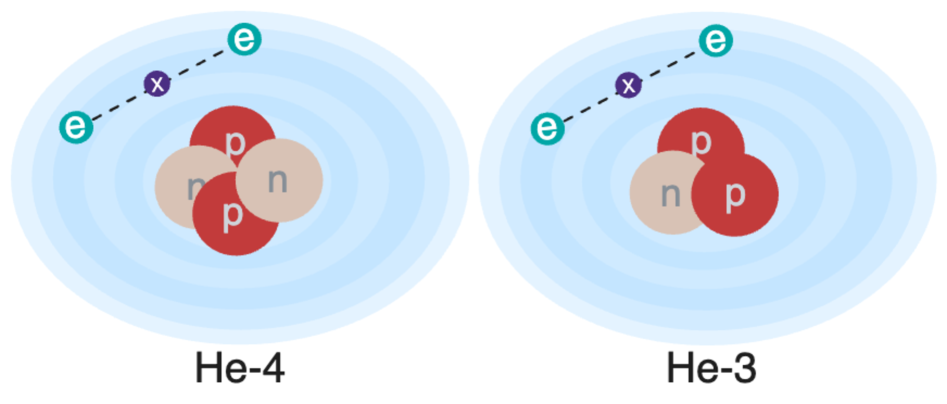
New spectroscopic analysis of helium ionization energy excludes several proposed scenarios for beyond-the-Standard-Model physics, but leaves a window for light scalar boson interactions.
A persistent discrepancy between theoretical prediction and experimental measurement challenges the completeness of the Standard Model, motivating searches for new physics. This is the focus of ‘Testing Exotic Electron-Electron Interactions with the Helium Ionization-Energy Anomaly’, which investigates a reported anomaly in the ionization energy of metastable helium as a potential signature of exotic interactions between electrons. Through a model-independent analysis, the authors demonstrate that several proposed scenarios-including vector-vector, pseudoscalar-pseudoscalar, and axial-vector interactions-can be effectively excluded, leaving a narrowly constrained scalar-mediated interaction as a partial explanation. Could further refinement of fundamental constants, such as the electron gyromagnetic ratio, ultimately resolve this anomaly and reveal the nature of these interactions?
Helium’s Stubborn Secret: A Glitch in the Matrix
Helium spectroscopy, employing techniques of exceptional precision, consistently demonstrates a statistically significant variance between measured ionization energies and predictions derived from the Standard Model of particle physics. This isn’t a marginal error; the discrepancy registers at 9\sigma, a level of certainty that, in scientific terms, strongly suggests the presence of new, unaccounted-for physics. Ionization energy, the energy required to remove an electron from an atom, is a fundamental property predicted with extreme accuracy by current theoretical frameworks, particularly Quantum Electrodynamics. However, repeated measurements on helium atoms reveal a consistent excess in the observed ionization energies, indicating that the theoretical models are falling short. This persistent anomaly isn’t attributed to experimental error, as meticulous procedures and independent verification have consistently confirmed the results, forcing physicists to consider modifications to the Standard Model or the existence of previously unknown interactions.
The consistently observed variance in helium ionization energies isn’t attributable to experimental error or random chance; repeated high-precision spectroscopic measurements have solidified its statistical significance. This discrepancy, exceeding a 9\sigma threshold, indicates a genuine deviation from predictions established by the Standard Model of particle physics. Scientists have rigorously examined potential sources of systematic error, confirming the anomaly’s robustness and necessitating a theoretical framework capable of explaining the unexpected results. The persistence of this finding challenges the completeness of current understanding and fuels ongoing investigations into new physics beyond the established model, potentially involving interactions or particles yet to be discovered.
Despite its remarkable accuracy in predicting electromagnetic interactions, Quantum Electrodynamics (QED) currently struggles to reconcile theoretical calculations with highly precise measurements of helium ionization energies. The persistent 9σ discrepancy suggests that the Standard Model of particle physics, of which QED is a cornerstone, may be incomplete. This mismatch isn’t simply a matter of refining existing calculations; it points toward the potential existence of new, undiscovered physics beyond our current understanding. Researchers are now exploring various theoretical extensions – including modifications to fundamental constants, the existence of dark photons, or even the influence of extra spatial dimensions – in an attempt to account for the observed variance and potentially unlock a deeper understanding of the universe’s fundamental forces. The helium anomaly, therefore, serves as a compelling impetus for pushing the boundaries of theoretical physics and experimental investigation.
Beyond the Standard Model: A Glimpse at the Unseen
Observations consistently reveal deviations from predictions made by the Standard Model of particle physics, necessitating exploration beyond its current framework. These discrepancies suggest the existence of Exotic Interactions, which propose forces not accounted for within the Standard Model’s known fundamental forces – strong, weak, electromagnetic, and gravity. The evidence for these interactions arises from precision measurements in various physical systems, indicating that currently unobserved particles or forces may be influencing observed phenomena. The investigation of Exotic Interactions is therefore a crucial area of research aimed at a more complete understanding of the fundamental constituents of the universe and the forces governing their behavior.
The theoretical framework of Exotic Interactions postulates forces not currently described by the Standard Model, and a key element of these interactions is the potential involvement of a New Boson. Bosons are fundamental particles with integer spin that act as force carriers; examples within the Standard Model include photons (electromagnetic force), gluons (strong force), and W and Z bosons (weak force). In the context of Exotic Interactions, this New Boson would mediate the force between particles, analogous to how established bosons mediate known forces. The properties of this hypothetical boson – its mass, spin, and coupling strength – determine the characteristics of the new interaction and are actively constrained by experimental measurements, such as those derived from Helium Spectroscopy.
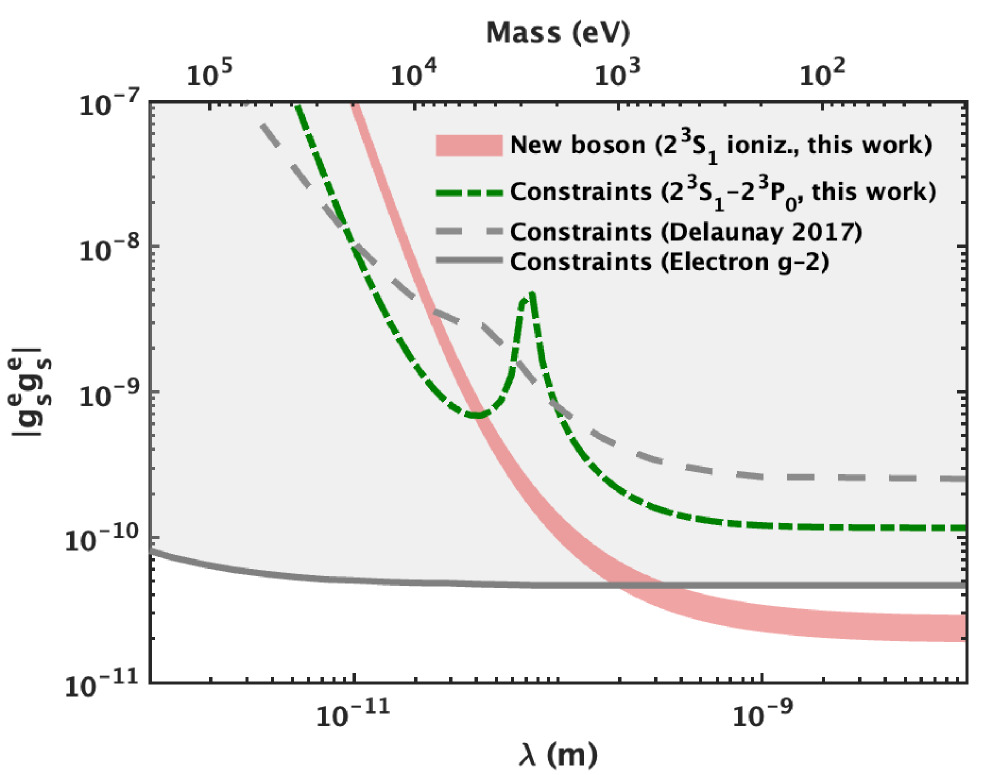
Helium spectroscopy provides high-precision data for constraining the properties of hypothetical force-mediating bosons beyond the Standard Model. Analysis of the 23S1-23P0 transition in Helium-4 yields stringent upper limits on the mass of a potential scalar mediator. Current measurements constrain the mass of this scalar mediator to be less than 5000 electron volts (eV). This limit is derived from the observed absence of specific spectral distortions that would be induced by interactions mediated by such a boson, effectively narrowing the parameter space for beyond-Standard-Model physics.
Testing the Hypothesis: A Consistency Check for New Physics
The Single-Boson Hypothesis posits that the observed anomaly in experimental data stems from interactions mediated by a single, as-yet-undiscovered particle. This framework simplifies the explanation by attributing the discrepancy to the exchange of this new boson between participating particles. Rather than requiring complex interactions involving multiple new particles or modifications to the Standard Model, this hypothesis suggests a straightforward mechanism: the anomalous signal is a direct consequence of the properties – mass and coupling strength – of this single mediating particle. While other explanations are possible, the Single-Boson Hypothesis provides a relatively parsimonious starting point for investigating the origin of the observed anomaly.
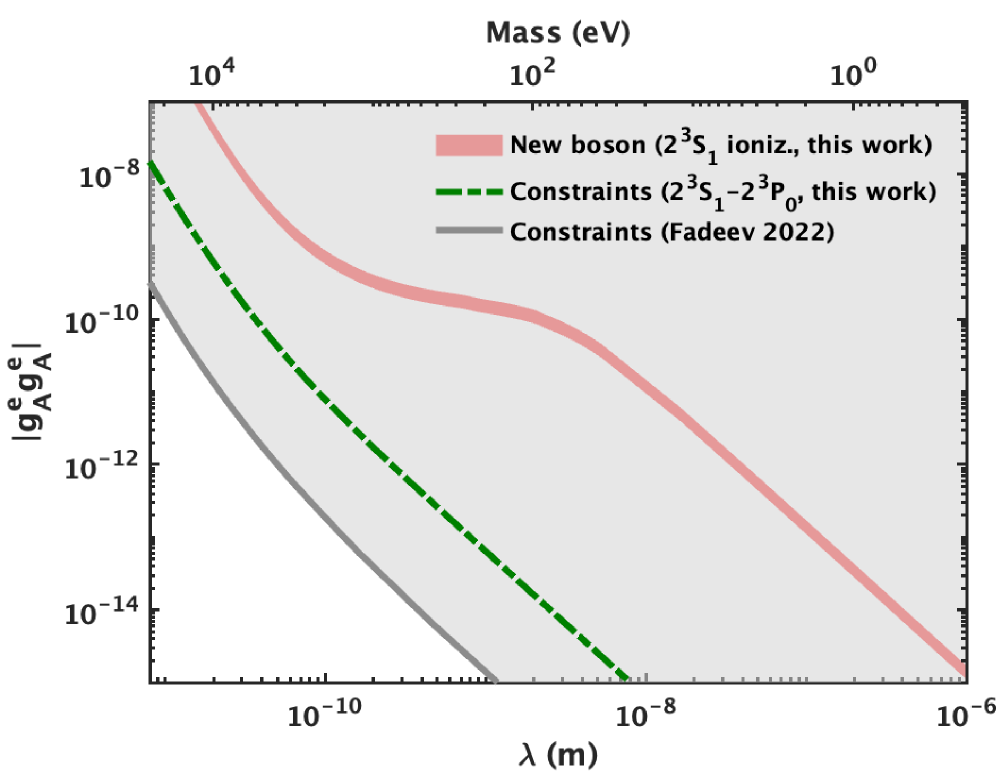
The Sign Consistency Criterion functions as a validation test for proposed exotic interactions by requiring quantitative agreement between the theoretical contribution of the new interaction and the magnitude of the observed anomaly. This criterion stems from the principle that any proposed interaction must account for the full discrepancy without introducing inconsistencies in the measured data; specifically, the sign of the interaction’s contribution must align with the observed deviation. Interactions failing this consistency check are considered non-viable explanations, as they predict a contribution that either cancels out the observed effect or exacerbates it in an unphysical manner. Therefore, only interactions that quantitatively and qualitatively match the anomaly’s signature are considered plausible candidates.
Scalar interactions, representing a potential explanation for observed anomalies, are subject to stringent consistency tests based on experimental data. Analysis indicates that while many scalar mediator masses are excluded, a scalar particle with a mass below 800 eV continues to provide a partially viable, though not definitive, explanation for the observed discrepancies. This lower mass range avoids immediate conflict with current experimental constraints, but further data is required to confirm or refute the scalar hypothesis within this parameter space. The viability is conditional and dependent on the specific coupling strengths and interaction parameters of the scalar mediator.
The pursuit of deviations from the Standard Model, as illustrated by this helium ionization-energy anomaly investigation, feels suspiciously like polishing brass on the Titanic. The researchers diligently exclude potential new physics scenarios – light scalars, mostly – refining the constraints with each iteration. It’s a commendable effort, of course, but one can’t help but suspect that production – in this case, the universe itself – will always find a way to introduce a new, equally perplexing wobble. As Pyotr Kapitsa once observed, “It is better to be slightly paranoid than to be completely surprised.” This paper meticulously narrows the possibilities, but the feeling lingers that the next measurement will reveal a problem far stranger than a light scalar. One builds elegant models; the universe writes code – and leaves notes for digital archaeologists.
So, What Breaks Next?
The continued scrutiny of helium’s ionization energy, as this work demonstrates, is less a search for new physics and more a remarkably precise exercise in confirming the Standard Model’s stubborn resilience. Each excluded parameter space for light scalar bosons feels less like a discovery averted and more like a shrinking target for the inevitable, messy reality of production systems. One suspects that whatever ultimately does explain the anomaly-should one persist with sufficient statistical rigor-will be something profoundly mundane, likely involving an overlooked systematic error or a calibration drift no one bothered to document.
Future iterations will, naturally, involve more digits of precision, more complex theoretical models, and increasingly desperate attempts to squeeze signal from noise. The trend is predictable. The search for exotic interactions will, predictably, discover increasingly mundane explanations. It’s a timeless cycle.
The real question isn’t whether a light scalar boson exists, but rather what unforeseen complication will emerge when someone inevitably attempts to apply these exquisitely precise calculations to a slightly more realistic, and therefore hopelessly messy, atomic system. Production is, after all, the ultimate QA. And it always finds a way.
Original article: https://arxiv.org/pdf/2602.09743.pdf
Contact the author: https://www.linkedin.com/in/avetisyan/
See also:
- Frieren: Beyond Journey’s End Gets a New Release After Season 2 Finale
- Surprise Isekai Anime Confirms Season 2 With New Crunchyroll Streaming Release
- PRAGMATA ‘Eight’ trailer
- Solo Leveling’s New Character Gets a New Story Amid Season 3 Delay
- All 7 New Supes In The Boys Season 5 & Their Powers Explained
- Pragmata Shows Off Even More Gorgeous RTX Path Tracing Ahead of Launch
- HBO Max Just Added the Final Episodes of a Modern Adult Swim Classic
- Crimson Desert’s Momentum Continues With 10 Incredible New Changes
- How Could We Forget About SOL Shogunate, the PS5 Action RPG About Samurai on the Moon?
- Hulu Just Added One of the Most Quotable Movies Ever Made (But It’s Sequel Is Impossible To Stream)
2026-02-11 12:08