Author: Denis Avetisyan
A novel search-based testing approach dramatically improves the detection of errors in quantum circuits, bringing us closer to reliable quantum computation.
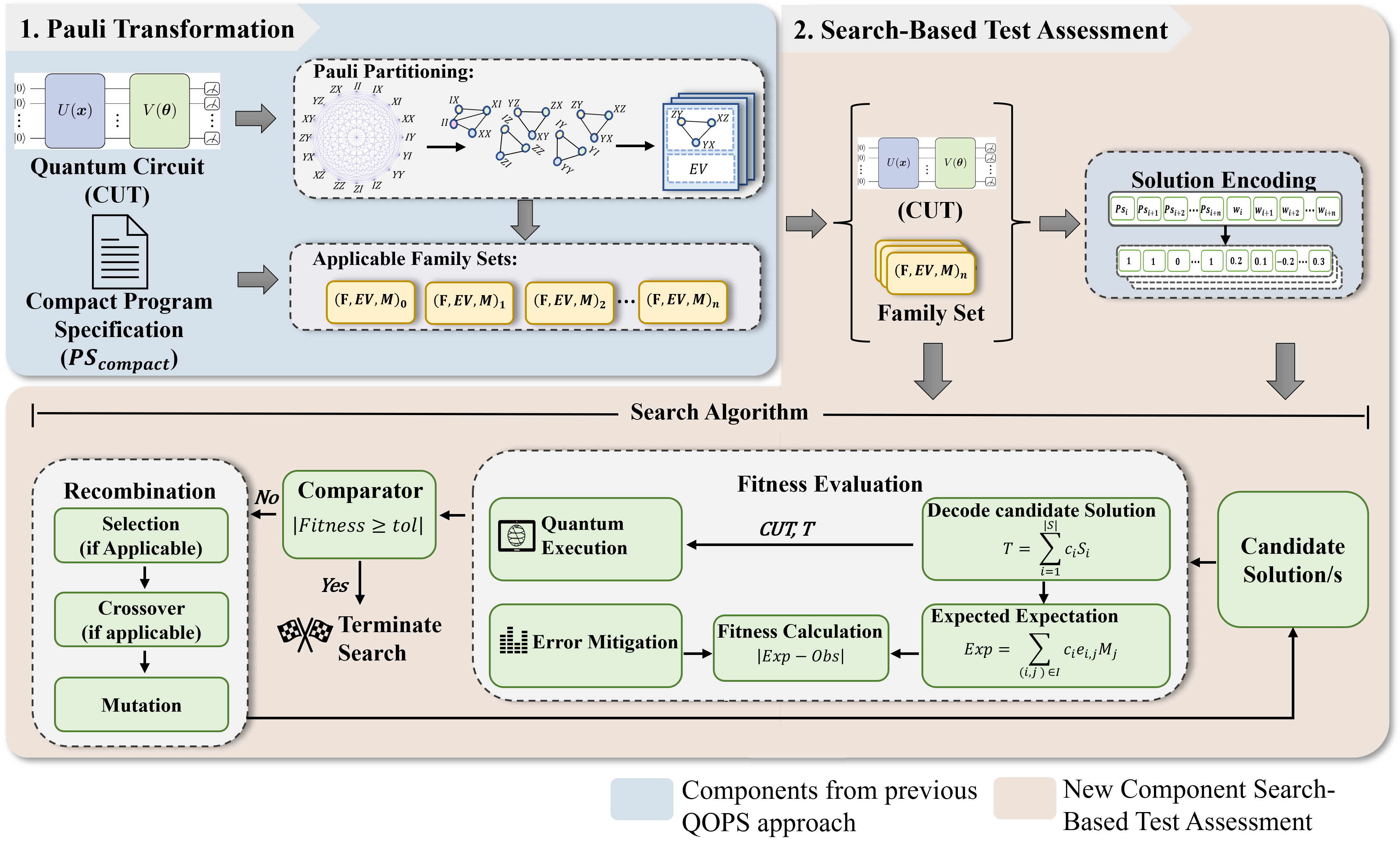
This paper introduces 𝚂𝙱-𝚀𝙾𝙿𝚂, a search-based quantum software testing method utilizing commuting Pauli strings and error mitigation for enhanced fault detection on real quantum hardware.
Reliable execution of quantum software remains a significant challenge despite advancements in quantum computing. This paper introduces SB-QOPS, a novel search-based approach for quantum program testing, detailed in ‘Search-Based Quantum Program Testing via Commuting Pauli String’, which leverages commuting Pauli strings to redefine test cases and enhance fault detection. Through systematic exploration of the test space and a measurement-centric oracle, SB-QOPS achieves 100% fault detection on circuits up to 29 qubits across multiple quantum platforms. Can this approach pave the way for more robust and scalable quantum software development in the presence of noise and limited resources?
The Quantum Fragility Problem: A Necessary Evil
The promise of quantum computation – solving problems intractable for even the most powerful classical computers – is shadowed by a fundamental challenge: quantum noise. Unlike bits in conventional computers which are either 0 or 1, quantum bits, or qubits, leverage superposition and entanglement to explore many possibilities simultaneously. However, this very sensitivity that grants them power also makes them incredibly vulnerable to environmental disturbances. Stray electromagnetic fields, temperature fluctuations, and even cosmic rays can disrupt the delicate quantum states of qubits, introducing errors into calculations. These aren’t simple glitches; because of the principles of quantum mechanics – notably the no-cloning theorem which prevents perfect copying of quantum information – error correction is far more complex than in classical computing. Consequently, building a reliable quantum computer necessitates not only creating stable qubits, but also developing sophisticated techniques to detect and mitigate the inevitable errors that arise from this inherent fragility, a hurdle that remains a significant obstacle in realizing the full potential of quantum computation.
The fundamental principles governing quantum computation present a unique challenge to software verification. Unlike classical systems where states are definite, quantum circuits operate on probabilities, meaning a given input can yield multiple outcomes, each with an associated likelihood. This inherent probabilistic nature renders traditional ‘pass/fail’ testing methodologies ineffective; a test might succeed a portion of the time due to chance, masking underlying errors. Furthermore, the very act of observing a quantum system to check its state fundamentally alters that state – a consequence of the Heisenberg uncertainty principle and the principles of quantum mechanics. This makes direct debugging and comprehensive state verification exceptionally difficult, as any attempt to inspect the system introduces further disturbances and potentially obscures the original fault. Consequently, entirely new strategies are required to assess the reliability of quantum software, moving beyond deterministic testing towards methods that can infer correctness without fully revealing the quantum state.
Successfully verifying the operation of quantum software presents a significant departure from conventional testing paradigms. Unlike classical systems where states can be directly observed, quantum computations are governed by probabilistic outcomes and the very act of measurement alters the system. Consequently, exhaustive testing – verifying every possible input and output – becomes impractical, if not impossible. Researchers are therefore developing innovative fault detection strategies that sidestep the need for complete state knowledge. These methods often rely on characterizing statistical properties of the computation, employing techniques like randomized compiling – running the same program multiple times with varied, randomly generated circuits – to amplify errors and reveal underlying defects. Other approaches focus on verifying specific properties of the quantum computation, such as unitarity or the preservation of entanglement, without needing to know the precise final state, thereby offering a pathway towards reliable quantum computation despite inherent noise and the limitations of direct observation.
QOPS: A Pragmatic Approach to Quantum Testing
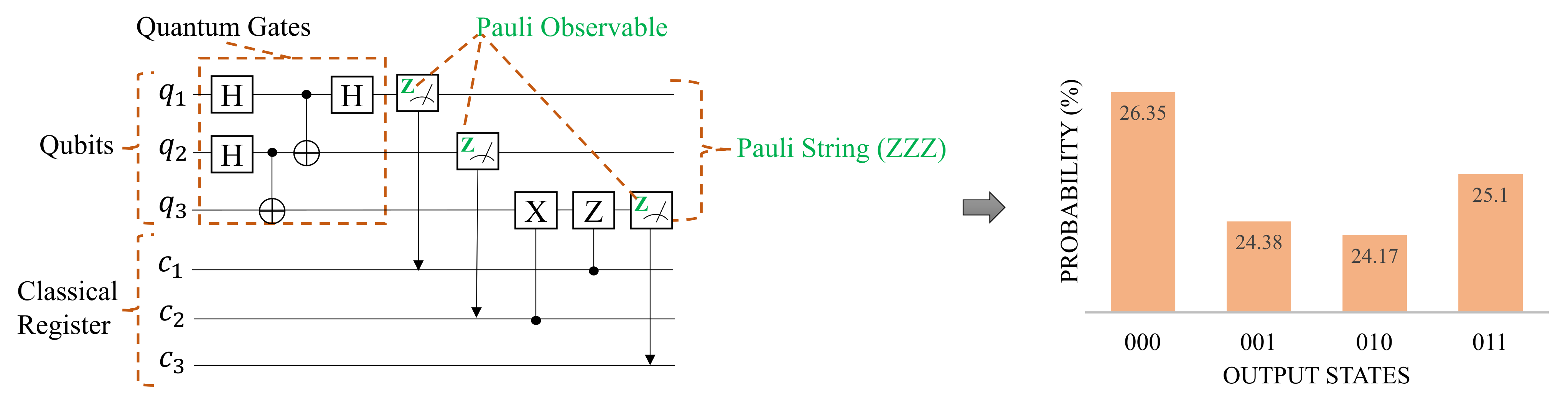
QOPS employs Pauli strings – tensor products of Pauli matrices \sigma_x, \sigma_y, \sigma_z, and the identity \sigma_0 – as a basis for defining quantum test cases. This approach allows for a compact representation of possible measurement outcomes, significantly reducing the size of the test space compared to exhaustive state vector testing. Each Pauli string represents a specific measurement basis, and a test case is constructed by specifying the expected result – typically a bitstring of +1 or -1 – for each Pauli string. The use of Pauli strings facilitates systematic testing by providing a standardized way to explore the circuit’s behavior under different measurement contexts, offering a computationally tractable method for verifying quantum software.
The Expectation Value Oracle (EVO) streamlines quantum software testing by focusing on verifying expected values of Pauli observables rather than requiring full state vector comparisons. This approach significantly reduces the complexity of test case creation; instead of defining the complete output state for a given circuit, tests only need to specify the anticipated expectation value for one or more Pauli strings. The EVO calculates the expectation value of a given Pauli string with respect to the circuit’s output state and compares it to the specified expected value, determining test pass/fail status. This methodology is effective because many quantum algorithms are characterized by their impact on specific observables, making expectation value verification a sufficient condition for basic functional correctness.
Systematic state space exploration within QOPS is achieved by generating Pauli strings, which represent a basis for observable measurements on a quantum system. Each Pauli string defines a specific measurement that, when applied to the output state of a quantum circuit, yields an expectation value. By evaluating these expectation values against predefined criteria, QOPS can identify discrepancies indicative of potential faults in the circuit’s implementation. This approach allows for initial fault detection without requiring complete knowledge of the expected output state, and facilitates verification by exhaustively testing the circuit’s behavior under a defined set of Pauli measurements, covering a substantial portion of the Hilbert space.
SB-QOPS: Automating the Hunt for Quantum Bugs
SB-QOPS builds upon the Quantum Oracle Performance Simulator (QOPS) by integrating search-based testing methodologies to automate the generation of test cases. This automation significantly enhances the efficiency of fault detection in quantum circuits. Unlike traditional, manually-defined test suites, SB-QOPS utilizes algorithms to explore the input test space, systematically identifying inputs that are likely to expose potential faults or errors within the circuit’s implementation. This approach allows for a more comprehensive and efficient evaluation of circuit functionality compared to the original QOPS framework, which relied on pre-defined test patterns.
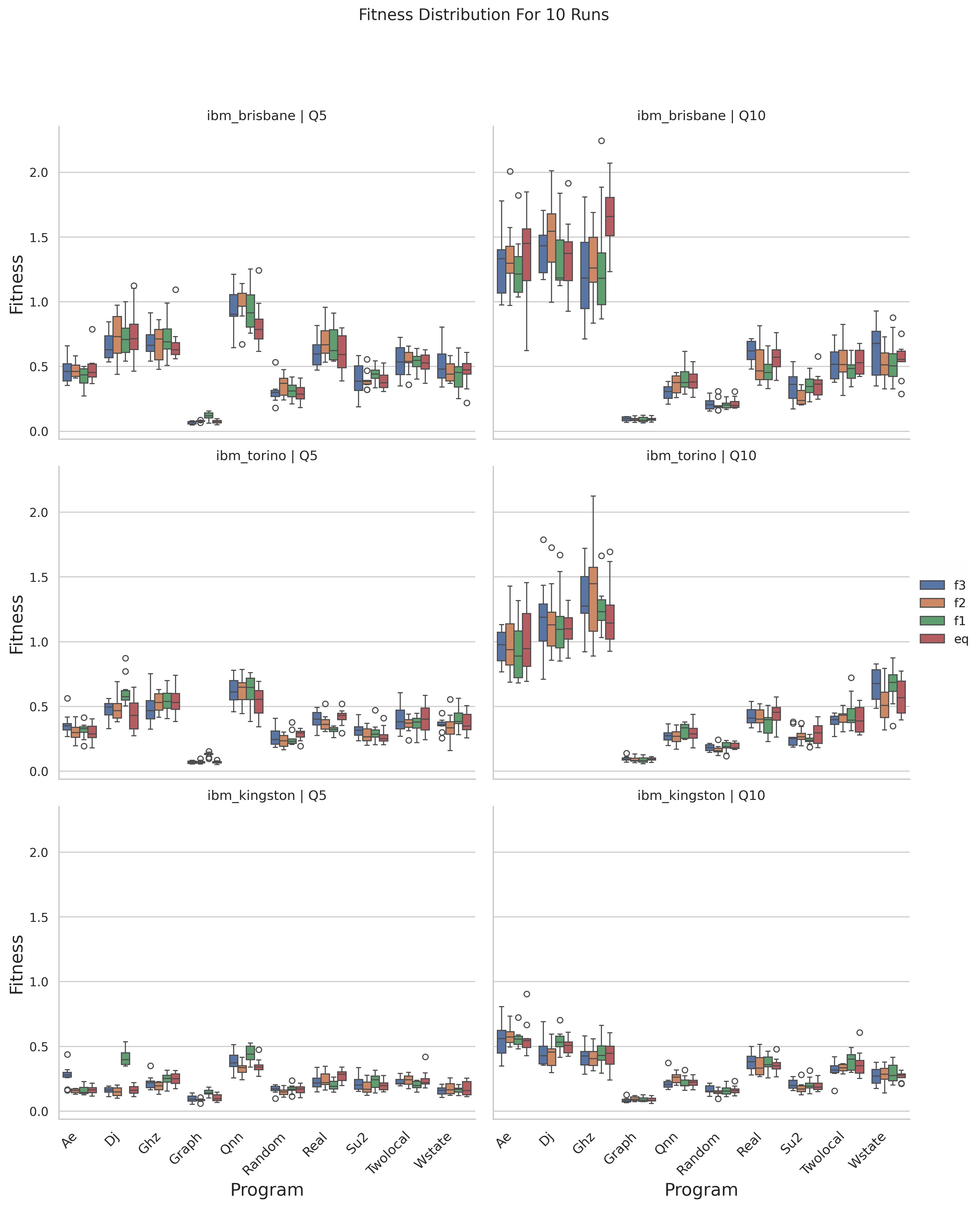
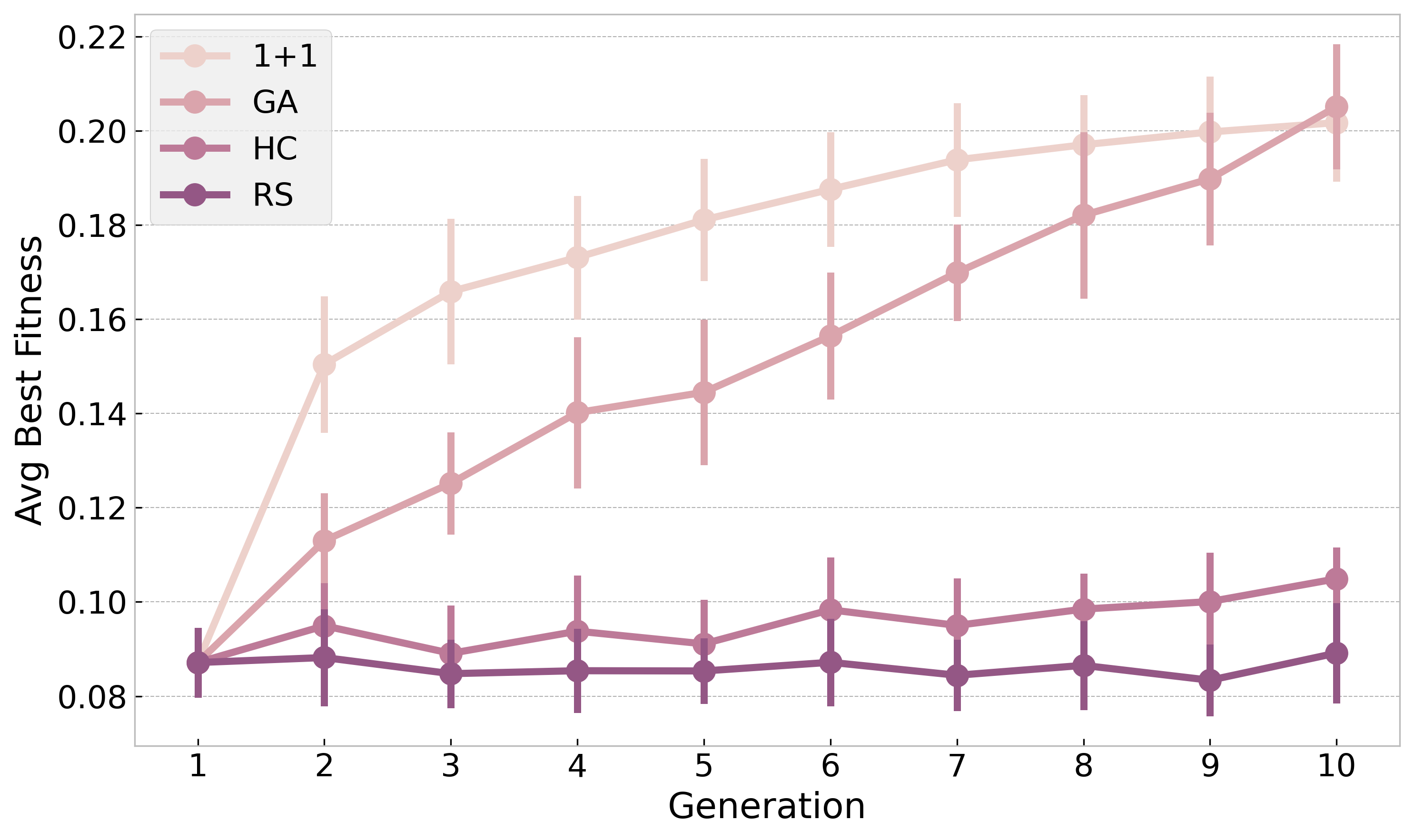
Search-based testing within SB-QOPS leverages algorithms including Genetic Algorithms, Hill Climbing, and the 1+1 Evolutionary Algorithm to systematically explore the space of possible quantum circuit inputs. These algorithms function by iteratively generating and evaluating test cases, with each iteration guided by a fitness function designed to identify inputs that expose circuit failures. Genetic Algorithms employ principles of natural selection, while Hill Climbing refines solutions through incremental adjustments. The 1+1 Evolutionary Algorithm, a simplified evolutionary strategy, utilizes mutation and selection to efficiently traverse the search space. By automating test case generation and focusing on areas likely to reveal faults, these algorithms improve the efficiency of fault detection compared to random or manually crafted test suites.
Fault Detection Score (FDS) is the primary metric used to evaluate the performance of search-based testing methods within the SB-QOPS framework. Testing on quantum circuits ranging in size up to 29 qubits has consistently yielded a 100% FDS, indicating complete fault detection capability. This represents a demonstrable improvement over the original QOPS approach, which does not consistently achieve 100% fault detection on circuits of comparable size. The FDS is calculated based on the percentage of injected faults correctly identified during automated test case generation and execution, providing a quantitative measure of the enhanced fault detection efficiency offered by SB-QOPS.
From Simulation to Reality: Validating on Actual Quantum Hardware
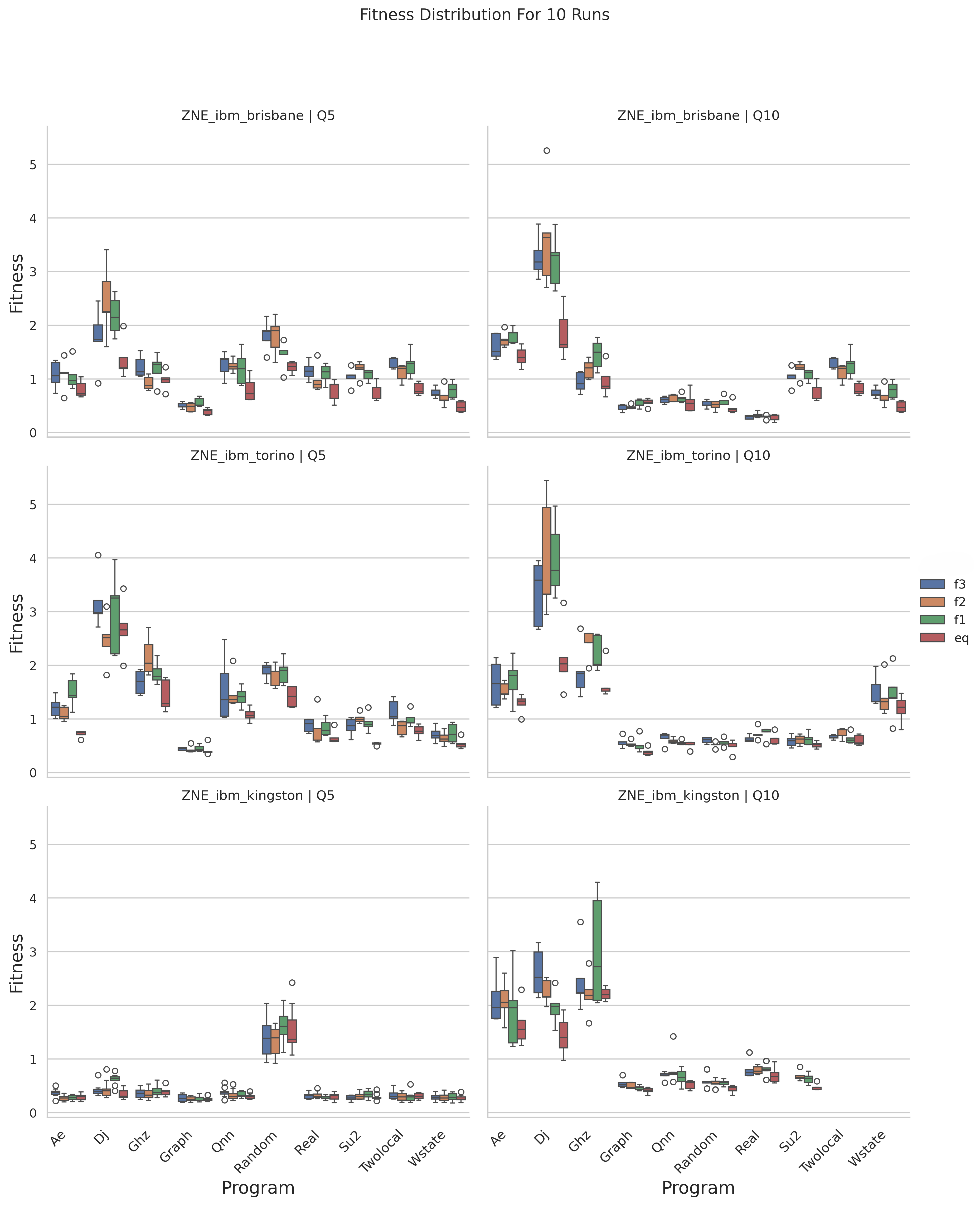
Successful implementation of SB-QOPS across diverse quantum computing platforms – specifically IBM Quantum Computer, IQM Quantum Computer, and the Quantinuum system – marks a significant step towards practical quantum validation. These experiments weren’t confined to simulations; the toolkit was directly applied to real quantum hardware, allowing for assessments of its functionality in authentic, noisy environments. The ability of SB-QOPS to operate consistently across these varied architectures – each with unique qubit characteristics and control mechanisms – demonstrates its adaptability and broad applicability. This cross-platform validation strengthens confidence in SB-QOPS as a reliable and versatile tool for characterizing quantum circuits and advancing the field of quantum computing.
Recent experimentation showcases the capacity of SB-QOPS to pinpoint errors and gauge the dependability of quantum circuits operating within genuine, noisy conditions. Unlike simulations performed on classical computers, these tests were conducted directly on leading quantum hardware – including platforms from IBM Quantum, IQM, and Quantinuum – exposing SB-QOPS to the realities of decoherence, gate infidelity, and other pervasive errors. The results indicate that SB-QOPS doesn’t merely identify that an error occurred, but provides data to characterize the type and location of the fault, allowing for a nuanced understanding of circuit performance. This ability to diagnose reliability issues in real-time is crucial for advancing quantum computing beyond theoretical demonstrations and towards practical application, as it enables iterative improvements in hardware and circuit design based on empirical evidence gathered from actual quantum processors.
Quantum systems are notoriously susceptible to noise, which introduces errors that can quickly corrupt computations. To address this fundamental challenge, error mitigation techniques were integrated directly into the SB-QOPS testing framework. These techniques don’t eliminate errors entirely, but rather statistically reduce their impact on the reliability assessment. By strategically applying methods like zero-noise extrapolation and probabilistic error cancellation, the system effectively compensates for the inherent imperfections of current quantum hardware. This allows for a more accurate evaluation of circuit performance, even in the presence of substantial noise, and ultimately strengthens the ability of SB-QOPS to identify and quantify faults with greater confidence. The result is a testing process that is considerably more robust and delivers more meaningful insights into the dependability of quantum circuits.
The Road Ahead: Towards Truly Reliable Quantum Software
The pursuit of fault-free quantum software benefits significantly from the integration of rigorous testing methodologies, and extending the Search-Based Quantum Operation Placement and Scheduling (SB-QOPS) framework with techniques like mutation testing and statistical hypothesis testing represents a key advancement. Mutation testing systematically introduces small errors into the quantum code, evaluating whether the testing suite can detect these intentionally induced faults, thereby gauging the test suite’s effectiveness. Complementing this, statistical hypothesis testing allows researchers to quantitatively assess the likelihood that observed test failures are due to genuine bugs rather than random chance. By combining these approaches, developers can achieve a more comprehensive fault coverage, identifying subtle errors that might otherwise remain hidden and ultimately building more reliable quantum algorithms and applications.
Current search-based algorithms, while promising for quantum software optimization, often operate with generalized assumptions about error profiles and hardware limitations. To truly maximize their effectiveness, these algorithms require adaptation to account for the unique characteristics of specific quantum platforms and the types of errors most prevalent within them. This involves tailoring the search space, fitness functions, and genetic operators to prioritize solutions resilient to decoherence, gate infidelity, or connectivity constraints inherent to particular quantum devices. By incorporating detailed models of error distributions and platform architecture, these algorithms can evolve quantum programs that are not simply optimal in theory, but demonstrably robust and performant on real-world quantum hardware, ultimately accelerating the path toward practical quantum computation.
The culmination of ongoing efforts in quantum software engineering promises a transition from theoretical potential to tangible reality. As advancements in testing methodologies and optimization algorithms mature, the resulting software will exhibit significantly improved reliability and resilience against errors inherent in quantum systems. This increased robustness is not merely an academic pursuit; it is the essential foundation upon which practical quantum applications – spanning fields like materials science, drug discovery, and financial modeling – can be built and deployed with confidence. The development of truly dependable quantum software unlocks the power of these technologies, moving them beyond the laboratory and into everyday problem-solving, ultimately realizing the long-anticipated quantum revolution.
The pursuit of perfect quantum circuits, as detailed in this work on 𝚂𝙱-𝚀𝙿𝚂, feels almost quaint. It’s a meticulous attempt to anticipate every possible failure mode, a noble effort doomed to be outpaced by the sheer creativity of real-world hardware. As Grace Hopper observed, “It’s easier to ask forgiveness than it is to get permission.” This resonates deeply; the paper proposes systematically finding errors through search-based testing, acknowledging that complete prevention is a fantasy. The focus on Pauli strings and error mitigation isn’t about building flawless systems, but about building systems that degrade predictably – systems that can be forgiven their inevitable flaws. Tests are, after all, a form of faith, not certainty.
What’s Next?
The pursuit of reliable quantum computation, as evidenced by this work, inevitably devolves into a sophisticated game of whack-a-mole with decoherence. 𝚂𝙱-𝚀𝙾𝙿𝚂 offers a marginally less chaotic method for finding faults, but the underlying problem remains: the hardware will always be messier than the models. One suspects future iterations will involve increasingly elaborate error mitigation schemes, layered atop equally complex testing frameworks – a beautiful, fragile tower built on a foundation of wishful thinking. They’ll call it AI and raise funding, naturally.
A critical, and largely unaddressed, issue is scalability. This approach, while promising for small circuits, will likely struggle as quantum programs grow in complexity. The search space explodes, and the cost of evaluating even a single test case becomes prohibitive. One imagines a future where quantum software testing is performed on a quantum computer, creating a recursive loop of debugging that may never terminate.
The documentation lied again, of course. The real challenge isn’t simply detecting errors, but understanding why they occur. This necessitates a deeper integration of testing with the underlying physics of the quantum device. Ultimately, the elegance of a theoretical testing framework will be judged not by its cleverness, but by its ability to predict-and compensate for-the inevitable chaos of the real world. It used to be a simple bash script, truly.
Original article: https://arxiv.org/pdf/2602.11487.pdf
Contact the author: https://www.linkedin.com/in/avetisyan/
See also:
- Trails in the Sky 2nd Chapter launches September 17
- HBO Max Just Added the Final Episodes of a Modern Adult Swim Classic
- Pragmata Shows Off Even More Gorgeous RTX Path Tracing Ahead of Launch
- Crimson Desert’s Momentum Continues With 10 Incredible New Changes
- Solo Leveling’s New Character Gets a New Story Amid Season 3 Delay
- PRAGMATA ‘Eight’ trailer
- All 7 New Supes In The Boys Season 5 & Their Powers Explained
- Dragon Quest Smash/Grow launches April 21
- Frieren: Beyond Journey’s End Gets a New Release After Season 2 Finale
- How Could We Forget About SOL Shogunate, the PS5 Action RPG About Samurai on the Moon?
2026-02-13 07:59