Author: Denis Avetisyan
A new analysis tightens the constraints on dark axion interactions, leveraging both searches for invisible particles and precise measurements of fundamental asymmetries.
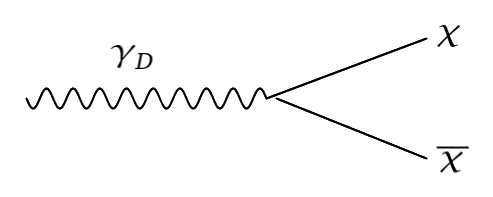
This review explores the phenomenological implications of the dark axion portal, focusing on signatures in fixed-target experiments and constraints from electric dipole moment measurements.
The persistent mystery of dark matter necessitates exploration of diverse theoretical frameworks beyond the Standard Model. This paper, ‘Constraints on dark axion portal: missing energy and fermion EDMs’, investigates a scenario where dark matter interacts with the visible sector via a ‘dark axion portal’, mediated by both dark photons and axion-like particles. By analyzing missing energy signatures in fixed-target experiments like NA64$e$ and LDMX, alongside constraints from electric dipole moment (EDM) measurements-sensitive to CP-violating interactions-we establish novel bounds on the parameter space of these hidden sector couplings. Could these combined constraints illuminate the nature of dark matter and reveal new sources of CP violation in the universe?
The Universe Whispers: Unseen Signatures of the Missing
Despite its extraordinary predictive power, the Standard Model of particle physics fails to account for a significant portion of the universe’s composition. Cosmological observations strongly suggest the existence of dark matter, an invisible substance comprising roughly 85% of the universe’s mass, and dark energy, responsible for the accelerating expansion of the cosmos. These phenomena remain unexplained within the Standard Model’s framework, indicating the presence of physics beyond what is currently understood. Furthermore, the model offers no explanation for the observed matter-antimatter asymmetry – the imbalance between matter and antimatter in the universe – prompting physicists to explore theoretical extensions and search for new particles that could resolve these fundamental mysteries. The continued success of the Standard Model, coupled with these glaring omissions, highlights the exciting possibility of discovering new particles and forces that will reshape our understanding of the universe.
The limitations of the Standard Model in explaining phenomena like dark matter have motivated exploration beyond its established framework, leading physicists to investigate hypothetical particles such as Axion-Like Particles (ALPs). These particles, not predicted by the Standard Model, are proposed as potential mediators between the visible universe and dark matter, and could also resolve inconsistencies in certain particle interactions. ALPs are characterized by their extremely weak interactions with ordinary matter, making direct detection incredibly challenging. Theoretical models suggest ALPs could be produced in high-energy processes, and their existence would manifest as subtle deviations from expected energy and momentum conservation – a ‘missing energy’ signature – offering a unique pathway to unveil the hidden components of the cosmos and refine ΛCDM cosmology.
The search for Axion-Like Particles (ALPs) hinges on a subtle but profound observational challenge: detecting ‘missing energy’. In particle interactions, fundamental laws dictate that energy and momentum must always be conserved. However, if ALPs exist and weakly interact with standard model particles, they could carry away a portion of this energy and momentum, leaving an apparent deficit in observed interactions. This wouldn’t represent a violation of physical laws, but rather energy escaping detection via these elusive particles. Experiments, therefore, meticulously analyze the products of high-energy collisions, seeking imbalances that can’t be accounted for by known particles – a ‘missing energy signature’ indicating the possible presence of these ghostly ALPs. The precision required is immense, demanding incredibly sensitive detectors and a thorough understanding of background noise, as even the smallest unaccounted-for energy loss could provide the crucial evidence needed to confirm their existence.
Forging the Shadows: Production Pathways of the Hidden Sector
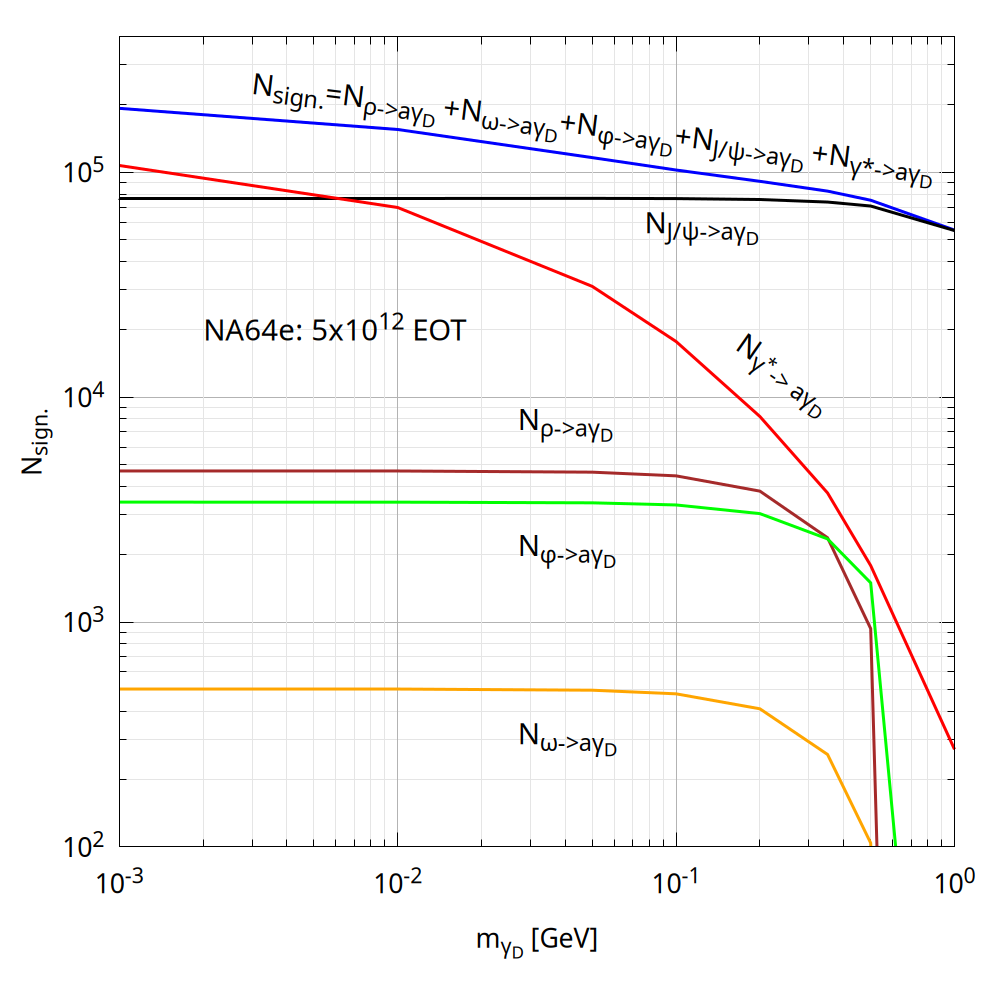
Axion-Like Particles (ALPs) are predicted to be produced in high-energy collision experiments through several distinct processes. Bremsstrahlung production involves the emission of an ALP from an energetic particle interacting with electromagnetic fields, effectively converting energy into the ALP. Vector Meson Photoproduction, conversely, relies on the interaction of high-energy photons with target nuclei to create vector mesons, which subsequently decay into ALP pairs. Both mechanisms are dependent on the energy of the colliding particles and the strength of the coupling between the ALP and Standard Model particles; therefore, these production rates are key parameters in experimental searches for ALPs.
Axion-like particles (ALPs) and their associated dark photons can be produced through interactions involving high-energy photons and target nuclei. Specifically, processes such as Bremsstrahlung production involve the emission of an ALP from an electron interacting with the nucleus, with the ALP subsequently decaying into a dark photon pair. Vector meson photoproduction utilizes a photon interacting with a nucleus to create a vector meson, which then decays into ALP-dark photon pairs. These production pathways rely on the electromagnetic interaction to initiate the process, followed by the decay of the intermediate particle into the hypothesized dark sector constituents; the efficiency of these processes is directly related to the strength of the coupling between ALPs and photons, as well as the energy of the incident particles.
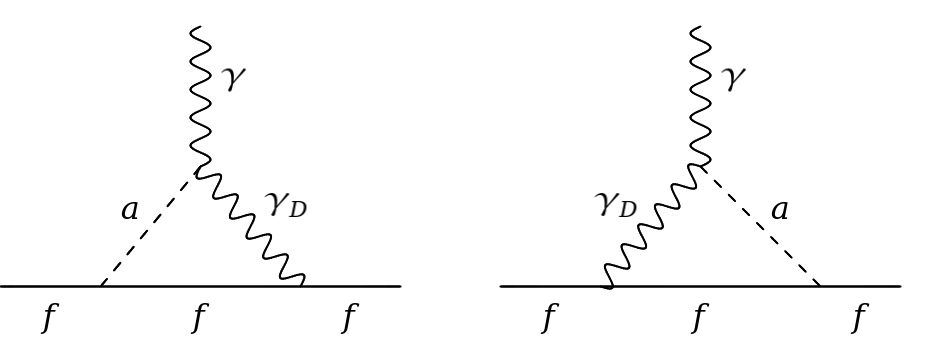
The Dark Axion Portal proposes a kinetic mixing interaction between axion-like particles (ALPs) and dark photons, effectively allowing ALPs to decay into dark photons and vice versa. This interaction is parameterized by a mixing parameter, ε, which quantifies the strength of the coupling. The portal’s framework predicts that ALPs can be produced in high-energy collisions, subsequently decaying into dark photons, or conversely, that dark photons can decay into ALPs. Crucially, this coupling facilitates detectable signatures in experiments designed to search for both ALPs and dark photons, providing a potential pathway for indirect detection even if both particles are weakly interacting and difficult to observe directly. The magnitude of ε directly impacts the production rates and decay lengths of both particles, influencing experimental sensitivity and search strategies.
Hunting Ghosts: Experimental Frontiers in the Search for the Invisible
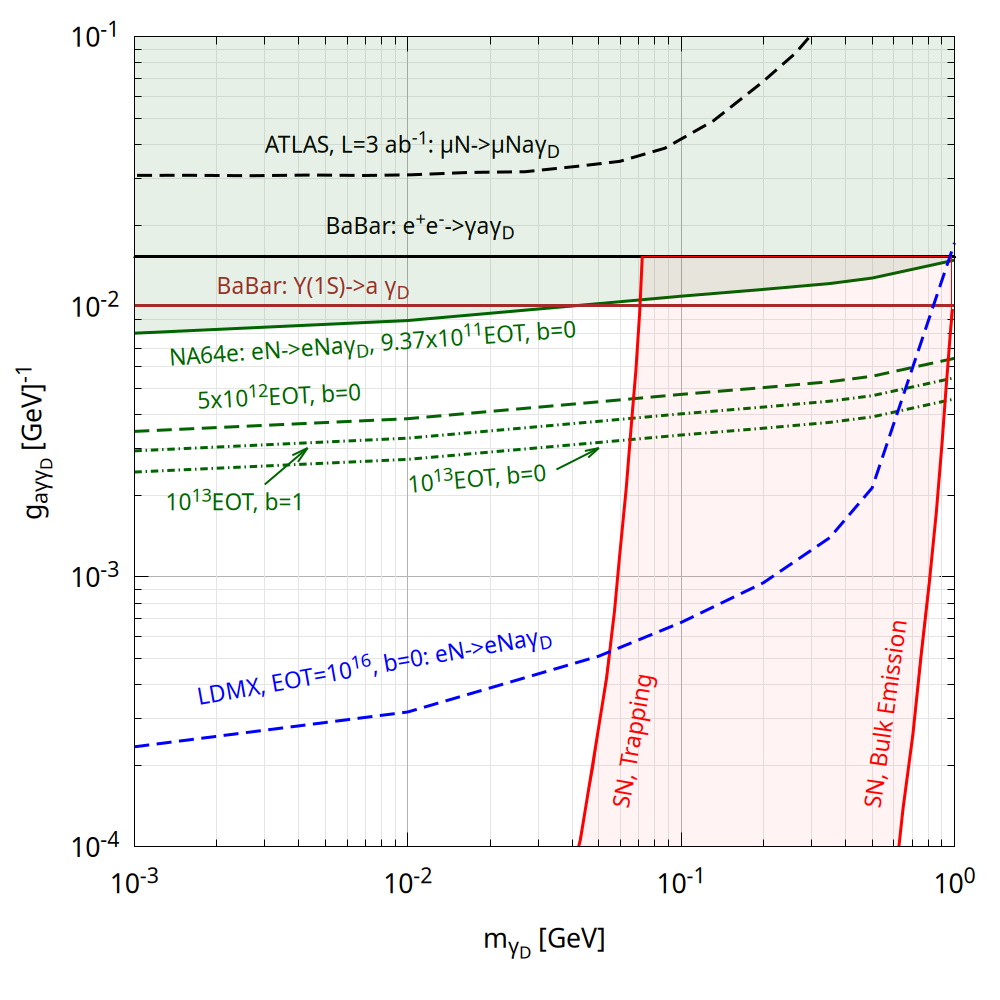
NA64ee and LDMX employ high-intensity electron beams to probe for physics beyond the Standard Model, specifically searching for signatures of new, weakly interacting particles that would manifest as missing energy in collision events. These experiments utilize a fixed-target approach, directing the electron beam onto a heavy nucleus to induce particle production and subsequent decay. The high beam intensity maximizes the probability of producing rare, exotic particles, while the fixed-target configuration allows for precise control of the interaction region and efficient particle detection. Data acquisition systems are designed to reconstruct the energy and momentum of detected particles, enabling researchers to identify discrepancies indicative of missing energy carried away by undetected particles, thus providing evidence for new physics.
Current searches for axion-like particles (ALPs) and dark photons employ fixed-target experimental setups where a high-intensity electron beam is directed at a stationary target nucleus. These collisions are specifically designed to produce ALP-dark photon pairs, leveraging the potential for these particles to be created through interactions within the electromagnetic field of the nucleus. The experimental strategy centers on detecting the decay products of these pairs, which are often photons or other Standard Model particles, and distinguishing these signals from substantial background noise. The fixed-target configuration allows for high interaction rates and simplifies the reconstruction of particle trajectories, crucial for identifying the faint signatures associated with these hypothetical particles.
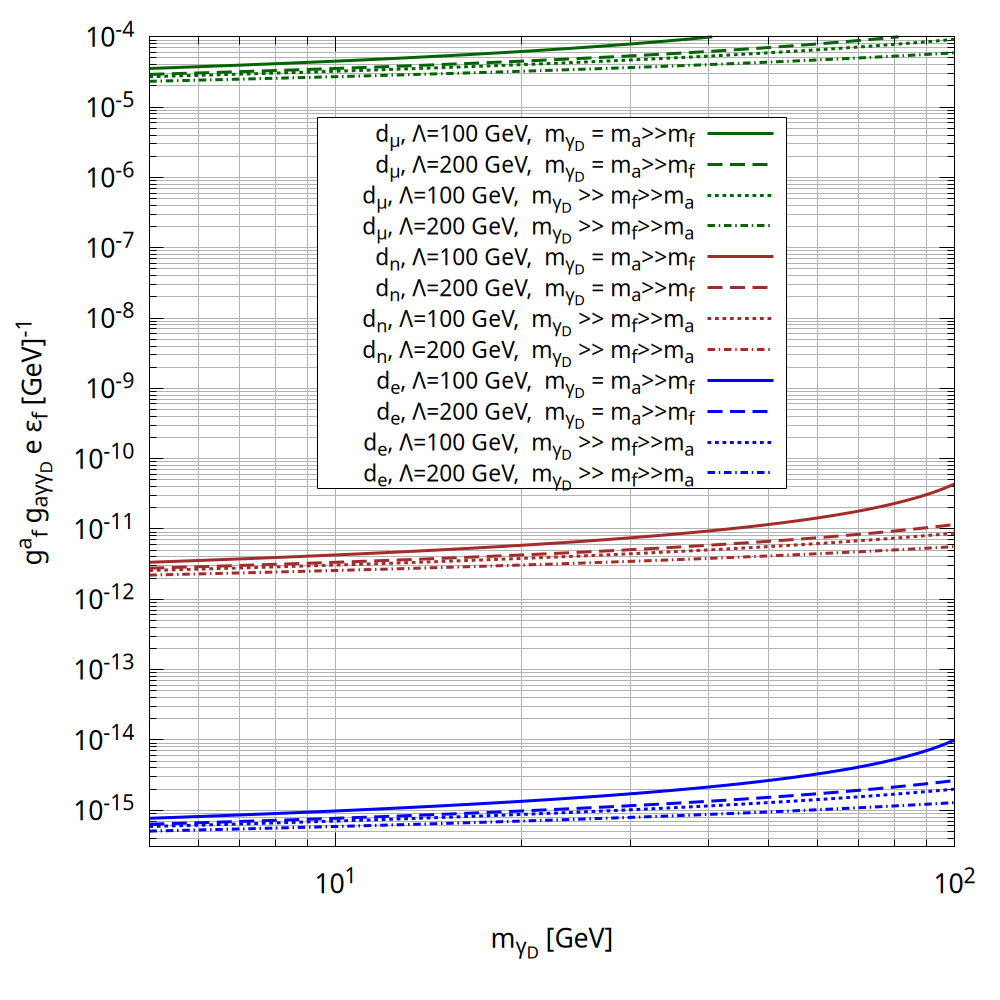
Distinguishing potential signals of new physics from inherent background noise requires highly sensitive detectors and advanced data analysis techniques. Current experimental constraints are derived, in part, from limits established by electron electric dipole moment (EDM) searches, reaching a sensitivity of < 4.1 x 10⁻³⁰ e cm, and from muon EDM searches, with limits currently at < 1.9 x 10⁻¹⁹ e cm. These EDM limits effectively constrain models predicting contributions to these dipole moments, providing a benchmark for experiments searching for faint signals indicative of new particles or interactions; improvements in detector sensitivity directly translate to tighter constraints on these theoretical models.
Beyond Completion: The Implications of a Dark Universe
The enduring puzzle of dark matter, comprising roughly 85% of the universe’s mass, may find a solution in axion-like particles (ALPs). These hypothetical particles, predicted by extensions to the Standard Model of particle physics, possess properties that make them compelling dark matter candidates. Unlike many other proposed solutions, ALPs naturally arise in models attempting to address other fundamental problems, offering an elegant theoretical framework. Current research focuses on detecting the subtle interactions between ALPs and ordinary matter, exploiting their predicted extremely weak coupling to photons and other particles. A confirmed detection of ALPs wouldn’t only illuminate the composition of dark matter, but also offer a window into physics beyond our current understanding, potentially reshaping cosmological models and our grasp of the universe’s evolution.
The potential discovery of axion-like particles (ALPs) extends far beyond simply adding a new particle to the known roster; it fundamentally challenges the completeness of the Standard Model of particle physics. Current theoretical frameworks struggle to account for the observed imbalance between matter and antimatter in the universe – a phenomenon known as CP violation – and ALPs offer a compelling pathway toward resolution. These hypothetical particles can contribute to electric dipole moments (EDMs) in neutrons and other systems, providing a measurable signal linked to CP-violating interactions not predicted by the Standard Model. Precision searches for neutron EDMs, currently constrained to less than 1.8 \times 10^{-{26}} \text{ e cm}, therefore serve as sensitive probes for ALP existence and their coupling strengths, potentially unlocking crucial details about the mechanisms driving matter-antimatter asymmetry and hinting at a more complete understanding of fundamental symmetries in nature.
Investigations into the properties of axion-like particles (ALPs), specifically their mass and how strongly they interact with other particles – their couplings – represent a promising avenue for uncovering connections between seemingly disparate areas of physics. Determining these characteristics isn’t merely about identifying a new particle; it’s about mapping the landscape beyond the Standard Model and potentially revealing relationships to fundamental constants and forces. Current experimental searches, notably those focused on the neutron electric dipole moment (nEDM), place stringent constraints on ALP couplings, with limits reaching below 1.8 \times 10^{-{26}} \text{ e cm}. These precise measurements not only refine theoretical models but also guide the development of new experiments designed to directly detect or further constrain the existence and properties of these elusive particles, potentially illuminating the origins of dark matter and the matter-antimatter asymmetry in the universe.
Refining the Search: Precision Tests and Theoretical Growth
Ongoing and future investigations into axion-like particles (ALPs) are strategically designed to dramatically enhance detection capabilities and broaden the search parameter space. These experiments aren’t simply seeking any ALP signal, but rather aim to map out the landscape of possible ALP masses and their interactions – known as couplings – with unprecedented precision. Researchers are employing innovative techniques, including leveraging vector mesons to amplify sensitivity, with projected improvements reaching a factor of one for the LDMX experiment and several orders of magnitude for NA64ee. This focused expansion of experimental reach is critical, as it allows scientists to probe previously inaccessible regions of theoretical models and potentially reveal the subtle signatures of these elusive particles, pushing the boundaries of established physics and offering insights into some of the universe’s deepest mysteries.
Determining the properties of axion-like particles (ALPs) with precision demands a concerted effort in both theoretical and experimental arenas. Accurate interpretation of experimental results hinges on sophisticated calculations that predict ALP interactions and decay rates, often requiring advanced techniques in quantum field theory and beyond. Equally crucial is a detailed understanding of experimental backgrounds – the various signals not originating from ALPs – which can mimic or obscure true ALP events. Researchers must meticulously model these backgrounds, accounting for all potential sources of noise and uncertainty, to confidently distinguish a genuine ALP signal from statistical fluctuations or known physics. This interplay between precise theory and careful experimental design is paramount, enabling scientists to extract meaningful information about ALP mass, coupling strength, and other fundamental characteristics, ultimately pushing the boundaries of particle physics.
Advancing the search for axion-like particles (ALPs) demands a synergistic relationship between experimental investigation and theoretical prediction. Current and future experiments, such as LDMX and NA64ee, are poised to significantly enhance sensitivity by leveraging vector mesons – short-lived particles composed of quarks and gluons. These enhancements aren’t simply about building more powerful detectors; they require intricate theoretical modeling to accurately predict ALP interactions and meticulously account for experimental backgrounds. LDMX anticipates a sensitivity improvement of approximately one order of magnitude through this approach, while NA64ee projects gains of several orders of magnitude, positioning these experiments at the forefront of probing beyond the Standard Model and potentially revealing the nature of dark matter through the detection of these elusive particles.
The pursuit of dark matter, as evidenced by this exploration of dark axion portals, resembles tending a garden in a perpetual twilight. One plants the seeds of theoretical models, hoping for a bloom of detectable signal, yet the soil is riddled with constraints – missing energy signatures, EDM limits – each a subtle warning of potential failure. As Jean-Paul Sartre observed, “Existence precedes essence.” The researchers don’t discover a dark matter particle with pre-defined properties; rather, through experimentation and constraint – the rigorous limits placed on CP-violating couplings – the very possibility of its existence, and its characteristics, are slowly, tentatively defined. The architecture of this search isn’t built, it grows, adapting to the inevitable failures that reveal the landscape of the possible.
Where the Shadows Lengthen
The search for dark axion portals, like all hunts for the unseen, reveals less about the quarry and more about the traps. This work, charting signatures in missing energy and the subtle language of electric dipole moments, doesn’t so much find a boundary to the unknown as it maps the limits of current detection. Every negative result is a promise made to the past – a constraint built on assumptions of interaction, of coupling strength, of the very nature of ‘darkness’. It is a temporary stillness in a cyclical process.
The reliance on fixed-target experiments, and the interpretation of EDM measurements, invites a particular fragility. These are, after all, localized probes, seeking whispers in a universe that rarely speaks directly. A more complete picture will demand a chorus of signals, from diverse experiments and astrophysical observations – a web of interconnected constraints. The hope isn’t to ‘discover’ the dark sector, but to triangulate its effects, to trace its influence on the visible world.
The true work lies not in building more sensitive detectors, but in anticipating the inevitable self-corrections within the theoretical framework. Everything built will one day start fixing itself. The next iteration won’t be about finding what is there, but about understanding why the expected signals remain elusive, and what new symmetries or dynamics might be masking their presence. Control, in this realm, is an illusion that demands SLAs – a temporary agreement with the universe, always subject to renegotiation.
Original article: https://arxiv.org/pdf/2602.11405.pdf
Contact the author: https://www.linkedin.com/in/avetisyan/
See also:
- Trails in the Sky 2nd Chapter launches September 17
- HBO Max Just Added the Final Episodes of a Modern Adult Swim Classic
- Paradox codes (April 2026): Full list of codes and how to redeem them
- PRAGMATA ‘Eight’ trailer
- Crimson Desert’s Momentum Continues With 10 Incredible New Changes
- Pragmata Shows Off Even More Gorgeous RTX Path Tracing Ahead of Launch
- How Could We Forget About SOL Shogunate, the PS5 Action RPG About Samurai on the Moon?
- Solo Leveling’s New Character Gets a New Story Amid Season 3 Delay
- Hulu Just Added One of the Most Quotable Movies Ever Made (But It’s Sequel Is Impossible To Stream)
- Dragon Quest Smash/Grow launches April 21
2026-02-13 21:22