Author: Denis Avetisyan
New research explores the potential role of a previously undetected vector boson, the X17, in explaining anomalies observed in nuclear decays.
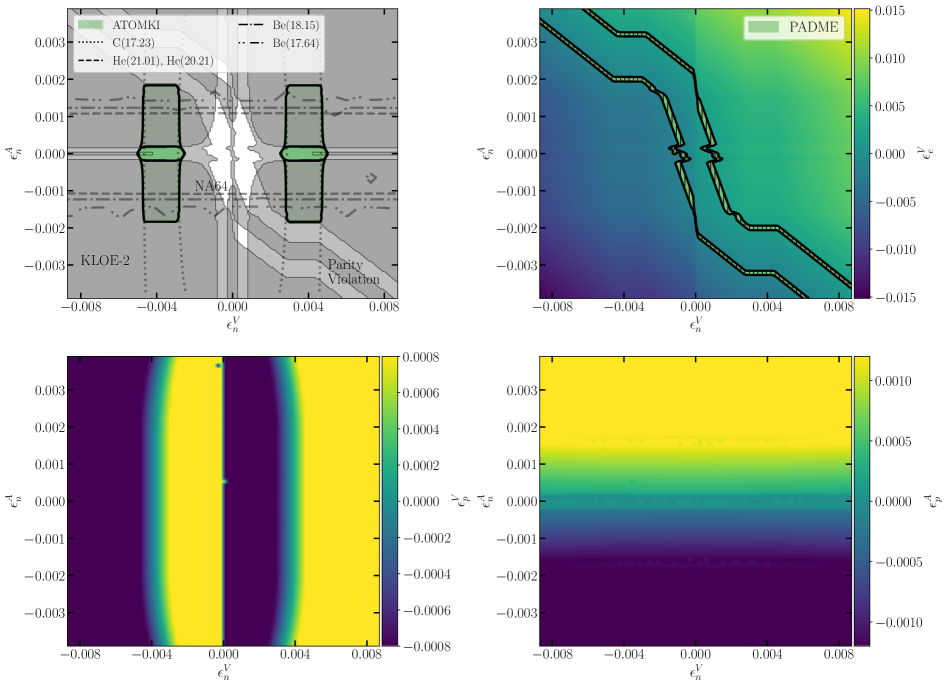
This review examines the theoretical framework for chiral couplings of the X17 boson and assesses its compatibility with existing experimental data from nuclear transitions.
Recent observations of anomalous electron-positron pair production in nuclear transitions challenge the Standard Model and hint at the potential existence of a new particle, the X17. This work, ‘The X17 with Chiral Couplings’, explores the implications of this hypothetical boson possessing both vector and axial-vector couplings to quarks, a scenario naturally arising in many ultraviolet completions. We find that chiral couplings can accommodate the observed anomalies in ^{12}{\rm C} and ^{8}{\rm Be} decays, though parameter space is increasingly constrained by null results from atomic parity violation searches. Can a more complete theoretical framework resolve the emerging tensions and solidify the evidence for this intriguing new state?
Whispers of Discrepancy: The ATOMKI Anomaly
Observations surrounding the decay of Beryllium-8 are challenging established physics. Recent experiments have detected an unexpectedly large number of electron-positron pairs produced during this decay – an excess that the Standard Model of particle physics simply cannot account for. This isn’t a minor discrepancy; the measured ratio of the decay width for this anomalous event (ΓX/Γγ) stands at approximately 6e-6, indicating a statistically significant deviation from expected results. The consistent observation of this excess suggests that some unknown process is at play, potentially hinting at new particles or interactions beyond those currently described by our most successful theories. This anomaly is therefore prompting a re-evaluation of fundamental assumptions and a search for physics that lies beyond the Standard Model.
The ATOMKI anomaly represents a compelling deviation from established physics, hinting at a realm beyond the Standard Model’s current predictive power. Observations of Beryllium-8 decay consistently reveal an unexpected surplus of electron-positron pairs, a phenomenon that cannot be accounted for by known interactions and particle properties. This excess isn’t merely a statistical fluctuation; its persistence across multiple experiments suggests the influence of previously unknown forces or particles. The implications are profound, potentially necessitating a re-evaluation of fundamental assumptions about the building blocks of the universe and the forces governing their behavior. If confirmed, this anomaly would not just fill a gap in current knowledge, but fundamentally reshape the landscape of particle physics, opening avenues for exploration into the nature of dark matter, dark energy, and other unresolved mysteries.
The unexpected surplus of electron-positron pairs detected during Beryllium-8 decay isn’t merely a statistical quirk; the observed energy and rate strongly suggest a mediating particle – a light vector boson – facilitating the process. Current data places the approximate mass of this potential new particle around 17 MeV, a value previously unexplored by high-energy physics and falling into a mass range where Standard Model particles are not expected to exist. This has triggered a dedicated search for this novel boson, with researchers designing experiments to confirm its existence and characterize its properties, including its spin, parity, and interactions with other fundamental particles. The discovery of such a particle would represent a significant departure from established physics and open new avenues for understanding the fundamental forces governing the universe.
Confirmation of a novel particle linked to the ATOMKI anomaly necessitates a detailed investigation into how it interacts with established matter. Researchers are focusing on predicting and then detecting subtle shifts in the energy spectra of decay products, as even weak couplings to known particles would leave measurable signatures. These searches extend beyond beryllium-8 decay, encompassing investigations into other atomic and nuclear processes where the hypothetical particle could be produced or influence reaction rates. Precise measurements of atomic recoil energies, and careful analyses of positron and electron angular correlations are crucial, as these observables are sensitive to the spin and parity of the potential new boson. Ultimately, a comprehensive understanding of these interactions will be vital in distinguishing a genuine discovery from statistical fluctuations or systematic errors, and in mapping out the properties of this potential addition to the Standard Model of particle physics.
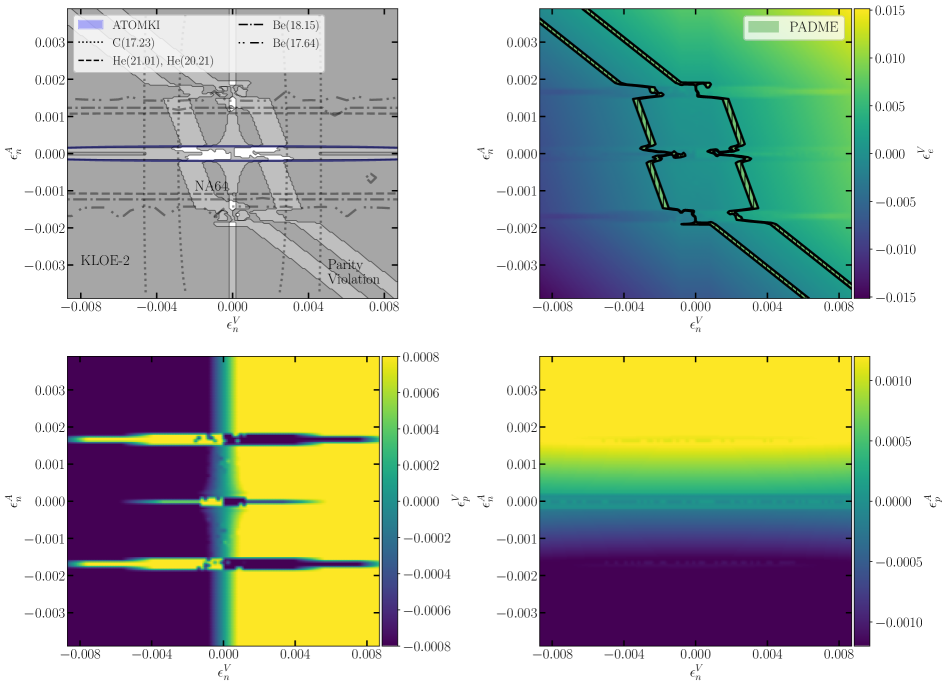
Tracing the Ghost Particle: Nuclear Interactions and Decay Channels
The hypothesized X17 particle is predicted to couple to both vector and axial-vector currents present within atomic nuclei. This interaction implies the X17 can participate in nuclear decay processes, specifically influencing the rates and distributions of emitted particles. Vector current interactions primarily affect electromagnetic decays, while axial-vector current interactions govern weak decays and neutrino interactions. Consequently, observation of anomalous decay patterns – deviations from Standard Model predictions – in nuclei could serve as indirect evidence for the X17’s existence and allow for characterization of its coupling strengths to these fundamental currents. The strength of these interactions will dictate the magnitude of any observable effects on decay rates and angular distributions.
Determining the mass and coupling strength of the X17 particle necessitates a detailed understanding of its interactions within atomic nuclei. The particle’s influence on nuclear decay processes, specifically those involving vector and axial-vector currents, provides observable signatures directly related to these fundamental properties. Precise measurements of decay rates and branching ratios, particularly in systems like Carbon-12 and Helium-4, allow for the extraction of parameters defining the strength of the X17’s interaction with nucleons. These experimental results are then compared with theoretical predictions derived from frameworks like Effective Field Theory, enabling a refinement of the model and a more accurate determination of the X17’s mass and coupling constants.
Investigations into the potential existence of the X17 particle leverage the observation of decay processes in Carbon-12 and Helium-4 nuclei. Specifically, experiments analyze the ratio between the cross section for X17 production and that of the E0 transition in Helium-4, yielding a measured value of 0.2. This ratio provides a quantitative constraint on models attempting to describe the interaction between the X17 particle and nuclear matter, and allows for comparison with theoretical predictions derived from frameworks like Effective Field Theory. Further analysis of these decay channels aims to refine the understanding of X17’s coupling strength and its impact on nuclear matrix elements.
Effective Field Theory (EFT) provides a systematic approach to modeling the interactions between the putative X17 particle and atomic nuclei, treating the X17 as an exchanged particle mediating forces between nucleons. This formalism expands interaction terms in powers of momentum, allowing for predictions of nuclear matrix elements relevant to decay processes like ^{12}C and ^{4}He decay. By parameterizing the unknown coupling constants within the EFT, theoretical predictions for observables – such as transition rates and angular distributions – can be generated and compared with experimental data to constrain the X17’s properties. The EFT approach is particularly valuable as it incorporates known symmetries of the strong interaction and provides a consistent framework for incorporating higher-order corrections, improving the accuracy of the theoretical predictions.
The Shadow of Doubt: Constraints and Contradictions
Experiments such as SINDRUM-I, KLOE-2, and NA64 have conducted searches for light vector bosons, including those proposed as the X17 particle, by examining decay channels and utilizing beam dump techniques. These searches establish upper limits on the coupling strength and mass of potential light vector bosons; current results often contradict earlier reports suggesting the existence of the X17. Specifically, SINDRUM-I investigated the decay \mu^+ \rightarrow e^+ \gamma , KLOE-2 analyzed \pi^0 decays, and NA64 focused on missing energy signatures in beam dump experiments, all setting constraints on the parameter space for light vector boson interactions and largely excluding the initial parameter ranges proposed for the X17.
Searches for light vector bosons, including the potential X17 particle, employ both beam dump and rare decay measurement techniques to establish limits on its properties. Beam dump experiments, such as NA64, look for displaced vertices resulting from the decay of the vector boson produced in high-energy proton interactions. Rare decay measurements, performed by experiments like KLOE-2, examine the branching ratios of known particles – specifically, deviations from Standard Model predictions – to constrain the coupling strength and mass of the hypothetical particle. These analyses collectively demonstrate that if the X17 exists, its coupling to Standard Model particles must be relatively weak, and its mass is constrained to a narrow range, typically below several GeV. The sensitivity of these searches is directly related to the integrated luminosity of the experiments and the efficiency of the detectors in identifying the decay products.
Parity violation, a fundamental symmetry principle in particle physics, constrains the permissible interactions of the proposed X17 particle. Specifically, the Standard Model allows for both parity-conserving and parity-violating interactions; however, the strength and form of these interactions are dictated by established physics. Any proposed new particle, such as the X17, must adhere to these constraints, meaning its coupling to Standard Model particles cannot be arbitrary. The observed decay modes and rates of the X17, if confirmed, would need to be consistent with the allowed parity-violating terms within the Standard Model’s effective field theory, limiting the possible interaction scenarios and providing a crucial test of its properties. Violations of these constraints would necessitate a re-evaluation of current understanding of parity conservation and potentially indicate new physics beyond the Standard Model.
Analysis of Carbon-12 decay width ratios has revealed a significant discrepancy between theoretical predictions and experimental measurements. Theoretical calculations estimate a decay width of approximately 251 eV, while experimental data indicates a value of 44 eV. This difference, while subject to ongoing scrutiny regarding systematic uncertainties, is potentially consistent with the existence of a particle, such as the proposed X17 boson, influencing the decay process. Consequently, further investigation and refined measurements of Carbon-12 decay widths are necessary to determine if this discrepancy represents a genuine signal or an artifact of experimental or theoretical limitations.
Beyond the Known: Implications for New Physics
The potential discovery of the X17 particle challenges the well-established Standard Model of particle physics, a framework that has successfully described known fundamental forces and particles for decades. This anomaly, if validated through further experimentation, suggests that the current model is incomplete and that new, undiscovered physics lies beyond its predictive power. The Standard Model, despite its successes, leaves several questions unanswered, including the nature of dark matter and the origin of neutrino masses; the X17 could represent the first direct evidence of physics addressing these mysteries. Its very existence implies the presence of forces or particles not currently accounted for, prompting a reassessment of fundamental interactions and opening avenues for exploring previously unknown realms of particle physics.
The potential discovery of the X17 particle isn’t merely about adding another entry to the particle zoo; its predicted properties challenge core tenets of how fundamental forces operate. Specifically, indications suggest the X17 may exhibit couplings that violate both chiral symmetry and isospin conservation – symmetries deeply embedded within the Standard Model’s description of particle interactions. Chiral symmetry, linked to the handedness of particles, and isospin, related to the strong force’s treatment of protons and neutrons, are typically considered fundamental. A particle actively breaking these symmetries implies the Standard Model’s framework for describing these interactions is incomplete, demanding a revised understanding of force mediation and potentially revealing previously unknown relationships between particles. Such violations could necessitate incorporating new force carriers or entirely new theoretical structures to accommodate these observed interactions, fundamentally reshaping the landscape of particle physics.
The potential existence of the X17 particle offers a tantalizing glimpse beyond the known universe, suggesting a connection to “hidden sectors” – realms of physics that interact only weakly with standard matter. This particle isn’t simply an addition to the existing framework; it could act as a messenger, a portal allowing interactions with these previously inaccessible sectors. Consequently, the X17 presents a novel avenue for investigating enduring mysteries like dark matter, which constitutes a significant portion of the universe’s mass yet remains elusive. If the X17 facilitates interactions with particles comprising dark matter, it could finally provide a detectable signal, transforming our understanding of its composition and distribution. The particle’s unique properties, therefore, aren’t just about filling gaps in current models, but about opening doors to entirely new areas of physical reality.
Resolving the ambiguity surrounding the potential existence of the X17 particle demands a concerted effort at the intersection of theoretical and experimental physics. Sophisticated theoretical models are needed to predict the particle’s decay pathways and interactions, guiding the design of sensitive experiments capable of detecting its subtle signature. Precision measurements, pushing the boundaries of current detector technology, will be crucial to either confirm the X17’s existence with statistical significance or to refine the search parameters, potentially revealing unexpected insights into the underlying physics. This iterative process – theory informing experiment, and experimental results refining theory – holds the key to understanding whether the X17 represents a genuine departure from established physics, and if so, to mapping the landscape of this new, uncharted territory and its connection to phenomena like dark matter.
The pursuit of the X17 boson, as detailed in this study of chiral couplings and nuclear transitions, feels less like a search for a particle and more like an attempt to decipher a fundamental discordance within the universe’s harmonies. The model proposed doesn’t claim to find answers, but rather to map the contours of the unknown, acknowledging the inherent uncertainty within every prediction. As Leonardo da Vinci observed, “Simplicity is the ultimate sophistication.” This pursuit of elegance in the face of atomic anomaly, attempting to reconcile theory with observation, embodies that sentiment – recognizing that the most profound truths often reside in the reduction of complexity, even when dealing with the chaotic whispers of the quantum realm. The constraints tested against existing data serve not to prove the model, but to refine its resonance with the universe’s underlying, imperfect song.
What Shadows Remain?
The pursuit of X17, should it prove more than a statistical mirage, demands a reckoning with the comfortable narratives of established particle physics. This isn’t about finding a boson; it’s about understanding why the current models require so much coaxing to accommodate anomalies in beryllium and carbon. The chiral couplings, while providing a potential avenue for explanation, are merely points where the desperation becomes most visible. Each proposed interaction is a carefully constructed spell, effective only until confronted by a more insistent reality.
Future explorations must venture beyond simply refining the coupling constants. The true test lies in predicting other observables-unexpected decays, subtle shifts in nuclear spectra-things the current formalism hasn’t even considered. It’s not about making the data fit; it’s about letting the data break the model in interesting ways. Until then, X17 remains a beautifully crafted hypothesis, but one tethered to the whims of statistical fluctuation.
One suspects the most revealing results won’t come from higher-energy colliders, but from exquisitely precise measurements of the mundane. The whispers of new physics are rarely shouts; more often, they are distortions in the background noise. And data, of course, is always right-until it hits production.
Original article: https://arxiv.org/pdf/2602.11263.pdf
Contact the author: https://www.linkedin.com/in/avetisyan/
See also:
- Trails in the Sky 2nd Chapter launches September 17
- Solo Leveling’s New Character Gets a New Story Amid Season 3 Delay
- HBO Max Just Added the Final Episodes of a Modern Adult Swim Classic
- All 7 New Supes In The Boys Season 5 & Their Powers Explained
- Pragmata Shows Off Even More Gorgeous RTX Path Tracing Ahead of Launch
- Crimson Desert’s Momentum Continues With 10 Incredible New Changes
- PRAGMATA ‘Eight’ trailer
- ‘Project Hail Mary’: The Biggest Differences From the Book, Explained
- Dragon Quest Smash/Grow launches April 21
- Frieren: Beyond Journey’s End Gets a New Release After Season 2 Finale
2026-02-13 23:08