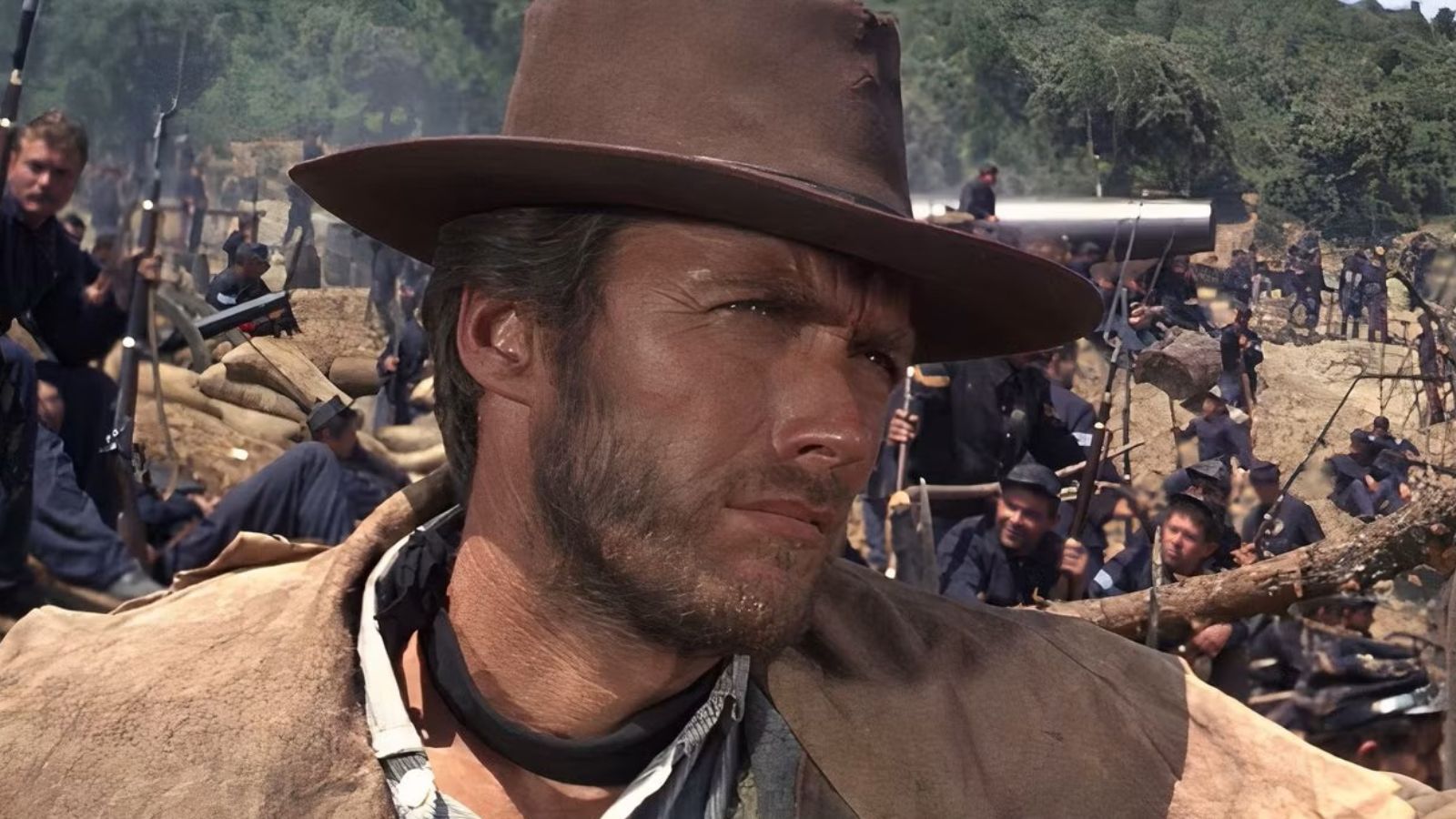
Quentin Tarantino has become one of Hollywood’s most famous and accomplished directors. He’s well-known for sharing his thoughts on film, and often highlights directors he respects, like Sergio Leone, who revolutionized the Western film genre.
Unlike many directors who avoid talking about their inspirations for fear of being compared to others, Quentin Tarantino readily discusses the sources of his style. He, like numerous filmmakers, frequently highlights The Good, the Bad and the Ugly as a particularly influential film that reshaped cinema for years to come.
Quentin Tarantino Has a Passion for Westerns
His career has been heavily shaped by classic Westerns, particularly films like Django and Rio Bravo, which he often cites as influences. He’s such a fan of the genre that he not only created two critically acclaimed modern Westerns, but also incorporated it into the storyline of Once Upon a Time in Hollywood.
With Django Unchained, Quentin Tarantino created a film that paid homage to classic Spaghetti Westerns, particularly Sergio Corbucci’s 1966 film Django. True to Tarantino’s signature style, the movie is full of violence and sparked controversy upon its release. However, it has since become a beloved and influential work within the genre.
Following the success of his previous films, Tarantino released The Hateful Eight in 2015. He created the characters as a tribute to the surprise guest stars often featured in classic TV Westerns. He combined this idea with the tense, isolated feeling of The Thing, a movie he’s long admired. Throughout his career, Tarantino has skillfully mixed his own unique style with references to the films he loves, and he considers a 1966 Western to be his biggest influence.
He clearly loves films by directors such as John Ford, Don Siegel, and Corbucci, but Sergio Leone is one director he especially admires. Leone, an Italian filmmaker who worked across many genres including dramas and gangster films, played a major role in shaping the modern film industry.
His career took off with his 1964 Spaghetti Western, where he first played the iconic character known as The Man With No Name. He refined his filmmaking approach with 1965’s For A Few Dollars More, but it was his 1966 masterpiece, The Good, the Bad and the Ugly, that truly established him as a cinematic legend.
Sergio Leone’s The Good, the Bad and the Ugly Is Among Tarantino’s Favorites
Leone always believed the best films prioritize their genre, and this is clear in his Westerns. He wasn’t interested in historical accuracy; instead, he focused on the popular myths and ideas about the Old West that audiences already had.
You know, watching his movies feels a bit like stepping into a classic fairytale. His characters aren’t exactly subtle; they’re almost too perfectly defined. Whether it’s a villain – a truly nasty mercenary, for example – or a hero like Harmonica, who embodies pure, unwavering honor, everyone feels like a clear-cut archetype. It’s a stylistic choice that really stands out.
In The Good, the Bad and the Ugly, the characters of Blondie, Angel Eyes, and Tuco are larger than life, almost like figures from a comic book, reflecting a unique take on the American West. Because Sergio Leone wrote and directed the film, the movie’s themes, visuals, characters, and overall mood are almost entirely a result of his personal artistic vision.
Quentin Tarantino sees Sergio Leone’s Dollars Trilogy as a turning point in film, connecting classic Hollywood with the way movies are made today. He particularly admires the trilogy’s energetic and visually striking opening credits. It’s therefore no surprise he considers the whole series flawless, calling it the best cinematic accomplishment ever.
As a longtime viewer of Quentin Tarantino’s work, I’ve always noticed echoes of classic Westerns in his films. It really hits home with the introduction of Christoph Waltz’s Hans Landa in Inglourious Basterds. That scene feels like a direct nod to Lee Van Cleef’s Angel Eyes from The Good, the Bad and the Ugly. Both characters are incredibly sharp, using their intelligence not for justice, but to serve their own selfish and frankly, villainous purposes. They’re products of their environments, and it’s chilling to see that reflected in how they operate.
Leone’s filmmaking isn’t just about exciting action and suspense. Right from the start, with the character of Angel Eyes, he uses drawn-out, calmer moments to create tension and reveal information about the characters naturally. In just a couple of scenes, we learn everything we need to know about Lee Van Cleef’s villain: he’s a ruthless detective who follows his own twisted sense of right and wrong.
Tuco is similarly compelling; even in limited screen time, he’s established as a resourceful survivor – a hardened gunslinger who prioritizes living to fight another day. His true character, though, is most evident in key moments like the Battle of Branston Bridge and the climactic showdown. His version of the West feels grander, more noble, and surprisingly romantic compared to other Westerns that try to redefine the genre, existing as a unique world separate from the rest of the country.
The Good, the Bad and the Ugly Has an Enduring Legacy
Quentin Tarantino isn’t alone in his appreciation for Sergio Leone and The Good, the Bad and the Ugly. Many others admire both the film and its director. It’s impossible to talk about Leone or his work without also acknowledging Ennio Morricone, whose music transformed a good story into a masterpiece.
The collaboration of Leone, Eastwood, and Morricone redefined the Western genre, creating a film so exceptional that it’s widely praised, even by those who don’t typically enjoy Westerns. While many debate the origins of the modern blockbuster, this film arguably paved the way for their creation.
Great directors all have a signature style – whether it’s how their films look, the kinds of stories they tell, or the impact they have on filmmaking. Quentin Tarantino made his mark by revitalizing crime films in the 1990s, and Pulp Fiction especially inspired a new generation of filmmakers to express themselves creatively.
Sergio Leone revolutionized both Westerns and modern blockbuster films with his iconic movie, The Good, the Bad and the Ugly.
Found an error? Send it so it can be corrected.
Read More
- Adam Levine Looks So Different After Shaving His Beard Off
- Gold Rate Forecast
- Steam Makes Sci-Fi Game 100% Free for 72 Hours
- From season 4 release schedule: When is episode 2 out on MGM+?
- Nintendo Switch 2 Reportedly Getting Remake of One of the Best PS3 and Xbox 360 Games
- Dialoop coming to Switch on June 17
- 10 Movies That Were Banned in Different Countries For Random Reasons
- Tekken 8 Fans Furious as Tifa Tipped for Street Fighter 6 Instead
- Welcome to Demon School! Iruma-kun season 4 release schedule: When are new episodes on Crunchyroll?
- When Things Fall Apart: A New View of Phase Transitions
2026-02-21 06:07