Author: Denis Avetisyan
New research sheds light on the complex interplay of quantum effects that govern particle production in high-energy collisions.
![Dilepton transverse momentum distributions-analyzed at collision energies of 13 TeV and 38.8 GeV using the Pdf2Is approach with a fixed gluon mass of 2.0 GeV-demonstrate the capacity to model experimental measurements [19, 21] and quantify theoretical uncertainties across a range of invariant masses.](https://arxiv.org/html/2602.17533v1/x23.png)
Consistent modeling of intrinsic transverse momentum and soft-gluon radiation is crucial for accurate predictions in low-$p_T$ Drell-Yan production.
Understanding the non-perturbative origins of particle momentum remains a central challenge in high-energy physics. This is addressed in ‘Non-perturbative effects and soft-gluon dynamics in low-$p_T$ Drell-Yan production’, which investigates the interplay between intrinsic transverse momentum and initial-state soft-gluon radiation in Drell-Yan lepton pair production. Through the novel PDF2ISR framework, this work demonstrates that a consistent treatment of both non-perturbative effects is crucial for accurately modeling low-$p_T$ spectra and reveals a sensitivity to the behavior of the strong coupling α_s at low scales. How can future experimental measurements further constrain the infrared behavior of α_s and refine our understanding of these fundamental QCD dynamics?
Beyond Simple Approximations: Unveiling the Hidden Momentum
For decades, calculations describing the outcomes of particle collisions have leaned heavily on Collinear Parton Density Functions, or PDFs. These functions represent the probability of finding a parton – a fundamental constituent of matter like a quark or gluon – within a hadron, but operate under a significant simplification: they assume all partons move strictly along the direction of the colliding beams. This approach effectively ignores any intrinsic transverse momentum – the sideways motion – that partons possess within the hadron itself. While this collinear approximation streamlines calculations and has yielded valuable results, it introduces a fundamental limitation, particularly when probing the dynamics at lower energies or when considering processes sensitive to the detailed momentum distribution of the colliding particles. The neglect of this intrinsic motion can lead to inaccuracies, hindering a complete understanding of the underlying physics and limiting the precision of experimental predictions.
Traditional calculations of particle interactions often streamline the depiction of particle motion, overlooking the inherent transverse momentum carried by quarks and gluons within protons. This simplification becomes particularly problematic at low momentum transfer, a regime where initial-state radiation – the emission of particles like photons or gluons before the main collision – significantly influences the outcome. Because initial-state radiation is sensitive to the full momentum distribution of the participating partons, neglecting their transverse momentum leads to inaccurate predictions for observable quantities. The emitted radiation’s angle and energy depend critically on this previously hidden transverse motion, meaning that a complete understanding of these dynamics requires a more nuanced approach that accounts for the full, multi-dimensional momentum space of the colliding particles.
Traditional analyses of particle collisions often treat colliding particles as one-dimensional beams, simplifying the intricate distribution of momentum within. However, a more complete picture demands accounting for the fact that constituent particles – quarks and gluons – possess not only longitudinal momentum but also transverse momentum, moving perpendicularly to the main collision axis. Transverse-Momentum-Dependent (TMD) parton densities provide this crucial extra dimension, characterizing the full momentum distribution within a hadron. By incorporating this transverse motion, TMDs allow physicists to move beyond approximations and generate predictions that more accurately reflect the dynamics of high-energy interactions. This is particularly important for processes sensitive to initial-state radiation and for precision measurements aiming to test the Standard Model and search for new physics, as subtle effects previously masked by simplified models become accessible through the use of these advanced distributions.
The pursuit of precision in high-energy physics demands a rigorous accounting of all contributing factors, and increasingly, subtle effects previously considered negligible are proving vital. Experiments at facilities like the Large Hadron Collider are now sensitive enough to reveal discrepancies between theoretical predictions based on simplified models and actual collision data; these differences often stem from an incomplete understanding of the initial state. Capturing the full momentum distribution of colliding particles, including the intrinsic transverse momentum ignored in traditional calculations, is no longer merely a refinement, but a necessity. This necessitates the use of Transverse-Momentum-Dependent (TMD) parton densities, which offer a more complete picture of particle interactions and allow for predictions that align with increasingly precise experimental observations, ultimately pushing the boundaries of pQCD and our understanding of fundamental forces.
![Transverse-momentum distributions of Drell-Yan lepton pairs at <span class="katex-eq" data-katex-display="false">\sqrt{s}=13</span> TeV, calculated using the Pdf2Is approach with PB-NLO-2018-Set2, align with experimental measurements [19] across three invariant-mass bins and are subject to 7-point theoretical uncertainties.](https://arxiv.org/html/2602.17533v1/x11.png)
Pdf2Isr: A Unified Framework for Momentum Evolution
Pdf2Isr establishes a new computational framework for Transverse Momentum Dependent (TMD) parton distribution functions by simultaneously addressing both collinear and intrinsic transverse momentum evolution. Traditional calculations often treat these effects separately; Pdf2Isr integrates them within a single parton shower process. Collinear evolution, governed by the DGLAP equations, accounts for momentum sharing during branching as a function of resolution scale. Intrinsic transverse momentum, representing the inherent momentum of partons within the hadron, is incorporated via a modified branching algorithm. This combined approach allows for a more accurate representation of the full momentum distribution of partons inside a hadron, crucial for high-energy collision phenomenology and precision measurements.
Pdf2Isr employs a parton shower methodology to model the distribution of transverse momentum within hadrons. This involves simulating a cascading process where high-energy partons successively emit gluons, each emission governed by probabilistic branching rules. The simulation begins with an initial high-energy parton and iteratively generates additional gluons, each with a decreasing energy scale, until a predetermined minimum energy or resolution limit is reached. This branching process, informed by the strong coupling constant \alpha_s and kinematic constraints, effectively generates a realistic momentum distribution reflecting the internal dynamics of the hadron and the correlated emission of multiple partons. The resultant distribution accounts for both collinear and intrinsic transverse momentum, providing a detailed description of the parton’s momentum space configuration.
Pdf2Isr addresses the challenge of infrared divergences inherent in perturbative calculations of transverse momentum distributions (TMDs) through the implementation of angular ordering and a running gluon mass. Angular ordering, a technique imposing a hierarchical structure on gluon emissions based on their angles relative to the parent parton, effectively suppresses contributions from highly collinear and soft emissions that drive infrared divergences. Furthermore, the inclusion of a running gluon mass, where the mass of the emitted gluon varies with the energy scale, provides an explicit infrared regulator. These combined mechanisms ensure the generated TMDs remain finite and consistent with established theoretical frameworks like DGLAP evolution, while also maintaining a connection to the underlying physics of parton branching and momentum sharing.
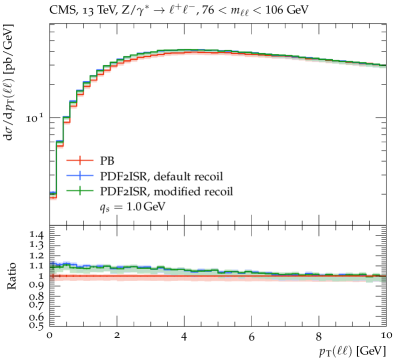
Recoil prescriptions are integral to the Pdf2Isr implementation for accurately distributing momentum during the simulated parton shower. As each gluon is emitted, its recoil must be appropriately assigned to the emitting parton and any subsequent shower constituents to conserve overall momentum. These prescriptions dictate how the emitted gluon’s momentum is ‘subtracted’ from the parent parton, influencing the kinematic properties of the generated transverse momentum distribution. Specifically, the approach employs a modified recoil scheme that accounts for both longitudinal and transverse momentum sharing, ensuring that the shower evolution remains physically realistic and avoids unphysical kinematic configurations. This precise momentum accounting is crucial for managing infrared divergences and ensuring the theoretical consistency of the generated TMDs.
Validation Through Established Theory: A Framework for Consistency
The Pdf2Isr method’s theoretical foundation rests on its adherence to the Dokshitzer-Gribov-Lipatov-Altarelli-Parisi (DGLAP) evolution equation, a set of coupled linear equations describing the energy dependence of parton distribution functions. This connection ensures that the generated parton showers exhibit proper behavior at high energy scales, specifically avoiding infrared and collinear divergences and maintaining predictive power as the energy of the collision increases. The DGLAP equation governs the evolution of parton densities as a function of the scale Q^2, effectively describing how quarks and gluons split into other quarks and gluons. By incorporating the DGLAP framework, Pdf2Isr accurately models the increasing importance of gluons at high energies and provides a theoretically consistent description of initial state radiation.
The Pdf2Isr methodology is implemented within established event generator frameworks, notably Pythia 8, facilitating the production of simulated high-energy particle collisions. This integration allows for a comprehensive comparison between theoretical predictions and experimental data collected by facilities such as the Large Hadron Collider. Pythia 8 handles the complexities of hadronization, underlying event, and initial state radiation, providing a complete simulation chain. By embedding Pdf2Isr within this framework, researchers can directly assess the impact of the generated parton distribution functions on observable quantities, enabling precise tests of the Standard Model and searches for new physics. The resulting simulations provide predictions for a wide range of observables, including particle multiplicities, transverse momentum distributions, and angular correlations, which can be directly compared with experimental measurements.
Hadron collisions at relevant energy scales involve strong interactions governed by the strong coupling constant, α_s. When α_s is sufficiently large, perturbative calculations become invalid, and non-perturbative effects dominate. These effects manifest as contributions from gluons and quarks that are not directly observable as asymptotic particles, influencing the overall dynamics of hadronization. Pdf2Isr addresses this by incorporating models that account for these non-perturbative contributions to parton distribution functions and fragmentation functions, specifically addressing the intrinsic transverse momentum of partons and the formation of hadrons from the quark-gluon plasma. Accurate modeling of these non-perturbative phenomena is essential for achieving quantitative agreement between theoretical predictions and experimental results in high-energy physics, particularly when analyzing final-state hadron spectra and jet substructure.
The Sudakov form factor, a key component of the DGLAP equation, addresses the issue of multiple and large logarithmic contributions that arise in perturbative QCD calculations of hadron collisions. These contributions, if not properly accounted for, lead to divergences and unphysical predictions. The Sudakov form factor effectively resums these logarithms to all orders, providing a stable and well-defined perturbative series. This regularization is crucial for accurately modeling the parton shower – the cascade of quark and gluon emissions – and ensuring the resulting event simulations adhere to fundamental physical constraints, such as unitarity and Lorentz invariance. The form factor’s mathematical expression incorporates a running coupling constant \alpha_s and accounts for the probability of emitting additional partons, effectively limiting the number of emissions at high energies and preventing the generation of excessive, unrealistic final-state radiation.
Towards Precision: The Impact on High-Energy Physics
The pursuit of precision in high-energy physics, particularly at facilities like the Large Hadron Collider (LHC), necessitates increasingly accurate calculations of Transverse Momentum Dependent (TMD) distributions. These distributions, which describe the momentum and angular distribution of partons within hadrons, are crucial for interpreting experimental results and extracting fundamental parameters. Traditional parton distribution functions (PDFs) provide only a one-dimensional picture of momentum, whereas TMDs offer a more complete, two-dimensional description including intrinsic transverse momentum-the inherent sideways motion of quarks and gluons. Without precise TMD calculations, subtle effects and potential new physics signatures embedded within high-energy collision data can be obscured or misinterpreted. Consequently, ongoing research focuses on refining theoretical frameworks and computational tools to model TMDs with ever-greater accuracy, enabling physicists to probe the internal structure of matter and test the limits of the Standard Model with unprecedented precision.
The Drell-Yan process, wherein a quark and antiquark combine to produce a virtual photon or Z boson which then decays into a lepton pair, holds a central position in quantum chromodynamics (QCD) factorization theory and, consequently, serves as a vital testing ground for methods like Pdf2Isr. This process provides a clean and well-defined environment for examining the interplay between parton distribution functions (PDFs) and fragmentation functions, allowing physicists to rigorously validate the accuracy of theoretical predictions. By comparing the predicted lepton pair spectra-differential rates as a function of various kinematic variables-with precise experimental measurements from colliders, researchers can refine their understanding of strong interactions and ensure the reliability of the frameworks used to interpret high-energy collision data. The success of Pdf2Isr in accurately describing the Drell-Yan process, therefore, not only confirms the method’s internal consistency but also reinforces its potential for broader applications in understanding more complex hadronic collisions and probing the fundamental structure of matter.
Ongoing development within the PB-TMD framework seeks to enhance the precision of high-energy physics predictions through increasingly sophisticated modeling of hadron structure and interactions. These advancements are largely realized via Monte Carlo event generators, notably Cascade, which allow for detailed simulations of particle collisions. By refining the algorithms governing initial-state radiation and intrinsic transverse momentum-the inherent sideways motion of quarks within hadrons-researchers aim to reduce theoretical uncertainties and achieve more accurate comparisons with experimental data from facilities like the Large Hadron Collider. This iterative process of refinement, implemented within Cascade and similar generators, not only improves the reliability of current analyses but also paves the way for extracting new insights into the complex dynamics governing the strong force and the fundamental constituents of matter, ultimately enabling more precise tests of the Standard Model and searches for physics beyond it.
A precise understanding of initial-state radiation and the intrinsic transverse momentum of partons within hadrons is poised to revolutionize high-energy physics. These phenomena, reflecting the complex internal dynamics of strongly interacting particles, directly influence the observed signatures of collisions at facilities like the Large Hadron Collider. Accurately modeling these effects allows physicists to peel back layers of complexity, revealing the fundamental distribution of momentum and spatial arrangement of quarks and gluons within protons and neutrons. Improved descriptions of intrinsic motion will not only refine predictions for established processes, but also enable the exploration of previously inaccessible aspects of hadron structure, potentially uncovering novel insights into the origins of mass and the behavior of matter under extreme conditions, and ultimately deepening the comprehension of the strong force itself.
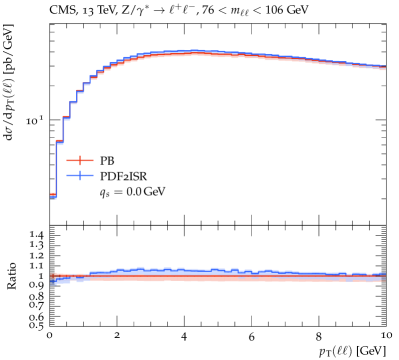
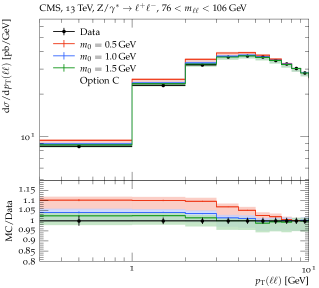
Recent investigations confirm the Pdf2Isr method provides a highly accurate description of Drell-Yan lepton-pair spectra, a crucial process for understanding particle interactions. Analysis reveals an intrinsic transverse momentum width of 1.04 \text{ GeV}, a key parameter characterizing the internal motion of particles. Importantly, this value remains consistent across a range of collision energies, suggesting a universal characteristic of hadronic structure. This consistency strengthens the reliability of predictions derived from the Pdf2Isr framework and provides a solid foundation for future high-energy physics research, allowing for more precise interpretations of experimental data from facilities like the LHC and a deeper understanding of the strong force.
Rigorous comparisons between theoretical predictions and experimental data reveal a compelling level of agreement, as evidenced by consistently low χ2 values obtained across multiple datasets. This strong concordance isn’t merely a statistical success; it lends significant support to the concept of a universal intrinsic transverse momentum k_{\rm T} width of approximately 1.04 GeV. The observed consistency across varying collision energies and experimental setups suggests that this intrinsic motion isn’t an artifact of specific conditions, but rather a fundamental property of the hadron’s internal structure. This validation of the intrinsic-k_{\rm T} framework is crucial for refining high-energy physics calculations and ultimately, for a more complete understanding of the strong force.
The study of Drell-Yan production, with its focus on low-$p_T$ dynamics, reveals a system where emergent behavior dominates. Rather than seeking a comprehensive, top-down control over particle interactions, this work demonstrates the necessity of accounting for intrinsic transverse momentum and soft-gluon radiation as locally determined effects. As Stephen Hawking once stated, “The best equations are those that describe the universe simply and beautifully.” This echoes the finding that consistent modeling isn’t about imposing structure, but allowing it to emerge from the interplay of these fundamental components. The sensitivity to infrared behavior suggests robustness arises not from design, but from the system’s inherent properties, aligning with the principle that system structure is stronger than individual control.
Beyond Perturbation
The pursuit of low-$p_T$ Drell-Yan production reveals, yet again, the limits of attempting to dictate order. This work demonstrates that intrinsic transverse momentum and soft-gluon radiation aren’t merely additive effects, but components of a self-organizing system – like a coral reef forms an ecosystem, local rules form order. To treat either in isolation is to misunderstand the emergent behavior at play. The sensitivity to infrared dynamics isn’t a nuisance to be tamed, but a signal of the underlying connectedness. Attempts at precise control, at pinning down the strong coupling with ever-finer resolution, seem increasingly futile.
The path forward isn’t toward ever-more-complex perturbative calculations. Rather, it lies in accepting the inherent stochasticity and focusing on the resulting distributions. The challenge now is to develop frameworks that describe the collective behavior, the statistical properties of these systems, rather than attempting to predict individual events. Constraints, after all, can be invitations to creativity – the infrared divergence isn’t a roadblock, but an indication that a different, more holistic, description is required.
Future work should explore the connections to other hadronic processes exhibiting similar soft-gluon dynamics. Investigating universality classes, identifying the common principles governing these emergent phenomena, offers a more promising avenue than continued attempts at brute-force calculation. The goal isn’t to solve the strong interaction, but to understand its language.
Original article: https://arxiv.org/pdf/2602.17533.pdf
Contact the author: https://www.linkedin.com/in/avetisyan/
See also:
- Adam Levine Looks So Different After Shaving His Beard Off
- After AI Controversy, Major Crunchyroll Anime Unveils Exciting Update
- Gold Rate Forecast
- Xbox Game Pass Users “Blown Away” by New Exclusive Game
- Japan’s No. 1 Spring 2026 Anime Is the True Successor to an All-Time Great
- Why is Tech Jacket gender-swapped in Invincible season 4 and who voices her?
- Steam Makes Sci-Fi Game 100% Free for 72 Hours
- Dialoop coming to Switch on June 17
- From season 4 release schedule: When is episode 2 out on MGM+?
- When Things Fall Apart: A New View of Phase Transitions
2026-02-22 03:51