Anatoly Yakovenko, a founder of Solana, is suggesting they try again to reduce the rate at which new SOL tokens are created. This comes after a recent proposal on GitHub suggested improving Solana’s financial system by introducing a fee that would destroy (burn) all collected resources. This discussion brings the topics of how many SOL tokens are issued, how fees are handled, and how validators are rewarded back into focus for the Solana community, following a similar, unsuccessful vote last year.
The conversation started with a post from a Solana researcher known as Dr Cavey phd, who jokingly suggested aiming for a SOL price of $300. Helius CEO Mert Mumtaz agreed with a simple “do it,” and Anatoly Yakovenko added his support with a “+1.” Vibhu Norby, a product leader at the Solana Foundation, responded with an eye emoji.
SIMD-0547 Puts Solana Burn Mechanics Back In Focus
The conversation started with a post on GitHub from dr cavey phd on May 30th, suggesting ways to improve the economics of the SOL token by using a fee system based on network resources. Proposal SIMD-0457 points out that the current amount of SOL being burned is too low to reflect actual network usage. The post explained that even with a high transaction rate of 3000 transactions per second (or 259 million per day), the current base fee only burns around 648 SOL daily. This number is even smaller if you don’t include transactions related to voting.
The author opposed a straightforward increase to the base transaction fee, believing it would disproportionately affect different users. Many everyday users and those searching the network already pay significantly higher priority fees, while validators and market makers, who process a lot of transactions, are more sensitive to changes in the base fee. The author explained in a post that a uniform increase would jeopardize the network’s decentralization by squeezing validator profits and could disrupt Solana’s trading environment by raising costs for market makers.
The proposal suggests a base fee based on how much computing power a transaction uses, and this fee would be completely destroyed after each transaction. Solana transactions already have costs based on factors like processing power, data usage, and storage. This new system would add a fee of 0.1 lamport for each unit of computing power used, a small amount chosen to avoid significantly increasing costs for services like market makers, who generally don’t require much computing power for their updates (typically under 2,500 units).
The suggested changes would significantly impact transaction costs, but the extent varies greatly depending on the type of transaction. For example, swapping Shekels for SOL on OKX would become 60% more expensive due to an added fee. Costs for a SOL-to-TRANSCEND transaction on Pump would jump by a substantial 639%. However, a USDC transaction on DFlow and Zerofi oracle updates would see minimal increases of just 2% and 3% respectively.
The proposal suggests that if most transactions cost between 50 and 300 cost units, the system could destroy approximately 1,080 to 6,480 SOL each day. The author believes a more likely figure is around 2,160 SOL. This would add to the existing daily burn of about 648 SOL, but remain significantly lower than the network’s current inflation rate of roughly 60,000 SOL per day.
People quickly began discussing whether the planned token burn would be significant. One person pointed out the estimated amount needed more solid evidence, while another shared data showing current network usage suggests the burn could be between 1,500 and 1,800 SOL per day. Another commenter cautioned that, given Solana’s current inflation rate of 3.8%, the burn would only reduce the supply by about 0.1% with current network activity. To reach 1% deflation, network demand would need to increase tenfold, assuming transaction fees remain consistent.
SIMD-0411 Revives Solana’s Failed Disinflation Debate
The conversation shifted to X, and after Dr. Cavey shared a meme referencing trader Ansem’s belief that SOL could regain its lead with better apps and economic policies, Yakovenko suggested a solution: “Create another SIMD proposal to speed up the reduction of SOL’s supply.” Helius CEO Mert Mumtaz responded that such a proposal already exists – SIMD-0411.
Proposal SIMD-0411 suggests doubling Solana’s rate of decreasing token supply, from 15% to 30%. This would speed up the reduction in new SOL tokens being created, while still aiming for a final, stable inflation rate of 1.5%. According to the proposal’s projections, Solana would reach this stable state in approximately 3.1 years (around early 2029), instead of the current estimate of 6.2 years (early 2032). This change is expected to reduce the total SOL supply over six years by 22.3 million tokens, representing a roughly 3.2% decrease compared to the current plan.
This new proposal is designed to be more straightforward than a previous one from March 2025, which didn’t pass. That earlier proposal aimed to use a system where emissions were tied to how much SOL people staked, but it didn’t get enough votes on the Solana network. While around 74% of staked SOL, from 910 validators, participated, it only received about 61.6% support – less than the required 66.67%.
Looking back at Solana’s last attempt to adjust its system, it wasn’t that people didn’t care about reducing emissions – it was a disagreement about *how* to pay for it. Some of us felt Solana was spending too much on security, effectively diluting the value of SOL for those of us holding it. But others, especially the smaller validators running the network, rightly pointed out that drastically cutting rewards could make it financially unsustainable for them to participate, potentially hurting the network’s decentralization. Now, as Solana considers further changes to its tokenomics, it’s clear they need to find a balance – maybe reducing the number of new tokens issued or burning more existing ones – *and* they absolutely need to address how to keep validators financially healthy. That’s the key to making it work this time.
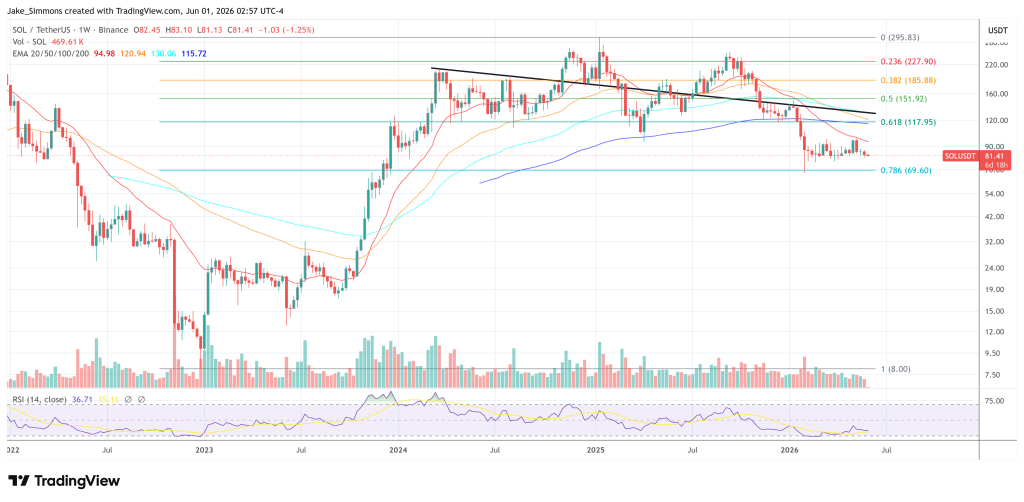
At press time, SOL traded at $81.41.
Read More
- Gold Rate Forecast
- 10 Most Powerful Versions of Superman, Ranked
- GBP CNY PREDICTION
- Forza Horizon 6 Car List So Far: Confirmed Highlights, Cover Cars, DLC, and Rewards
- 007 First Light: Release Date, Story, Gameplay, Cast, Editions, and Platforms
- DOGE PREDICTION. DOGE cryptocurrency
- Superman’s 7 Best Power-Ups, Ranked
- 10 Greatest Wii U Games of All Time, Ranked
- EUR CNY PREDICTION
- What happened to Soldier Boy in The Boys?
2026-06-01 10:42