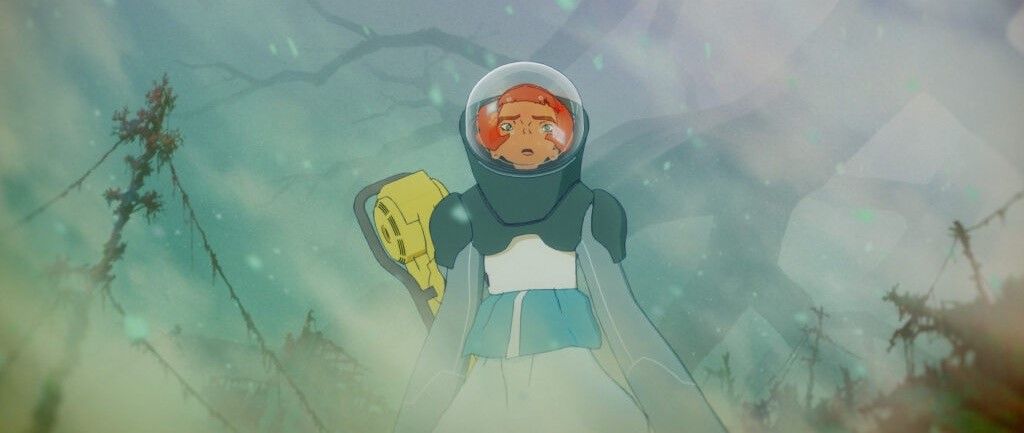
Rita, played by Ai Mikami, finds herself in a deeply ironic predicament. She’s a lonely and depressed woman who wishes for death, but she’s trapped in a time loop where she can’t die – and can’t truly live either. It’s a frustrating and never-ending situation. The film, based on the popular light novel and manga, is also the source material for the Tom Cruise and Emily Blunt movie The Edge of Tomorrow (also known as Live. Die. Repeat.). It’s a surprisingly effective story about how the everyday routine of life can feel like a prison. Director Kenichiro Akimoto’s fast-paced film is a more accurate adaptation of Hiroshi Sakurazaka’s original book than the previous film version, but it doesn’t quite have the same energy and drive.
I really connected with ALL YOU NEED IS KILL because it’s so upfront about valuing life and showing empathy – it wears its heart on its sleeve, which I appreciated. However, that directness unfortunately meant the story felt a little thin. The script seemed to run out of ideas quickly, making the 82 minutes feel longer than it was. Honestly, I think the movie would have been much stronger if it had been longer, giving us a chance to really feel what the main character was going through. We just didn’t get to know her well enough, and she ended up being defined by her sadness rather than being a fully developed person.
ALL YOU NEED IS KILL Cannot Match Its Beautiful Visuals With Its Unimaginative Writing
Everything changes for Rita and the rest of the world when a bright red light crashes into rural Japan and quickly grows into an enormous tree whose roots spread across the planet. The Japanese government calls it “Darol.” For a year, it remains inactive, appearing harmless despite forcing everyone within twenty kilometers of its base to evacuate. Rita joins teams of volunteers who are studying Darol, charting its surface and collecting samples. News reports suggest that the tree’s cells might be able to control time and space.
Rita, easily recognizable with her orange bob haircut, loose-fitting pants, and striking blue eyes, mostly keeps to herself, finding comfort in listening to her CDs. She receives an invitation to a birthday party for someone named Darol, but remains quiet and withdrawn. While venturing out in a bulky mechanical suit, she’s unexpectedly caught in a violent attack when Darol unexpectedly comes to life, growing rapidly and unleashing fast, ravenous, flower-headed monsters. The attack is total, and everyone, including Rita, is killed.
Rita wakes up again at 7:03 AM, and it quickly becomes clear the day is repeating. At first, she thinks the terrible events were just a nightmare, but they happen over and over. By her third life, she frantically tries to warn her coworkers, but they don’t know her and dismiss her as crazy. Like the movie Groundhog Day, Rita tries everything to break the cycle. She initially focuses on escaping the danger, but soon realizes the disaster will follow her no matter where she goes.
While All You Need Is Kill is commendable for its ultimately hopeful outlook, the film’s message feels a bit too forceful and enthusiastic.
Rita even considers suicide, but it doesn’t feel like a significant change for her. She wonders if simply giving up might offer a way out, but even that doesn’t work. She then decides to fight the monsters directly, attempting to understand their weaknesses and motivations. Her deaths become learning experiences – much like in a video game, each failure teaches her how to survive longer. As a way to keep track, Rita marks each death on her hand, a constant reminder of the blurred line between her life and death.
Rita feels a little better when she discovers Keiji is stuck in the same time loop as her. For reasons they don’t understand, their lives are connected – if one dies, the other restarts too. Keiji, a shy and anxious young man, hides his pessimism behind nervous laughter. They connect over the frustrating realization that their lives seem endlessly pointless. No matter how many monsters they defeat or how much ‘purple blood’ is spilled, they’re forced to relive the same strange, monotonous day again and again.
Young people in Japan are facing a significant mental health crisis, particularly since the start of the COVID-19 pandemic, with suicide rates reaching record highs. This is made worse by a cultural stigma around openly discussing mental health, leading to indirect portrayals of suicidal thoughts in the media. While the film ALL YOU NEED IS KILL is commendable for its hopeful message, it feels somewhat overbearing. However, with its striking visuals of both intense action and beautiful, otherworldly landscapes reminiscent of Dale Chihuly’s art, it presents a surprisingly compelling, if unusual, exploration of mortality.
ALL YOU NEED IS KILL has a limited theatrical release on January 16th, 2026.
Read More
- What Song Is In The New Supergirl Trailer (& What It Means For The DC Movie)
- TV legend Carol Kirkwood reveals the reasons why she decided to retire after 28 years with BBC
- Dune 3 Gets the Huge Update Fans Have Been Waiting For
- Robinhood’s Tokenized Stock Fiasco: A Tale of Tokens and Tussles
- After 13 Years, Someone Earned One of the Hardest Achievement Trophies in Gaming
- 5 Best Superman-Centric Crossover Events
- New Open-World “AAAA” Game Coming From Tomb Raider Developer
- Crimson Desert is a “Cynical Amalgamation of Borrowed Mechanics,” Says Larian’s Publishing Director
- Jaleco Sports: Bases Loaded II announced for PS5, Switch; now available
- Digimon Is Getting a New RPG in 2026 (And You Probably Missed It)
2026-01-12 17:10