Author: Denis Avetisyan
New simulations reveal how energy transfer between axion-like particles and gauge fields could have seeded the early universe.
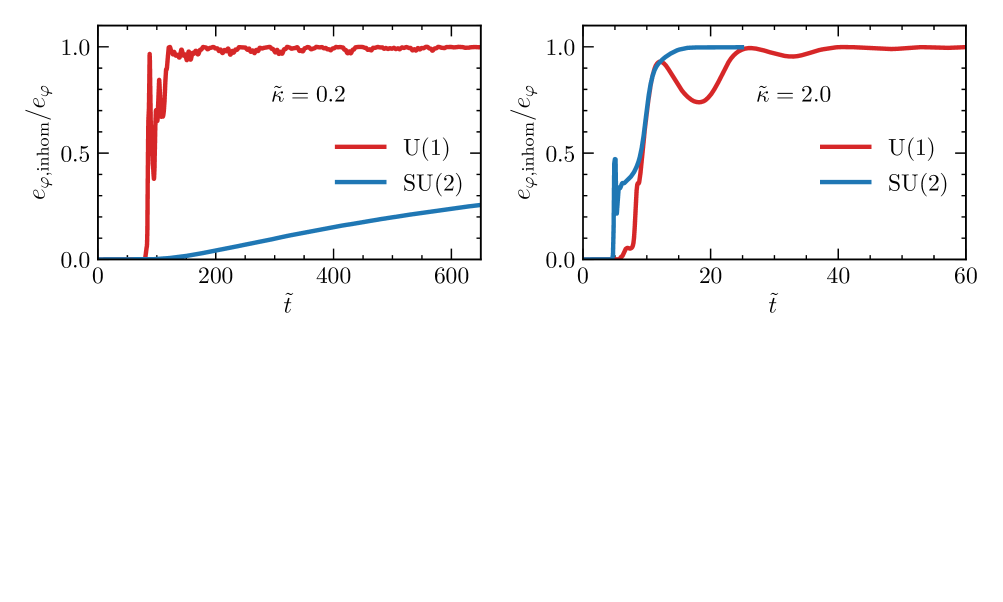
Numerical studies demonstrate classical equipartition dynamics between axions and non-Abelian gauge fields, providing a framework for modeling warm inflationary cosmology.
Understanding the dynamics of inflationary cosmology requires exploring mechanisms beyond the simplest models, particularly those involving interactions between the inflaton and gauge fields. This is the focus of ‘Classical equipartition dynamics between axions and non-Abelian gauge fields’, which presents non-linear, real-time lattice simulations of energy transfer between an axion condensate and an SU(2) gauge ensemble. Our results demonstrate a clear pathway to energy equipartition between these fields, with distinct dynamics compared to Abelian gauge theories, likely due to self-interactions. Could this process provide a crucial link in understanding the thermalization and subsequent evolution of gauge fields in early universe scenarios, potentially shaping the conditions for baryogenesis and other fundamental processes?
The Illusion of Completion: Beyond Standard Inflation
Despite its remarkable success in explaining the large-scale structure of the cosmos, the standard model of inflation remains incomplete, largely due to the enigmatic nature of the inflaton field itself. This hypothetical field, responsible for driving the universe’s exponential expansion in the fraction of a second after the Big Bang, lacks a concrete identification with any known particle within the Standard Model of particle physics. While various candidates, such as the Higgs boson or axions, have been proposed, none fully satisfy the theoretical requirements or observational constraints. Furthermore, the precise potential energy landscape of the inflaton-determining the duration and rate of inflation-remains largely unknown, leading to a vast landscape of possible inflationary scenarios. Understanding the fundamental physics governing the inflaton-its mass, interactions, and decay products-is therefore a central challenge in modern cosmology, requiring a combination of theoretical innovation and increasingly precise cosmological observations to probe the very earliest moments of the universe.
Despite the successes of inflationary theory in explaining the large-scale structure of the cosmos, current models face challenges when reconciling predictions with precise cosmological observations. Specifically, explaining the remarkably flat geometry of the universe – where Ω ≈ 1 – requires an improbable fine-tuning of initial conditions within these models. Furthermore, the origin of primordial fluctuations – the tiny quantum seeds that grew into galaxies and cosmic structures – isn’t fully accounted for. While inflation predicts a nearly scale-invariant spectrum of these fluctuations, detailed analyses of the cosmic microwave background reveal subtle deviations and complexities that existing models struggle to fully reproduce. These discrepancies suggest that the underlying physics governing the very early universe may be more nuanced, and potentially involve modifications to the standard inflationary framework or entirely new theoretical approaches.
A comprehensive understanding of the universe’s earliest moments necessitates investigation beyond the conventional inflationary paradigm, prompting researchers to explore a diverse landscape of potential inflaton candidates and driving mechanisms. While the standard model successfully addresses several cosmological puzzles, it remains incomplete, lacking a definitive explanation for the inflaton field itself – the hypothetical entity responsible for the rapid expansion. Current investigations encompass scenarios featuring multiple inflaton fields, modified gravity theories influencing the inflationary epoch, and even the possibility that inflation arose from phase transitions within the early universe. These alternative models not only seek to refine predictions regarding primordial gravitational waves – detectable ripples in spacetime that could confirm inflationary theories – but also to address lingering questions about the universe’s initial conditions and the origin of cosmic structures, potentially revealing new physics beyond the Standard Model of particle physics.
The Axion as Inflaton: A Glimmer of Resolution
The axion, initially postulated in 1977 as a solution to the strong CP problem in quantum chromodynamics, possesses characteristics that also qualify it as a candidate for the inflaton field driving cosmic inflation. The strong CP problem arises from the theoretical possibility of a charge-parity (CP) violating term in the strong interaction, which is experimentally absent; the axion provides a dynamical mechanism to naturally suppress this term. Crucially, the potential energy landscape of the axion field, arising from non-perturbative effects in QCD, exhibits a shallow minimum suitable for initiating a period of slow-roll inflation. This arises because the axion’s potential, typically expressed as V(\phi) \approx \Lambda^4 \sin^2(\phi/f_a), where Λ represents the QCD scale and f_a is the axion decay constant, allows for a sufficiently flat region during the early universe, fulfilling the necessary conditions for driving inflation and subsequently seeding the large-scale structure observed today.
The axion field’s potential, specifically its relatively flat region at large field values, facilitates a period of slow-roll inflation. This inflationary epoch is characterized by an extremely rapid expansion of the early universe, driven by the potential energy of the axion field. Crucially, the shape of the axion potential dictates the resulting spectral tilt (n_s) and the amplitude of primordial density perturbations, parameters which are tightly constrained by observations of the cosmic microwave background (CMB). Current analyses of the CMB data from the Planck satellite indicate a spectral tilt of approximately n_s \approx 0.96 and a tensor-to-scalar ratio (r) less than 0.05. Axion-based inflationary models can accommodate these observational limits through appropriate choices of the axion potential, providing a viable framework consistent with cosmological data.
Axions, due to their coupling to gauge fields through an anomaly, can generate currents in the early universe when a primeval magnetic field is present or during periods of significant cosmological evolution. This interaction results in a phenomenon where the axion field drives currents along magnetic field lines, effectively amplifying them. The resulting magnetic fields, seeded during inflation or a subsequent reheating phase, possess a coherence length dictated by the axion’s mass and the Hubble parameter at the time of generation. Calculations demonstrate that these axion-driven mechanisms can produce primordial magnetic fields with amplitudes and coherence lengths consistent with current observational upper limits derived from measurements of the intergalactic magnetic field and the cosmic microwave background’s polarization.
Lattice Simulations: Peering into the Quantum Foam
Lattice simulation offers a numerical approach to investigate the non-perturbative dynamics of axions and Non-Abelian gauge fields relevant to the early universe. Traditional analytical methods struggle with strongly coupled systems and scenarios where interactions dominate; lattice simulation circumvents these limitations by discretizing spacetime into a four-dimensional lattice. This allows for the direct computation of field configurations and their evolution, providing insights into phenomena inaccessible through perturbation theory. Specifically, the technique involves solving discretized versions of the equations of motion on this lattice, enabling the study of complex interactions between axions – hypothetical particles proposed to solve the strong CP problem – and Non-Abelian gauge fields, such as those described by Quantum Chromodynamics (QCD). The computational cost scales significantly with the lattice resolution, but advancements in high-performance computing continue to expand the scope and accuracy of these simulations.
Discretization of spacetime in lattice simulations addresses limitations inherent in analytical approaches to early universe cosmology. Analytical methods often struggle with strongly coupled systems and non-perturbative effects, particularly those involving complex field interactions. Lattice simulations, by representing spacetime as a discrete grid, transform continuous field theories into finite-dimensional statistical systems amenable to numerical computation. This allows for the direct calculation of quantities that are inaccessible through perturbative expansions or simplified approximations. The granularity introduces a natural ultraviolet cutoff, regularizing divergences and enabling the study of phenomena at energy scales relevant to the early universe, such as phase transitions and particle interactions, without requiring approximations that might obscure key physics.
This research details the initial numerical simulation investigating the interaction between an axion-like inflaton field and a non-Abelian gauge field ensemble. The study demonstrates a quantifiable transfer of energy between these fields during the early universe, specifically showing that energy is distributed, achieving approximate equipartition. The simulations were conducted on a discretized spacetime lattice, allowing for the modeling of non-perturbative dynamics. Analysis of the simulated data reveals that the energy density of the axion-like field and the non-Abelian gauge field approach comparable levels, indicating a significant degree of energy sharing and interaction between the two.
Instabilities and Sphaleron Processes: A Universe Remade
A departure from the conventional paradigm of slow-roll inflation is instigated by a tachyonic instability-a phenomenon born from the interplay between axions and gauge fields. This instability doesn’t simply perturb the inflationary landscape; it actively reshapes it, allowing for a dynamic evolution previously unseen in standard models. The interaction creates conditions where certain modes become unstable to exponential growth, effectively ‘rolling off’ the flat potential that defines slow-roll. This rapid evolution is crucial because it allows for a pathway towards warm inflation, where substantial particle production occurs during inflation, potentially resolving issues related to the initial conditions of the universe and providing a natural mechanism for reheating. The consequence is a universe that doesn’t simply expand smoothly, but undergoes a period of heightened activity and energy transfer, driven by this fundamental instability at the quantum level.
The emergence of tachyonic instability doesn’t simply alter the inflationary landscape; it actively instigates the Sphaleron process, a fundamental mechanism in particle physics that violates baryon and lepton number conservation. This process, typically suppressed in standard cosmology, becomes highly efficient due to the instability, driving the early universe away from thermal equilibrium. The resulting non-equilibrium state is crucial because it provides a pathway towards Warm Inflation, a scenario where substantial particle production during inflation moderates the expansion rate and offers potential solutions to several challenges faced by traditional cold inflation models. Instead of relying on a slow-roll phase dominated by a potential energy landscape, Warm Inflation harnesses the energy released by these interactions, offering an alternative source of driving force for cosmic expansion and potentially explaining the observed spectrum of primordial fluctuations.
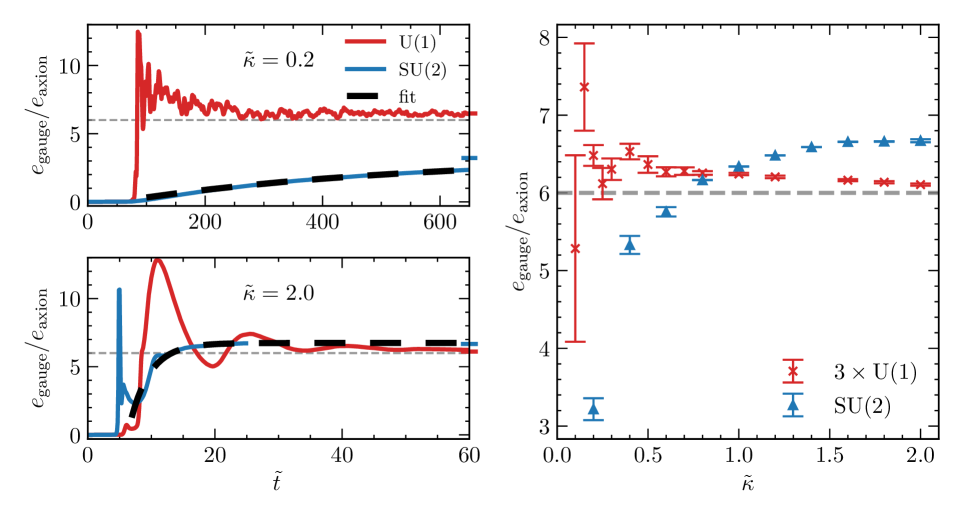
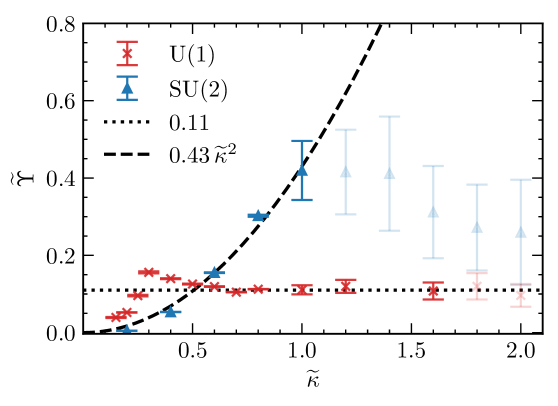
Numerical simulations of the interaction between axions and gauge fields reveal a compelling energy distribution during the inflationary epoch. These studies demonstrate that, despite the complex dynamics, energy tends toward approximate equipartition, quantified by a ratio of approximately 2(N_c^2 - 1), where N_c represents the number of color charges. The rate at which these instabilities develop-the growth rate Γ-scales linearly with the coupling constant, measured as \Gamma = 3.7\kappa. Conversely, the damping rate Υ, which governs the dissipation of these instabilities, exhibits a quadratic dependence on the coupling, scaling as \Upsilon = 0.4\kappa^2. This precise relationship between growth, damping, and coupling suggests a self-regulating mechanism within the inflationary process, potentially contributing to the observed homogeneity and isotropy of the early universe.
Mapping the Fluctuations: Echoes of the Quantum Past
The primordial fluctuations, subtle variations in the density of the early universe, leave an indelible imprint on the cosmic microwave background and the large-scale structure of galaxies. Analyzing the power spectrum of these fluctuations – a measure of the amplitude of variations at different scales – offers a direct window into the period of cosmic inflation, a hypothesized epoch of exponential expansion shortly after the Big Bang. The shape of this power spectrum is exquisitely sensitive to the details of the inflationary dynamics, specifically the potential energy landscape driving the expansion. Different inflationary models predict distinct power spectra, allowing researchers to test these theories against increasingly precise cosmological observations. For instance, deviations from a perfectly scale-invariant spectrum, represented mathematically as P(k) \propto k^n, where n is the spectral index, can indicate the presence of additional fields or modified gravity effects during inflation. Consequently, meticulous analysis of the power spectrum remains a cornerstone of modern cosmology, providing vital clues to unravel the mysteries of the universe’s earliest moments.
To accurately characterize the primordial fluctuations believed to have seeded the large-scale structure of the universe, researchers employ spatial averaging techniques. This process doesn’t simply measure fluctuations at a single point, but instead calculates an average value over a representative volume of space. Such averaging is critical because initial conditions in the very early universe were likely not perfectly uniform; local variations and density contrasts existed. By smoothing out these localized differences, spatial averaging yields a more robust and representative value for the overall fluctuation amplitude, allowing cosmologists to better constrain models of inflation and the subsequent evolution of the cosmos. This technique effectively reduces the impact of noise and provides a clearer signal, enabling more precise measurements of the power spectrum – a key tool for understanding the fundamental properties of the early universe and potentially revealing new physics beyond the standard model.
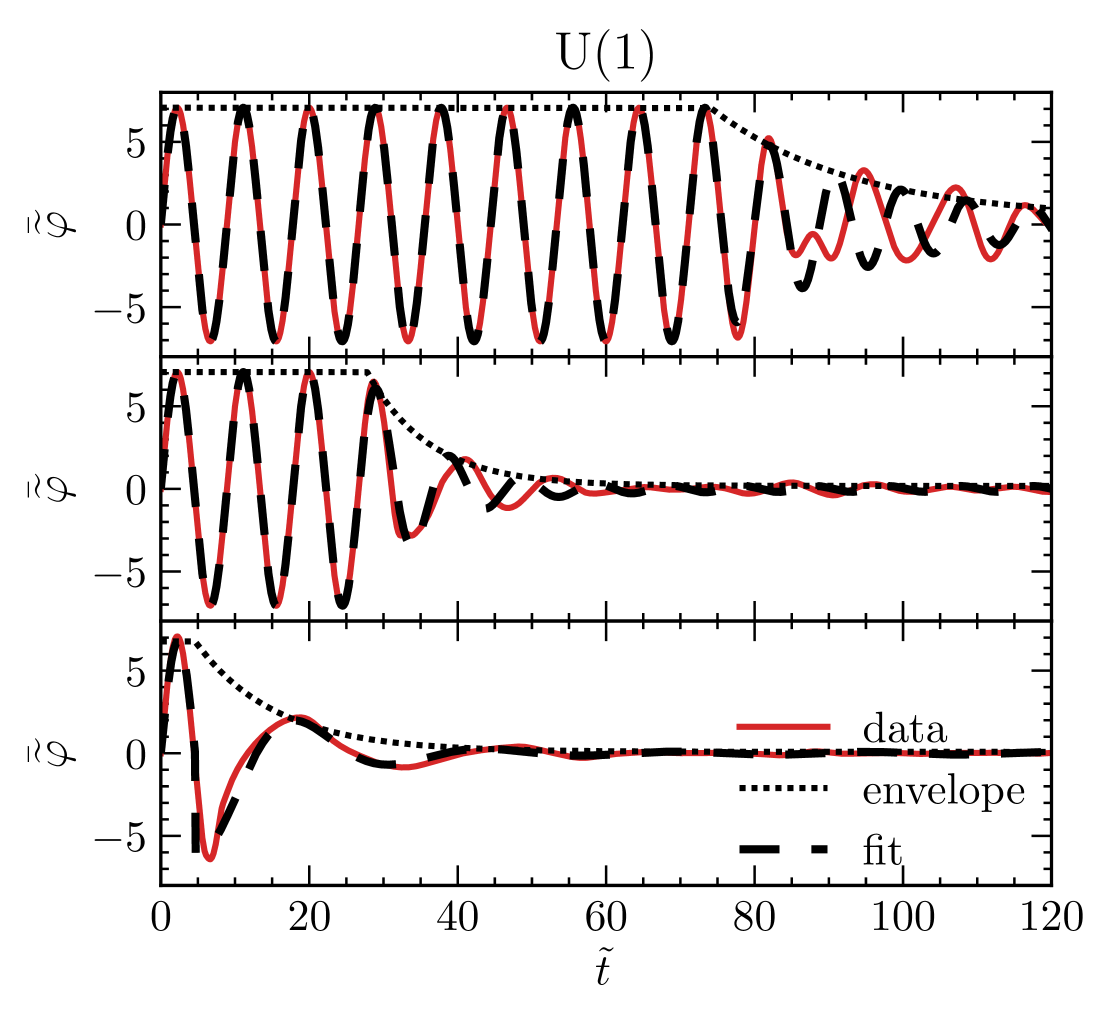
Simulations of primordial fluctuations reveal a quantifiable delay preceding the onset of instability, characterized by a delay factor of t₀⁻¹ = 0.07κ. This delay scales linearly with the coupling constant κ, offering a crucial parameter for modeling the very early universe. The precision afforded by spatial averaging techniques enables researchers to not only refine existing inflationary models, but also to probe for deviations indicative of physics beyond the standard model. Specifically, future investigations employing these methodologies can account for subtle effects, such as the influence of a chemical potential, potentially unveiling novel insights into the fundamental forces and constituents of the cosmos and furthering our understanding of the conditions immediately following the Big Bang.
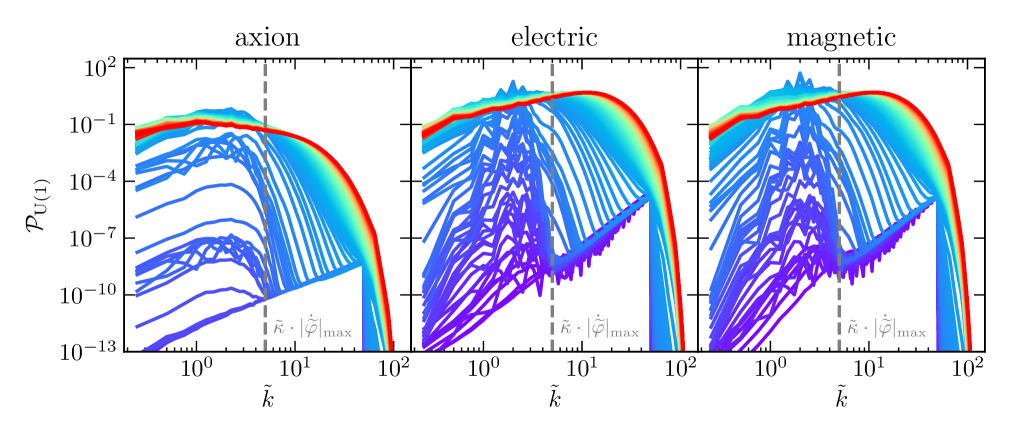
The study meticulously charts energy transfer between axion-like fields and non-Abelian gauge fields, revealing a dynamic approaching equipartition. This resonates with a certain philosophical truth: “Do not go where the path may lead, go instead where there is no path and leave a trail.” Emerson’s words speak to the inherent unpredictability of complex systems-much like this simulation, where initial conditions propagate toward emergent behaviors. The research doesn’t construct a model of warm inflation; it cultivates conditions for it to grow from the interplay of fundamental fields. Every parameter chosen isn’t a definitive answer, but a prediction of how dependencies will unfold, and ultimately, how the system might fail – or, more interestingly, evolve.
The Loom Unwinds
The simulations detailed here offer not a resolution, but a sharpening of the questions. The achieved equipartition, while demonstrating a plausible mechanism for warm inflation, is predicated on initial conditions that themselves demand justification. Each carefully tuned parameter is, in effect, a prophecy of the sensitivities yet to be discovered. The system will not remain quiescent at this balance; perturbations – inevitable in any cosmological model – will drive it towards new, and likely more complex, instabilities. The very act of modeling introduces a fear of unseen resonances.
Future work will inevitably focus on extending these simulations to incorporate additional fields and interactions. But the true challenge lies not in adding complexity, but in accepting the inherent limitations of any attempt to map the primordial universe. The precision sought is an illusion; the signal will always be buried within layers of unmodeled physics. Each refinement of the model will reveal new avenues for decay, new forms of entropy asserting themselves.
The belief that a complete, self-consistent picture of the early universe is attainable is a comforting fiction. The more this work progresses, the clearer it becomes: the goal is not to build a perfect model, but to cultivate a resilient understanding of the inevitable imperfections. The loom will unwind, and the pattern, though beautiful, will always be transient.
Original article: https://arxiv.org/pdf/2601.09784.pdf
Contact the author: https://www.linkedin.com/in/avetisyan/
See also:
- The Super Mario Galaxy Movie: 50 Easter Eggs, References & Major Cameos Explained
- Surprise Isekai Anime Confirms Season 2 With New Crunchyroll Streaming Release
- 10 Best Free Games on Steam in 2026, Ranked
- ‘Project Hail Mary’: The Biggest Differences From the Book, Explained
- Preview: Sword Art Online Returns to PS5 as a Darker Open World Action RPG This Summer
- Sydney Sweeney’s The Housemaid 2 Sets Streaming Release Date
- Why is Tech Jacket gender-swapped in Invincible season 4 and who voices her?
- Starfield (PS5) Review – A Successful Cross-Console Voyage
- Frieren: Beyond Journey’s End Gets a New Release After Season 2 Finale
- Skate 4 – Manny Go Round Goals Guide | All of the Above Sequence
2026-01-18 20:37