Author: Denis Avetisyan
A new cosmological model proposes that the Big Bang wasn’t the beginning, but a transition from a fundamentally Euclidean spacetime, offering a potential resolution to the singularity problem.
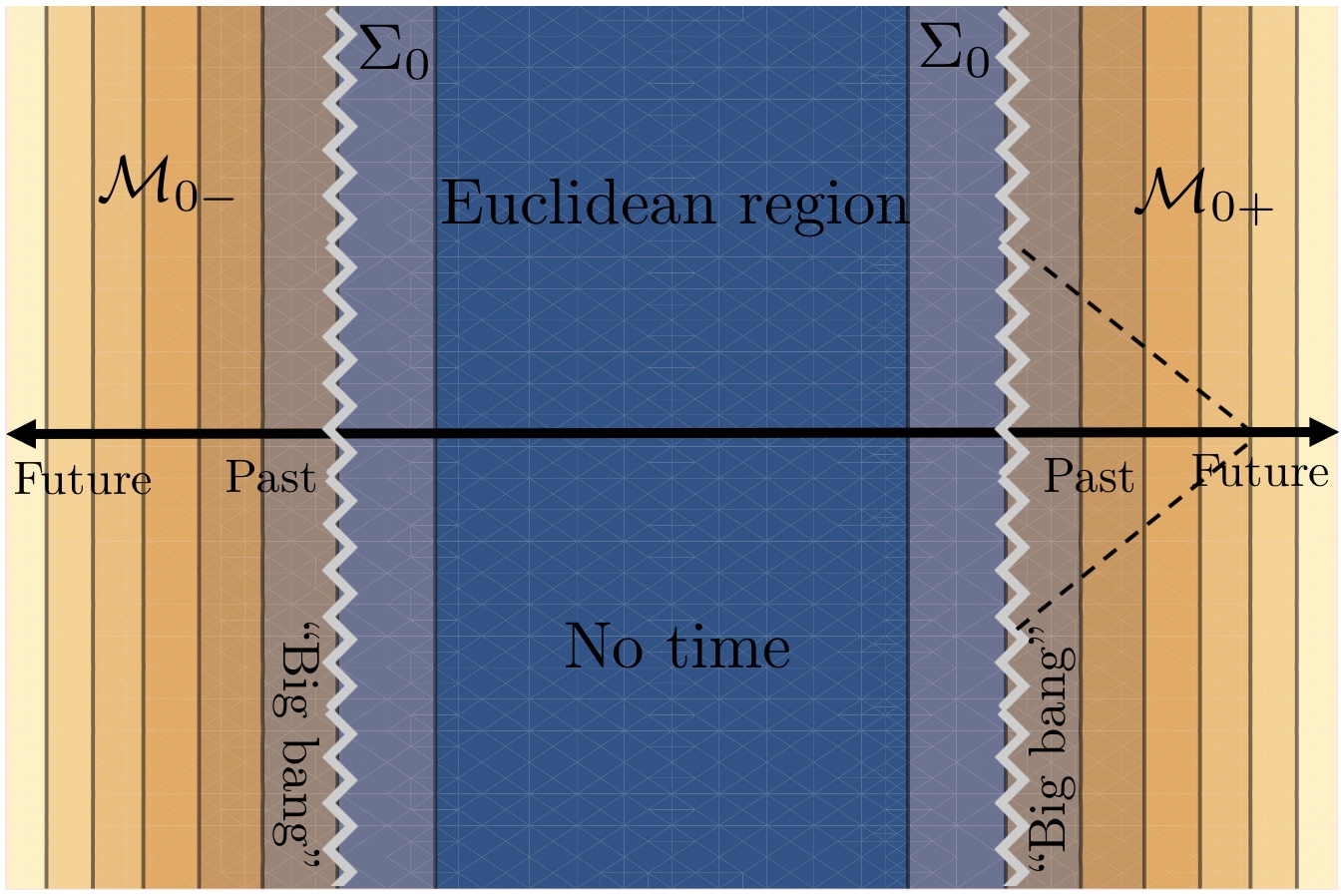
This review details a scenario where the universe emerges from a non-Lorentzian phase, marked by a changing metric signature, and explores its implications for the origin and evolution of spacetime.
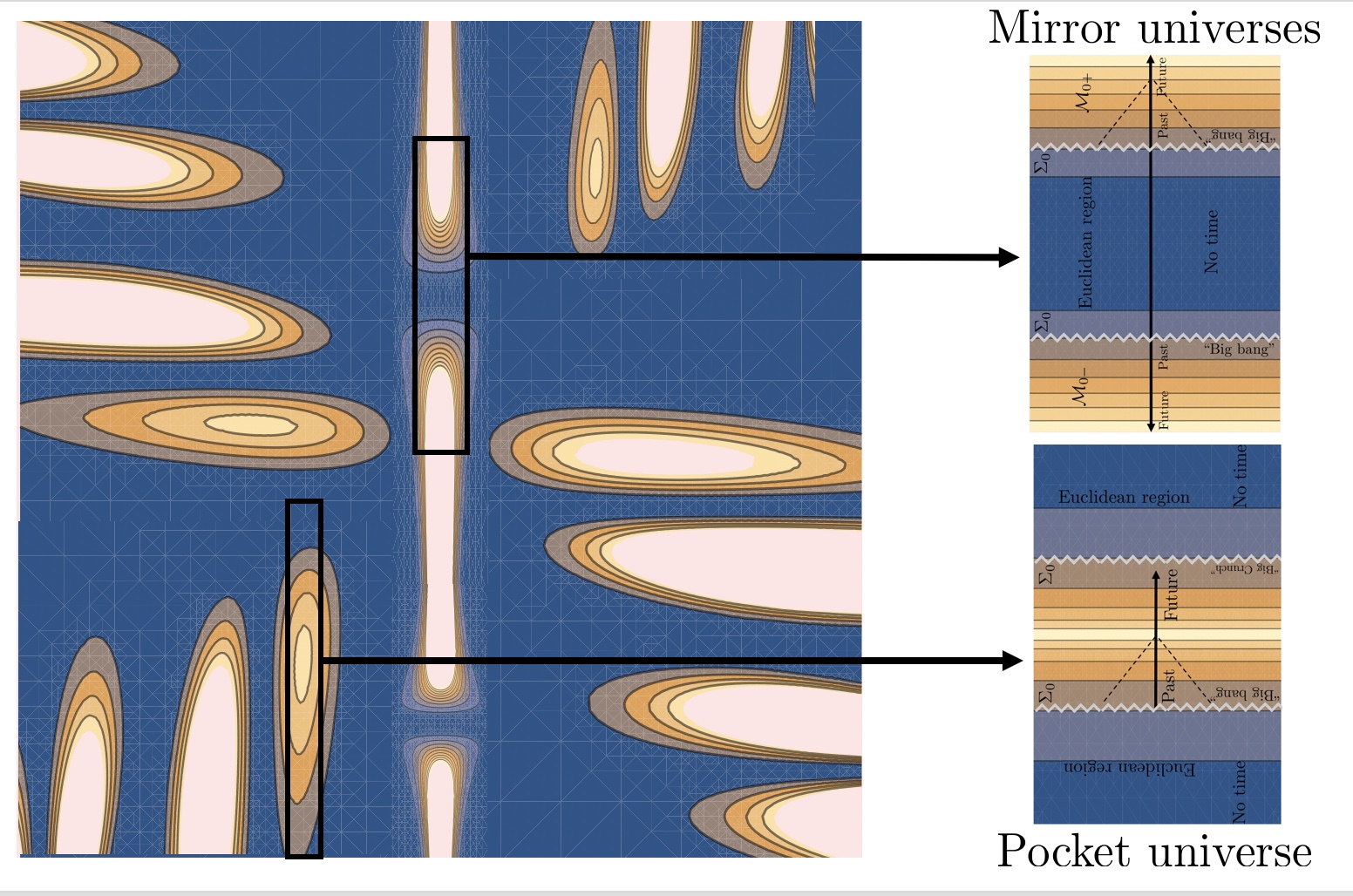
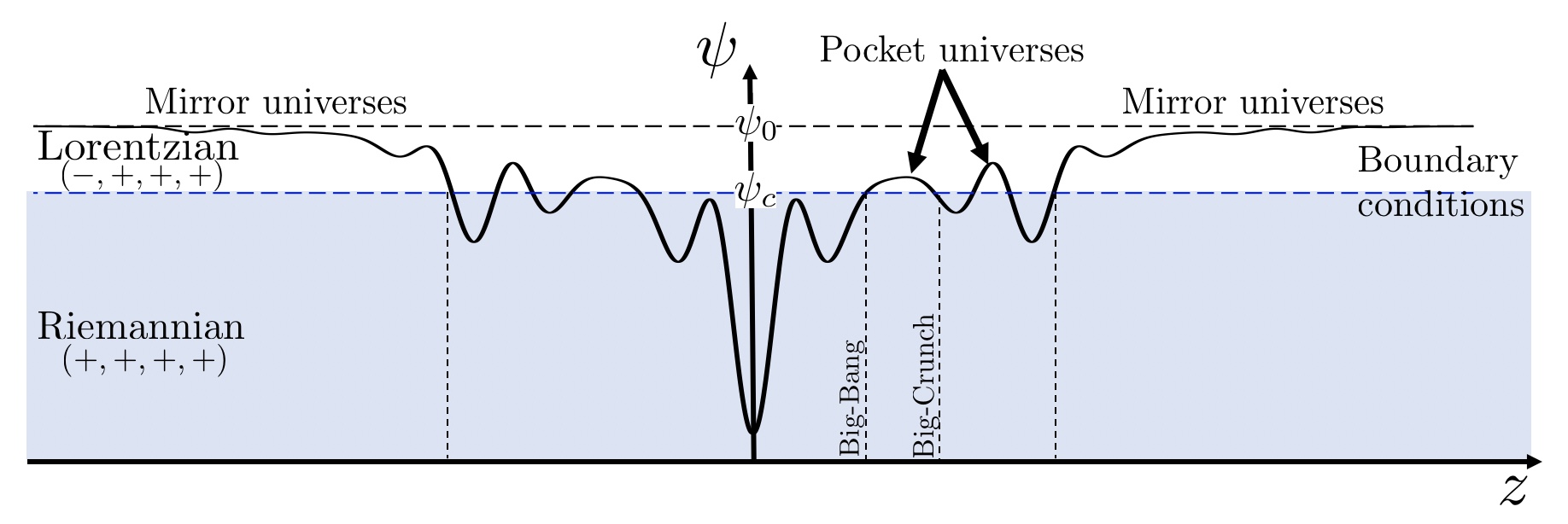
The cosmological singularity at the heart of the standard Big Bang model presents a fundamental challenge to our understanding of spacetime origins. This letter, ‘The emergent Big Bang scenario’, proposes a novel resolution, positing that this singularity is replaced by a smooth hypersurface marking a transition from a fundamentally Euclidean to a Lorentzian geometry. By rewriting physics within a Riemannian framework and introducing a ‘clock field’ responsible for signature change, the authors demonstrate the existence of solutions leading to an emergent universe initially dominated by a de Sitter phase. Could this model, suggesting our universe emerges from a larger ‘Euclidean sea’ of Lorentzian islands, offer testable predictions for cosmology beyond our observable horizon?
Unveiling the Origin: The Limits of Classical Cosmology
Current cosmological models, firmly rooted in Einstein’s General Relativity, project the universe’s origin as a gravitational singularity – a state where density and spacetime curvature become infinite. This isn’t simply a very small point, but a boundary where the known laws of physics cease to apply, rendering predictions impossible. The mathematics of General Relativity, when applied to the extreme conditions immediately following the Big Bang, inevitably leads to this singularity. Essentially, all matter and energy in the observable universe were, according to these models, compressed into an infinitely small volume. While remarkably successful in describing the universe’s subsequent evolution, this initial singularity represents a fundamental limit to the theory, suggesting that a more complete understanding of gravity – potentially incorporating quantum mechanics – is required to accurately describe the universe’s very beginning and resolve this perplexing prediction of infinite density.
The predicted Big Bang singularity isn’t merely an oddity within the framework of General Relativity; it fundamentally signals the theory’s limitations. At this point of infinite density and spacetime curvature, the equations of General Relativity cease to provide meaningful predictions, effectively breaking down as a descriptive tool. This breakdown isn’t a minor issue requiring simple refinement; it demands a completely new theoretical framework capable of describing physics at such extreme scales. Current research explores avenues like quantum gravity – attempting to reconcile General Relativity with quantum mechanics – and alternative theories of spacetime, all driven by the necessity to resolve the singularity and provide a consistent description of the universe’s origin. The inability to accurately model this initial state highlights a crucial gap in modern physics, pushing the boundaries of theoretical investigation and challenging foundational assumptions about the nature of reality itself.
The prediction of an initial spacetime singularity by General Relativity doesn’t simply indicate a moment of incredibly high density; it fundamentally challenges the concept of a definite ‘beginning’ to the universe as understood through current physics. Extrapolating the equations of General Relativity backward in time leads to a point where spacetime itself ceases to be well-defined, suggesting the theory’s limitations at extreme energy scales. This breakdown implies that the laws governing the universe at its earliest moments were likely different from those we currently describe, and that a complete understanding of cosmic origins requires a more comprehensive theoretical framework-one that can account for quantum effects and potentially eliminate the singularity altogether. The existence of such a boundary to predictability raises profound questions about causality and the very nature of time, hinting that our conventional understanding of spacetime may be an approximation valid only under specific conditions.
Beyond the Singularity: Exploring Bouncing Cosmologies
Bouncing cosmologies propose a resolution to the initial singularity predicted by classical Big Bang theory by replacing it with a \text{bounce} . Instead of a spacetime singularity-a point of infinite density and curvature-these models posit a prior contracting phase that transitions into the current expanding phase. This transition is not a singular point but a finite-density, finite-curvature turning point. Mathematically, this requires modifications to General Relativity, particularly at extremely high densities, and necessitates an effective equation of state that prevents the complete contraction of the universe. The bounce represents a minimum scale factor, after which expansion commences, avoiding the problematic infinite quantities associated with the initial singularity. These solutions are actively investigated as viable alternatives to the standard cosmological model.
Bouncing cosmological models, posited as alternatives to an initial singularity, necessitate specific relationships between pressure and density – termed equations of state – to facilitate the transition from contraction to expansion. Current research within the field of Quantum Gravity Phenomenology focuses on identifying observational signatures that could validate these models. This involves examining the Cosmic Microwave Background (CMB) for non-Gaussianities or specific spectral features, as well as analyzing primordial gravitational waves for deviations from predictions based on standard inflationary cosmology. The required equations of state often involve exotic fluids or modifications to general relativity, and their observational verification is a primary goal of ongoing research efforts, utilizing data from current and future cosmological surveys.
String Theory and Loop Quantum Gravity represent distinct, yet complementary, approaches to resolving the singularity problem through bounce cosmology. String Theory postulates that fundamental constituents of the universe are not point-like particles, but rather one-dimensional extended objects-strings-and incorporates concepts like extra spatial dimensions and supersymmetry, potentially modifying gravitational interactions at extremely high energies to prevent singularity formation. Loop Quantum Gravity (LQG) quantizes spacetime itself, predicting that spacetime is granular at the Planck scale and replacing the classical singularity with a quantum bounce due to quantum gravitational effects. Within LQG, the \rho \approx 10^{109} \text{ g/cm}^3 density predicted by the Big Bounce is a key feature. Both frameworks are actively explored to derive specific equations of state and predict observational signatures, such as primordial gravitational waves, that could differentiate these models and provide evidence for a bouncing universe.
A Shift in Perspective: From Lorentzian to Euclidean Origins
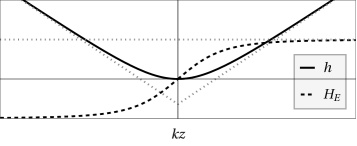
Current cosmological models typically assume an initial Lorentzian spacetime, but a developing theoretical approach posits that the universe began as a Euclidean space characterized by a positive-definite metric. In Euclidean space, the interval ds^2 is calculated as ds^2 = dx^2 + dy^2 + dz^2, resulting in a purely spatial geometry. The transition to Lorentzian spacetime-where the interval is defined as ds^2 = -dt^2 + dx^2 + dy^2 + dz^2-introduces a temporal dimension and the concept of causality. This “Signature Change” proposes that time, and therefore the Lorentzian nature of our universe, emerged from a fundamentally spatial, timeless precursor. This differs from standard Big Bang cosmology, which begins with a singularity within a Lorentzian spacetime, and instead suggests the spacetime itself is emergent.
Sakharov’s Conjecture posits that the universe may have originated from a de Sitter space, a maximally symmetric Lorentzian spacetime with a positive cosmological constant, transitioning from an earlier, non-singular state. This provides a potential mechanism for universe creation circumventing the problematic initial singularity predicted by standard Big Bang cosmology. The conjecture suggests that the observed universe emerged from a primordial de Sitter phase through a process of quantum tunneling or inflationary decay, effectively avoiding the need for an infinitely dense and hot initial state. This approach allows for a finite, albeit potentially unbounded, universe originating from a pre-existing spacetime, thereby addressing the singularity issue inherent in models relying on extrapolation back to time zero.
The model posits that our universe originates from a pre-existing 4-dimensional Euclidean space, rather than arising from a singularity. Within this Euclidean foundation, localized Lorentzian “pockets” emerge, constituting our spacetime. This emergence is governed by a scalar field, termed the “Clock Field”, which dictates the direction and rate of temporal evolution within these pockets. Crucially, because the Lorentzian pockets are embedded within a finite Euclidean space, the overall universe may also be spatially finite, differing from the traditional infinite-universe cosmological models. The Clock Field’s gradient defines the flow of time, effectively creating the temporal dimension within the emergent Lorentzian spacetime, and its properties determine the characteristics of our observed universe.
Rethinking Reality: The Implications of Emergent Time
The Signature Change paradigm proposes a radical shift in cosmological thinking, suggesting the universe didn’t begin with a singularity but rather underwent a fundamental transition from a prior state. This framework posits that certain measurable characteristics – or ‘signatures’ – of the early universe underwent a distinct alteration, resolving issues with traditional Big Bang models like the horizon and flatness problems without invoking inflation. Instead of exponential expansion, the universe experienced a phase change, similar to water freezing into ice, altering its properties and setting the stage for the cosmos observed today. This offers potential explanations for dark energy and dark matter as remnants of this transition, framing them not as exotic entities, but as inherent aspects of the universe’s evolving structure, and providing a new avenue for connecting quantum gravity with large-scale cosmological observations.
The Signature Change paradigm inherently necessitates a deeper investigation into the interconnectedness of quantum gravity, emergent spacetime, and the very definition of time. Current cosmological models struggle to reconcile general relativity with quantum mechanics, and this framework proposes a resolution by suggesting spacetime itself isn’t fundamental, but rather emerges from underlying quantum processes. This shifts the focus from describing the universe within a pre-existing spacetime to understanding how spacetime, and consequently time, arises from more fundamental degrees of freedom. Exploring this relationship demands novel theoretical tools, potentially leveraging concepts like loop quantum gravity or string theory, and calls for observational tests that might reveal subtle signatures of quantum gravity effects on the cosmic microwave background or gravitational waves – essentially searching for evidence that time, as presently understood, is not a fixed background but a dynamic, emergent property of the universe.
The continued development of the Signature Change paradigm hinges on a synergistic relationship between theoretical innovation and observational precision. Researchers are actively pursuing more refined models of quantum gravity and emergent spacetime, seeking mathematical frameworks that not only align with existing cosmological data, but also generate testable predictions. Simultaneously, next-generation telescopes and cosmic microwave background experiments promise to deliver unprecedented measurements of the early universe, potentially revealing subtle signatures that either support or challenge the paradigm’s core tenets. This iterative process – where theoretical insights guide observational strategies and observational data refine theoretical models – is crucial for rigorously validating the approach and ultimately unlocking a deeper understanding of the universe’s origin and evolution. The prospect of definitively confirming, or refining, these concepts relies heavily on this combined effort, promising a new era of cosmological discovery.
The exploration of emergent spacetime, as detailed in this model, echoes a sentiment articulated by Isaac Newton: “If I have seen further it is by standing on the shoulders of giants.” This research doesn’t seek to dismantle established cosmological principles, but rather builds upon them, proposing a novel mechanism-a signature change-to resolve the long-standing issue of the Big Bang singularity. Like Newton’s own work, this model functions as a microscope, examining the specimen of cosmological data to reveal hidden patterns within the very fabric of spacetime, suggesting the universe didn’t begin from nothing, but emerged from a prior state. The clock field, integral to the model, serves as a crucial tool in this observational process.
Looking Beyond the Emergence
The proposition that spacetime emerges from a fundamentally Euclidean precursor, circumventing the Big Bang singularity through a metric signature transition, naturally invites scrutiny of the ‘clock field’ mechanism. While mathematically elegant, the physical instantiation of this field-its coupling to matter, its potential for observational detection, and its stability over cosmological timescales-remains largely unexplored territory. A detailed investigation into these aspects is crucial, lest the model remain a fascinating, yet ethereal, construct.
Further refinement necessitates a rigorous examination of the model’s predictions concerning the cosmic microwave background. Does the signature change leave any subtle, detectable imprint? Equally compelling is the question of initial conditions. A purely Euclidean starting point, while conceptually appealing, begs the question of its own origin – pushing the explanatory burden one step further back. The pursuit of a self-consistent framework, capable of addressing both the very large and the very small, will undoubtedly prove challenging.
Ultimately, the value of this emergent scenario lies not in providing definitive answers, but in framing the right questions. The universe, after all, has a disconcerting habit of resisting simple narratives. To view the Big Bang not as an absolute beginning, but as a transition within a larger, more fundamental structure, is a shift in perspective that may prove surprisingly fruitful-even if it leads only to more refined paradoxes.
Original article: https://arxiv.org/pdf/2602.02646.pdf
Contact the author: https://www.linkedin.com/in/avetisyan/
See also:
- The Super Mario Galaxy Movie: 50 Easter Eggs, References & Major Cameos Explained
- All 13 Smash Bros. Characters in the Super Mario Galaxy Movie
- 10 Best Free Games on Steam in 2026, Ranked
- Highly Anticipated Strategy RPG Finally Sets Release Date (And It’s Soon)
- Dune 3 Gets the Huge Update Fans Have Been Waiting For
- Welcome to Demon School! Iruma-kun season 4 release schedule: When are new episodes on Crunchyroll?
- Sydney Sweeney’s The Housemaid 2 Sets Streaming Release Date
- Control Resonant’s Hiss and Mold Are “Way More Complex” Than Before (and More Aggressive)
- Why is Tech Jacket gender-swapped in Invincible season 4 and who voices her?
- TV legend Carol Kirkwood reveals the reasons why she decided to retire after 28 years with BBC
2026-02-04 10:03