Author: Denis Avetisyan
New simulations reveal how light confinement dramatically alters the behavior of interacting quantum particles, leading to exotic phases and delocalized states.
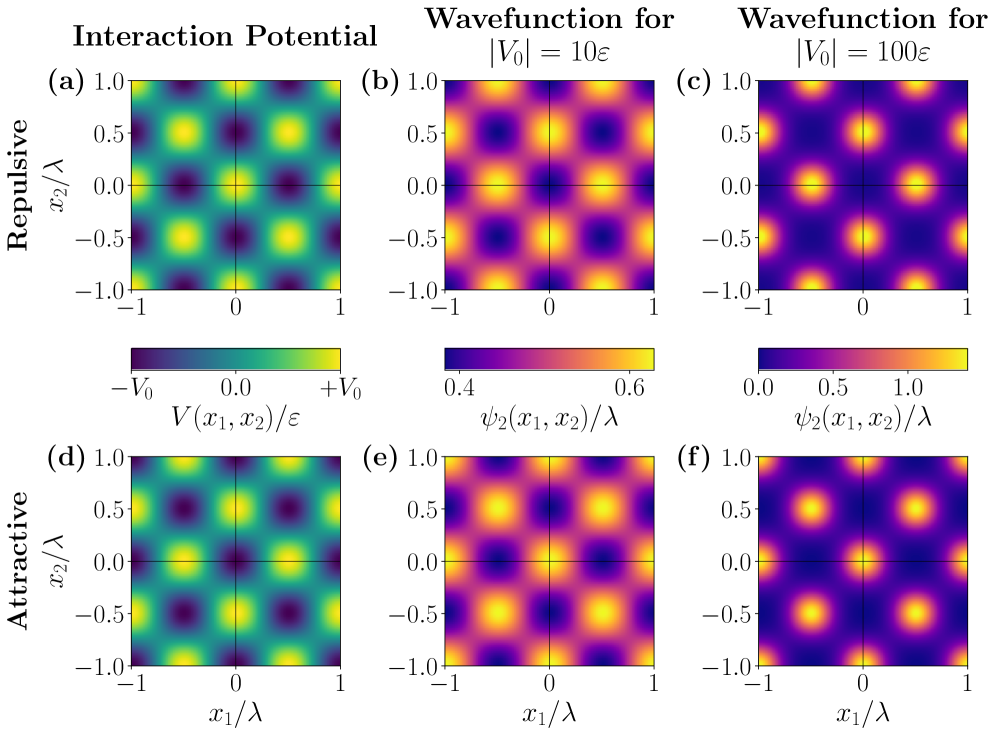
Quantum Monte Carlo methods are used to investigate the ground-state properties of a one-dimensional Bose gas with long-range interactions mediated by an optical cavity.
Understanding the collective behavior of quantum many-body systems remains a fundamental challenge, particularly when confronted with long-range interactions. This work, ‘Quantum Monte Carlo study of systems interacting via long-range interactions mediated by a cavity’, employs advanced Quantum Monte Carlo techniques to investigate the ground-state properties of one-dimensional quantum gases subject to cavity-mediated, infinite-range interactions. Our simulations reveal a rich phase diagram characterized by both delocalized bound states and mesoscopic gas-like regimes, strongly influenced by quantum statistics and the interplay of short- and long-range interactions. How do these findings extend to higher dimensions, and what implications do they hold for controlling and manipulating quantum systems with tailored light-matter interactions?
Beyond the Reach of Nearest Neighbors: Unveiling Long-Range Quantum Control
The study of many-body physics, while powerful, has historically faced a significant hurdle: the practical difficulty of manipulating interactions between particles that aren’t immediately adjacent. This limitation restricts the ability to fully investigate complex quantum states, as the emergence of novel phases of matter often relies on the subtle interplay of long-range forces. Unlike systems where each particle primarily ‘feels’ its nearest neighbors, controlling interactions that extend across greater distances – akin to coordinating a complex dance across a large room – presents immense technical challenges. Consequently, researchers have often been forced to simplify models, focusing on short-range interactions, which, while manageable, may inadvertently obscure or even miss entirely the existence of entirely new and potentially groundbreaking states of matter waiting to be discovered. This inability to reliably engineer and observe long-range interactions has, for a considerable time, impeded progress in understanding and harnessing the full potential of collective quantum phenomena.
Traditional methods for simulating many-body systems often falter when faced with long-range interactions, where a particle’s influence isn’t limited to its immediate neighbors. This limitation arises because most computational techniques are optimized for scenarios with localized interactions, requiring increasingly complex calculations to accurately represent the cascading effects of distant relationships. Consequently, predictions based on these approximations can diverge significantly from experimental observations, hindering a complete understanding of emergent phenomena like collective behavior and phase transitions. The inability to faithfully model these extended interactions effectively restricts the exploration of novel states of matter and limits the potential for discovering and harnessing exotic physical properties, as subtle long-range correlations often dictate the system’s overall behavior.
The ability to finely tune interactions between quantum particles is paramount to realizing and studying exotic states of matter. Specifically, achieving precise control unlocks the potential to engineer systems exhibiting supersolidity – a phase where matter flows without resistance yet maintains a crystalline structure – and to probe non-equilibrium phase transitions, which reveal how systems respond to external stimuli. This level of control is not merely about observation; it allows researchers to move beyond passive study and actively design materials with unprecedented properties. Ultimately, manipulating these long-range interactions paves the way for exploring a “frustrated mesoscopic phase,” a complex state arising from competing interactions across a mid-sized scale, potentially leading to novel quantum technologies and a deeper understanding of collective quantum behavior.
Extending the Reach: New Platforms for Long-Range Quantum Control
High-finesse and multimode optical cavities enable long-range interactions between particles by confining photons within a large volume, effectively increasing the interaction range beyond direct, short-range forces. These cavities function as resonators, enhancing the light-matter interaction and mediating interactions between spatially separated particles; the finesse, defined as the free spectral range divided by the cavity linewidth, determines the cavity’s ability to store photons and thus enhance interaction strength. Multimode cavities, unlike single-mode cavities, support multiple resonant frequencies, allowing for the coupling of diverse particle species or internal states. This cavity-mediated interaction strength scales with the cavity’s quality factor Q and the number of particles, providing a means to engineer strong, long-range forces and study many-body physics.
Dynamically tunable optical lattices and programmable optomechanical arrays facilitate precise manipulation of interparticle interactions by controlling the potential landscape experienced by constituent elements. Optical lattices, formed by interfering laser beams, allow for adjustment of lattice spacing and depth, thus altering the hopping amplitudes and on-site energies of atoms trapped within. Programmable optomechanical arrays leverage micro- or nano-mechanical resonators coupled to optical waveguides, enabling independent control of coupling strengths and geometries between individual elements. This level of control permits the creation of customized many-body systems, allowing researchers to investigate phenomena such as correlated electron behavior, topological phases, and quantum phase transitions by tailoring the interaction parameters and lattice configurations.
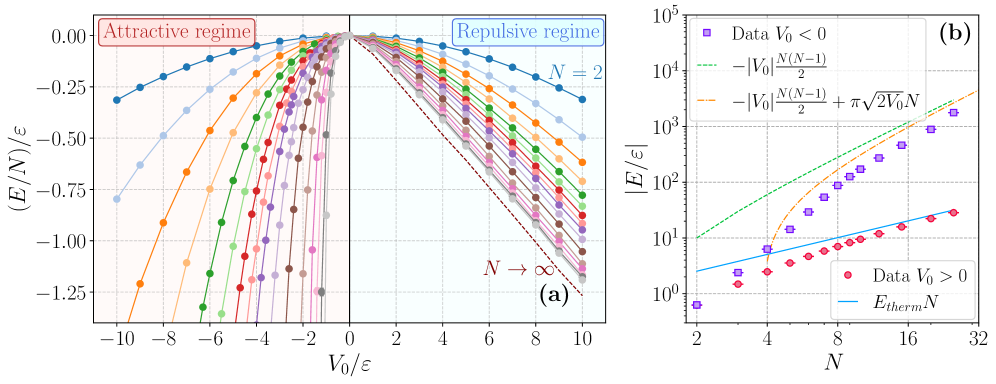
The implementation of high-finesse and multimode optical cavities, alongside dynamically tunable lattices, enables the engineering of effective infinite-range interactions between quantum gas constituents. This is achieved by coupling particles through the cavity modes, effectively eliminating spatial limitations on interaction range. Such long-range connectivity fundamentally alters the system’s behavior, moving beyond the localized interactions typical of conventional quantum gases. Specifically, these platforms have facilitated the observation of a frustrated mesoscopic phase, characterized by competing interactions that prevent the system from settling into a simple, ordered ground state, and opening research pathways into novel quantum phenomena and many-body physics.
Validating the Models: From Theory to Experiment
The Extended Bose-Hubbard Model (EBHM) builds upon the standard Bose-Hubbard Model by incorporating terms that account for long-range interactions between bosons trapped in optical lattices. The conventional Bose-Hubbard Model typically considers only on-site interaction and tunneling between nearest-neighbor lattice sites; however, many experimental realizations exhibit interactions extending beyond immediate neighbors. The EBHM introduces additional parameters to describe the strength and range of these long-range interactions, often utilizing V_{ij} to denote the interaction potential between bosons at sites i and j. This extension allows for the investigation of phenomena not captured by the simpler model, such as the emergence of novel phases and modified excitation spectra, and is crucial for accurately describing systems where long-range interactions significantly influence the collective behavior of the Bose gas.
Variational Monte Carlo (VMC) and Diffusion Monte Carlo (DMC) are quantum many-body methods employed to approximate the ground-state properties of complex systems. VMC utilizes trial wavefunctions, parameterized functions representing the system’s quantum state, and optimizes these parameters to minimize the system’s energy, providing an upper bound to the true ground-state energy. DMC, building upon VMC, projects out the ground state from the trial wavefunction through imaginary time evolution – effectively simulating the system’s time evolution in imaginary time τ. This process amplifies the ground-state component while suppressing excited states, yielding a more accurate estimate of the ground-state energy and other observables. The accuracy of both methods depends heavily on the quality of the chosen trial wavefunction, and the results are often benchmarked against experimental data or other theoretical calculations to validate the model’s predictive power.
Analysis of experimentally accessible observables in one-dimensional quantum gases provides a means to validate theoretical models incorporating long-range interactions. Specifically, the static structure factor, which describes the spatial correlations between particles, the density profile characterizing particle distribution, and the pair distribution function detailing the probability of finding two particles at a given distance, are key indicators of system behavior. Measurements of these quantities demonstrate a transition sequence: from a mesoscopic gas exhibiting standard Bose gas properties, through a frustrated phase arising from competing interactions, and culminating in a delocalized bound state characterized by extended correlations and altered density profiles; these observed transitions serve as benchmarks for the accuracy of the underlying theoretical framework and parameterizations.
Beyond Conventional Phases: Towards a New Era of Quantum Matter
Supersolidity, a fascinating and counterintuitive phase of matter, emerges when a substance simultaneously exhibits the properties of a solid and a superfluid. Recent research demonstrates that long-range interactions between particles are crucial for stabilizing this delicate state, preventing its collapse into more conventional phases. These interactions don’t just hold the structure together; they actively encourage the formation of long-range diagonal order – a specific arrangement of particles extending over macroscopic distances – alongside the frictionless flow characteristic of superfluids. Moreover, these extended interactions also bolster the tendency towards crystalline order, effectively reinforcing the solid component of this dual-natured material, and suggesting a pathway toward controlling and manipulating matter at the quantum level.
The imposition of long-range interactions within certain systems doesn’t simply alter existing phases of matter; it fundamentally reshapes the pathways available for phase transitions, frequently bypassing the constraints of equilibrium. This allows for the emergence of exotic states – those exhibiting properties impossible to achieve under standard, thermally balanced conditions. These non-equilibrium transitions are driven by the system’s response to external stimuli or internal dynamics, resulting in behaviors like the fleeting existence of metastable phases or the formation of structures with unusual order. Consequently, researchers observe phenomena not predicted by traditional phase diagrams, potentially unlocking materials with unprecedented functionalities and opening avenues for manipulating matter in ways previously considered unattainable.
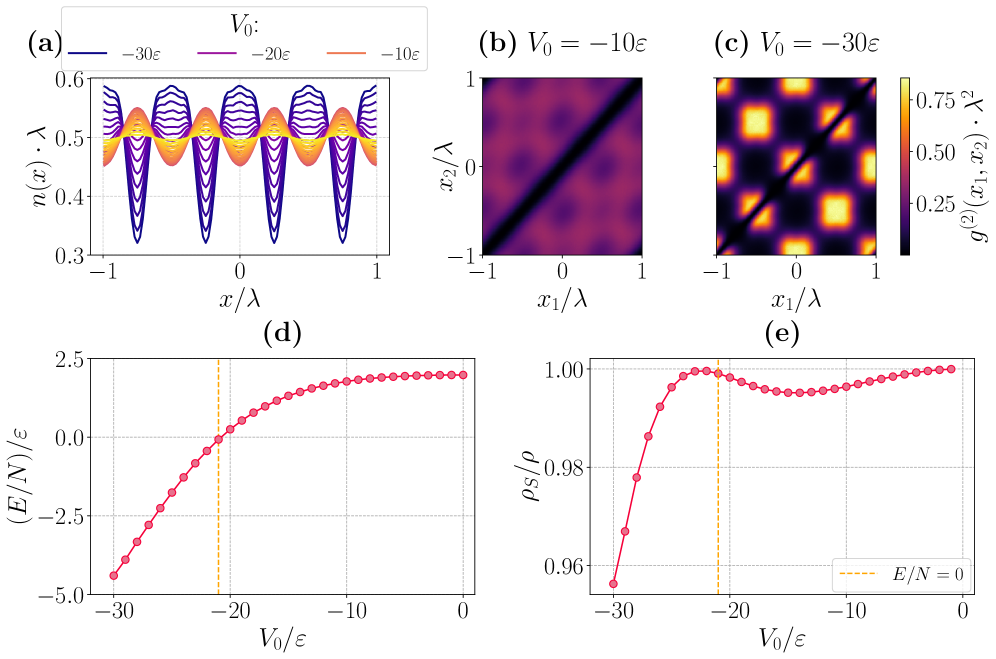
The deliberate manipulation of long-range interactions within these systems presents a pathway toward engineering novel phases of matter with tailored properties. Research indicates that precise control over these interactions doesn’t require achieving absolute equilibrium; a finite fraction of superfluidity can be observed even before a complete transition to a delocalized bound state occurs, offering a window for practical application. This suggests the potential to create materials exhibiting both frictionless flow and structural order, opening doors for advancements in areas such as quantum computing, energy storage, and the development of ultra-sensitive sensors. Further investigation focuses on harnessing these controllable transitions to design materials with specific functionalities, effectively moving beyond passive observation toward active material creation and manipulation at the quantum level.
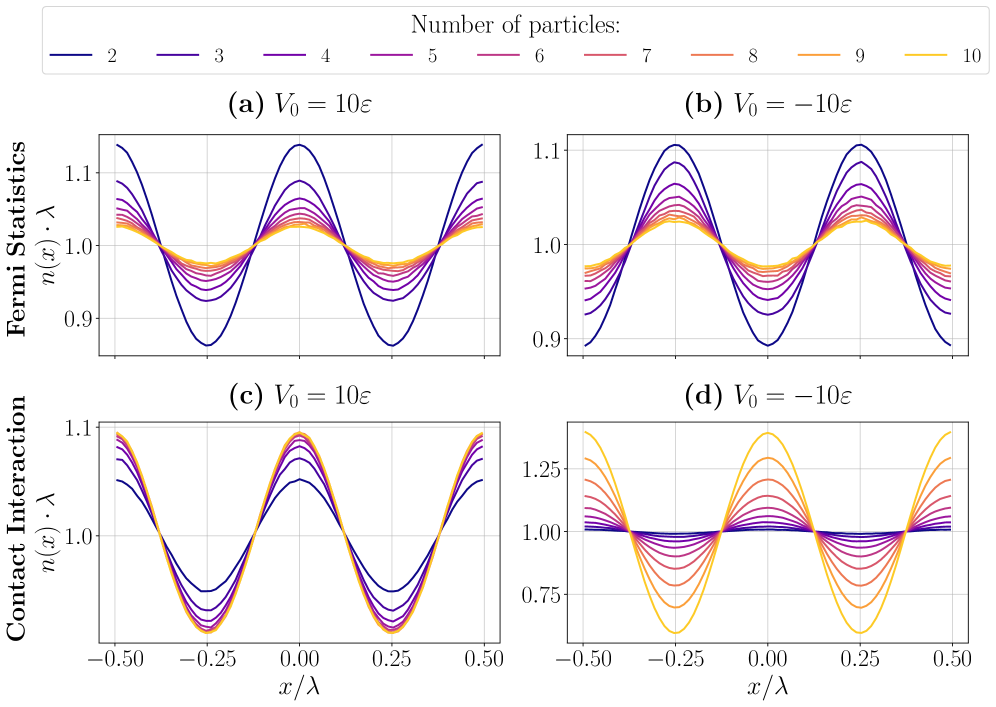
Beyond Bosons and Fermions: Charting New Statistical Territories
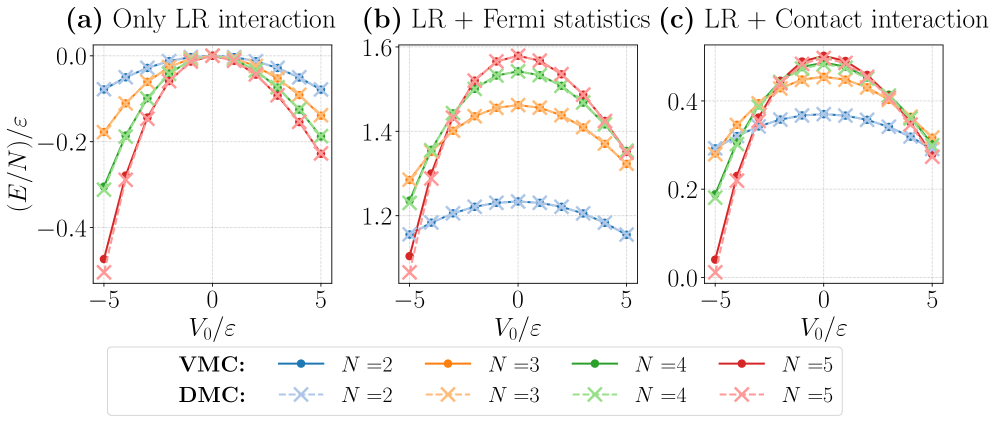
Fermionic systems, governed by the Pauli exclusion principle, present unique computational challenges due to the antisymmetric nature of their wavefunctions. Accurately describing these systems requires methods that explicitly account for this constraint, and techniques like Diffusion Monte Carlo (DMC) have become indispensable. However, directly solving the many-body Schrödinger equation for fermions remains intractable; therefore, the fixed-node approximation is often employed within DMC. This approximation constrains the nodal surface of the wavefunction – the surface where the wavefunction equals zero – based on a trial wavefunction. The accuracy of the resulting DMC calculation is thus intimately tied to the quality of this trial wavefunction; significant discrepancies between Variational Monte Carlo (VMC) and DMC energies often signal the presence of strong correlations and the need for improved trial wavefunctions capable of accurately representing the complex interplay of interactions and fermionic statistics within the system.
Investigating materials where particles obey different statistical rules-beyond the familiar fermions and bosons-offers a powerful route to unraveling the complex relationship between particle interactions, fundamental statistics, and the resulting macroscopic behaviors. These explorations aren’t merely academic exercises; they reveal how collective phenomena emerge from the microscopic world. For example, systems exhibiting anyonic statistics – where particles neither fully obey fermionic nor bosonic rules – are predicted to host exotic excitations with potential applications in topological quantum computation. By systematically studying these diverse statistical systems, researchers can gain crucial insights into the origins of emergent order, potentially leading to the discovery and control of novel phases of matter with unprecedented properties. This pursuit necessitates increasingly sophisticated theoretical models and computational techniques to accurately capture the subtle interplay between these fundamental factors and predict new, observable phenomena.
Investigations are now shifting towards applying these computational methods to increasingly intricate physical systems, with a particular emphasis on uncovering and controlling novel states of matter exhibiting exotic properties. This pursuit necessitates not only refining existing techniques, such as Diffusion Monte Carlo, but also developing new approaches to accurately describe many-body interactions. A critical component of these studies involves rigorous validation of the initial trial wavefunctions used in these calculations; substantial discrepancies between Variational Monte Carlo (VMC) and Diffusion Monte Carlo (DMC) energies serve as a key indicator of complex correlations within the system, suggesting the need for more sophisticated wavefunction forms to capture the underlying physics and ensure reliable predictions about material behavior.
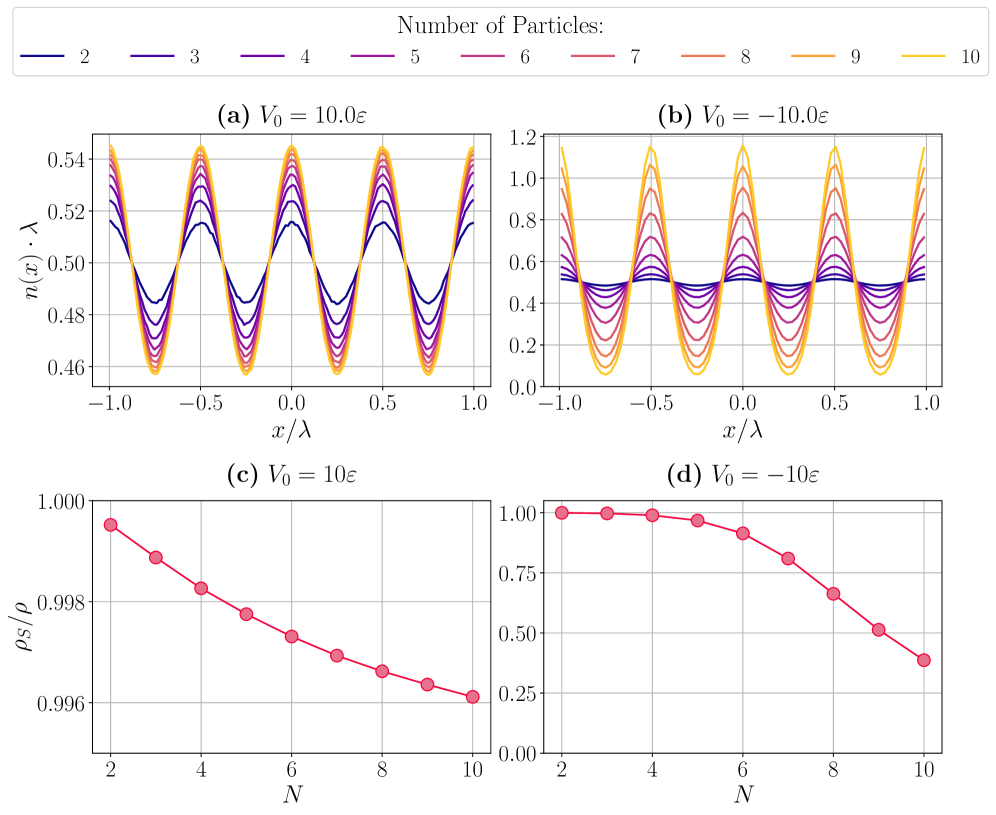
The pursuit of understanding complex quantum systems, as demonstrated in this study of cavity-mediated long-range interactions, mirrors a dedication to revealing inherent order. This work, employing Quantum Monte Carlo methods to map the phase diagram of a one-dimensional quantum gas, embodies a quest for clarity amidst intricacy. Søren Kierkegaard observed, “Life can only be understood backwards; but it must be lived forwards.” Similarly, researchers delve into the complexities of these quantum systems-analyzing emergent properties like delocalized bound states-to gain insight into the fundamental principles governing their behavior, always moving forward with each computational step. The elegance of this approach lies in its ability to distill meaningful results from computationally intensive simulations, a testament to the power of well-defined methods.
Beyond the Horizon
The pursuit of understanding many-body quantum systems, even within the seeming simplicity of one dimension, persistently reveals the limits of intuition. This work, while illuminating the phase diagram for cavity-mediated interactions, does not offer closure, but rather a sharpened view of the questions that remain. The emergence of delocalized bound states, for instance, hints at a subtle interplay between confinement and long-range order – a phenomenon demanding further scrutiny with tailored observables beyond those traditionally employed. A good interface is invisible to the user, yet felt; similarly, a robust theoretical understanding should yield predictions that resonate with experimental observation without excessive parameter tuning.
Future investigations should not shy away from extending these methods to higher dimensions, though the computational cost will undoubtedly demand ingenuity. More fundamentally, a deeper theoretical framework is needed to elegantly describe the transition between the mesoscopic gas phases observed and the truly collective behavior expected of a Bose-Einstein condensate. Every change should be justified by beauty and clarity; the current formalism, while functional, feels… labored. A more concise and insightful description of the underlying physics remains a worthy goal.
Ultimately, the true test lies not in reproducing known results, but in predicting novel phenomena. This demands a willingness to embrace complexity, yet always striving for an underlying simplicity. The path forward is not merely to compute more accurately, but to understand more deeply – to find the elegant solution hidden within the seeming chaos.
Original article: https://arxiv.org/pdf/2601.10301.pdf
Contact the author: https://www.linkedin.com/in/avetisyan/
See also:
- The Super Mario Galaxy Movie: 50 Easter Eggs, References & Major Cameos Explained
- 10 Best Free Games on Steam in 2026, Ranked
- Sydney Sweeney’s The Housemaid 2 Sets Streaming Release Date
- Why is Tech Jacket gender-swapped in Invincible season 4 and who voices her?
- All 13 Smash Bros. Characters in the Super Mario Galaxy Movie
- Welcome to Demon School! Iruma-kun season 4 release schedule: When are new episodes on Crunchyroll?
- Forza Horizon 6 ‘Prologue’ gameplay
- WTH?! Twitter Drops Fake Daredevil: Born Again Season 2 Spoilers as Character Return Confirmed
- Dune 3 Gets the Huge Update Fans Have Been Waiting For
- What happened to Soldier Boy in The Boys?
2026-01-16 18:19