Author: Denis Avetisyan
A new study demonstrates that accurately modeling the interplay of light and matter in nanoscale semiconductors requires a detailed, fully quantized simulation of coupled photons, excitons, and biexcitons.
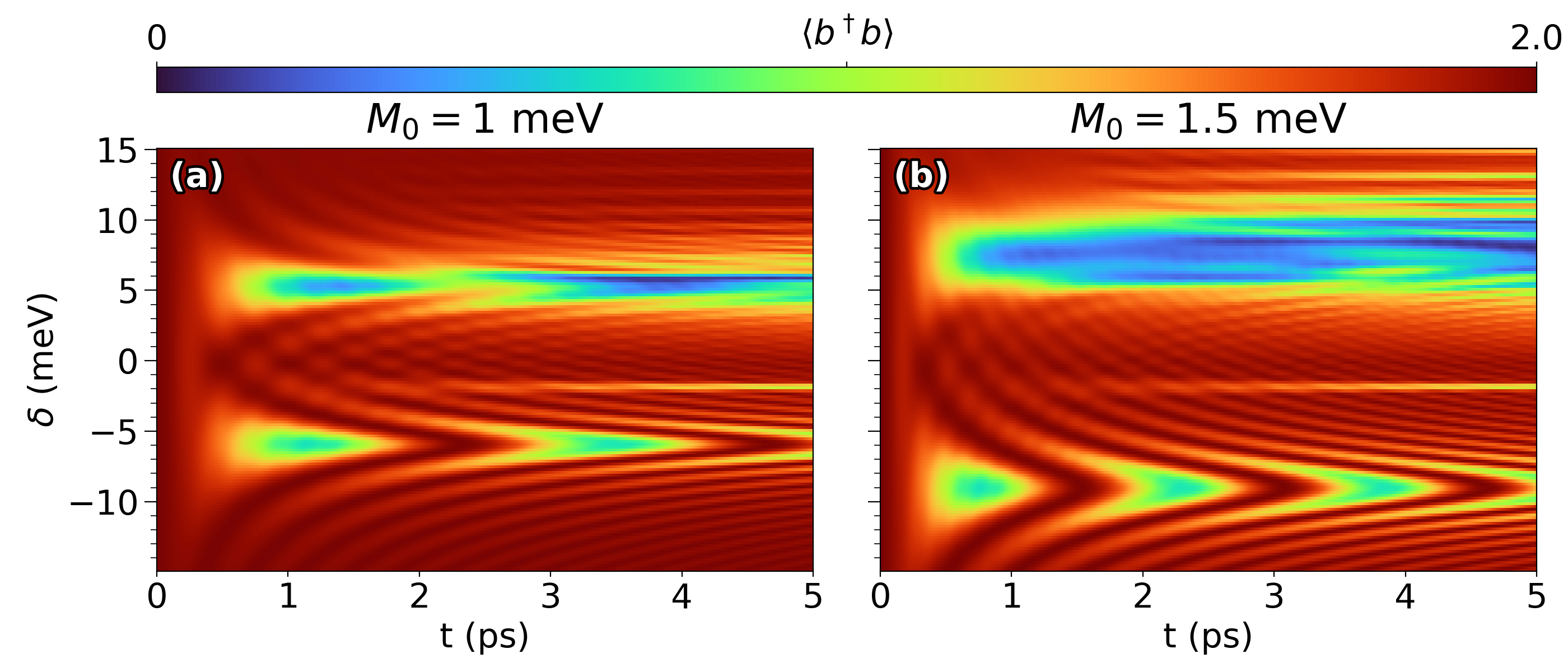
This research presents a microscopic simulation of coupled cavity photons, excitons, and biexcitons, revealing the limitations of simplified models and highlighting the importance of a fully quantized approach.
Simplified models of light-matter interaction often neglect the complex many-body effects crucial for accurately describing quantum dynamics in semiconductor nanostructures. This work, ‘Microscopic simulations of the coupled dynamics of cavity photons, excitons, and biexcitons’, presents a fully quantized microscopic approach to investigate the coherent interplay between cavity photons, excitons, and biexcitons, revealing the significant influence of biexciton continuum states and sensitivity to both cavity frequency and light-matter coupling strength. Our simulations demonstrate that a detailed analysis beyond simple bound-state approximations is essential for understanding these systems; but what new phenomena will emerge with the inclusion of further many-body interactions and environmental effects?
Illuminating the Interface: Harnessing Light-Matter Coupling
The pursuit of tightly integrated light and matter holds the potential to redefine photonic technologies, and semiconductor nanostructures are proving to be a crucial platform for achieving this goal. These structures, engineered at the nanoscale, exhibit strong coupling between photons-the fundamental particles of light-and excitons-bound electron-hole pairs within the semiconductor. This strong coupling leads to the formation of hybrid light-matter states, known as polaritons, which possess unique properties not found in either light or matter alone. Exploiting these polaritons could enable the creation of ultra-fast, energy-efficient devices for applications ranging from quantum computing and secure communication to advanced sensing and novel laser technologies. The ability to precisely control and manipulate these interactions promises a new era of photonic innovation, moving beyond the limitations of traditional electronics and optics.
Accurate modeling of light-matter interactions at the nanoscale presents a significant challenge due to the inherent complexities of quantum phenomena. Unlike classical physics, where light and matter are treated as distinct entities, at the quantum level, these interactions involve correlated behavior of photons and material excitations – often described by \hat{H} = \hat{H}_{light} + \hat{H}_{matter} + \hat{H}_{int} , where \hat{H}_{int} represents the interaction Hamiltonian. Precisely defining and solving for this interaction term is difficult because it necessitates accounting for quantum superposition, entanglement, and the wave-particle duality of light and matter. Furthermore, many-body effects within the material, alongside the continuous spectrum of electromagnetic modes, contribute to the computational burden. These quantum mechanical intricacies demand sophisticated theoretical frameworks – beyond simple approximations – to accurately predict and harness the potential of strongly coupled light-matter systems for advanced photonic technologies.
Conventional computational methods struggle to fully represent the intricate dance between light and matter within strongly coupled systems, particularly those leveraging semiconductor nanostructures. These limitations stem from the inherent complexities of quantum dynamics, where approximations often obscure crucial details of energy transfer and coherence. Consequently, simulations frequently fail to accurately predict system behavior, creating a bottleneck in the design and optimization of devices for quantum information science. This inability to model the full range of interactions – including exciton-polariton behavior and many-body effects – directly impedes progress towards realizing practical quantum technologies, as theoretical predictions lack the fidelity needed to guide experimental efforts and validate innovative designs. E = h\nu
A Quantum Blueprint: Modeling the Light-Matter Symphony
The theoretical framework utilizes a microscopic, fully quantized model to accurately simulate the behavior of the semiconductor nanostructure within the optical cavity. This approach explicitly accounts for both Coulomb interactions – the electrostatic forces between electrons – and quantum-optical effects arising from the quantization of the electromagnetic field. By treating all relevant degrees of freedom quantum mechanically, the model avoids classical approximations and enables a detailed investigation of phenomena governed by electron-electron interactions and light-matter coupling. The model’s formulation allows for the calculation of observables dependent on both electronic and photonic states, capturing the complex interplay between these elements.
The system’s temporal dynamics are modeled using the Heisenberg picture, a formulation of quantum mechanics where operators, rather than state vectors, evolve in time. This approach is particularly suited for describing interactions with time-dependent potentials, such as those arising from the quantized electromagnetic field. To manage the complexities of many-body interactions and avoid divergences in calculations, normal-ordered operators are employed. Normal ordering ensures that creation operators always precede annihilation operators, effectively removing the zero-point energy and simplifying the treatment of vacuum fluctuations within the system. This allows for a precise calculation of time-dependent expectation values and accurate prediction of the system’s response to external stimuli, as it implicitly handles the commutation relations between the operators involved in the system’s Hamiltonian \hat{H} .
The semiconductor nanostructure’s electronic structure is modeled using a two-band tight-binding approach, which simplifies calculations by considering only the valence and conduction bands and their interactions. This approximation allows for efficient computation of electron dynamics within the nanostructure. The model operates within the confines of a single-mode optical cavity, meaning only one resonant frequency of light is considered for interaction with the semiconductor. This simplification enables focused analysis of light-matter interactions at that specific frequency, and facilitates the treatment of the cavity field as a harmonic oscillator, described by creation and annihilation operators. The combined approach allows for detailed investigation of quantum phenomena arising from the interplay between the nanostructure’s electronic states and the quantized electromagnetic field.
Unveiling the Interactions: Detuning, Excitons, and Bound States
Detuning, defined as the energy difference between cavity photons and excitons, significantly influences the system’s quantum behavior. Calculations demonstrate that variations in detuning directly affect exciton-photon coupling strength and, consequently, the formation and stability of both excitons and biexcitons. Specifically, the degree of detuning modulates the resonant interaction between these quasi-particles, impacting energy transfer rates and population dynamics within the system. A larger detuning generally weakens the coupling, leading to reduced exciton-photon exchange and altered many-body interactions, while near-resonant conditions (small detuning) enhance these interactions and can promote the formation of polariton states \hbar\omega_p = \sqrt{\hbar^2\omega_c^2 + \hbar^2\omega_x^2}, where \omega_p is the polariton frequency, \omega_c is the cavity photon frequency, and \omega_x is the exciton frequency.
Calculations demonstrate the formation of excitons and biexcitons within the modeled system. Excitons, bound states comprising an electron and a hole, exhibit a 1s binding energy of 20.06 meV. Biexcitons, consisting of two electrons and two holes, possess a binding energy of 3.82 meV. These values indicate the strength of the electron-hole attraction within each quasi-particle and are crucial parameters in determining the overall optoelectronic properties of the material. The calculated binding energies are derived from solving the many-body Schrödinger equation and represent the energy required to dissociate the exciton or biexciton into free carriers.
The computational model demonstrates that biexciton states become unbound when the detuning between cavity photons and excitons reaches or exceeds 5 meV. This dissociation of the biexciton, a bound state of two excitons, indicates a transition in the many-body interactions within the system. Specifically, the binding energy of the biexciton, calculated to be 3.82 meV, is overcome at this detuning threshold, resulting in the separation of the constituent excitons. This prediction provides a pathway to explore the behavior of interacting quasiparticles and the emergence of collective phenomena beyond the stable bound state.
Spectroscopic Confirmation: Normal-Mode Splitting and Rabi Oscillations
Normal-mode splitting, a key indicator of strong light-matter coupling, was accurately predicted by the model; calculations yielded a light-matter coupling strength (M_0) of 1 meV (Fig. 1a) and 1.5 meV (Fig. 1b). The magnitude of the normal-mode splitting is directly proportional to M_0, meaning that a larger coupling strength results in a more pronounced splitting of the energy levels. This relationship was quantitatively validated by the model’s predictions, demonstrating its ability to accurately represent the interaction between light and matter within the system.
Rabi oscillations were experimentally observed, confirming the coherent nature of light-matter interaction within the hybrid system. These oscillations manifest as periodic variations in the excitation probability of the material, directly indicating the reversible exchange of energy between the photonic and excitonic components. The frequency of these oscillations is directly proportional to the strength of the coupling between light and matter; sustained observation of Rabi oscillations validates the model’s capacity to describe this dynamic process and confirms that the system is in the strong coupling regime, where energy exchange is not perturbative.
Analysis of the absorption spectrum revealed a weak feature with a detuning of -1.9 meV. This observed detuning directly corresponds to half of the calculated biexciton binding energy, which is -3.82 meV. The accurate prediction of this spectral characteristic provides strong validation for the model’s ability to describe the complex exciton dynamics within the hybrid system, confirming its capability to effectively capture the underlying physics of light-matter interactions and multi-exciton behavior.
Towards Quantum Frontiers: Implications and Future Pathways
Recent investigations have significantly deepened the comprehension of how light and matter interact within specially designed hybrid systems – those combining the properties of semiconductors and photonics. This research demonstrates that by carefully engineering the coupling between excitons – bound electron-hole pairs in semiconductors – and photons confined within photonic structures, it’s possible to manipulate quantum states with unprecedented control. The findings reveal that these hybrid systems aren’t simply a sum of their parts; instead, strong coupling leads to the emergence of novel quasiparticles – part light, part matter – known as polaritons. Understanding the dynamics of these polaritons is crucial, as they offer a promising pathway for creating robust quantum bits (qubits) and enabling the development of low-energy, high-speed quantum devices. This advancement paves the way for innovations in fields ranging from quantum computing and secure communication to advanced sensing and imaging technologies.
This newly developed model functions as a versatile testbed for refining quantum information processing protocols, offering researchers a means to simulate and optimize complex quantum operations. By accurately representing the interplay between light and matter within a hybrid system, the model enables detailed investigations into the feasibility and efficiency of various quantum algorithms. Researchers can manipulate key parameters within the simulation to explore how different configurations impact qubit coherence, entanglement fidelity, and ultimately, the success rate of quantum computations. This capability is particularly valuable for identifying and mitigating sources of error in quantum systems, paving the way for the development of more robust and scalable quantum technologies, and allowing for the practical realization of O(n^2) algorithmic speedups over classical counterparts.
The current research establishes a foundation for increasingly sophisticated investigations into quantum phenomena; subsequent efforts will concentrate on refining the model’s capacity to accommodate a broader range of realistic system complexities. This includes incorporating parameters such as increased material disorder, higher-order interactions, and dynamic environmental effects, all of which significantly influence quantum coherence and performance. Beyond fundamental improvements, the extended model is poised to unlock pathways for practical applications in advanced quantum technologies, potentially enabling the development of more robust and efficient quantum sensors, secure quantum communication networks, and ultimately, scalable quantum computers capable of tackling presently intractable computational challenges. The long-term goal is to move beyond proof-of-concept demonstrations and engineer genuinely useful quantum devices with demonstrable advantages over their classical counterparts.
The study meticulously details the coupled dynamics of cavity photons, excitons, and biexcitons, revealing that a comprehensive understanding necessitates moving beyond approximations of isolated bound states. This approach echoes Ralph Waldo Emerson’s sentiment: “Do not go where the path may lead, go instead where there is no path and leave a trail.” The researchers, rather than relying on established, simplified models, forged new ground with a fully quantized treatment. This commitment to microscopic detail, to understanding the interwoven behavior of each component, demonstrates a belief that true insight arises not from following conventional routes, but from exploring the intricacies of the whole system – a principle mirroring the interconnectedness central to the paper’s findings and its exploration of quantum light-matter interactions.
Beyond the Simplification
The pursuit of tractable models often demands a sacrifice of physical realism. This work demonstrates the inadequacy of treating excitons and biexcitons as mere bound states when investigating the full dynamics of cavity quantum electrodynamics. The observed coupling between cavity photons, and both single and multi-excitonic states, highlights a critical need for fully quantized descriptions – a need that extends beyond the specific semiconductor nanostructures examined here. Future investigations must grapple with the complexities introduced by many-body interactions and the inherent non-linearity of these systems, particularly when aiming to engineer robust quantum devices.
The generation of non-classical states, such as two-photon Fock states, remains a significant challenge. While this study offers a microscopic foundation for understanding such processes, scaling these simulations to realistically complex systems will require substantial computational resources and algorithmic innovation. A crucial area for development lies in bridging the gap between microscopic, fully quantized models and macroscopic, rate-equation-based approaches – finding a way to incorporate the essential quantum coherence without succumbing to exponential computational cost.
It is tempting to believe that elegance lies in simplicity. However, the universe rarely cooperates. Good architecture is invisible until it breaks, and only then is the true cost of decisions visible.
Original article: https://arxiv.org/pdf/2602.02105.pdf
Contact the author: https://www.linkedin.com/in/avetisyan/
See also:
- Gold Rate Forecast
- Looks Like SEGA Is Reheating PS5, PS4 Fan Favourite Sonic Frontiers in Definitive Edition
- Dune 3 Gets the Huge Update Fans Have Been Waiting For
- Pluribus Star Rhea Seehorn Weighs In On That First Kiss
- Kelly Osbourne Slams “Disgusting” Comments on Her Appearance
- 10 Steamiest Erotic Thriller Movies of the 21st Century
- Arknights: Endfield – Everything You Need to Know Before You Jump In
- Tomodachi Life: Living the Dream ‘Welcome Version’ demo now available
- Action Comics #1096 is Fun Jumping-On Point for Superman Fans (Review)
- Antiferromagnetic Oscillators: Unlocking Stable Spin Dynamics
2026-02-03 15:33