Author: Denis Avetisyan
New research explores how modified models of gravity might allow collapsing dust clouds to ‘bounce’ instead of forming a singularity.

This study investigates dust collapse in spherically symmetric spacetime using quantum-inspired gravity, demonstrating potential singularity avoidance within modified LTB models.
The persistence of singularities in classical general relativity motivates exploration beyond its established framework. This is the central concern of ‘Dust collapse and bounce in spherically symmetric quantum-inspired gravity models’, a study employing modified LTB models to investigate the fate of collapsing dust within quantum-inspired gravity. The authors demonstrate that, across several metrics, effective quantum gravity effects can halt collapse and induce a bounce, potentially resolving the singularity problem without requiring exotic matter. Could this formalism provide a viable pathway towards a complete quantum gravity theory and a more accurate description of black hole formation and evolution?
The Inevitable Demise of Prediction
General Relativity, while remarkably successful in describing gravity, predicts its own demise in the face of complete stellar collapse. As a star exhausts its fuel and can no longer support itself against its own gravity, the theory foretells the formation of a singularity – a point of infinite density where the curvature of spacetime becomes infinite and the laws of physics, as currently understood, cease to apply. This isn’t merely a mathematical quirk; it represents a fundamental limit to the theory’s predictive power. Within the singularity, quantities like density and spacetime curvature diverge, rendering calculations meaningless and signaling that General Relativity is an incomplete description of gravity under such extreme conditions. The existence of these singularities isn’t proof they physically occur, but rather an indication that a more comprehensive theory, likely incorporating quantum mechanics, is needed to accurately describe what happens at the heart of a collapsing star and resolve this breakdown in predictability.
The Oppenheimer-Snyder model, developed in 1939, remains a cornerstone in the study of gravitational collapse, yet its very success underscores a critical gap in physical understanding. This foundational work demonstrated, through relatively simple equations, that a massive star, once its nuclear fuel is exhausted, will inevitably collapse under its own gravity. However, the model doesn’t halt at a neutron star or black hole formation; it relentlessly predicts the compression of all stellar material into a single point of infinite density – a singularity. This isn’t a feature of the collapsing star, but a failing of the model, indicating that General Relativity, while remarkably accurate in most scenarios, breaks down under these extreme conditions. The unavoidable singularity within the Oppenheimer-Snyder framework isn’t a prediction about reality, but a clear signpost demanding a more complete theoretical framework – one that incorporates quantum effects to accurately describe gravity at incredibly small scales and high densities, and ultimately resolve the singularity problem.
Attempts to model stellar collapse using the Schwarzschild exterior metric, a cornerstone of general relativity describing spacetime around a non-rotating, spherically symmetric mass, consistently encounter a problematic endpoint: a singularity. This solution, while mathematically elegant, predicts that all matter collapses to a single point of infinite density – a point where the laws of physics, as currently understood, cease to function. The persistence of this singularity isn’t merely a technical difficulty; it signifies a fundamental limit in the classical description of gravity. The metric accurately portrays spacetime far from the collapsing star, but breaks down precisely where it’s needed most – at the event horizon and within the star itself. This failure suggests that a more complete theory, likely incorporating quantum effects, is necessary to accurately describe the behavior of matter under such extreme gravitational pressures and resolve the singularity issue, preventing the prediction of unphysical infinities.
A Quantum Fabric for Collapsing Stars
Loop Quantum Gravity (LQG) proposes a resolution to the singularity problem in classical general relativity by treating spacetime itself as quantized, rather than continuous. This quantization fundamentally alters gravitational dynamics at extremely high densities, such as those found within collapsing stars or at the Big Bang. Unlike classical gravity, which predicts infinite densities and curvatures at singularities, LQG introduces a minimum characteristic length scale – the Planck length – preventing spacetime from collapsing to a point. This is achieved through the application of quantum operators to the geometry of spacetime, effectively ‘discretizing’ it into fundamental quanta of area and volume. Consequently, the gravitational field is no longer described by a smooth manifold, but by a spin network, and the Einstein field equations are modified to incorporate these quantum corrections, avoiding the formation of singularities and potentially leading to a ‘bounce’ instead of a collapse.
Quantum-Inspired Gravity represents an approach to resolving issues in classical general relativity, particularly concerning the singularity problem in collapsing stars. This framework employs techniques, such as the Deformed Friedmann Equation, to introduce quantum corrections to the standard Friedmann equations that govern cosmological expansion and, conversely, stellar collapse. The Deformed Friedmann Equation modifies the relationship between the energy density ρ, the radius R , and the Hubble parameter H by incorporating terms proportional to the inverse of R^2 . These terms introduce a repulsive force at extremely high densities, preventing the complete collapse to a singularity and suggesting a possible bounce or a minimum radius for the collapsing star. The specific form of the quantum corrections is derived from Loop Quantum Gravity considerations, effectively quantizing spacetime geometry at the Planck scale.
The Ashtekar-Pawlowski-Singh (APS) metric represents a modification of the Friedmann-Lemaître-Robertson-Walker (FLRW) metric used in standard cosmology, incorporating quantum gravity effects to resolve the singularity problem inherent in classical general relativity. Specifically, the APS metric introduces a term dependent on the energy density ρ that effectively replaces the singularity at r = 0 with a minimum radius. This is achieved through modifications to the spatial curvature, preventing infinite density and spacetime curvature. The metric’s form ensures that as density increases, the spatial curvature is altered, leading to a bounce rather than a collapse to a singular point. This modification is crucial for modeling the interiors of collapsing stars and potentially describing the very early universe, offering a framework where spacetime remains well-defined even at extremely high densities.
A Quantum Interior: The Fate of Collapse
Quantum-Inspired Gravity offers a theoretical framework to address the singularity problem inherent in classical General Relativity when modeling stellar collapse. Unlike classical models which predict the formation of a spacetime singularity at the star’s center as density increases without bound, this approach incorporates quantum corrections to the gravitational field. These corrections effectively introduce a repulsive force that counteracts the inward pull of gravity at extremely high densities. This modification to the gravitational dynamics prevents the complete collapse to a zero-volume singularity, instead allowing for the possibility of a “bounce” into an expanding phase. The model achieves this without violating established physical principles and provides a potential pathway for describing the ultimate fate of massive stars and the formation of potential traversable wormholes, all while remaining consistent with observed astrophysical phenomena.
The LTB (Lemaitre-Tolman-Bondi) model provides a framework for analyzing gravitational collapse that accounts for spatial inhomogeneities – variations in density and pressure across different regions of the collapsing star. Classical LTB solutions frequently predict the formation of a singularity at the center of the collapsing mass. By incorporating quantum corrections into the LTB metric, specifically through modifications to the energy momentum tensor informed by Quantum-Inspired Gravity, the model moves beyond the assumption of perfect spherical symmetry and uniform density. This allows for a more realistic representation of stellar interiors, accommodating variations in density and pressure profiles that are expected in actual collapsing stars and avoids the need for unrealistic fine-tuning of initial conditions. The resulting solutions describe inhomogeneous collapse, where different radial shells can experience varying degrees of compression and potentially exhibit differing fates – some collapsing further while others may begin to expand – thus offering a pathway to singularity avoidance.
Critical density, within the Quantum-Inspired Gravity model, functions as a key parameter determining the ultimate fate of a collapsing star. This threshold, calculated based on the star’s initial conditions and the quantum corrections applied to the LTB model, represents a specific mass-energy density. If the density at any given radial coordinate exceeds the critical density, continued gravitational collapse is predicted; conversely, if the density remains below this critical value, a repulsive quantum effect dominates, halting the collapse and initiating an outward expansion – a ‘bounce’. The precise value of critical density is not a universal constant, but rather a function of the radial coordinate and the evolving spacetime geometry, meaning different stellar layers may exhibit different behaviors relative to this threshold. \rho_{critical} = f(r, t)
Quantum corrections to the LTB model demonstrate a modification to the time evolution of the outer shell during stellar collapse. Specifically, these corrections introduce a repulsive force that counteracts the gravitational attraction as density increases. This results in a reversal of the collapse before the formation of a singularity, effectively producing a ‘bounce’. Unlike classical predictions which invariably lead to continued contraction toward a spacetime singularity, the quantum-corrected model predicts an expansion phase originating from a minimum radius. The magnitude of this effect is dependent on the strength of the quantum corrections and the initial conditions of the collapsing shell, but simulations consistently show a departure from classical behavior and the avoidance of singularity formation. R_{min} > 0
The Echo of a Bounce: Observables at the Edge
The apparent horizon represents a pivotal boundary in spacetime, marking the point where even light rays emitted outwards are pulled back towards the collapsing matter. Its identification isn’t merely a geometric observation, but a dynamic indicator of gravitational trapping – the very condition necessary for a cosmic bounce to occur. As matter collapses, the shrinking apparent horizon signals increasing gravitational dominance, and its location is calculated by tracing null geodesics-paths light would take. Crucially, the disappearance of the apparent horizon doesn’t necessarily signify a singularity; instead, it suggests a transition where the inward collapse halts and reverses, potentially leading to an expanding phase – a ‘bounce’ – and the birth of a new universe, as described by some loop quantum gravity models. This boundary, therefore, isn’t a point of no return, but rather a critical turning point in the lifecycle of spacetime.
Understanding the fate of collapsing matter requires careful tracking of its volume change, a process achieved through the utilization of the Scalar Expansion. This quantity, essentially a measure of how quickly space is expanding or contracting at a given point, is critically paired with the identification of the Apparent Horizon – the boundary beyond which nothing, not even light, can escape. By monitoring how the Scalar Expansion evolves in relation to the Apparent Horizon, physicists can effectively map the dynamics of the collapse, distinguishing between scenarios where the matter continues to compress into a singularity, or undergoes a “bounce” into a new expanding phase. A negative Scalar Expansion indicates contraction, but its rate, when considered alongside the horizon’s location, reveals whether this contraction will lead to infinite density or a rebound, offering crucial insights into the potential quantum nature of gravity and the avoidance of spacetime singularities.
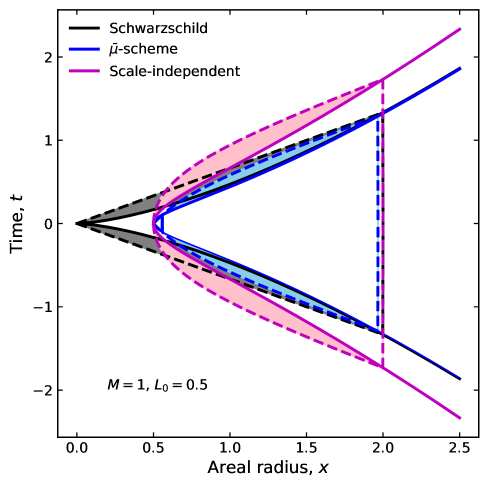
The evolving size of a collapsing object, particularly as it undergoes a quantum bounce, is meticulously charted by tracking its areal radius. This radius, effectively measuring the circumference of increasingly compressed surfaces, provides a direct quantification of the object’s shrinking dimensions during gravitational collapse. As the object approaches a minimum size-a point where classical physics predicts a singularity-the areal radius doesn’t simply vanish; instead, calculations suggest it reaches a minimum value before expanding again. This expansion signifies the quantum bounce, a transition from collapse to re-expansion, and the areal radius continues to grow, mirroring the birth of a new, expanding phase. By precisely monitoring the areal radius’s evolution through this critical juncture, researchers gain insight into the geometry and dynamics of spacetime during extreme gravitational events, offering a means to probe the quantum nature of gravity itself and the potential avoidance of a true singularity.
The precise location of the apparent horizon – the boundary beyond which nothing can escape – is mathematically defined by shape functions within the collapsing spacetime. Recent studies reveal that, under certain conditions, these functions indicate the simultaneous presence of two apparent horizons, rather than a single one. This isn’t a flaw in the model, but rather a signal of a dramatic phase transition. As the initial collapse proceeds, one horizon forms as expected in a black hole. However, the second horizon emerges as the collapse reaches its minimum volume, signifying the turning point and the birth of a white hole. This dynamic suggests the collapsing object doesn’t simply vanish into a singularity, but instead undergoes a ‘bounce,’ transitioning from a black hole phase to a white hole phase, effectively reversing the collapse and potentially leading to the emission of matter and energy. The shape functions, therefore, aren’t merely locators of boundaries, but indicators of a fundamental shift in the spacetime geometry, confirming the theoretical possibility of a universe that avoids a singular beginning or end.
The pursuit of singularity resolution, as demonstrated within modified LTB models, echoes a fundamental philosophical tension. As Jean-Paul Sartre observed, “Existence precedes essence.” This study, by challenging the inevitability of singularities in dust collapse, suggests that the universe isn’t predetermined to an ultimate point of infinite density. Rather, the potential for a bounce-a transition from collapse to expansion-implies a reality constructed through the dynamics of spacetime itself, a process unfolding before any fixed, essential endpoint. The investigation into apparent horizons and modified gravity frameworks thus reveals the universe as a perpetually becoming entity, continually defining its own essence.
What Lies Beyond the Bounce?
The exploration of dust collapse within these modified LTB models, and the tentative suggestion of singularity avoidance, offers a familiar comfort. Each calculation, each potential ‘bounce’, merely postpones the inevitable confrontation with the limits of description. The Painlevé-Gullstrand coordinates, while elegant, remain a scaffolding built upon assumptions-a localized perspective in a universe that may not possess a privileged frame. The true test lies not in achieving a mathematical continuation, but in confronting the information lost when any model, however refined, simplifies the relentless complexity.
Further investigation must necessarily address the fragility of these results. How sensitive are these ‘bounces’ to deviations from perfect spherical symmetry, or to the introduction of even minimal pressure? The current framework, while demonstrating a path away from singularity, does not yet illuminate the nature of what lies beyond. Is it a continuation of spacetime, a transition to another universe, or simply a region where the very concept of spacetime ceases to hold meaning?
It is worth remembering that each measurement is a compromise between the desire to understand and the reality that refuses to be understood. This work doesn’t reveal the universe-it tests the limits of what a universe allows itself to be revealed. The next step is not necessarily to refine the model, but to acknowledge the inherent darkness, and to consider what aspects of reality might remain forever beyond the event horizon of our comprehension.
Original article: https://arxiv.org/pdf/2602.10804.pdf
Contact the author: https://www.linkedin.com/in/avetisyan/
See also:
- Gold Rate Forecast
- Looks Like SEGA Is Reheating PS5, PS4 Fan Favourite Sonic Frontiers in Definitive Edition
- Dune 3 Gets the Huge Update Fans Have Been Waiting For
- Arknights: Endfield – Everything You Need to Know Before You Jump In
- Jack Osbourne Shares Heartbreaking Tribute to Late Dad Ozzy Osbourne
- Dungeon Stalkers to end service on June 9
- Disney Promotes Thomas Mazloum To Lead Parks and Experiences Division As Josh D’Amaro Prepares To Become CEO
- Antiferromagnetic Oscillators: Unlocking Stable Spin Dynamics
- 22 actors who were almost James Bond – and why they missed out on playing 007
- 5 Weakest Akatsuki Members in Naruto, Ranked
2026-02-12 13:17