Author: Denis Avetisyan
Researchers have developed a new method for modeling quantum field theories with boundaries in curved spacetime using open spin systems, offering a path to understanding physics in extreme environments.

This work establishes a framework for mapping boundary conditions between discrete lattice models and continuous quantum field theories using open spin systems like the Kitaev chain.
Reconciling quantum field theory (QFT) with discrete lattice simulations remains a fundamental challenge, particularly when boundaries and curved spacetime geometries are involved. This is addressed in ‘Simulating Quantum Field Theories with Boundaries in Curved Spacetimes Using Open Spin Systems’, which introduces a framework for mapping QFTs with boundaries onto open spin systems-specifically, utilizing Majorana fermions to accurately represent boundary conditions. The authors demonstrate that these spin systems successfully replicate the dynamics of QFTs in curved spacetime, establishing a crucial correspondence between continuum and lattice descriptions. Could this approach pave the way for more efficient and accurate simulations of complex quantum phenomena in realistic gravitational backgrounds?
The Elusive Nature of Majorana Fermions
Majorana fermions, particles that are their own antiparticles, hold a unique position at the forefront of theoretical physics, promising insights into phenomena beyond the Standard Model – including neutrino mass mechanisms and topological quantum computation. However, a fundamental challenge hinders their study: direct observation remains impossible. Unlike particles with distinct antiparticles which are routinely detected through annihilation events, Majorana fermions leave no such signature. Consequently, physicists rely on indirect methods, primarily theoretical modeling and sophisticated simulations within the framework of quantum field theory, to explore their properties and potential roles in exotic physical systems. These investigations delve into scenarios like the existence of Majorana modes in condensed matter systems or their potential as building blocks for robust qubits, despite the inherent difficulty in confirming their existence through conventional experimental means. The ongoing theoretical effort aims to predict observable consequences stemming from the presence of these elusive particles, guiding future searches and potentially unlocking new realms of physics.
Lattice fermion theory, a cornerstone of modern particle physics simulations, discretizes spacetime to enable numerical calculations. However, this discretization introduces a significant challenge: the emergence of unphysical solutions known as ‘doubler modes’. These modes arise because a simple discretization can mimic the behavior of multiple particles with the same mass, effectively creating spurious copies of the desired fermion. This complication necessitates the implementation of sophisticated techniques – such as Wilson fermions or staggered fermions – to suppress these doublers, adding considerable complexity to simulations and potentially introducing further approximations that affect the accuracy of results. The presence of these unwanted modes isn’t merely a technical nuisance; it fundamentally alters the theoretical landscape and demands careful consideration when interpreting the simulated behavior of fundamental particles like the Majorana fermion.
Simulating Majorana fermions within the complexities of curved spacetime and the presence of boundaries demands advanced theoretical and computational techniques. Unlike simulations in flat spacetime, incorporating curvature introduces geometric factors that significantly alter fermionic behavior and require careful treatment within the discretized lattice framework. Boundaries further complicate matters, as they break symmetries and necessitate the implementation of specialized boundary conditions to avoid spurious solutions and ensure physical accuracy. Researchers employ techniques like domain wall fermions or overlap fermions, alongside sophisticated discretization schemes, to mitigate these challenges, often requiring substantial computational resources to achieve reliable results. These methods aim to preserve the essential properties of Majorana fermions-their self-conjugate nature and potential for forming non-Abelian anyons-even within the approximations inherent in numerical simulations, ultimately paving the way for exploring their exotic behavior in realistic physical scenarios.
Understanding the collective behaviors arising from fundamental particles like Majorana fermions necessitates a powerful simulation framework, as direct observation remains beyond current experimental capabilities. These simulations aren’t simply about recreating known physics; they delve into the emergent properties – phenomena that arise from the complex interplay of many particles, often exhibiting behaviors not predictable from the particles’ individual characteristics. Developing such a framework requires advanced computational techniques to accurately represent the quantum fields and their interactions, especially when dealing with complex geometries like curved spacetimes or systems with boundaries. The robustness of the simulation hinges on minimizing artifacts – such as the ‘doubler modes’ inherent in some approaches – and ensuring the results reliably reflect the underlying physics, offering a crucial pathway to explore exotic states of matter and potentially unlock new technological advancements rooted in these fundamental particles.
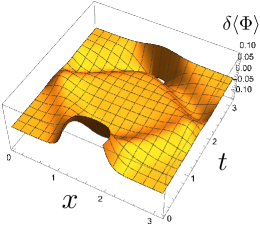
Spin Systems as Quantum Emulators: A Path to Clarity
Spin system simulations provide an efficient method for emulating boundary Quantum Field Theories (QFTs) featuring Majorana fermions due to the inherent suitability of spin variables for representing fermionic degrees of freedom. Traditional lattice fermion simulations are computationally expensive, scaling poorly with system size and requiring significant resources to handle the anti-commutation relations of fermions. Spin systems, governed by simpler algebraic rules, offer a pathway to circumvent these limitations. By mapping the relevant QFT onto a spin Hamiltonian, the behavior of Majorana fermions at the boundary can be studied via classical or quantum simulations of the resulting spin model, enabling investigations into critical phenomena and non-perturbative effects that are inaccessible through direct fermion discretization.
The Kitaev chain, described by the Hamiltonian H = - \sum_{i} (\sigma^x_i \sigma^x_{i+1} + \sigma^y_i \sigma^y_{i+1} + h_i \sigma^z_i), provides a direct mapping to the boundary quantum field theory (QFT) of interest due to its inherent connection to Majorana fermions. Specifically, the low-energy excitations of the Kitaev chain are precisely these Majorana modes, which are fundamental to describing the edge states of topological phases and the behavior of certain QFTs. The chain’s parameters, including the pairing amplitude and chemical potential, directly correspond to parameters within the target QFT, enabling a one-to-one correspondence between observables calculated in the spin system and those predicted by the QFT. This isomorphism facilitates the emulation of complex QFT phenomena using a relatively simple and computationally tractable spin model.
Mapping a quantum field theory (QFT) onto a spin system involves transforming the fermionic degrees of freedom of the QFT into localized spin operators. This is achieved by extending the Kitaev chain Hamiltonian – originally defined for a one-dimensional p-wave superconductor – to include additional terms and interactions necessary to represent the desired QFT. Crucially, the implementation of specific boundary conditions on this extended spin Hamiltonian dictates the behavior of the emulated QFT at its edges. These boundary conditions directly translate the boundary behavior of the QFT, such as the presence of edge states or specific scattering properties, into constraints on the spin configurations at the boundaries of the spin system. This process yields a discrete, computationally accessible spin model that effectively emulates the continuous QFT, allowing for numerical investigations that would otherwise be intractable due to the complexities of simulating fermionic fields directly.
Direct lattice fermion simulations, used to study quantum field theories, encounter significant computational challenges stemming from the fermionic sign problem and the need to represent a large number of fermionic degrees of freedom. These simulations scale exponentially with system size, limiting the accessible system parameters and simulation times. Utilizing spin systems as emulators circumvents these issues by representing fermionic degrees of freedom with localized spin operators, effectively mapping the fermionic problem into a sign-problem-free spin system. This transformation reduces the computational cost from exponential to polynomial scaling with system size, enabling simulations of larger systems and longer timescales than are feasible with traditional lattice fermion methods. Furthermore, spin system simulations can be efficiently performed using well-established techniques like exact diagonalization and quantum Monte Carlo, offering a practical path toward exploring strongly correlated fermionic systems.

Validating the Emulation: A Rigorous Assessment
The time evolution of the spin system is determined by the Heisenberg equation of motion. This equation directly relates the time-dependent spin operators to the system’s Hamiltonian, specifically the Kitaev chain Hamiltonian, H = \sum_{j} (h_j \sigma^z_j + \Delta_j \sigma^x_j + \frac{w_j}{2} \sigma^y_j). The parameters within this Hamiltonian – namely, the local magnetic field h_j, pairing amplitude \Delta_j, and chemical potential w_j – directly influence the dynamics described by the Heisenberg equation, defining the interactions and energy landscape governing the spin system’s behavior. Accurate specification of these parameters is therefore crucial for modeling the system’s temporal evolution.
Linear response theory is employed to characterize the simulated spin system by applying a weak, time-dependent perturbation and measuring the resulting change in a physical observable. This technique allows for the calculation of response functions, such as the dynamic conductivity or magnetic susceptibility, which directly relate the perturbation to the system’s response. These calculated response functions serve as key observables for comparison with theoretical predictions; deviations indicate discrepancies between the simulation and the underlying physical model. Specifically, the response functions are obtained by calculating the Fourier transform of the time-dependent change in the observable, providing information about the system’s behavior at different frequencies. The use of linear response ensures that the perturbation does not significantly alter the system’s state, allowing for a clear and accurate extraction of the relevant physical properties.
Validation of the emulation’s accuracy is achieved through quantitative comparison of simulated observables with analytical predictions derived from the corresponding Quantum Field Theory (QFT). Specifically, observables extracted via linear response theory, such as correlation functions and spectral functions, are compared to their theoretical counterparts calculated using established QFT techniques. Discrepancies are assessed using established statistical methods to determine if they fall within acceptable tolerances, thereby establishing the fidelity of the emulation. Rigorous validation requires demonstrating consistency across a range of parameter values and observable types, confirming that the emulation faithfully reproduces the expected behavior predicted by the QFT.
Validation of the emulation process confirms the spin system accurately represents the physics of Majorana fermions under the defined boundary conditions. This is evidenced by the decoupling of doubler modes, achieved through adherence to the boundary condition |w_{j+1/2}|^2 - |\Delta_{j+1/2}|^2 = 0. This specific boundary condition on the spin system directly corresponds to the required boundary condition for the Majorana field when transitioning to the continuum limit, ensuring a faithful representation of the target fermionic behavior and eliminating spurious modes that would otherwise arise in the simulation.
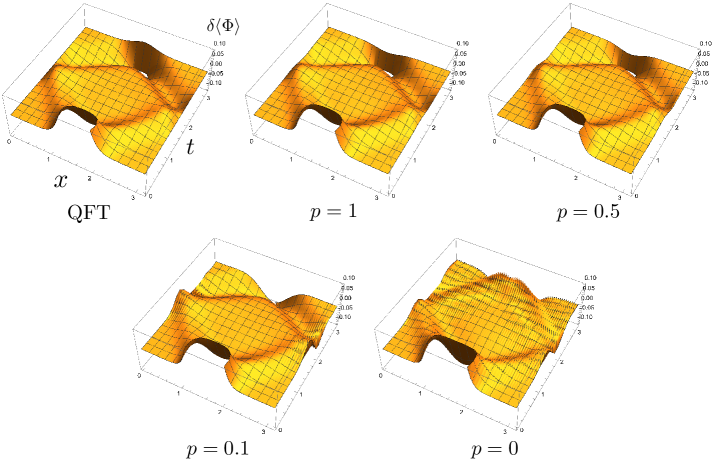
Unlocking New Insights: Expanding the Horizon
The developed approach establishes a remarkably adaptable framework for investigating Majorana fermions – particles that are their own antiparticles – across a wide spectrum of physical conditions and spatial arrangements. This versatility stems from the ability to model these exotic particles not just within conventional, simplified systems, but also in complex, realistic scenarios including varied geometries and material compositions. Researchers can now probe how Majorana fermions behave when confined within intricate networks, subjected to external fields, or interacting with other quantum entities-opening up opportunities to observe and understand their unique properties in previously inaccessible regimes. This capability is crucial for unraveling the full potential of Majorana fermions, particularly their promise in creating robust quantum bits for advanced computation, as their behavior is highly sensitive to the surrounding environment and topological features of the material.
The ability to probe emergent phenomena represents a significant advancement facilitated by this research. Specifically, investigations into topological protection – a state where quantum information is shielded from local disturbances due to the material’s global properties – become readily accessible. This framework also allows for detailed analysis of edge state localization, where electrons are confined to the boundaries of the material, creating robust and potentially manipulable quantum channels. These edge states are particularly promising for building fault-tolerant quantum devices, as their inherent protection against decoherence could dramatically improve qubit stability and computational power. Understanding how these phenomena arise and interact within different material systems is crucial not only for fundamental physics but also for realizing practical applications in quantum technologies.
The developed framework isn’t limited to simple models; its architecture readily accommodates investigation into more intricate quantum field theories and many-body systems. By adapting the core principles, researchers can explore phenomena arising from strong interactions, emergent behaviors in condensed matter physics, and the dynamics of complex quantum systems. This extensibility stems from the framework’s modular design, allowing for the incorporation of additional terms and degrees of freedom without fundamentally altering its underlying methodology. Consequently, it offers a powerful tool for simulating and analyzing systems where traditional analytical approaches become intractable, potentially unlocking insights into previously unexplored regimes of quantum physics and materials science.
This research represents a significant step forward in comprehending the underlying principles governing the universe, extending beyond theoretical constructs to offer tangible pathways for technological innovation. By deepening the understanding of exotic quantum states and their behavior, the work not only refines existing models of fundamental physics but also provides crucial building blocks for realizing the potential of quantum computing. Specifically, the insights gained could facilitate the design and fabrication of more stable and robust qubits, essential for scalable quantum processors. Simultaneously, the framework’s adaptability to various material systems suggests the possibility of discovering and engineering novel materials with tailored quantum properties, potentially revolutionizing fields ranging from energy storage to advanced sensing technologies.
The pursuit of simulating quantum field theories in curved spacetime demands ruthless simplification. This work, mapping boundary conditions using open spin systems, exemplifies that principle. It strips away unnecessary complexity to reveal underlying truths. As Leonardo da Vinci observed, “Simplicity is the ultimate sophistication.” The core idea – establishing a framework linking discrete lattice models to continuum theories – benefits from this clarity. Abstractions age, principles don’t. Every complexity needs an alibi, and this research provides a compelling case for elegant reduction. The avoidance of doubler modes further underscores the power of streamlined design.
Further Horizons
The demonstrated correspondence between open spin systems and quantum field theories in curved spacetime, while a necessary advance, does not erase the inherent difficulties. The persistent specter of doubler modes-artifacts of discretization-remains. Future work must prioritize methods for their systematic suppression, not merely their palliative treatment. A complete understanding demands a rigorous demonstration of how boundary conditions, discrete on the lattice, truly converge to their continuum counterparts. This is not a matter of numerical precision, but of fundamental consistency.
The present framework, centered on Majorana fermions and the Kitaev chain, offers a tractable, if limited, arena. The question arises: can this approach be generalized to accommodate more complex field configurations and interactions? The answer likely resides in exploring alternative spin system Hamiltonians, perhaps those exhibiting inherent topological protection beyond the simple constraints of the Kitaev model. Unnecessary complication is violence against attention; the search for elegant simplicity remains paramount.
Ultimately, the value of this mapping lies not in its ability to replicate known results-that is merely validation-but in its capacity to reveal genuinely novel phenomena. Curved spacetime presents a natural laboratory for exploring physics beyond the standard model. The capacity to simulate such environments-however imperfectly-offers a path, however arduous, toward a more complete understanding. Density of meaning is the new minimalism; the focus must remain on extracting maximum insight from minimal assumptions.
Original article: https://arxiv.org/pdf/2602.17935.pdf
Contact the author: https://www.linkedin.com/in/avetisyan/
See also:
- What Song Is In The New Supergirl Trailer (& What It Means For The DC Movie)
- TV legend Carol Kirkwood reveals the reasons why she decided to retire after 28 years with BBC
- Highly Anticipated Strategy RPG Finally Sets Release Date (And It’s Soon)
- Dune 3 Gets the Huge Update Fans Have Been Waiting For
- Way of the Hunter 2 adds PS5, Xbox Series versions
- The Most Surreal Moments From the O.J. Simpson Murder Trial
- Grab These Resident Evil PSN Avatars for Free This Month
- Gold’s March Madness: Plumbing, Panic, and Polish Central Banks
- Whales, Channels, and the Inevitable Dance of Folly
- The War Film Harrison Ford Completely Disowned Finally Returns to Streaming – “A Terrible Experience”
2026-02-23 06:56