Author: Denis Avetisyan
Accounting for the subtle interplay between new particle signals and known Standard Model processes is critical for accurately interpreting collider data and avoiding false discoveries.

This review details the importance of interference effects in searches for new physics, particularly resonant production of scalar particles and di-boson final states, and highlights how neglecting these effects can lead to inaccurate modeling of observed distributions.
Accurate modeling of new physics signatures often relies on simplifying assumptions that can obscure crucial effects. This review, ‘Interference effects in new physics searches’, addresses the frequently neglected interference between resonant new physics signals and Standard Model backgrounds-or even between different resonant states-in collider physics. Accounting for these interference patterns is critical for correctly interpreting observed kinematical distributions and extracting reliable limits on beyond-the-Standard-Model parameters, particularly in searches for extended scalar sectors and di-boson/di-Higgs final states. Will a more comprehensive treatment of these interference effects reveal previously hidden signatures or necessitate a reevaluation of existing search strategies?
Unveiling the Universe Beyond: Patterns of Incompleteness
Despite its remarkable predictive power, the Standard Model of particle physics remains incomplete. Observations such as the existence of dark matter and dark energy, the non-zero mass of neutrinos, and the matter-antimatter asymmetry in the universe cannot be adequately explained within its framework. Furthermore, the model relies on several arbitrary parameters, and offers no explanation for the observed pattern of particle masses. These unresolved puzzles suggest the existence of more fundamental physics at higher energy scales, motivating the search for new particles and interactions that extend beyond the Standard Model’s current limitations. The model’s inability to incorporate gravity also points toward the necessity of a more comprehensive theoretical structure, hinting at a deeper, more intricate reality governing the cosmos.
The relentless pursuit of a more complete understanding of the universe has led scientists to scrutinize the Standard Model of particle physics with unprecedented precision. These investigations, employing both direct and indirect methods, reveal subtle discrepancies between theoretical predictions and experimental observations. Anomalies in muon behavior, neutrino oscillations, and the measured properties of known particles consistently suggest the existence of particles and interactions not accounted for within the current framework. Rather than observing these new entities directly, researchers often infer their presence through minute deviations in established processes – a technique akin to detecting a hidden mass by its gravitational influence. These ‘indirect searches’ are crucial, as the energy scales at which new physics might manifest could be far beyond the reach of current colliders, making subtle effects the most accessible signatures of a more profound reality.
The quest to understand the universe extends beyond the remarkably successful, yet incomplete, Standard Model of particle physics. Current theoretical frameworks and experimental observations suggest the existence of phenomena – such as dark matter, dark energy, and neutrino masses – that lie outside its predictive power. Exploring ‘New Physics Scenarios’ – hypothetical extensions to the Standard Model involving new particles and interactions – is therefore not merely an academic exercise, but a crucial step towards a complete and accurate depiction of reality. These investigations promise to resolve existing inconsistencies, explain observed anomalies, and ultimately reveal the fundamental laws governing the cosmos, potentially revolutionizing our understanding of space, time, and the very fabric of existence.
The search for physics beyond the Standard Model frequently leads to theoretical extensions incorporating scalar bosons – fundamental particles possessing no intrinsic angular momentum. These particles, including the famed Higgs boson, aren’t merely add-ons; they often act as force carriers or mediate interactions not described by current frameworks. Their properties – mass, spin, and how they interact with other particles – are crucial probes for new physics. Many theoretical models, such as supersymmetry and extra-dimensional scenarios, predict the existence of multiple scalar bosons, each with potentially unique characteristics. Precisely measuring the properties of known scalar bosons, like the Higgs, and searching for evidence of these predicted companions represents a key strategy in completing the Standard Model and resolving long-standing mysteries about the universe’s fundamental constituents and forces.
Revealing Hidden States: Resonance Production as a Diagnostic Tool
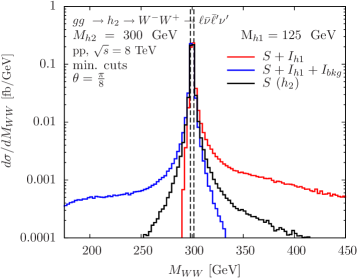
Resonance production is a prevalent technique in particle physics used to identify and study short-lived, intermediate particles. This method relies on creating these resonances – transient states formed during high-energy collisions – which subsequently decay into readily detectable particles like photons, leptons, or hadrons. The existence of a resonance is inferred from an enhancement, or peak, in the cross-section of the final state particles at a specific invariant mass, corresponding to the mass of the intermediate resonant state. By analyzing the decay products and their distributions, physicists can determine the properties of the newly produced resonance, including its mass, spin, parity, and decay modes, thereby revealing information about fundamental particle interactions and potentially discovering new particles beyond the Standard Model.
Resonance production modeling fundamentally relies on the framework of Quantum Field Theory (QFT), which treats particles as excitations of quantum fields and interactions as processes governed by field interactions. The S-Matrix formalism, central to QFT, mathematically describes the evolution of particle states during interactions, relating initial and final states via a scattering matrix S. This matrix encapsulates all possible interactions and allows for the calculation of probabilities for specific particle production and decay processes. Specifically, elements of the S-matrix, calculated using Feynman diagrams and perturbation theory, provide amplitudes for transitions between initial and final particle configurations, enabling precise predictions of observable quantities like cross-sections and decay rates. Accurate calculations within this framework are crucial for interpreting experimental data and confirming the existence of new resonant states.
The Factorized Approach to resonance production simplifies complex calculations by treating the process as two distinct, sequential steps: production of the resonant state and its subsequent decay. This method assumes that the production and decay amplitudes can be calculated independently and then multiplied to obtain the overall amplitude for the process. Mathematically, this is expressed as \mathcal{M} = \mathcal{M}_{production} \times \mathcal{M}_{decay} , where \mathcal{M} represents the total scattering amplitude. This factorization is valid under specific conditions, primarily when the resonant state’s lifetime is short enough that the production and decay processes can be considered temporally separated. The simplification significantly reduces computational complexity, enabling more efficient theoretical predictions and comparisons with experimental data.
The factorized approach to resonance production relies fundamentally on the principle of on-shellness, which dictates that intermediate particles involved in the process must satisfy the energy-momentum relation E^2 = p^2c^2 + m^2c^4 . This condition ensures that at each stage of the calculation – both production and decay – energy and momentum are conserved. Specifically, it allows the calculation of the amplitude for the overall process to be separated into the product of amplitudes for each individual step, simplifying the mathematical complexity. If an intermediate particle is not ‘on-shell’ – meaning it doesn’t satisfy this energy-momentum relation – the factorization breaks down, and a more complete, and computationally intensive, calculation is required to accurately describe the interaction.
Unveiling Subtle Signatures: The Dance of Interference
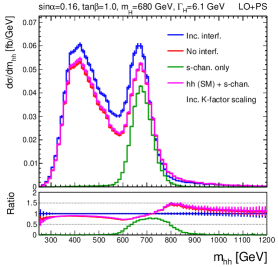
Interference effects are fundamental to resonance production processes, directly influencing the observed distributions of decay products. These effects arise from the superposition of multiple contributing amplitudes, including those from the resonance itself and any underlying non-resonant backgrounds or other resonances. Consequently, the observed lineshapes deviate from simple expectations, such as the Breit-Wigner distribution, and the total and differential cross-sections are modified. The magnitude of these interferences is dependent on the phase relationships between the contributing amplitudes, and can significantly alter the apparent resonance properties, including its width, mass, and production rate. Accurate modeling of these interference patterns is essential for precise measurements of resonance parameters and for distinguishing resonance signals from background contributions.
Accurate prediction of resonance production and decay necessitates precise theoretical calculations. Leading-order (LO) calculations are often insufficient due to approximations inherent in perturbative expansions; therefore, Next-to-Leading Order (NLO) corrections are routinely employed. These NLO corrections involve including higher-order terms in the perturbation series, accounting for additional virtual and real emission processes. Specifically, NLO calculations introduce loop diagrams and real radiation, significantly improving the accuracy of cross-section predictions and the modeling of final-state particle distributions. The inclusion of NLO corrections is crucial for reducing theoretical uncertainties and ensuring reliable comparisons between theoretical predictions and experimental measurements, particularly in high-energy physics where subtle effects can mask or mimic new physics signals.
The Complex Mass Scheme (CMS) is a theoretical framework used in particle physics calculations to accurately represent unstable particles. Unlike the physical mass, which is difficult to define for decaying states, CMS utilizes a complex pole in the scattering amplitude to define the particle’s mass and width simultaneously. This complex mass, M - i\Gamma/2 , where M is the real part and Γ the decay width, allows for a consistent treatment of resonance production and decay within scattering amplitudes. By incorporating the decay width directly into the propagator, CMS avoids unphysical behavior at the resonance peak and provides a more realistic description of invariant mass distributions, particularly crucial for precision studies and searches for new physics beyond the Standard Model.
The Optical Theorem, relating scattering amplitudes to the imaginary part of the forward scattering amplitude, serves as a fundamental verification of theoretical calculations predicting interference patterns in particle decays. Observed deviations from the expected Breit-Wigner distribution – a Lorentzian profile describing the resonance shape – in invariant mass distributions are indicative of physics beyond the Standard Model. These distortions, which can be substantial in magnitude, arise from interference effects and modifications to the underlying decay dynamics, necessitating adjustments to search strategies employed in high-energy physics experiments; for example, traditional resonance counting techniques may underestimate signal yields or misidentify decay modes when significant distortions are present.
Expanding the Landscape: Models and Projections for New Scalars
Beyond the single Higgs boson discovered in 2012, several theoretical frameworks posit the existence of additional scalar particles. Models like the Two Higgs Doublet Model (2HDM) and the Singlet Extension introduce extended Higgs sectors, motivated by shortcomings in the Standard Model and the desire to explain phenomena like dark matter. The 2HDM, for instance, postulates a second Higgs doublet, effectively doubling the number of physical Higgs bosons and leading to a richer landscape of potential decay channels. Similarly, the Singlet Extension introduces a real scalar field that mixes with the Standard Model Higgs, altering its properties and providing a potential dark matter candidate. These extensions not only offer avenues for new physics but also necessitate careful theoretical calculations and experimental searches to identify and characterize these predicted additional scalar bosons, which could manifest as deviations from Standard Model predictions in various particle collisions.
Beyond the initially discovered Higgs boson, theoretical models predicting additional scalar particles necessitate a broad search strategy targeting diverse decay channels. Analyses focusing on ‘Di-Higgs Production’ seek the simultaneous creation and decay of two Higgs bosons, offering a sensitive probe of Higgs self-coupling. Simultaneously, explorations of ‘Di-Boson Final States’ – involving pairs of W, Z, or photons – provide complementary sensitivity, particularly if the new scalar particles couple preferentially to vector bosons. Further broadening the scope, investigations into ‘Di-Top Final States’ examine decays into pairs of top quarks, capitalizing on the substantial mass of both the new scalars and the top quark, which amplifies the production rate in certain models. The complexity of these searches demands sophisticated analysis techniques and careful consideration of background processes to reliably identify potential signals arising from physics beyond the Standard Model.
The exploration of physics beyond the Standard Model often involves hypothesizing new, unstable particles that decay rapidly. Calculations involving these particles are significantly streamlined by employing the ‘Narrow Width Approximation’. This technique rests on the assumption that the decay width – a measure of the particle’s propensity to decay – is much smaller than the difference in energy between the particle’s production and decay. Consequently, the resonance line shape describing the particle’s production becomes approximately Gaussian, vastly simplifying the mathematical complexity of predicting event rates and facilitating precise comparisons with experimental data. Without this approximation, modeling the full Breit-Wigner distribution – which accounts for the particle’s natural width – would require considerably more computational resources, hindering the search for subtle signals indicating new physics.
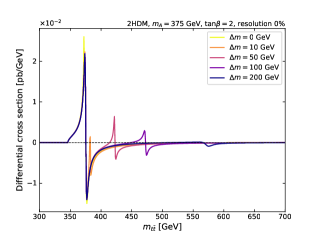
Electroweak precision measurements, analyses of properties like the W boson mass and the strengths of electroweak interactions, serve as stringent tests of any proposed extension to the Standard Model, including those featuring additional Higgs bosons. These measurements effectively constrain the allowable parameter space for models like the Two-Higgs-Doublet Model (2HDM). Interestingly, in specific and complex 2HDM configurations, the contributions from resonant production of new scalar particles can exhibit complete interference, leading to a cancellation in the observed invariant mass distributions. This phenomenon underscores the critical need for precise theoretical modeling; without careful consideration of these interference effects, experiments might fail to detect the presence of new physics or, conversely, falsely identify signals where none exist, thus necessitating a comprehensive understanding of these subtle quantum effects when interpreting high-energy collision data.
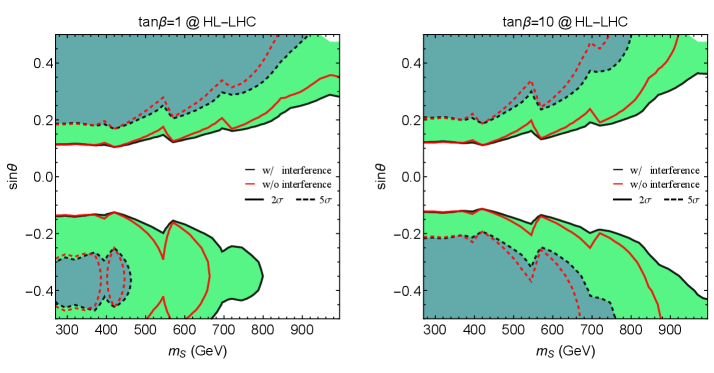
The study of interference effects, as detailed in the paper, necessitates a holistic approach to model building. It’s not simply about identifying a signal, but understanding how it interacts with the broader landscape of potential backgrounds and resonances. This resonates with the philosophical stance of Paul Feyerabend, who famously stated, “Anything goes.” While seemingly radical, Feyerabend’s point underscores the importance of methodological pluralism – acknowledging that rigid adherence to a single approach can stifle discovery. The paper demonstrates that overlooking interference – a complex, nuanced effect – can lead to inaccurate conclusions, highlighting the need for flexible, adaptable methodologies when exploring the boundaries of known physics and searching for new phenomena like scalar resonances.
Beyond the Resonance
The pursuit of new physics at colliders has, for some time, leaned heavily on the identification of resonant features – peaks in distributions signifying the production of a new, massive particle. This work suggests a necessary, though often overlooked, refinement: the landscape surrounding such resonances is rarely pristine. Interference between the sought-after signal, the Standard Model backgrounds, and even other potential resonances, shapes the observable distributions in subtle, but critical ways. A continued reliance on simplified models, ignoring these interference patterns, risks mistaking statistical fluctuations for genuine discoveries – or, equally concerning, dismissing true signals obscured by incomplete theoretical understanding.
Future progress demands a shift in emphasis. The focus should move beyond simply maximizing sensitivity to a particular resonance and toward a more holistic modeling of the entire event topology. This necessitates improved theoretical tools capable of accurately calculating interference effects, alongside the development of novel analysis techniques that can disentangle these complex patterns from the noise. Reproducibility will hinge not just on sharing code, but on transparently documenting the assumptions and approximations inherent in these calculations.
Ultimately, the question is not simply if new physics exists, but how it manifests within the broader framework of observed phenomena. The patterns are there, embedded within the data; it is the task of the scientific community to develop the means to interpret them with rigor and, perhaps, a touch of humility.
Original article: https://arxiv.org/pdf/2602.00256.pdf
Contact the author: https://www.linkedin.com/in/avetisyan/
See also:
- What Song Is In The New Supergirl Trailer (& What It Means For The DC Movie)
- Why is Tech Jacket gender-swapped in Invincible season 4 and who voices her?
- Dune 3 Gets the Huge Update Fans Have Been Waiting For
- Highly Anticipated Strategy RPG Finally Sets Release Date (And It’s Soon)
- TV legend Carol Kirkwood reveals the reasons why she decided to retire after 28 years with BBC
- After 13 Years, Someone Earned One of the Hardest Achievement Trophies in Gaming
- Jaleco Sports: Bases Loaded II announced for PS5, Switch; now available
- Digimon Is Getting a New RPG in 2026 (And You Probably Missed It)
- Kanye West’s Wife Bianca Censori Details New Marriage Milestone
- Butcher’s Transformation Into A “Ruthless Killer” In The Boys Season 5 Explained By Karl Urban
2026-02-03 10:28