Author: Denis Avetisyan
New precision measurements of diboson production from the ATLAS experiment are pushing the boundaries of our understanding of fundamental particle interactions.
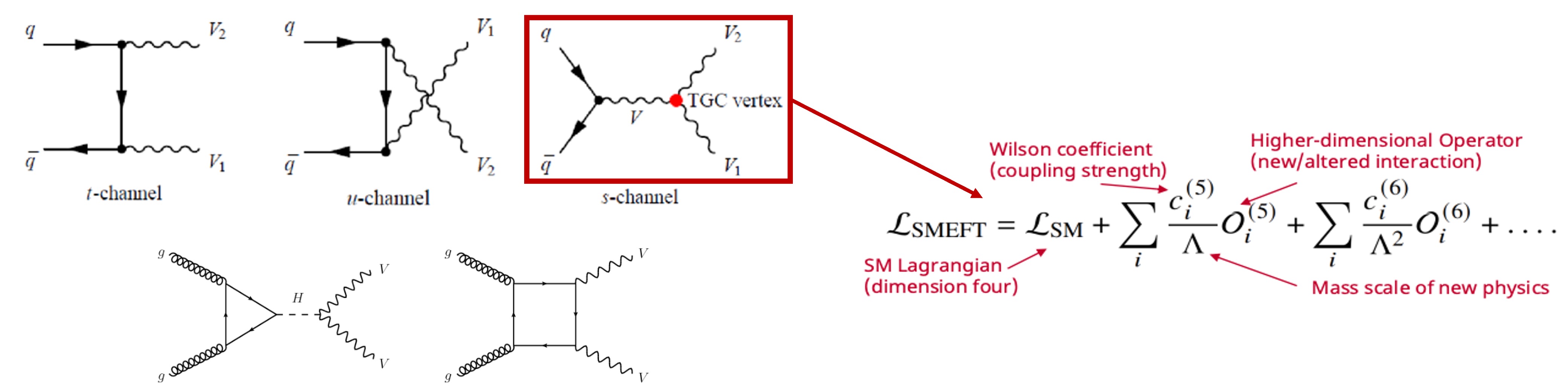
This review details measurements of electroweak diboson production in proton-proton collisions and their implications for Standard Model Effective Theory constraints and searches for new physics.
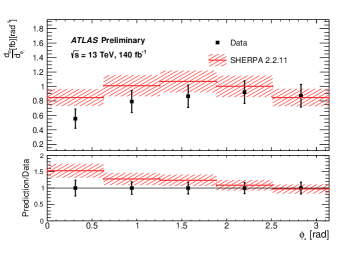
Despite the Standard Model’s remarkable success, precision tests remain crucial for uncovering potential new physics beyond its framework. This paper, ‘Measurement of diboson production and precision EFT constraints in ATLAS’, presents the latest measurements of diboson production-processes involving pairs of electroweak bosons-using the full Run 2 dataset from the ATLAS experiment at the LHC. These analyses yield stringent constraints on anomalous triple gauge couplings and, for the first time at the LHC, provide evidence of W^{+}W^{-} charge asymmetry and measurements sensitive to CP violation in WZ events. Will these increasingly precise measurements reveal deviations from the Standard Model and illuminate the path towards a more complete understanding of fundamental interactions?
Foundations of Precision: Mapping the Electroweak Landscape
The Standard Model Lagrangian, a complex equation encapsulating the fundamental forces and particles, serves as the cornerstone of modern particle physics. This mathematical framework doesn’t simply describe interactions; it predicts how particles should behave, from the scattering of electrons to the decay of massive bosons. However, the Lagrangian’s inherent complexity and the numerous parameters within it necessitate constant, rigorous testing against experimental data. While remarkably successful in explaining a vast range of phenomena, the Standard Model isn’t considered a final theory; subtle discrepancies between theoretical predictions derived from the Lagrangian and actual observations could unveil the presence of new particles or forces beyond what is currently understood. Consequently, high-precision experiments are crucial not only to confirm the Standard Model’s predictions, but also to identify potential deviations that may point towards a more complete and accurate description of the universe at its most fundamental level.
Electroweak boson interactions, involving particles like the W and Z bosons, offer a uniquely sensitive arena for testing the Standard Model’s predictions with remarkable accuracy. These interactions aren’t simply confirmed or refuted; instead, precise measurements of their rates and properties – such as masses and decay widths – are compared to theoretical calculations that incorporate quantum loop effects. Discrepancies, however small, could signal the presence of new, heavier particles influencing these interactions indirectly, providing a glimpse beyond the currently known particle spectrum. The ongoing effort in SM Electroweak Boson Physics focuses on refining these measurements at colliders like the Large Hadron Collider, pushing the boundaries of precision to identify subtle deviations that may unveil the physics lying beyond the Standard Model and offer clues to long-standing mysteries like the hierarchy problem and the nature of dark matter.
The detailed study of electroweak bosons – the force carriers of the weak interaction, namely the W and Z bosons, as well as the photon – provides a unique window into physics beyond the Standard Model. These bosons aren’t just fundamental particles; their production and subsequent decay offer sensitive probes of potential new phenomena. Deviations from the Standard Model’s predictions regarding their properties – such as mass, spin, and interaction strengths – could signal the existence of undiscovered particles or forces. By precisely measuring the rates and angular distributions of their decay products, physicists search for subtle hints of interactions with hypothetical particles contributing to quantum corrections, or even the direct production of entirely new bosons. This meticulous analysis, often performed at high-energy colliders, allows researchers to constrain the parameter space of various extensions to the Standard Model, including supersymmetry and extra dimensions, ultimately pushing the boundaries of current understanding and guiding the search for a more complete theory of fundamental interactions.
Diboson Processes: Probing the Electroweak Sector
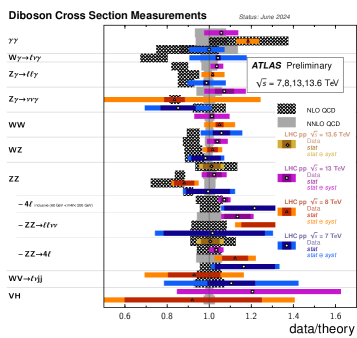
Standard Model (SM) electroweak diboson processes – namely, the decays of ZZ, WW, and WZ boson pairs – offer complementary probes of the SM parameter space. ZZ decay is particularly sensitive to the mass and couplings of the Higgs boson, as well as searches for deviations indicating new physics. WW decay, while subject to challenges from neutrino reconstruction, provides a higher production cross-section and allows for sensitive measurements of the W boson mass and couplings. WZ decay offers a unique channel to study the interplay between neutral and charged bosons, providing further tests of electroweak interactions and potential sensitivity to anomalous triple gauge couplings. Precise measurements of the production cross-sections and decay angular distributions of these processes, when compared to high-order theoretical predictions, enable stringent tests of the SM and provide opportunities to search for evidence of physics beyond it.
Accurate prediction of diboson processes at the Large Hadron Collider relies heavily on detailed event simulations. Powheg MiNNLO is employed for precise next-to-leading-order (NLO) calculations of the initial hard process, particularly for processes involving color-singlet final states. NLO Electroweak (NLO EWK) calculations are essential to properly model electroweak contributions and radiative corrections to these processes, accounting for effects not captured in pure strong interaction simulations. Finally, Pythia8 is utilized for hadronization and the modeling of underlying event, simulating the subsequent evolution of partons into observable hadrons and providing a complete simulated event record. The combination of these tools allows for precise theoretical predictions that can be directly compared to experimental data, enabling sensitive searches for physics beyond the Standard Model.
Vector Boson Scattering (VBS) represents a crucial process for probing the electroweak sector of the Standard Model due to its direct sensitivity to the self-couplings of the W and Z bosons. Unlike most other processes which indirectly constrain these couplings through loop-induced effects, VBS proceeds via direct boson-boson interactions at tree-level, providing a cleaner signal for their measurement. Specifically, the cross-section for VBS is directly proportional to the strength of the WWV and ZZV couplings, where V represents a neutral boson (Z or γ). Precise measurements of VBS, therefore, offer a unique opportunity to test the Standard Model and search for evidence of new physics that could manifest as deviations from predicted electroweak boson self-interactions.
Beyond the Standard Model: Seeking Anomalous Interactions
Anomalous Triple Gauge Couplings (nTGCs) represent deviations from the interaction strengths predicted by the Standard Model (SM) for vector bosons – specifically, the W and Z bosons – and fermions. These couplings are examined in processes such as Z(\ell\ell)\gamma, where a Z boson decays into a lepton-antilepton pair and a photon. Any observed discrepancy between experimental measurements and SM predictions in these decay channels could indicate the presence of new physics beyond the SM, potentially arising from contributions of virtual particles or interactions not currently accounted for. Precise measurements of nTGCs are therefore vital for testing the validity of the SM and searching for evidence of physics beyond it, as they provide a sensitive probe of the electroweak sector at high energies.
Constraints on anomalous triple gauge couplings (nTGC Limits) are derived from precision measurements at colliders like the LHC and from electroweak precision tests. These limits are typically expressed as 95% confidence level intervals on the magnitudes of relevant coupling modifiers, quantifying deviations from Standard Model predictions. Refinement of these limits requires both improved experimental precision – particularly in measurements of Z boson production and decay channels – and the development of sophisticated theoretical tools for accurately predicting Standard Model backgrounds and signal efficiencies. Current nTGC limits are crucial inputs for global fits to electroweak data, allowing theorists to constrain the parameter space of beyond-the-Standard-Model scenarios and prioritize searches for new physics at higher energies and luminosities.
The Standard Model Effective Field Theory (SMEFT) provides a systematic approach to search for new physics by extending the Standard Model with higher-dimensional operators, suppressed by a characteristic energy scale Λ. These operators, constructed from Standard Model fields and derivatives, modify existing interactions and introduce new ones. The effects of new physics are thus parameterized by Wilson coefficients associated with these operators, allowing for model-independent analyses. Importantly, the SMEFT framework includes operators that violate Charge-Parity (CP) symmetry, termed CP-Violating EFT Operators, which are crucial for exploring potential new sources of CP violation beyond the Standard Model and are subject to stringent constraints from experimental measurements.
Precision Measurements at the LHC: Tools and Techniques
The ATLAS experiment, located at the Large Hadron Collider, generates the experimental data necessary to validate and refine theoretical predictions in particle physics. This data acquisition necessitates complex analysis techniques due to the high event rates and substantial backgrounds present in proton-proton collisions. Sophisticated trigger systems are employed to select events of interest, and detailed reconstruction algorithms are used to identify and measure the properties of the produced particles. Furthermore, the analysis requires precise calibration of the detector components and careful modeling of detector effects to minimize systematic uncertainties, ultimately enabling high-precision measurements of various Standard Model processes and searches for new physics.
Accurate Standard Model predictions for high-energy physics at the Large Hadron Collider depend on Next-to-Next-to-Leading Order (NNLO) calculations in Quantum Chromodynamics (QCD). These calculations account for radiative corrections to processes involving strong interactions, and require substantial computational resources. The precision of these predictions is further refined through the use of Parton Distribution Functions (PDFs), which represent the probability of finding a parton within a hadron. The NNPDF3.1 set represents a current state-of-the-art determination of PDFs, derived from a global fit to a wide range of deep inelastic scattering and hadron production data, and incorporates advanced methodologies for estimating theoretical and experimental uncertainties, directly impacting the accuracy of cross-section predictions.
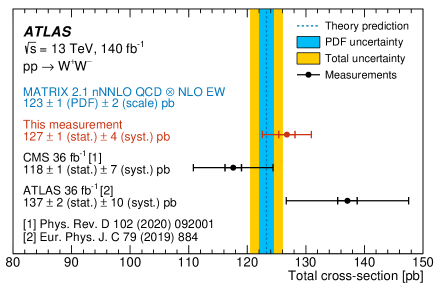
The ATLAS experiment at the Large Hadron Collider has, with an integrated luminosity of 140 fb-1, measured the fully leptonic W+W– production cross section with a precision of 3.1%. This measurement relies on precise detector calibration and reconstruction algorithms to identify and measure the momenta of the decay leptons. The achieved precision is critical for testing predictions from the Standard Model, particularly Quantum Chromodynamics (QCD) and electroweak interactions, and provides stringent constraints on potential new physics phenomena beyond the Standard Model, informing searches for deviations from expected rates and distributions.
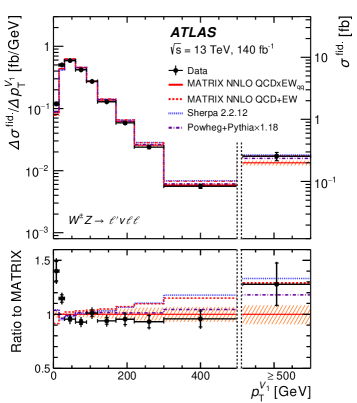
Measurements of the W±Z W±Z fiducial cross section at the Large Hadron Collider have attained a precision of approximately 2% when compared to theoretical predictions calculated to Next-to-Next-to-Leading Order (NNLO) in Quantum Chromodynamics (QCD) combined with electroweak (EW) corrections at the quark-quark level (qq). This comparison utilizes fiducial volumes, defined by specific kinematic requirements on the decay products, to reduce systematic uncertainties. The achieved precision is a result of analyzing substantial datasets, and represents a stringent test of the Standard Model’s predictions for electroweak interactions and provides sensitivity to potential new physics contributions.
Measurements of the charge ratio in W±ZW±Z events at the Large Hadron Collider have achieved a precision of approximately 2%. This ratio, defined as \Gamma(W^+Z) / \Gamma(W^-Z) , is sensitive to potential new physics contributions that could violate parity, and its precise determination provides a stringent test of the Standard Model. The achieved 2% precision relies on the analysis of 140 fb-1 of proton-proton collision data collected by the ATLAS experiment, incorporating sophisticated techniques to account for detector effects and background contributions. This level of accuracy allows for a sensitive probe of electroweak interactions and constrains possible deviations from Standard Model predictions.
The Future of Electroweak Precision: Expanding the Horizon
The Standard Model of particle physics, while remarkably successful, leaves room for refinement, and continued high-precision studies of electroweak diboson processes – where particles like W and Z bosons are produced and interact – are crucial for this endeavor. Experiments at the Large Hadron Collider and proposed future colliders don’t simply confirm the Standard Model; they subject it to increasingly stringent tests, probing for subtle deviations that could hint at new physics beyond SU(2)_L \otimes U(1)_Y gauge symmetry. These measurements meticulously map the interactions of fundamental particles, allowing physicists to precisely determine key parameters like particle masses and coupling constants, and to search for virtual effects from undiscovered particles. The accumulation of data from these processes isn’t merely about increasing statistical significance; it’s about constructing a more complete and accurate picture of the fundamental forces governing the universe, potentially revealing inconsistencies that demand explanation and guide the development of new theoretical frameworks.
The Standard Model Effective Field Theory (SMEFT) offers a systematic approach to searching for physics beyond the well-established Standard Model. Rather than hypothesizing specific new particles, the SMEFT introduces higher-dimensional operators, representing the effects of unknown high-energy phenomena, into the Standard Model Lagrangian. These operators, suppressed by a characteristic energy scale Λ, modify existing interactions and introduce new ones. By precisely measuring electroweak processes and comparing the results to Standard Model predictions – and then fitting the coefficients of these added operators – scientists can constrain the possible scales and forms of new physics. This framework doesn’t dictate what new physics exists, but rather provides a versatile tool for identifying evidence of its presence, guiding future collider designs and focusing experimental efforts on the most promising avenues of discovery.
The Standard Model’s description of electroweak interactions, built upon the SU(2)_L \otimes U(1)_Y gauge group, remains a cornerstone of particle physics, yet its limits are continually scrutinized through increasingly precise experiments. Investigations into the properties of W and Z bosons, as well as their couplings to fermions, serve as stringent tests of this fundamental symmetry. Deviations from the predictions of this established framework-even subtle ones-could signal the presence of new particles or forces. Current and future collider experiments are designed to probe these interactions with unprecedented accuracy, meticulously mapping the parameter space for potential new physics and pushing the boundaries of established laws to reveal the underlying structure of the universe.
The pursuit of precision in measurements, as demonstrated by the ATLAS experiment’s investigation of diboson production, reveals a fundamental truth about complex systems. Every refinement in understanding, every constraint placed on theoretical models, necessitates acknowledging the interconnectedness of observed phenomena. As Georg Wilhelm Friedrich Hegel observed, “The truth is the whole.” This principle is particularly evident in the analysis of triple gauge couplings and the search for CP violation; each measurement isn’t isolated, but contributes to-and is defined by-the broader framework of the Standard Model and potential extensions beyond it. The study highlights how understanding the ‘whole’ is crucial, as modifications to one aspect invariably ripple through the system, demanding a holistic approach to interpretation.
Beyond Precision
The pursuit of ever-more-precise measurements of electroweak diboson production, as demonstrated in this work, invites a critical question: what are these refinements actually optimizing for? The Standard Model, while remarkably resilient, remains a low-energy effective theory. The observed harmony between theory and experiment could simply reflect the current limits of experimental reach, a fortunate circumstance masking more complex underlying dynamics. The true value lies not merely in confirming existing predictions, but in illuminating the path towards a more complete framework.
Future progress demands a shift in focus. While continued refinement of triple gauge couplings and searches for CP violation are crucial, the field must confront the limitations of approaching Beyond the Standard Model (BSM) physics solely through direct searches. A more holistic approach-considering the interplay between parton showers, detector effects, and theoretical uncertainties-is essential. Simplicity is not minimalism; it is the discipline of distinguishing the essential from the accidental.
The next generation of experiments, and the theoretical frameworks that interpret their data, must prioritize a deeper understanding of the fundamental principles governing particle interactions. The current emphasis on precision, while laudable, risks becoming an end in itself. The ultimate goal is not merely to map the contours of the Standard Model, but to discover what lies beyond-and to understand the elegant, underlying structure that dictates its behavior.
Original article: https://arxiv.org/pdf/2601.17461.pdf
Contact the author: https://www.linkedin.com/in/avetisyan/
See also:
- Looks Like SEGA Is Reheating PS5, PS4 Fan Favourite Sonic Frontiers in Definitive Edition
- Pluribus Star Rhea Seehorn Weighs In On That First Kiss
- Dune 3 Gets the Huge Update Fans Have Been Waiting For
- Kelly Osbourne Slams “Disgusting” Comments on Her Appearance
- Gold Rate Forecast
- Arknights: Endfield – Everything You Need to Know Before You Jump In
- Tomodachi Life: Living the Dream ‘Welcome Version’ demo now available
- Disney Promotes Thomas Mazloum To Lead Parks and Experiences Division As Josh D’Amaro Prepares To Become CEO
- Ahsoka Season 2 Will Officially Include 3 Marvel Actors
- Alien & Predator Shared Universe Explained: All Crossovers, Connections, Canon & Secret 3rd Sci-Fi Franchise
2026-01-27 16:54