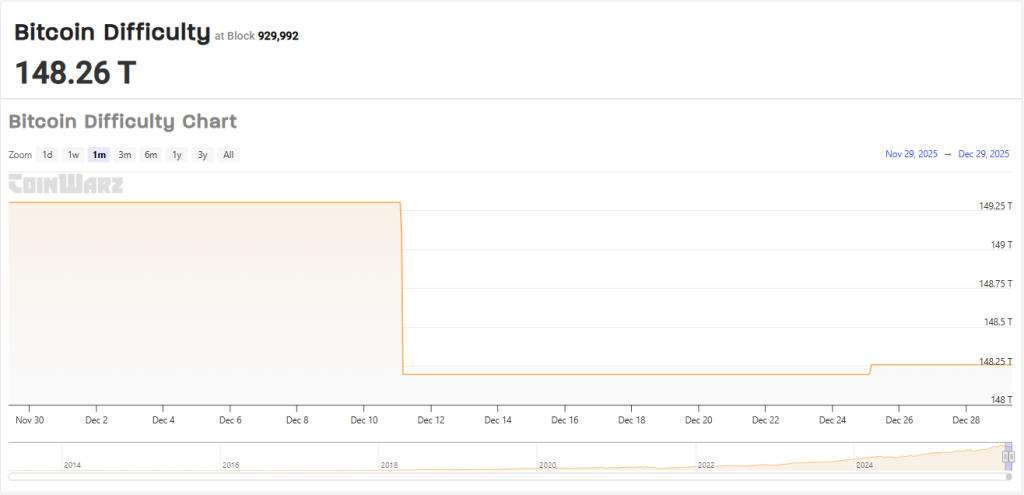
The Bitcoin network, that ever-cryptic ledger of digital gold, has decided to throw another spanner in the works for its miners. The latest difficulty adjustment has nudged the number up to a mere 148 trillion-because why not make solving blocks feel like a PhD thesis in quantum mechanics? Block times are currently averaging 9.95 minutes, which is technically faster than the 10-minute goal, prompting the network to adjust with the subtlety of a sledgehammer. “We’re not late,” it seems to say. “We’re just… creatively punctual.”
Projected Difficulty Rise
Bitcoin’s difficulty adjustment occurs every 2016 blocks, roughly every two weeks-a biweekly ritual of chaos and calculation. When blocks are mined too quickly, the network slaps on extra difficulty like a teacher handing out pop quizzes. If they’re too slow? Well, it’s not like the blockchain’s going to hand out participation trophies. The system’s as fair as a tax audit, really.
Right now, miners are churning out blocks faster than the target, which means the network will crank up the challenge. It’s like a gym that suddenly replaces all the dumbbells with bricks. Based on CoinWarz estimates, the next adjustment on January 8, 2026 (block 931,392), is expected to push difficulty past 148 trillion. Bring snacks. And a calculator.
Historical Context And Market Moves
Mining difficulty hit stratospheric heights in 2025, with two sharp jumps in September that coincided with Bitcoin’s price surge earlier that year. The coin hit $125,100 in October before plummeting like a toddler off a slide. As prices rise, so do the number of mining rigs-because nothing says “smart investment” like buying a warehouse full of hardware that’ll be obsolete in six months. More rigs = more computing power = higher difficulty. It’s a feedback loop that would make a cat proud.
Miners’ Costs And Network Security
Higher difficulty means miners now need more computing power and energy to solve blocks. This raises costs, which is great if you enjoy living in a data center powered by a nuclear plant. Smaller operations, meanwhile, are getting squeezed like toothpaste. But fear not-the network’s got your back! By adjusting difficulty, it ensures no one miner can dominate the block production. It’s like a dinner party where everyone’s allowed to bring a fork, but no one’s allowed to bring a sword. Mostly.

Outlook From The Investment Side
According to Bitwise CIO Matt Hougan, Bitcoin may deliver steady growth over the next decade, which is code for “we’re not promising a rocket ship, but we’re not selling you a goat either.” He told CNBC to expect “strong returns” with “moderate ups and downs”-a phrase so vague it could describe the weather in London. Hougan also claims 2026 will be a positive year for Bitcoin, because what’s a market without a little optimism? The rise to 148 trillion isn’t dramatic, but it’ll tighten miners’ margins like a belt on a budget.
For investors, difficulty trends are a window into the real-world effort securing Bitcoin. It’s like watching a game of chess where the pieces are made of electricity bills and hope. The network’s adjustments are routine but vital-ensuring coins are released steadily, miners stay challenged, and Bitcoin’s decentralized design remains as clear as mud. And really, isn’t that the point? To keep everyone guessing, sweating, and occasionally screaming into their ASIC miners? 🚀
Read More
- The Super Mario Galaxy Movie: 50 Easter Eggs, References & Major Cameos Explained
- 10 Best Free Games on Steam in 2026, Ranked
- Surprise Isekai Anime Confirms Season 2 With New Crunchyroll Streaming Release
- ‘Project Hail Mary’: The Biggest Differences From the Book, Explained
- Skate 4 – Manny Go Round Goals Guide | All of the Above Sequence
- Starfield (PS5) Review – A Successful Cross-Console Voyage
- Preview: Sword Art Online Returns to PS5 as a Darker Open World Action RPG This Summer
- Sydney Sweeney’s The Housemaid 2 Sets Streaming Release Date
- Why is Tech Jacket gender-swapped in Invincible season 4 and who voices her?
- Coronation Street airs horrifying discovery for Summer Spellman about villainous Theo in early ITVX release
2025-12-29 15:34