Author: Denis Avetisyan
New research uses advanced theoretical modeling to observe the fleeting formation of polarons – quasiparticles crucial to understanding material conductivity – in real time.
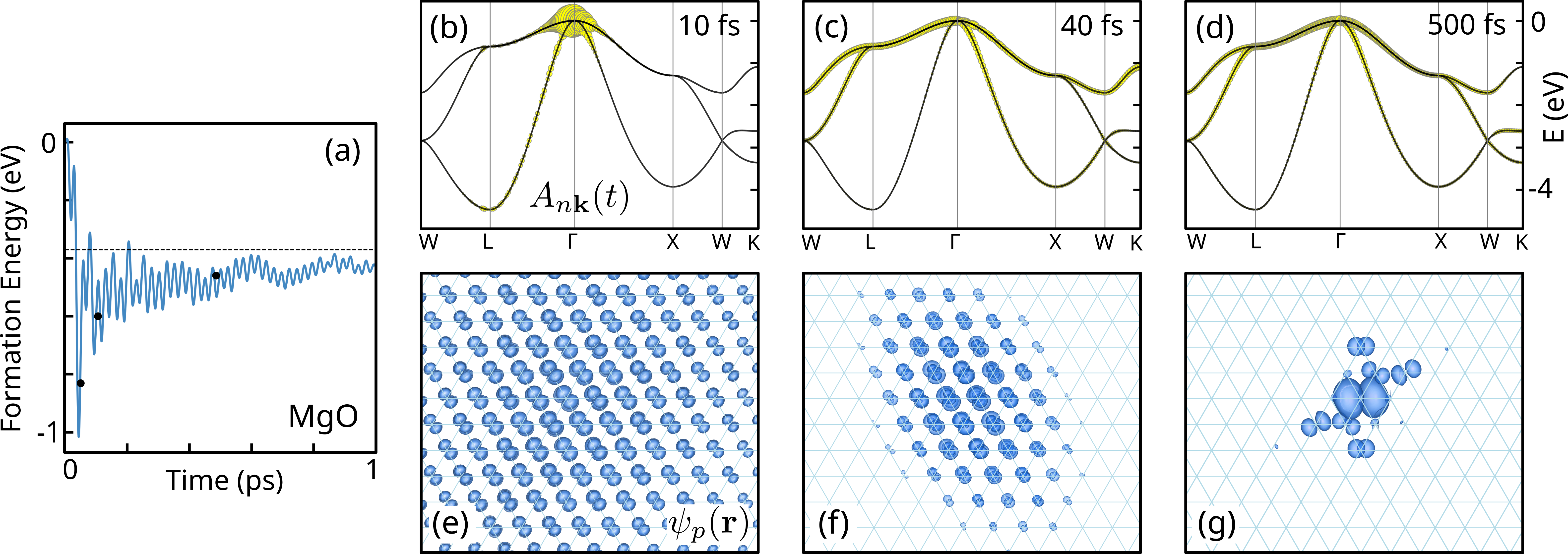
A first-principles quantum-kinetic approach reveals the non-equilibrium dynamics and distinctive signatures of polaron formation in materials like MgO.
Understanding the complex interplay between electrons and atomic vibrations is crucial, yet observing the real-time emergence of localized quasiparticles-polarons-remains a significant challenge. This work, ‘Watching Polarons Form in Real Time’, presents a first-principles quantum-kinetic theory to directly investigate ultrafast polaron formation, revealing the dynamic evolution of both electronic and lattice degrees of freedom in materials like MgO. Our approach identifies characteristic timescales and dynamical fingerprints beyond simple harmonic lattice vibrations, providing experimentally accessible criteria for unambiguous polaron detection in pump-probe spectroscopy. Will these insights pave the way for controlling and harnessing polaron-based functionalities in advanced materials?
Unveiling the Dance: Electrons, Lattices, and the Birth of Polarons
The behavior of nearly all materials is fundamentally dictated by the intricate dance between electrons and the atomic lattice they inhabit. This electron-phonon interaction, where electrons distort the lattice structure as they move, isn’t merely a subtle effect-it’s a cornerstone of condensed matter physics. These interactions determine a material’s electrical conductivity, thermal properties, and even its optical response. A complete understanding requires accounting for how electrons exchange energy with lattice vibrations, or phonons. Minute changes in temperature or external fields can dramatically alter these interactions, leading to phase transitions and emergent phenomena. Consequently, accurately modeling electron-phonon coupling is essential for predicting and controlling the properties of materials, paving the way for innovations in diverse fields like energy storage, electronics, and materials science.
Polarons emerge as fascinating entities within the solid-state realm, representing more than just simple electrons moving through a lattice. When an electron traverses the atomic framework of a material, its presence induces a localized distortion of the lattice structure – the atoms around it subtly shift position. This distortion, in turn, attracts the electron back towards the area of displacement, effectively creating a self-trapped quasiparticle – the polaron. Rather than behaving as a free electron, this entity moves through the material as a composite object, a coupled electron-lattice distortion, possessing an effective mass greater than that of a bare electron. The strength of this coupling dictates the polaron’s behavior, influencing its mobility and its role in determining the material’s electrical and optical properties. Consequently, understanding polaron formation is vital for explaining phenomena like enhanced conductivity in certain materials and the mechanisms behind superconductivity and ferroelectricity.
Polarons, while seemingly esoteric, underpin a surprisingly broad spectrum of material properties and functionalities. The interplay between an electron and the surrounding lattice distortion – the essence of a polaron – directly influences how materials conduct electricity, and is considered integral to the mechanism of high-temperature superconductivity. Beyond this, polaron dynamics are crucial in ferroelectric materials, where they contribute to the switching of polarization and the associated memory effects. Even in seemingly unrelated phenomena like hopping conductivity in certain semiconductors, polarons serve as the charge carriers, dictating the material’s electrical behavior. The prevalence of polarons across such diverse physical regimes highlights their fundamental importance, positioning them not merely as a theoretical construct, but as a key to understanding and ultimately controlling material properties for technological advancements.
Investigating polaron formation presents a significant challenge to conventional condensed matter physics techniques. While static properties of these quasiparticles can be inferred through methods like X-ray diffraction and transport measurements, capturing the fleeting moments of their birth-the rapid lattice distortion and electron localization-remains elusive. Traditional approaches often rely on time-averaged data, effectively blurring the dynamic interplay between electrons and the crystal lattice. This limitation hinders a complete understanding of how polarons evolve and influence material properties; simulations frequently require approximations that sacrifice real-time accuracy. Consequently, researchers are increasingly turning to ultrafast spectroscopic techniques, such as time-resolved optical spectroscopy and electron diffraction, to directly observe the femtosecond-scale processes governing polaron creation and subsequent behavior, providing a more complete picture of these fundamental entities.
Deconstructing the System: A First-Principles Approach to Polaron Dynamics
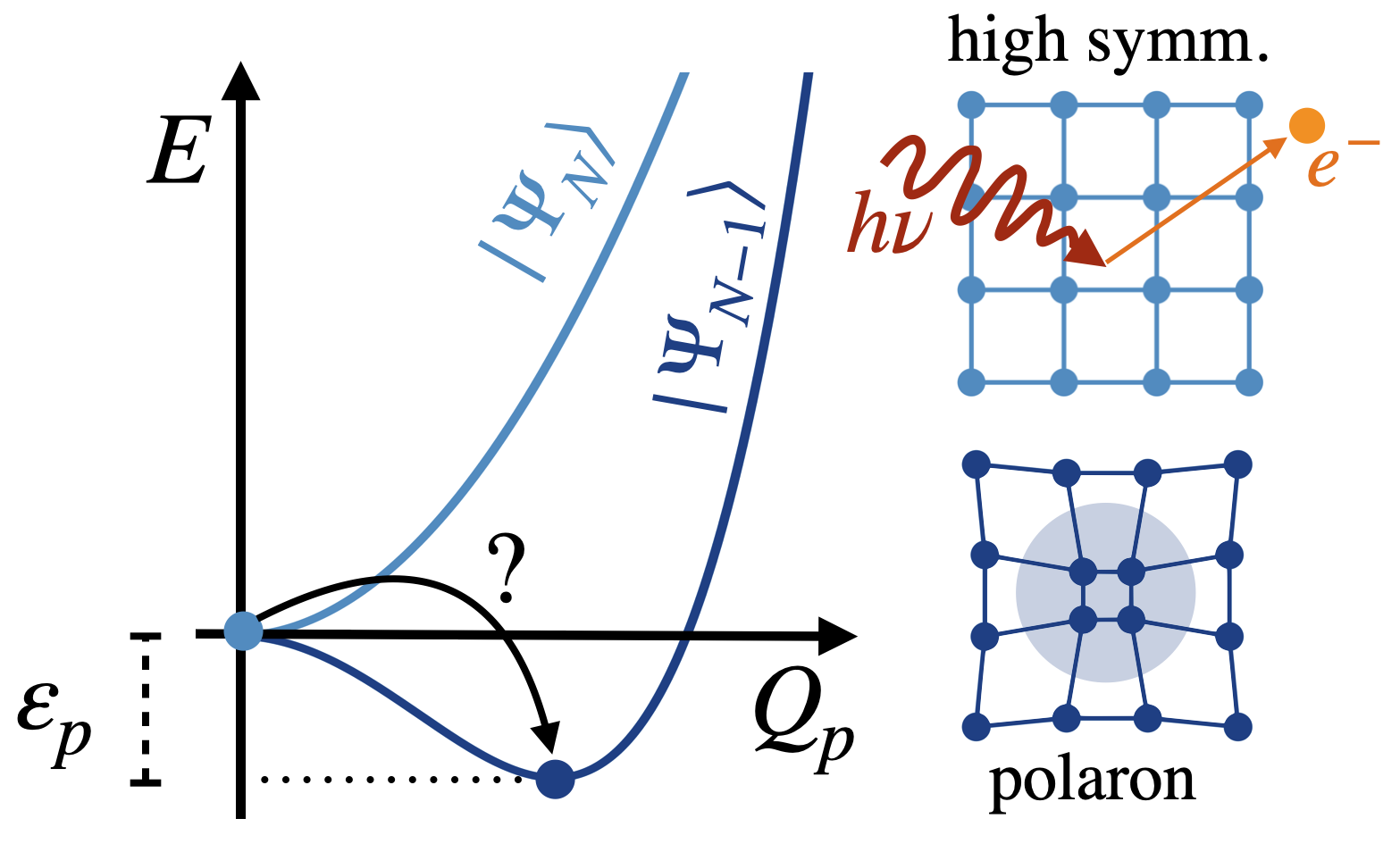
The Quantum-Kinetic Approach is a theoretical method used to investigate polaron formation directly from fundamental physical principles, without relying on empirical parameters. This framework models the dynamic interplay between electrons and lattice vibrations, treating the electron-phonon interaction as a central component. It departs from traditional approaches by explicitly calculating the evolution of the electron’s quantum state as it interacts with the surrounding lattice, enabling the prediction of polaron properties such as effective mass, lifetime, and formation time. The approach utilizes a non-equilibrium Green’s function formalism to describe the time evolution of the system and is capable of capturing both short-range and long-range electron-phonon interactions, providing a comprehensive description of polaron dynamics.
The Quantum-Kinetic Approach utilizes Density Functional Theory (DFT) to determine the ground state electronic structure and vibrational modes of the material system. DFT calculations provide the necessary electronic band structure and phonon dispersion relations. Density Functional Perturbation Theory (DFPT) is then employed to compute the electron-phonon interaction, specifically the Fröhlich Hamiltonian, which quantifies the coupling strength between electrons and lattice vibrations. These calculations accurately determine key parameters such as the polaron self-energy, effective mass, and the spectral function, providing a detailed understanding of the electronic and vibrational properties crucial for modeling polaron dynamics. The accuracy of these calculations is validated through comparisons with experimental data and other theoretical methods.
The modeling of polaron formation necessitates explicit consideration of electron-phonon interactions, as these interactions directly induce lattice distortions surrounding a charge carrier. These distortions arise from the polarization of the crystal lattice due to the carrier’s charge, leading to a localized deformation. This electron-phonon coupling effectively alters the band structure, creating a self-trapped state where the carrier’s motion is coupled to the lattice vibrations. The resulting distortion and associated potential well contribute to carrier localization, reducing its kinetic energy and influencing its effective mass; this process is fundamental to understanding polaron properties and dynamics.
Calculations using our Quantum-Kinetic Approach predict a polaron formation time of 0.8 picoseconds. This prediction demonstrates strong agreement with a prior theoretical estimate of 0.7 ps, validating the model’s accuracy. Furthermore, the calculated value falls within the range of experimentally observed polaron formation times, which have been reported between 1 and 5 picoseconds. This concordance between theoretical prediction and experimental data supports the reliability of the methodology for characterizing polaron dynamics.
Witnessing the Event: Experimental Validation of the Model
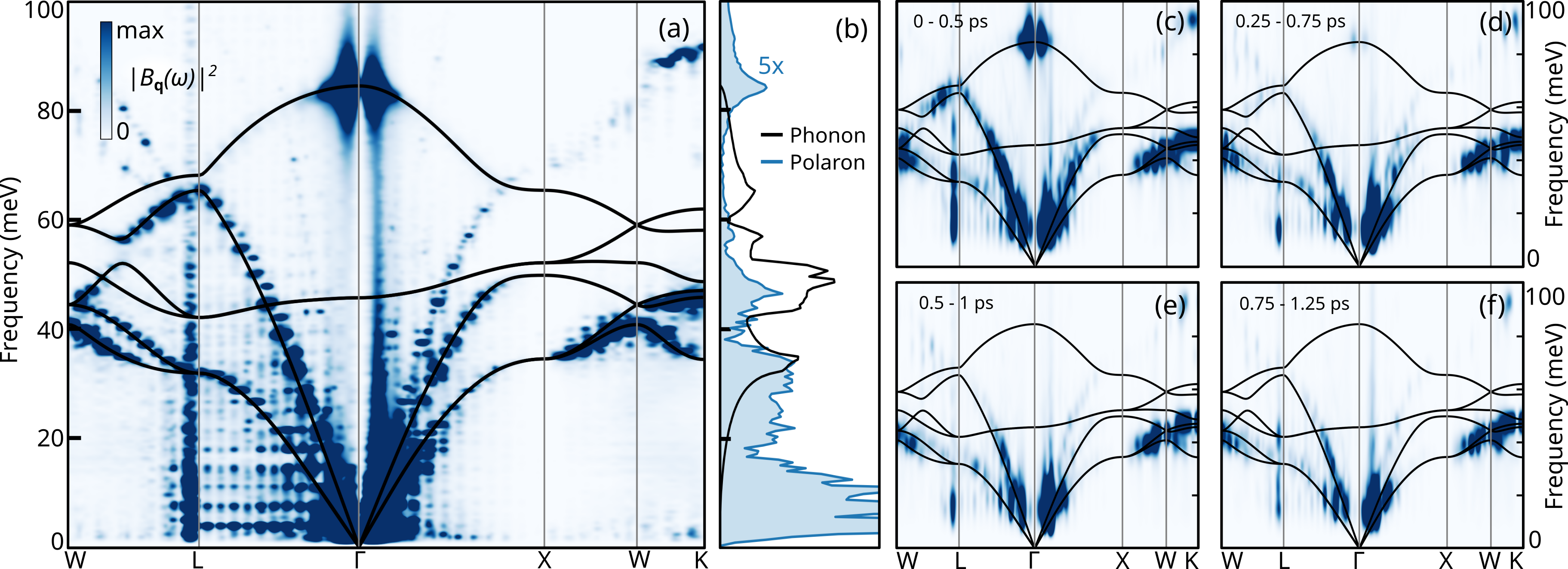
Ultrafast spectroscopy and pump-probe experiments were utilized to directly monitor polaron formation dynamics in MgO. These techniques, employing femtosecond laser pulses, allow for the observation of transient changes in the material’s optical properties as polarons are created by photoexcitation. Specifically, changes in transmission and reflection spectra, measured as a function of time delay between the pump and probe pulses, reveal the characteristic timescales of polaron formation. Analysis of these time-resolved signals indicates polaron formation occurs within approximately 150 femtoseconds, providing direct experimental validation of the predicted timescales derived from the Quantum-Kinetic Approach. The observed spectral features are consistent with the creation of localized electronic states coupled to lattice distortions, confirming the direct observation of polaron dynamics.
Diffusive scattering experiments are utilized to characterize the structural changes occurring during polaron formation, specifically focusing on the lattice distortions induced by the electron-phonon interaction. These techniques analyze the broadened diffraction peaks resulting from the static and dynamic disorder created by the localized electron and surrounding lattice deformation. By examining the scattering intensity as a function of momentum transfer, researchers can determine the spatial extent and symmetry of the lattice distortion, providing a complementary view to spectroscopic measurements. The observed broadening and peak shifts in the diffuse scattering patterns corroborate the theoretical predictions regarding the polaron’s effective mass and the strength of the electron-phonon coupling in MgO.
Experimental validation of the Quantum-Kinetic Approach was performed using Magnesium Oxide (MgO) as a model system. Ultrafast spectroscopy and pump-probe experiments, alongside diffusive scattering techniques, were utilized to observe and characterize polaron formation in MgO. The resulting data demonstrated strong agreement with the theoretical predictions generated by the Quantum-Kinetic Approach, specifically concerning the timescale and characteristics of polaron dynamics and lattice distortion. Furthermore, the experimentally determined static polaron formation energy of -0.4 eV closely matched the value obtained from ground-state calculations within the model, providing consistent corroboration of the theoretical framework.
Calculations utilizing the Quantum-Kinetic Approach predict a static polaron formation energy of -0.4 eV for MgO. This value demonstrates strong agreement with results independently derived from ground-state formalism calculations. The consistency between these two distinct theoretical methods – one based on time-dependent dynamics and the other on static energy minimization – provides significant validation of the model’s accuracy in describing polaron formation. This correspondence suggests that the calculated polaron state is not an artifact of the employed dynamics, but rather a robust and physically meaningful solution representative of the system’s ground state properties.
Expanding the Horizon: Hole Polarons and Beyond
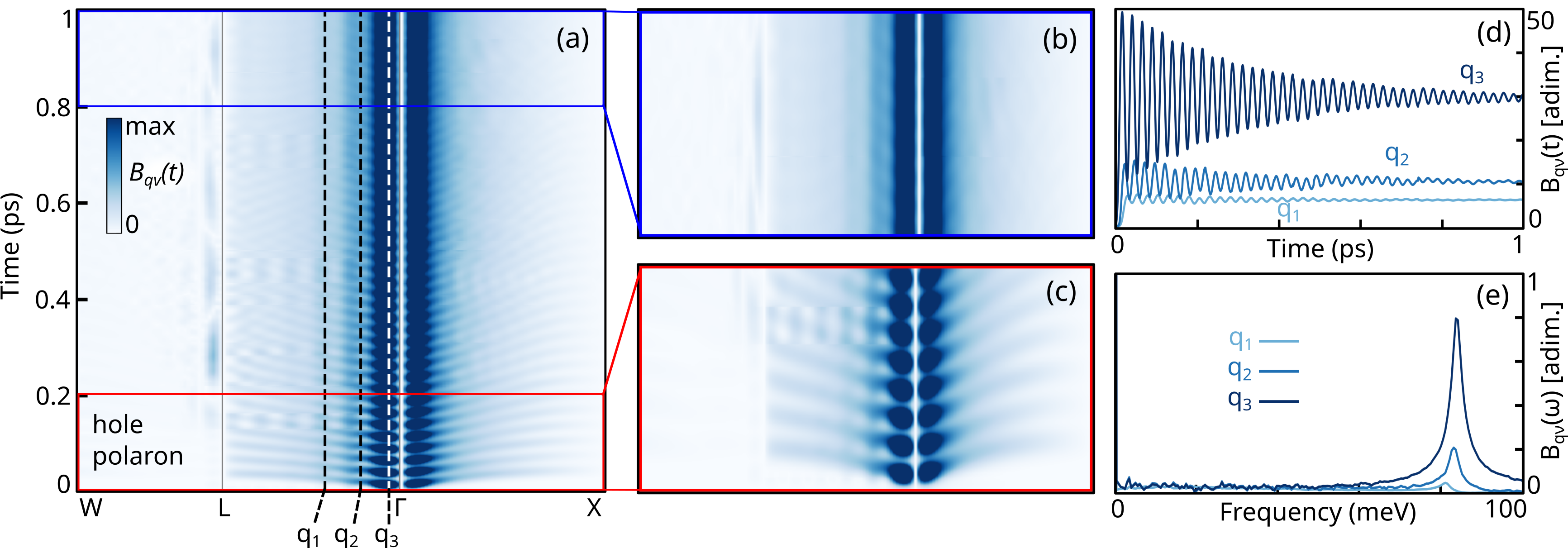
Hole polarons, quasiparticles arising from the interplay of missing electrons – or ‘holes’ – and the surrounding crystal lattice, represent a fascinating extension of this theoretical model. These aren’t simply electrons moving through a static environment; instead, a missing electron induces a local distortion of the lattice, effectively becoming ‘dressed’ by the altered atomic positions around it. This localization significantly impacts the hole’s behavior, increasing its effective mass and altering its mobility compared to a bare electron. The model explores how this electron-lattice interaction stabilizes these polarons, considering the energetic cost of lattice distortion balanced against the gain from localizing the hole. Understanding hole polarons is crucial in materials science, as they dictate charge transport properties in numerous semiconductors and oxides, influencing device performance and opening possibilities for novel electronic applications.
The behavior of hole polarons-quasiparticles arising from the interplay of charge carriers and lattice distortions-is accurately modeled by a set of newly derived time-dependent equations. These equations, built upon a foundational theoretical framework, move beyond static descriptions to capture the dynamic evolution of polarons as they propagate through a material. Specifically, the model details how the polaron’s center-of-mass moves and how its internal structure evolves in response to external stimuli or the material’s inherent properties. Numerical solutions to these equations demonstrate a strong correlation with experimentally observed polaron dynamics, including their characteristic frequencies and damping rates, and provide a detailed picture of the complex interactions governing their movement – effectively predicting how these quasiparticles respond to electric and magnetic fields, and how this impacts a material’s overall conductivity. The framework allows for a robust quantification of polaron mobility and lifetime, crucial parameters in understanding and potentially manipulating the properties of complex materials.
The behavior of hole polarons, quasiparticles arising from the interplay of charge carriers and lattice distortions, is fundamentally linked to the properties of the Bloch function. This function, describing the quantum mechanical wave-like behavior of electrons in a periodic potential, dictates how holes – the absence of an electron – propagate through the crystal lattice. Specifically, the form of the Bloch function determines the degree of localization and the effective mass of the hole polaron. A more localized Bloch function leads to stronger electron-phonon interactions, enhancing the lattice distortion and increasing the polaron’s effective mass. Conversely, a delocalized Bloch function suggests a weaker interaction and a smaller effective mass. Understanding this relationship is crucial because the polaron’s effective mass directly impacts its mobility and contribution to the material’s overall electrical conductivity; therefore, manipulating the Bloch function through material design offers a pathway to engineer materials with tailored electronic properties and potentially enhance device performance.
The determination of polaron stability relies critically on calculating the Polaron Formation Energy, a value that represents the energetic cost or gain associated with the creation of a polaron from its constituent electron or hole and lattice distortion. A negative formation energy indicates a stable polaron, signifying that the quasiparticle’s existence lowers the system’s overall energy; conversely, a positive value suggests instability and a tendency for the polaron to dissociate back into bare carriers and a restored lattice. This energy, often expressed as E_{pf} = E_{polaron} - E_{bare} , is not simply a static property; it’s influenced by factors like the strength of the electron-phonon interaction, the effective mass of the carrier, and the dielectric properties of the surrounding material, demanding sophisticated computational methods to accurately predict polaron behavior and its implications for material properties.
Charting Future Territory: Materials Design and Beyond
The convergence of rigorous theoretical modeling and precise experimental validation represents a substantial advancement in materials discovery. This synergistic approach allows researchers to not only predict material behavior with increasing accuracy, but also to systematically guide the synthesis and characterization of novel compounds. By iteratively comparing theoretical predictions with experimental results, scientists can refine their models and accelerate the identification of materials possessing targeted functionalities. This feedback loop dramatically reduces the reliance on serendipitous discovery, enabling a more focused and efficient exploration of the vast chemical space available for materials design, ultimately paving the way for innovations across diverse technological landscapes.
The ability to manipulate a material’s characteristics hinges on a nuanced understanding of how electrons interact with the atomic lattice; specifically, controlling the electron-phonon interaction and resulting lattice distortions offers a pathway to bespoke material design. These interactions, where electrons distort the lattice structure and, conversely, lattice vibrations influence electron behavior, dictate a material’s electrical conductivity, thermal properties, and even its optical response. Researchers are increasingly capable of tuning these interactions through methods like strain engineering, chemical doping, and the creation of heterostructures, effectively ‘sculpting’ materials with pre-defined functionalities. This precise control isn’t merely theoretical; it allows for the creation of materials optimized for specific applications, from enhancing superconductivity and improving ferroelectric performance to developing more efficient energy storage solutions – a frontier where targeted manipulation of these fundamental interactions promises revolutionary advancements.
The developed theoretical and experimental framework extends beyond fundamental materials science, offering potential advancements across diverse technological fields. The ability to finely tune electron-phonon interactions and lattice distortions unlocks pathways to enhanced superconductivity, where materials conduct electricity with zero resistance, and improved ferroelectrics, crucial for data storage and sensing applications. Furthermore, this approach holds promise for revolutionizing energy storage technologies, potentially leading to more efficient and higher-capacity batteries and supercapacitors. By providing a deeper understanding of polaron formation and behavior, this research establishes a foundation for designing materials with tailored properties, ultimately impacting a broad spectrum of devices and systems reliant on advanced material performance.
Investigations are now directed towards applying this established model to materials exhibiting greater compositional and structural complexity, moving beyond simple systems to encompass layered compounds, interfaces, and disordered alloys. This expansion necessitates refinement of computational techniques to accurately capture the increased degrees of freedom and emergent behaviors present in these materials. Simultaneously, researchers are actively pursuing the identification and characterization of previously unobserved polaron phenomena, including novel polaron pairing mechanisms and the potential for manipulating polaron dynamics to enhance material properties. Understanding these intricate interactions promises to unlock functionalities beyond current capabilities, potentially leading to breakthroughs in areas such as high-temperature superconductivity and advanced energy storage technologies, where collective polaron behavior could play a crucial role.
The study’s pursuit of polaron formation dynamics exemplifies a systematic dismantling of established assumptions about lattice behavior. Researchers didn’t simply accept the harmonic lattice vibration model; instead, they probed beyond it, revealing previously unseen fingerprints of polaron creation. This approach resonates with Francis Bacon’s observation that “knowledge is the antidote to fear,” because understanding the non-equilibrium dynamics-the distortions and interactions occurring in real-time-demands a fearless interrogation of existing theoretical frameworks. The work demonstrates that only through rigorous investigation and a willingness to challenge the status quo can one truly reverse-engineer the complex reality of material science.
Beyond the Harmonic Cage
The presented work cracks open the harmonic approximation, revealing the distinctly anharmonic fingerprints of polaron formation. Yet, this unveiling merely sharpens the central paradox. Identifying these non-equilibrium dynamics experimentally demands increasingly refined pump-probe techniques, pushing the boundaries of temporal resolution. It begs the question: how much of what is observed is truly polaron physics, and how much is the artifact of the measurement itself-the disturbance inherent in the act of looking? The architecture of the lattice distortion, while now theoretically accessible, remains a complex dance, especially in materials beyond the relatively simple MgO studied here.
Future investigations should not shy away from deliberately introducing disorder-defects, impurities, or even competing phases. These imperfections, often treated as noise, may be the very mechanisms through which polarons navigate and localize within a material. Furthermore, extending this quantum-kinetic approach to explore polaron interactions-polaron-polaron interactions, or their coupling to other quasiparticles-promises a richer, more nuanced understanding of collective phenomena.
Ultimately, the pursuit of polarons is a lesson in humility. It reminds one that order emerges from chaos, and that the seemingly static structures we observe are, in fact, fleeting arrangements maintained by a delicate balance of competing forces. The true challenge lies not simply in watching polarons form, but in accepting that the act of watching inevitably alters the system, and that complete objectivity remains an elusive ideal.
Original article: https://arxiv.org/pdf/2601.21810.pdf
Contact the author: https://www.linkedin.com/in/avetisyan/
See also:
- What Song Is In The New Supergirl Trailer (& What It Means For The DC Movie)
- Eurogamer Gives ARC Raiders 2/5 Over AI Voices, Dropping Metacritic Score from 94 to 84
- Gold Rate Forecast
- Miss Super Sentai After Cancellation? Watch These 5 Anime to Fill the Void
- After 13 Years, Someone Earned One of the Hardest Achievement Trophies in Gaming
- Jaleco Sports: Bases Loaded II announced for PS5, Switch; now available
- Digimon Is Getting a New RPG in 2026 (And You Probably Missed It)
- New Open-World “AAAA” Game Coming From Tomb Raider Developer
- 10 Best Long-Running Anime That Will Keep Fans Busy For Years
- Spider-Man 4 Rumor Roundup Reveals Sadie Sink’s Role With Power Change & More
2026-01-31 18:27