Unlocking Quark-Gluon Plasma Secrets with String Theory
![The study of quark-antiquark interactions within a Rindler-AdS background reveals that the potential energy [latex]VV[/latex] between quarks scales with both the separation distance [latex]LL[/latex] and a constant [latex]\mathcal{C}[/latex] characterizing the system’s acceleration, exhibiting distinct behaviors across varying acceleration levels-specifically, [latex]a = 0.4/\ell[/latex], [latex]0.6/\ell[/latex], [latex]1/\ell[/latex], and [latex]2/\ell[/latex]-and demonstrating how fundamental forces are modulated by spacetime curvature.](https://arxiv.org/html/2601.10668v1/x3.png)
New research explores the fundamental forces binding quarks together under extreme conditions, shedding light on the behavior of matter in heavy ion collisions.
New research explores the fundamental forces binding quarks together under extreme conditions, shedding light on the behavior of matter in heavy ion collisions.
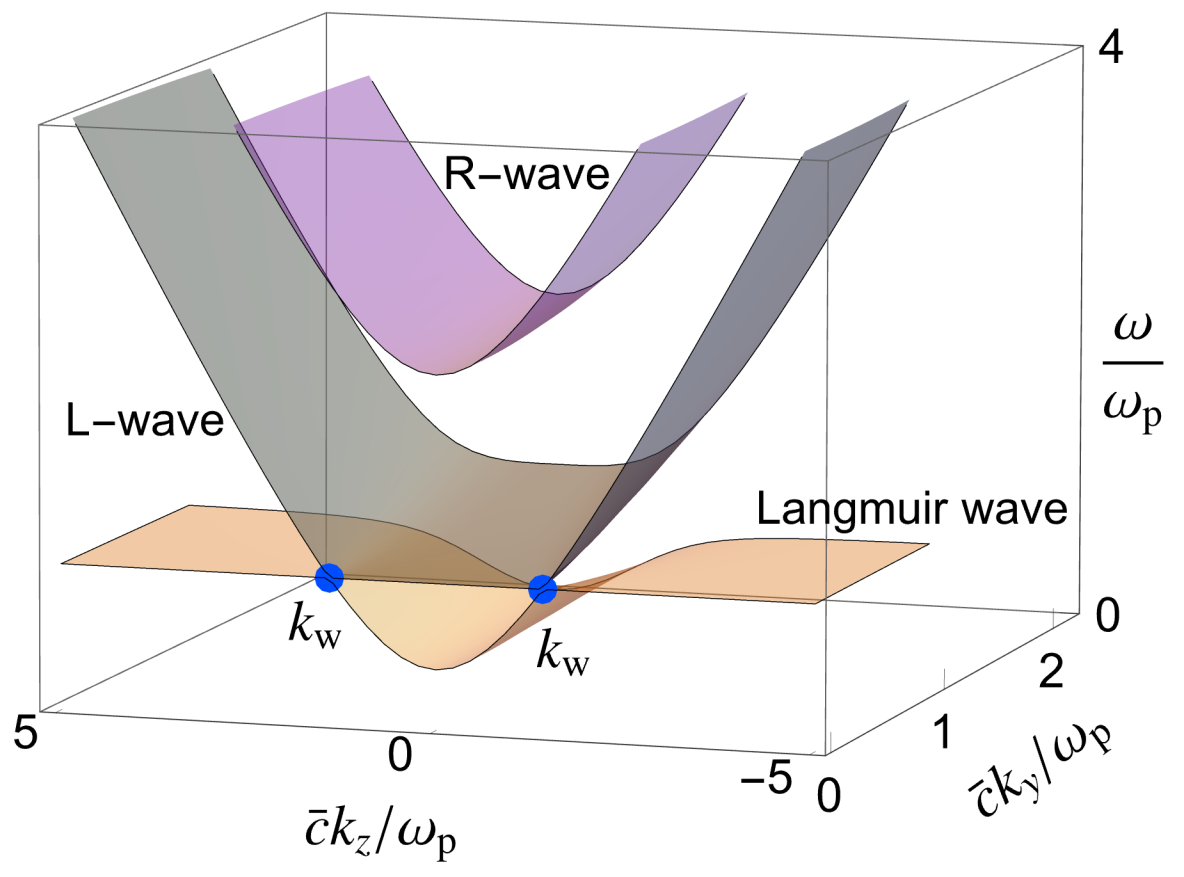
New research reveals how magnetic Weyl semimetals can host unique, localized waves with potential for advanced photonic technologies.
![For charged black holes with a charge-to-mass ratio of [latex]Q/M = 0.5[/latex], an angular momentum-to-mass ratio of [latex]L/M = 1[/latex], and a cosmological constant of [latex]\Lambda = -0.001/M^2[/latex], the effective potential governing null geodesic trajectories demonstrates configuration-dependent behavior, revealing how spacetime curvature influences the paths of massless particles near these objects.](https://arxiv.org/html/2601.10303v1/x12.png)
New research explores how violations of fundamental symmetry and the presence of exotic matter alter the geometry around charged black holes, potentially leaving observable traces in gravitational wave or electromagnetic signals.
New research confirms the consistency of key holographic entropy inequalities, bolstering their potential connection to time-dependent quantum gravity.
New research unveils a supersymmetric solution describing highly excited strings, offering a potential pathway to understanding the quantum nature of black holes without invoking a traditional event horizon.
New research explores how gravity might differentiate between quantum matter states by analyzing the way particles scatter, revealing potential violations of fundamental principles.
![Black hole evaporation proceeds via a beam splitter mechanism coupled with single-mode squeezing for each interaction event, indexed by integer [latex]k[/latex], fundamentally altering the understanding of Hawking radiation.](https://arxiv.org/html/2601.09820v1/x3.png)
New research leverages the principles of quantum optics to create models that explain how information can escape black holes over time.
![The study elucidates dark matter-nucleon scattering and the decay of eta mesons into two pions via a scalar resonance, demonstrating that the coupling strength [latex]g_{u}(g_{\chi})[/latex] - and its effective counterpart [latex]g_{N}[/latex] as defined in equations (3) and (5) respectively - fundamentally governs these interactions.](https://arxiv.org/html/2601.10597v1/x701.png)
Researchers are leveraging meson decays to search for extremely light dark matter candidates, opening a novel window into the universe’s missing mass.
New research suggests that completely separating topological field theories from the influence of gravity is fundamentally impossible, challenging assumptions about global symmetries in quantum gravity.
![The study demonstrates how cavity-mediated interactions sculpt the behavior of two-body wavefunctions, revealing distinct ground states-either spatially extended for repulsive interactions at strengths of [latex]V_0 = 10\varepsilon[/latex] and [latex]V_0 = 100\varepsilon[/latex], or localized for the corresponding attractive cases-as dictated by the second term of Eq. (II.2).](https://arxiv.org/html/2601.10301v1/x1.png)
New simulations reveal how light confinement dramatically alters the behavior of interacting quantum particles, leading to exotic phases and delocalized states.