Beyond the Horizon: A New Look at Black Hole Entropy
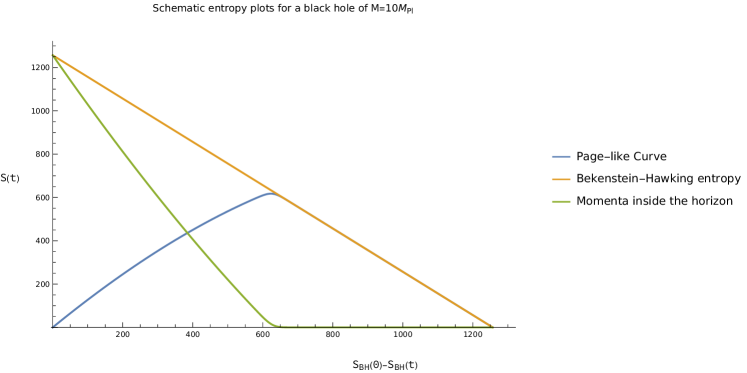
New research reveals a surprising duality between particle and field behavior near black hole horizons, offering potential corrections to our understanding of Hawking radiation and quantum gravity.
![The study demonstrates that, for fermion dark matter with a [latex]\psi \sim (3,1,1)[/latex] representation, the test statistic varies predictably with the fermion mass [latex]m_\psi[/latex], allowing for the determination of the best-fit value for the new physics parameter Λ as a function of that same mass.](https://arxiv.org/html/2601.08907v1/x2.png)
![Estimates of gravitational wave modes-specifically, the real and imaginary components of prograde and retrograde signals at [latex]\ell = 2[/latex] with an eccentricity of [latex]\epsilon = 0.4[/latex]-demonstrate that while approximations like post-Kerr and Padé can align with predictions from the eikonal method, residual errors in [latex]\log_{10}[/latex] and [latex]\log_{2}[/latex] scales reveal the sensitivity of these estimations to the order of approximation-with discrepancies highlighting the limitations of each approach when compared against Prony extraction.](https://arxiv.org/html/2601.09607v1/x8.png)
![The study investigates how different new physics scenarios-including scalar, vector, and tensor interactions-manifest in correlations observed in particle collisions, revealing distinctions in purity [latex]\Gamma\Gamma[/latex], concurrence [latex]{\cal C}[/latex], the Bell-CHSH observable [latex]{\cal B}\_{\rm CHSH}[/latex], and measures of entanglement like helicity-basis SREM2M\_{2} and beam-basis SREM2(z^)M\_{2}^{(\hat{z})}, all as functions of the scattering angle [latex]\cos\Theta[/latex] at a center-of-mass energy of 500 GeV and an effective field theory cutoff scale of [latex]\Lambda/3[/latex], demonstrating how these observables vary across different polarization settings-unpolarized, PP, PN, NP, and NN-to characterize the underlying physics.](https://arxiv.org/html/2601.09558v1/x87.png)
