Beyond Locality: Unraveling Entanglement in Complex Quantum Systems

New research explores how breaking the rules of local interactions impacts the fundamental properties of quantum entanglement.
New research explores how breaking the rules of local interactions impacts the fundamental properties of quantum entanglement.

A new quantum algorithm tackles the notoriously difficult SAT problem, leveraging measurement-driven computation and spectral properties to potentially outperform classical approaches.
Researchers have developed efficient quantum algorithms for calculating key statistical measures, paving the way for advancements in quantum machine learning and data analysis.

Researchers have experimentally demonstrated a new technique that enhances the complexity of photonic quantum computation using optical feedback, potentially simplifying the path to scalable quantum systems.

New research explores the fundamental trade-offs between energy dissipation, information processing, and the speed at which quantum systems can evolve.
Researchers have developed a weight-based measure to assess the practical capacity of quantum memory, linking it directly to real-world applications and performance limits.
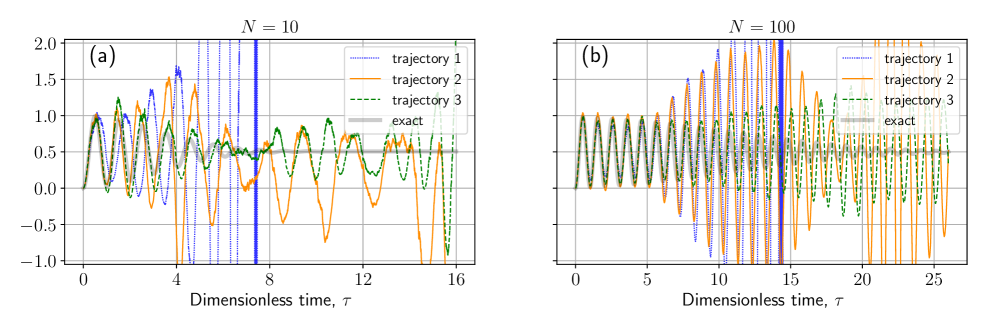
New research critically examines the limits of simulating complex quantum systems using stochastic trajectories, revealing challenges in long-term stability.

Researchers have developed a new method for compiling quantum circuits using the unique properties of non-semisimple anyons in topological quantum computation.
This review clarifies the methods used to detect and characterize entanglement, the bizarre quantum phenomenon that connects particles in ways classical physics cannot explain.

Researchers propose a new experimental approach to differentiate between quantum and classical gravity by exploiting the unique properties of massive mechanical oscillators coupled to engineered reservoirs.