Skip to content

PricPR

  • Cryptonews
  • Tech News
  • Currency prediction
  • Science

Science

Tuning Spin Defects with Light: A New Control Mechanism for hBN Quantum Sensors

07.02.2026 by pricpr

New research reveals that controlling the excitation wavelength significantly alters the behavior of spin defects in hexagonal boron nitride, opening doors for improved quantum sensing performance.

Categories Science

A Universe From Within: Quantum Mechanics in Expanding Space

07.02.2026 by pricpr

Within a closed anti-de Sitter (AdS) universe, the expectation value and its square for a patch operator demonstrate inherent properties of the spacetime geometry, revealing how quantum fluctuations manifest within this constrained cosmological model [latex]AdS[/latex].

New research suggests that the quantum reality experienced by observers within a de Sitter space can emerge from a broader description of a ‘baby universe’ and its statistical properties.

Categories Science

The Hunt for Invisible Matter: A Narrowband Search for Axions

07.02.2026 by pricpr

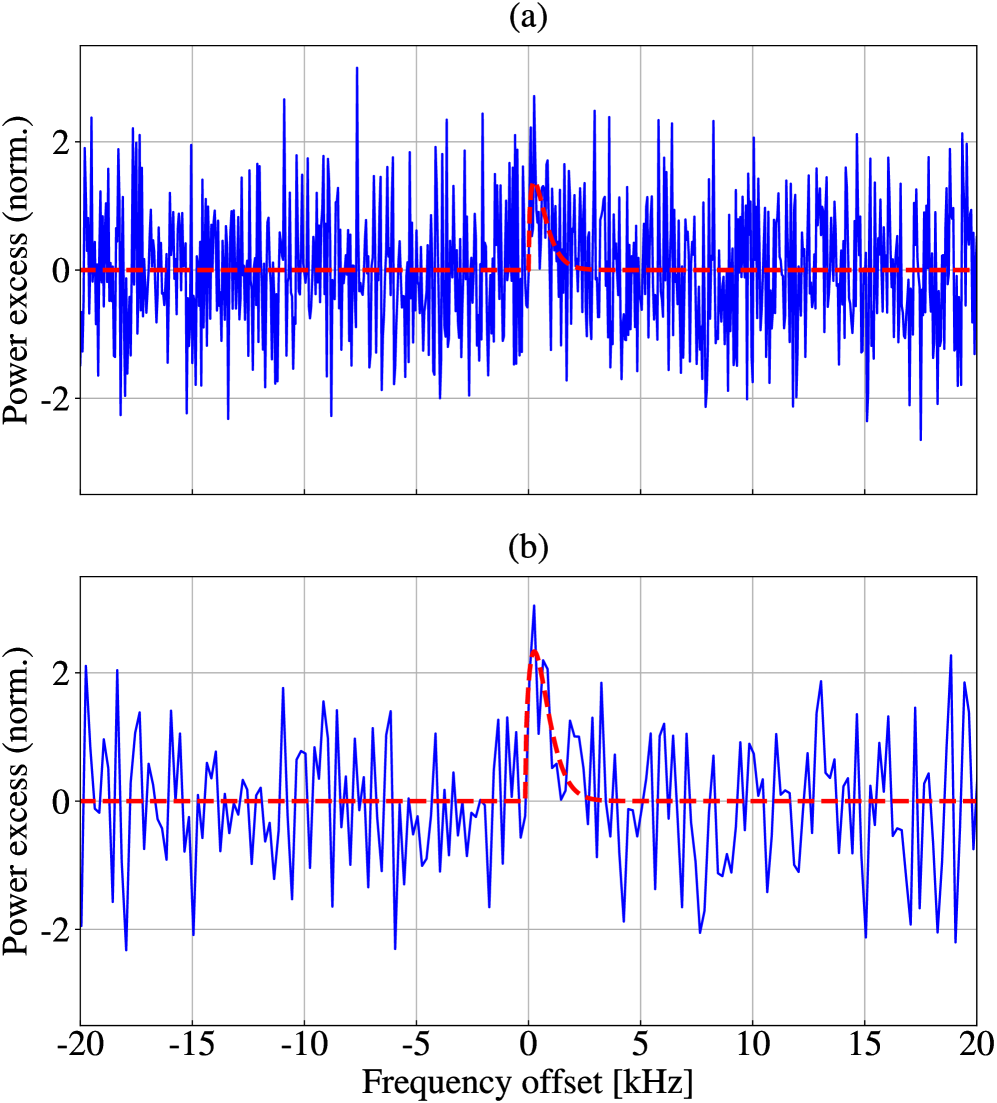
The analysis of power spectra, conducted with frequency-bin widths of both 50 Hz and 200 Hz, seeks to discern signals predicted by the standard axion halo model - a theoretical framework suggesting faint, oscillating patterns within the data - and tests the resolution's impact on identifying these subtle cosmological whispers.

Researchers pushed the boundaries of dark matter detection with a highly sensitive haloscope experiment, refining the search for axions-hypothetical particles that could make up the universe’s missing mass.

Categories Science

Beyond Perturbation: Unveiling Hidden Structures in Superconformal Field Theories

07.02.2026 by pricpr

The convergence of [latex]\mathcal{Z}(g\_{\text{YM}},\phi)[/latex] and [latex]\mathcal{Z}\_{\text{ScYM}}(g\_{\text{YM}},\phi)[/latex] is dictated by rotational symmetry-a φ rotation of the integration contour induces a corresponding rotation of the divergent region, expanding until, at [latex]\phi=\pi/4[/latex], divergence dominates the second and fourth quadrants, after which convergence is localized within figure-eight domains through continued rotation beyond [latex]\arg(a)>\pi/4[/latex], with the formal sum of residues converging within the shaded regions and mirrored across the yy-axis for the negative contour.

New research connects the seemingly complex world of four-dimensional superconformal Yang-Mills theory to a surprisingly simple two-dimensional picture, revealing a deep link between instantons and unstable configurations.

Categories Science

Mapping the Forces Within: Chemical Potentials Reveal Nuclear Structure

07.02.2026 by pricpr

A new method for extracting mesoscopic chemical potentials from experimental data offers insights into the equation of state governing dense nuclear matter.

Categories Science

Terahertz Light Trapped: New States Emerge in Superconductor Heterostructures

07.02.2026 by pricpr

The study of a superconducting/ferroelectric/superconducting structure reveals distinct ferron-polariton and ferron excitations, characterized by parameters [latex]\alpha_{1,2,3} = \{-2.012, 3.608, 1.345\} \times 10^{9} \text{ Nm/C}^{2}[/latex] and [latex]\Omega_{p} = 6.39 \text{ THz}[/latex], demonstrating that the [latex]\delta p_{x}[/latex]-ferron-polariton branches ([latex]\omega_{u,l}[/latex], shown in blue) diverge from the [latex]\delta p_{x}[/latex]-ferron dispersion ([latex]\omega_{1}[/latex], shown in red) as effective wavelength approaches infinity, while the [latex]\delta p_{y,z}[/latex]-ferron frequencies ([latex]\omega_{\pm}[/latex], shown in blue-red dashed curves) remain consistent both with superconducting screening and in the limit of infinite effective wavelength.

Researchers have demonstrated the creation of novel light-matter quasiparticles in layered superconductor/ferroelectric materials, paving the way for exploring quantum phenomena at terahertz frequencies.

Categories Science

Simulating Quantum Fields with Ultracold Atoms

07.02.2026 by pricpr

Numerical simulations explore the dynamic evolution of chiral condensates in a proposed quantum simulator of the (2+1)-dimensional spin-1 quantum liquid magnet, demonstrating how manipulation of the staggering potential δ - ranging from 79.49 to 79.64 Hz - and the electric field energy [latex]g^2[/latex], achieved through coordinated adjustments to both on-site interactions [latex]U[/latex] and δ, influences the system’s response to quenching from the vacuum state on an infinite cylinder with a width of two matter sites.

Researchers demonstrate a promising pathway to quantum simulate 2+1D quantum electrodynamics using tunable optical lattices and trapped atoms.

Categories Science

Taming Quantum Chaos with Magnetic Fields

06.02.2026 by pricpr

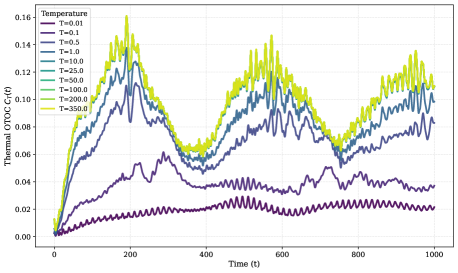
The study of out-of-time-ordered correlators (OTOCs) for a charged particle within a circular magnetic billiard-examined under magnetic field strengths of 0, 1, 2, and 4-reveals how even seemingly contained systems are susceptible to the erosion of predictability, mirroring the inherent limitations of any theoretical framework when confronted with absolute boundaries.

New research demonstrates how transverse magnetic fields can be used to control the scrambling of quantum information in chaotic systems.

Categories Science

Information’s Grip on Matter: Guiding Principles for nullquilibrium Systems

06.02.2026 by pricpr

The study demonstrates that conditional mutual information [latex]I(l|l_B,p)[/latex] collapses onto a universal scaling function [latex]f[(p-p_c)l_B^{1/\nu}][/latex] with critical exponent [latex]\nu=1[/latex] and critical point [latex]p_c=1[/latex], indicating a robust phase transition governed by the system’s parameters and reflected in the corresponding renormalization group flow.

A new framework leverages quantum information inequalities to constrain the behavior of complex materials far from equilibrium.

Categories Science

Untangling Magnetic Chaos: How Fields Restore Order in Frustrated Magnets

06.02.2026 by pricpr

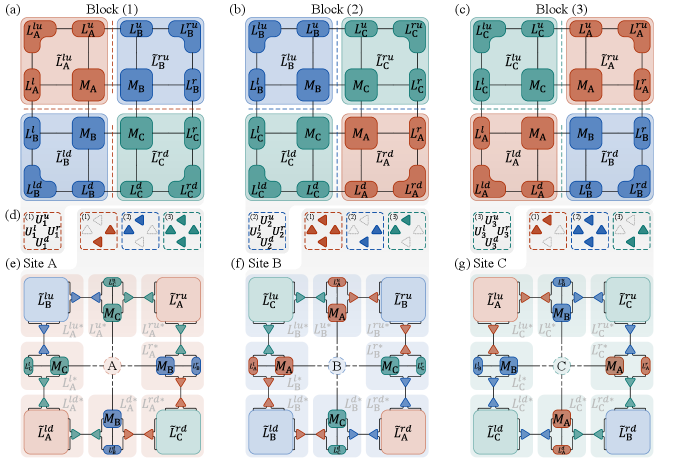
The study details a procedure-cornered at the geometry of a triangular lattice-where local tensors and their associated edges are iteratively updated through contractions with isometries derived from singular-value decompositions, effectively renormalizing the system and hinting at the limits of any attempt to fully capture its complexity.

New research reveals a surprising rule governing the behavior of quantum magnets on triangular lattices, demonstrating that external magnetic fields can actually restore broken symmetry.

Categories Science
Older posts
Newer posts
← Previous Page1 … Page13 Page14 Page15 … Page111 Next →
© 2026 PricPR • Built with GeneratePress