Beyond the Limit: How Incompatible Measurements Boost Quantum Estimation
New research reveals that strategically employing incompatible measurements can significantly improve the precision of estimating multiple parameters in quantum systems.
New research reveals that strategically employing incompatible measurements can significantly improve the precision of estimating multiple parameters in quantum systems.

New simulations leverage advanced many-body techniques to unravel the complex collective behavior of neutrinos in extreme astrophysical environments.

A new analytical framework unlocks deeper understanding of multi-photon interactions using squeezed light states.

Researchers propose a new method for creating and verifying non-classical states in levitated nanoparticles, opening doors to more sensitive quantum sensors and advanced information processing.
A new benchmarking method leverages mid-circuit parity measurements to assess the degree of non-classicality in quantum computers, offering a more nuanced metric than traditional quantum volume.

New research demonstrates non-classical behavior in sizable groups of qubits, suggesting the transition from quantum to classical isn’t a fundamental limit, but a consequence of practical constraints.

A new mathematical framework leveraging Lie groups and symplectic geometry offers a deeper understanding of the forces governing electronic structure calculations.
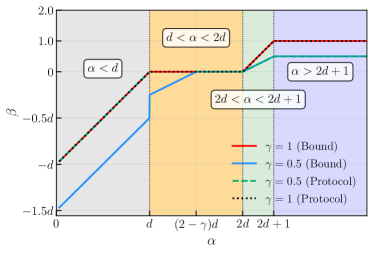
New research establishes fundamental limits on how quickly useful quantum states can be created, impacting the speed of quantum sensing and metrology.

New research simplifies calculations for determining the ultimate precision achievable when estimating multiple parameters using quantum probes.

A new technique enhances the sensitivity of quantum measurements in a fundamental model of light-matter interaction by strategically introducing nonlinearity.