Beyond Neutron Stars: Unlocking the Secrets of Ultra-Dense Matter
![Calculated momentum distributions reveal how quark-like fermions [latex]f_Q(k)[/latex] and baryon-like trimers [latex]f_B(K)[/latex] respond to variations in [latex]\mu/T[/latex], with behavior anchored by the Fermi momentum [latex]k_F = \sqrt{2m\mu}[/latex] at a fixed temperature of [latex]T = 0.1\mathcal{B}[/latex].](https://arxiv.org/html/2602.14113v1/x1.png)
New research draws parallels between ultracold atoms and the exotic states of matter found in neutron stars to explain the transition between hadronic and quark-dominated phases.
New research draws parallels between ultracold atoms and the exotic states of matter found in neutron stars to explain the transition between hadronic and quark-dominated phases.
![As system size increases from [latex]L=8[/latex] to [latex]L=14[/latex], latent variance exhibits sharpening peaks approaching a critical value of [latex]h_c=1[/latex], a behavior consistent with quantum finite-size scaling and indicative of a quantum critical region mirroring the diverging susceptibility observed in classical systems.](https://arxiv.org/html/2602.14928v1/figures/latent_trajectories.png)
A new machine learning framework autonomously identifies critical points and exotic behavior in both classical and quantum materials, offering a powerful tool for materials discovery and fundamental physics research.
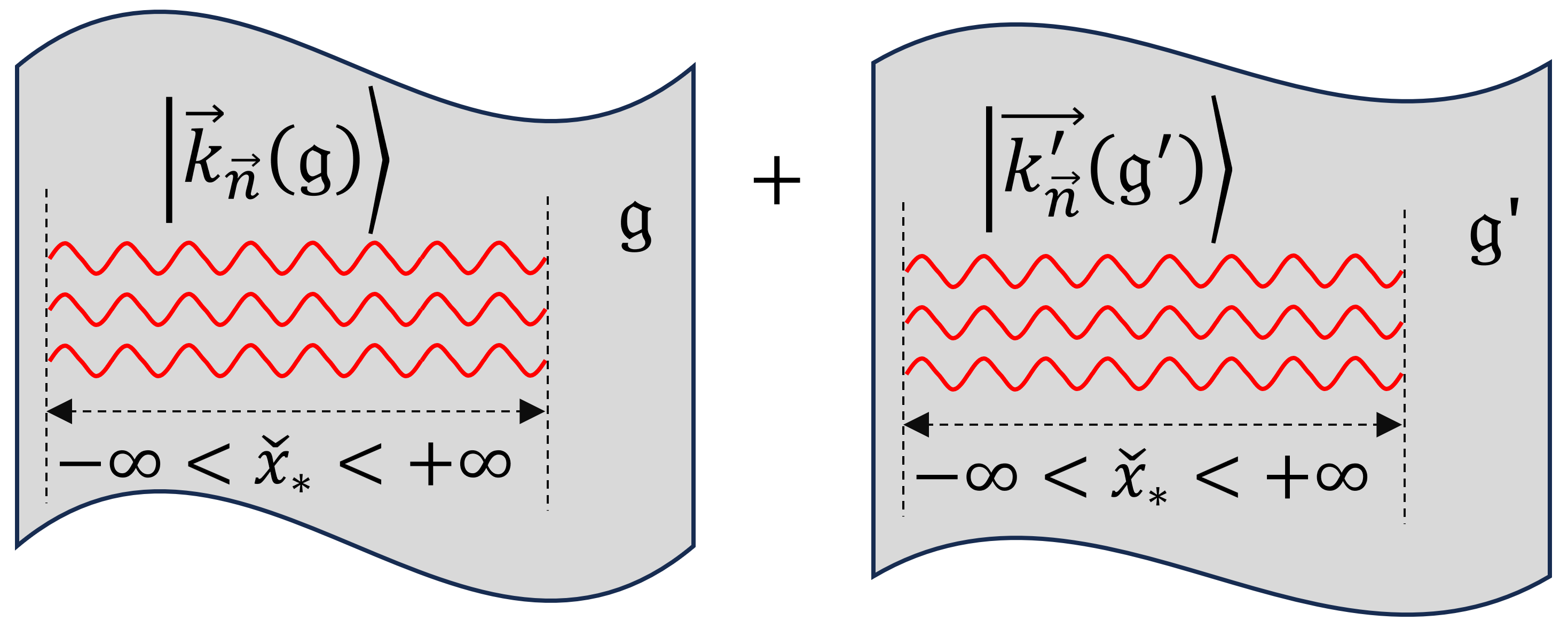
A novel theoretical framework demonstrates that treating spacetime geometry as a quantum variable leads to inherent entanglement with matter fields.
![The study demonstrates that the fraction of impurities escaping the host gas increases with initial momentum-quantified as [latex]Q/k_F[/latex]-though reported experiments focus on lower momenta-specifically below [latex]2.3k_F[/latex]-and dissipationless flow is maintained when [latex]Q/k_F \leq 0.6[/latex].](https://arxiv.org/html/2602.12320v1/x6.png)
New research reveals a microscopic object can move through a one-dimensional quantum fluid with surprising efficiency, defying classical expectations of friction and energy loss.
![The study contrasts the field content required to compute entanglement entropy between subregions [latex]\bm{A\_{1}}[/latex] and [latex]\bm{A\_{2}}[/latex] within the frameworks of standard conformal field theory and double holography, revealing that while standard CFT relies on quantum fields across both subregions and their union, the double holographic approach utilizes distinct “Q-EWs” - [latex]\mathcal{W}\_{\bm{A\_{1}}}[/latex] and [latex]\mathcal{W}\_{\bm{A\_{2}}}[/latex] - to characterize entanglement, highlighting a fundamental difference in how these theories approach the same quantum information problem.](https://arxiv.org/html/2602.12627v1/figures/%22semiclassical.png%22)
A new study delves into how entanglement within holographic heat baths affects the mutual information between regions on the boundary of spacetime.
![A binary Bose-Einstein condensate, subjected to spin-dependent periodic potential and increasing intercomponent interactions [latex]g_{12}[/latex], transitions from partially miscible quasicrystalline density clusters exhibiting eightfold rotational symmetry-observed at moderate [latex]g_{12}[/latex]-to complete phase separation as interactions strengthen, effectively dissolving the delicate order within the system.](https://arxiv.org/html/2602.13129v1/x4.png)
New research reveals that aperiodically structured quasicrystalline phases can spontaneously form in binary Bose-Einstein condensates under specific conditions, opening avenues for novel quantum simulations.
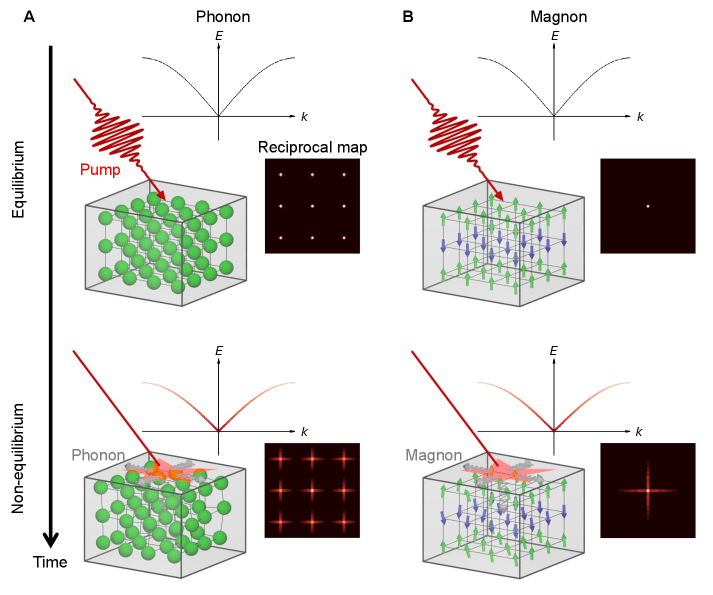
New research details the intricate pathways of energy flow within antiferromagnetic materials immediately following photoexcitation, providing key insights into the fundamental mechanisms of ultrafast demagnetization.
![The analysis of SYK data, specifically the moments [latex]\ln(\overline{\xi(w)^{2}})/N[/latex] evaluated at [latex]q=4[/latex], [latex]\beta=20[/latex], and [latex]L=1000[/latex], demonstrates strong alignment with the classical action predicted by the wormhole model-characterized by the functional form [latex]c\_1 w \ln(c\_2 w)[/latex]-and yields fitted constants of approximately [latex]c\_1 \approx 0.94[/latex] and [latex]c\_2 \approx 0.53[/latex].](https://arxiv.org/html/2602.12339v1/x53.png)
New research delves into the surprisingly deep links between quantum many-body chaos and the emergence of spacetime geometry using the Sachdev-Ye-Kitaev model as a testing ground.
Researchers are refining methods to measure the Bartnik mass-a crucial quantity for understanding gravitational energy-by relaxing strict symmetry requirements in initial spacetime data.
New analysis of Kπ form factors provides the first constraints on how axion-like particles might interact with mesons.