Unlocking the Secrets of Hyperon Production
![The analysis of the [latex]\pi^{-}p\rightarrow K\Lambda(1405)[/latex] reaction at varying center-of-mass energies reveals a distinct [latex]\tt[/latex]-distribution pattern, consistent with observations detailed in prior analysis, and providing further insight into the reaction dynamics.](https://arxiv.org/html/2602.11480v1/x6.png)
A new analysis of pion-proton collisions sheds light on the inner workings of the Λ(1405) and Λ(1520) hyperons.
A new analysis of pion-proton collisions sheds light on the inner workings of the Λ(1405) and Λ(1520) hyperons.
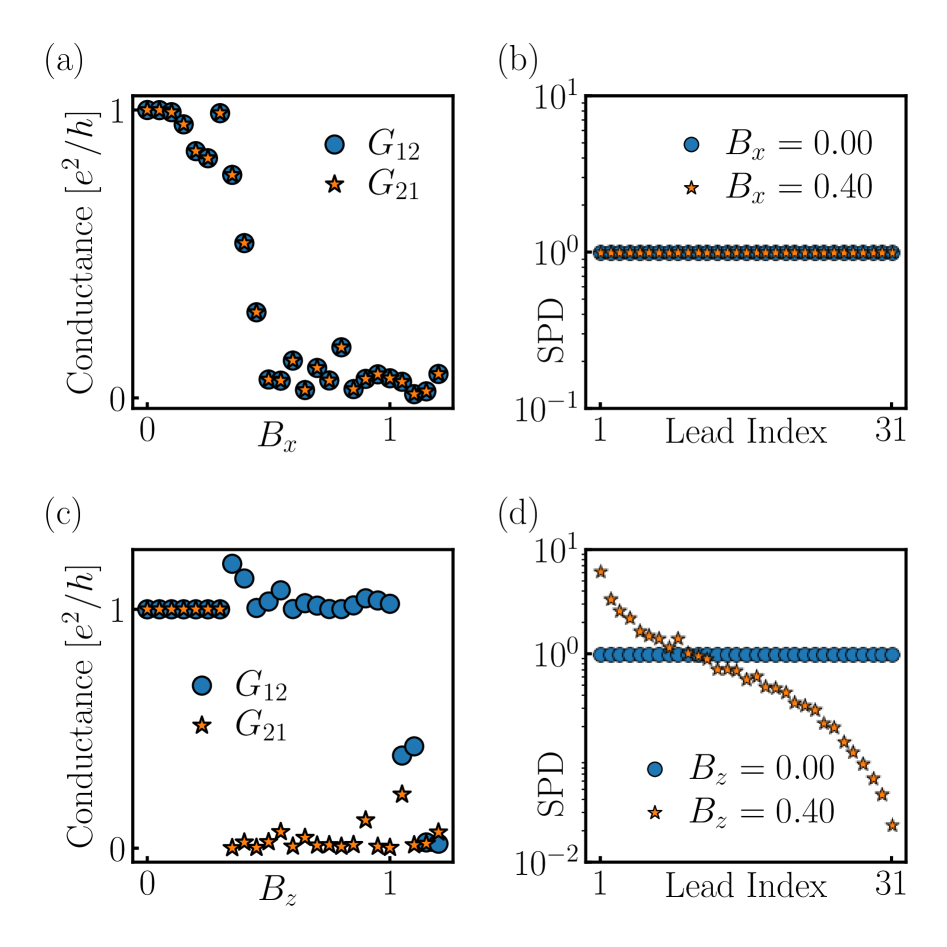
New research reveals that carefully designed quantum spin-Hall devices can exhibit unusual transport properties, allowing for the detection of edge-state spin polarization through non-Hermitian topological effects.
![The density ratio [latex]\rho_{T}/\rho_{J}[/latex] near the central massive black hole exhibits a sensitivity to halo size, with curves representing halo sizes of [latex]a_0 = 100M[/latex] and [latex]a_0 = 10^4M[/latex] demonstrating differing density distributions.](https://arxiv.org/html/2602.12022v1/x3.png)
New research highlights the importance of accurately modeling dark matter distributions around merging black holes to unlock the full potential of future gravitational wave observations.
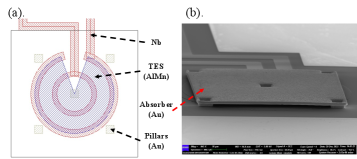
A new aluminum-manganese transition-edge sensor achieves energy resolution below 0.1%, offering a promising alternative to existing technologies.
![The study defines the kinematic relationships within a three-body system comprised of a [latex]D[/latex] meson, a [latex]D^{\<i>}[/latex] meson, and a [latex]\bar{K}^{\</i>}[/latex] anti-kaon through the use of three distinct Jacobi coordinate sets.](https://arxiv.org/html/2602.12010v1/x4.png)
New research explores the potential formation of complex, three-body states involving charmed and bottomed mesons, challenging conventional understandings of strong force interactions.
![The distribution of [latex]\widetilde{\phi}[/latex] for the [latex]\lambda\phi^{4}[/latex] potential, with [latex]\lambda = 0.25[/latex], demonstrates that even after reaching a stationary state at [latex]N=100[/latex], the system’s probabilistic profile remains distinguishable whether modeled through a full non-Markov simulation or a simplified Markovian approach, suggesting that approximations, while convenient, may not fully capture the nuanced reality of the underlying potential.](https://arxiv.org/html/2602.11652v1/x10.png)
New numerical simulations reveal the crucial role of quantum fluctuations and memory effects in the earliest moments of the universe.
![The study elucidates the mechanisms of Rydberg dephasing within a four-level microwave electro-induced transparency (EIT) system, demonstrating that interaction-induced dephasing-manifest in contributions from [latex]C_{6}^{33}[/latex], [latex]C_{6}^{44}[/latex], and [latex]C_{6}^{34}[/latex] terms-affects levels [latex]\ket{3}[/latex] and [latex]\ket{4}[/latex] differently at a probe rate of 8.9 μs⁻¹, revealing the nuanced decay of quantum coherence within complex atomic ensembles.](https://arxiv.org/html/2602.11563v1/x4.png)
Researchers are harnessing the unique properties of Rydberg atoms to explore novel nonlinear optical phenomena and their potential for advanced quantum sensing applications.
![The study demonstrates that a specific spin configuration within the Ising Hamiltonian-characterized by [latex]1/9[/latex] and [latex]1/9[/latex]-plateau states-induces a corresponding lattice distortion, subsequently manifesting as a unique phonon spectrum along the K-Γ-M-K pathway and exhibiting distinct characteristics within localized regions of that spectrum.](https://arxiv.org/html/2602.12168v1/x8.png)
New research reveals that the interplay between magnetic spins and the structure of crystalline materials can give rise to emergent mechanical phenomena and robust topological properties.
This review explores fluctuation theorems, powerful tools for understanding how deviations from average behavior reveal fundamental properties of systems far from equilibrium.
![In Entangled Relativity, the relative variation of a constant, [latex]\frac{C\_{i}-C\_{0}}{C\_{0}}[/latex], is numerically integrated and demonstrably changes with radius, exhibiting a dependency linked to a central density of 100 MeV/fm[latex]^{3}[/latex].](https://arxiv.org/html/2602.11811v1/first_integral_constant.png)
New research delivers precise calculations of how alternative gravity theories diverge from General Relativity in extreme cosmic scenarios.