The Limits of Quantum Distinction
![Information-dissipation efficiency is maximized within a specific spectral window-approximated by the Planckian regime-as systems concentrating spectral weight in this region achieve near-optimal performance, while those exhibiting significant high-frequency contributions demonstrate parametrically reduced efficiency, a relationship quantified by [latex]\eta(\omega)/\beta[/latex] and illustrated through comparative analysis of Drude-like dissipation spectra.](https://arxiv.org/html/2602.04953v1/x1.png)
New research reveals a fundamental link between how well we can tell quantum states apart and the energy dissipated in the process.
New research reveals a fundamental link between how well we can tell quantum states apart and the energy dissipated in the process.
New calculations refine the theoretical tools needed to search for physics beyond our current understanding of the universe.
New research demonstrates how a sophisticated gauge theory framework, leveraging ‘ersatz gravity’ and double-copy techniques, can reproduce key features of gravitational systems, including black hole thermodynamics.
![The study demonstrates that a variational approximation [latex]\text{VA}[/latex] effectively captures the broad dynamics of unstable vortices-specifically, regimes of macroscopic self-trapping at weaker coupling and Josephson oscillations at stronger coupling-though it fails to predict instability onsets like vortex splitting or the development of crescent-shaped distortions, suggesting the model accurately reflects the <i>qualitative</i> behavior despite limitations in forecasting precise structural failures.](https://arxiv.org/html/2602.05001v1/x45.png)
New research delves into the dynamics of quantum tunneling between superfluids in Bose-Einstein condensates, revealing insights into the behavior of quantum droplets and vortices.
This review delves into the holographic properties of black branes within a non-minimal Einstein-Yang-Mills framework, examining how modifications to gravity impact key transport coefficients.
![The study demonstrates how the drag coefficient of a hadron gas fluctuates with temperature, exhibiting a sensitivity dependent on both the applied charge [latex]q[/latex] and the imposed mass cutoff, thereby illuminating the complex interplay of these parameters in determining the gas’s hydrodynamic behavior.](https://arxiv.org/html/2602.05478v1/x2.png)
New research explores how non-equilibrium effects influence the transport properties of hadronic matter, impacting our understanding of the quark-gluon plasma and heavy-ion collisions.
A new study reveals how a mathematical trick-imaginary rotation-can induce confinement and chromomagnetic condensation within the well-known framework of SU(2) Yang-Mills theory.
A new approach reveals how to detect subtle non-Hermitian behavior in Dirac materials by observing the system’s response to minimal changes.
New calculations reveal how black holes absorb energy and angular momentum during collisions by analyzing the subtle waveforms generated at their event horizons.
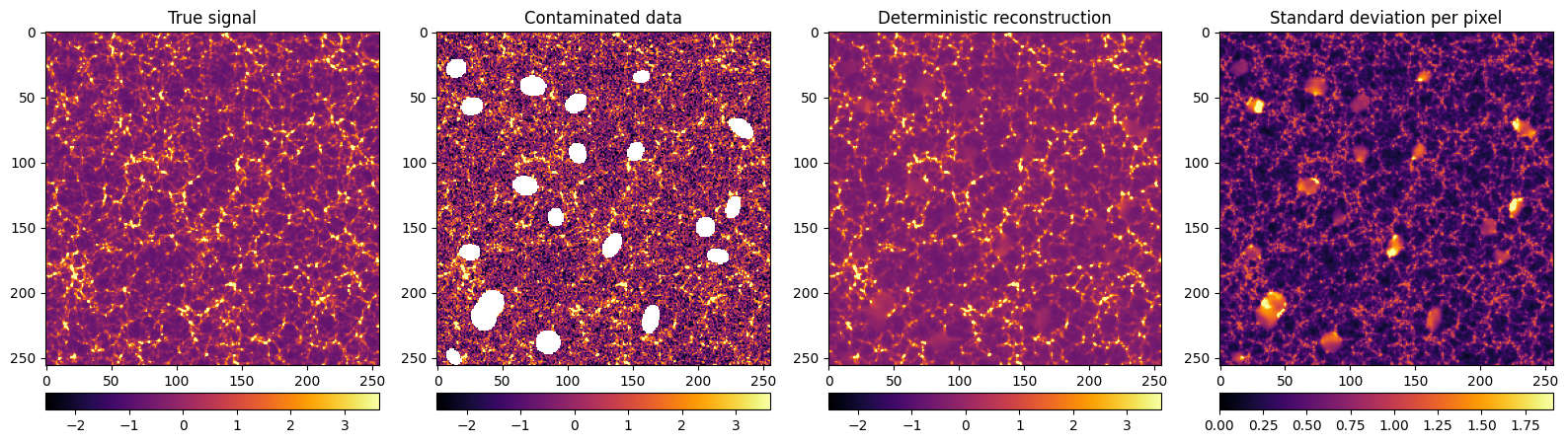
Researchers are leveraging Bayesian inference and scattering transforms to build more robust imaging systems, especially when data is scarce.