The Boltzmann Peak: How Noise Drives Universal Sampling
![The study demonstrates how varying potential functions-specifically even order polynomials, double Gaussians, and cosh functions-influence the probability distribution of synaptic input within double-well energy systems, with simulations under noise conditions [latex]K_n = 0.1[/latex], [latex]0.2[/latex], [latex]0.3[/latex], and [latex]0.4[/latex] revealing corresponding shifts in the extracted inverse temperature.](https://arxiv.org/html/2602.04014v1/Figure2.png)
New research reveals that even simple bistable systems exhibit predictable sampling behavior when initialized at their energy barrier, opening doors to novel computing architectures.
New research reveals that even simple bistable systems exhibit predictable sampling behavior when initialized at their energy barrier, opening doors to novel computing architectures.
![The DUNE experiment’s sensitivity to mass ordering is demonstrably affected by supernova distance, with analyses across multiple channels (A, B, C, and their combination) revealing that the inclusion of neutrino entanglement-quantified by entanglement of formation-heightens this sensitivity, a relationship further modulated by variations in survival probability [latex]\Delta p[/latex].](https://arxiv.org/html/2602.04800v1/x38.png)
New research suggests quantum entanglement among neutrinos emitted from supernovae could significantly improve our ability to determine the fundamental ordering of neutrino masses.
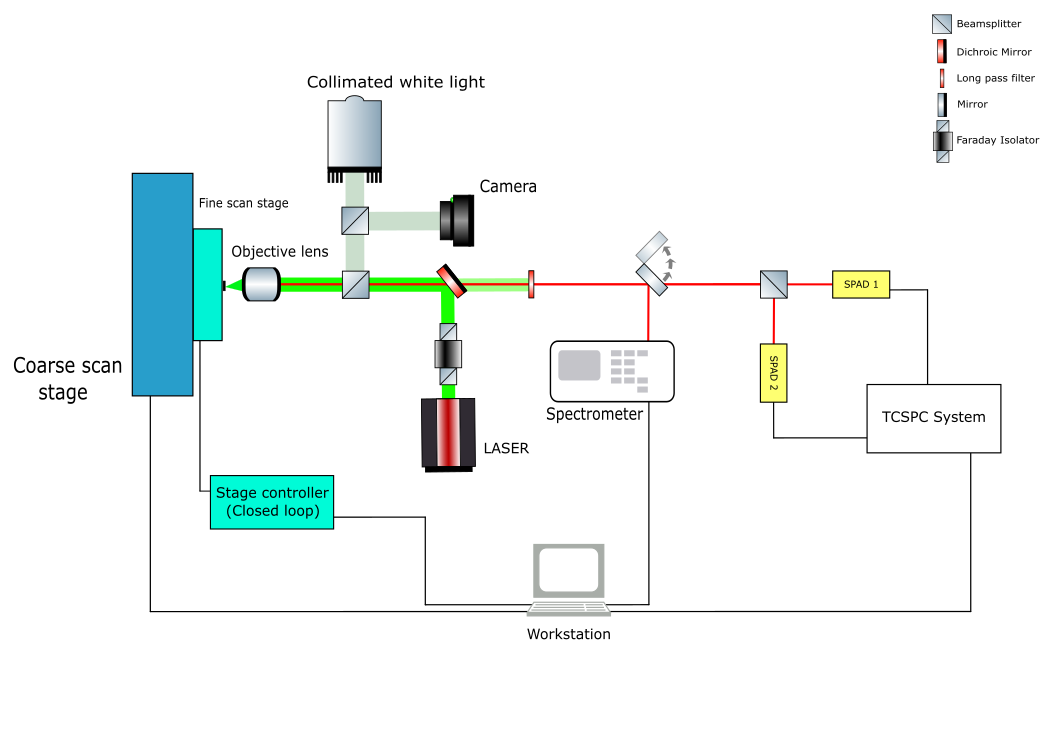
Researchers have developed a flexible Python framework to streamline complex optical experiments on quantum materials, boosting reproducibility and data acquisition speed.
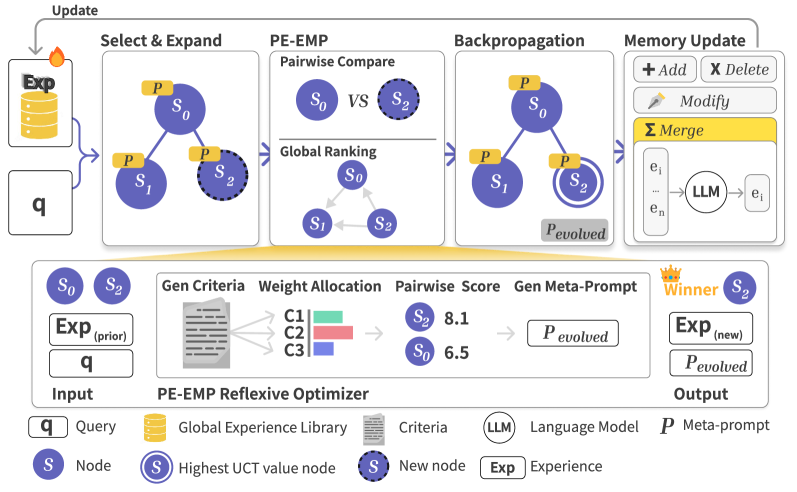
A new approach combines search algorithms with experience replay to enable large language models to continuously refine their problem-solving skills without retraining.
![The study establishes model-independent exclusion limits on the production rates of additional Higgs bosons ([latex]H_{2,3}[/latex]) against the Standard Model-assuming a 125 GeV Higgs-through analysis of [latex]b2b_2[/latex] and [latex]b4b_4[/latex] observables evaluated in both laboratory and center-of-mass frames, with sampled data from the Two-Higgs-Doublet Model ([latex]C2HDM[/latex])-where the mass of [latex]H_{2,3}[/latex] falls between twice the top quark mass-further constraining potential deviations from established particle physics.](https://arxiv.org/html/2602.04511v1/x31.png)
New research explores how studying the debris from top quark collisions can reveal clues about additional Higgs bosons predicted by extensions to the Standard Model.
![The study visualizes real-space lattices of [latex]2d_{x^2-y^2}[/latex] and [latex]d_{xy}[/latex] wave amplitudes, alongside their corresponding Brillouin zones, to demonstrate the fundamental relationship between spatial wave patterns and their momentum-space representations.](https://arxiv.org/html/2602.04854v1/x3.png)
A new theoretical analysis reveals the unique spin-polarized currents and topological electronic structure of 2D d-wave altermagnets, paving the way for advanced spintronic devices.
A novel approach reimagines relativistic quantum field theory by framing quantum fields as evolving probability distributions, offering fresh insights into real-time dynamics and entanglement.
![Meson exchange facilitates interactions between quark-antiquark pairs [latex]q\bar{q}[/latex] and quark triplets [latex]qqq[/latex], demonstrating a fundamental mechanism governing particle interactions.](https://arxiv.org/html/2602.04090v1/x2.png)
A new review explores the evolution of our understanding of matter’s building blocks, from traditional quark models to the surprising discovery of multi-quark states and their implications for hadron structure.
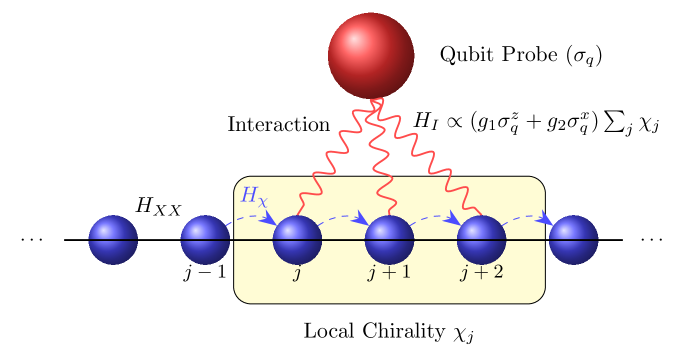
New research demonstrates a pathway to detect analogue Hawking radiation using a quantum sensor embedded within a chiral spin chain, offering a novel platform for studying quantum gravity effects.
![The study demonstrates that tau pair spin correlations exhibit entanglement-quantified by [latex]\mathcal{C}>0[/latex]-and nonlocality-signaled by [latex]\mathfrak{m}\_{12}>1[/latex]-as functions of center of mass energy and scattering angle, revealing intrinsic quantum properties within particle interactions.](https://arxiv.org/html/2602.03960v1/m12.png)
Future lepton colliders offer an unprecedented opportunity to explore the fundamental nature of quantum entanglement and nonlocality in high-energy particle collisions.