Smarter Materials Design: Guiding Exploration with Information Theory
![The study demonstrates consistent convergence on challenging 20-dimensional benchmarks-Ackley, Rastrigin, and Schwefel functions-achieved through an initialization of 10 points, iterative proposal of 10 candidates, and averaging across 10 independent runs, as evidenced by decreasing objective values and minimized feature-space distance to the global optimum-[latex] \min ||x - x^*|| [/latex]-across all tested functions.](https://arxiv.org/html/2602.03319v1/img/math/math_res.png)
A new framework leverages the principles of information theory to efficiently navigate complex materials spaces and accelerate the discovery of optimal compounds.
A new framework leverages the principles of information theory to efficiently navigate complex materials spaces and accelerate the discovery of optimal compounds.
![The reflection probability [latex]R(\omega)[/latex] of a charged Bardeen black hole is demonstrably modulated by the parameters α and β, with increasing α suppressing reflection and increasing β enhancing it-a complementary behavior observed across variations of [latex]\alpha = 0.1, 0.2, 0.3[/latex] at fixed [latex]\beta/M = 1[/latex] and [latex]\beta = 1, 1.5, 2[/latex] at fixed [latex]\alpha = 0.2[/latex], given parameters [latex]M = 1[/latex], [latex]Q = 1[/latex], and [latex]q = 0.1[/latex].](https://arxiv.org/html/2602.02586v1/x27.png)
New research explores how the interplay of dark matter, cosmic strings, and electrical charge alters the fundamental properties and observable signatures of Bardeen black holes.
![The Page curve for a non-extremal Kerr [latex]AdS_4[/latex] black hole-shown as a solid line-reveals how the inclusion of an island-represented by a blue line-alters the calculation of entanglement entropy compared to its omission, depicted in red.](https://arxiv.org/html/2602.03366v1/x4.png)
New research suggests a resolution to the black hole information paradox by demonstrating how entanglement can preserve information seemingly lost to Hawking radiation.
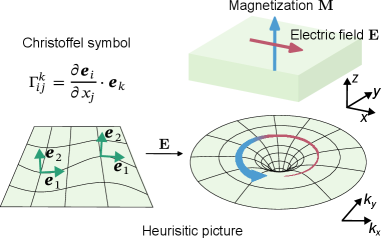
New research reveals a hidden source of magnetization in quantum materials arising not from electron spin, but from the curvature of momentum space.
![The metric function [latex]f(r)[/latex] reveals a nuanced relationship between horizon configurations and spacetime geometry in charged Hayward black holes, demonstrating how parameters such as [latex]g/M[/latex], α, and [latex]\beta/M[/latex] dictate transitions from standard Schwarzschild horizons to regular black holes with two horizons, non-extremal cases exhibiting dual horizon crossings, and ultimately, to scenarios involving extremal tangencies or even naked singularities-all while reflecting the non-flat nature of charged de Sitter spacetimes through asymptotic behavior of [latex]f(\in fty) = 1 - \alpha < 1[/latex].](https://arxiv.org/html/2602.02621v1/x1.png)
A new study explores how dark matter and string clouds affect the observable characteristics of charged Hayward black holes, potentially offering pathways to differentiate them from their standard counterparts.
New research bridges the gap between quantum mechanics and stochastic thermodynamics, revealing how interactions with quantum environments can reshape our understanding of heat and work.
![The study demonstrates how approximations to the effective potential-ranging from full calculations using [latex]CosmoTransitions[/latex] to those neglecting Daisy contributions-systematically shift the computed bounce action [latex]S\_{3}(T)[/latex], with results benchmarked against a fit from prior work to polynomial potentials, thereby revealing the sensitivity of cosmological phase transitions to the details of potential calculations.](https://arxiv.org/html/2602.02829v1/x6.png)
A new semi-analytical framework streamlines the calculation of gravitational wave signals originating from cosmological phase transitions, offering a computationally efficient path to understanding the universe’s earliest moments.
![The study demonstrates that correlation functions in the random antiferromagnetic Heisenberg chain exhibit power-law finite-size scaling-specifically for operators governed by both exact and average symmetries-a finding established through strong-disorder renormalization group analysis utilizing [latex]10^5[/latex] disorder realizations and restricted to instances where [latex]r \geq 3[/latex] and signal-to-noise ratio exceeds [latex]10[/latex].](https://arxiv.org/html/2602.02648v1/x4.png)
New research reveals how strong randomness shapes the behavior of quantum systems at critical points, offering insights into the fundamental principles governing their emergent properties.
![The study of neutron and hyperon star mass-radius relationships reveals a characteristic “softening” of the equation of state with the introduction of hyperons - specifically [latex]\Lambda N[/latex] and [latex]\Lambda\Lambda[/latex] interactions - leading to a reduction in maximum mass, a phenomenon known as the hyperon puzzle, and constrained by observational data from NICER and LIGO/Virgo detections.](https://arxiv.org/html/2602.03388v1/x2.png)
New research leverages hypernuclear physics and Bayesian inference to refine our understanding of the forces governing ultra-dense matter inside neutron stars.
![The entanglement entropy, capacity of entanglement, and quantum scrambling time were analyzed across four neutrino oscillation scenarios-SO+NO, SO+IO, NSI+NO, and NSI+IO-using best-fit CP-violating phases, revealing how variations in the diagonal Non-Standard Interaction parameter [latex]\left|\epsilon_{ee}-\epsilon_{\mu\mu}\right|[/latex] impact these quantum information metrics at the baselines and energies of the T2K, NOνA, and DUNE experiments.](https://arxiv.org/html/2602.03748v1/x36.png)
New research explores how interactions beyond the Standard Model impact the speed of entanglement in neutrino oscillations, potentially revealing hidden signatures in long-baseline experiments.