Beyond Tension: Exploring the Strange World of Null Strings
This review delves into the surprising physics of null strings, a unique limit of string theory with profound implications for our understanding of spacetime and quantum gravity.
This review delves into the surprising physics of null strings, a unique limit of string theory with profound implications for our understanding of spacetime and quantum gravity.
![In Einstein-GB gravity, with parameters set to [latex] \alpha\_2 = 10^{-2} [/latex] and in four dimensions, the dynamics of interior spikes-specifically the effective Kasner exponents and spike positions-exhibit a quantifiable relationship to initial horizon values of the scalar field; analysis demonstrates that for [latex] \psi(z\_H) = 0.10 [/latex], spike positions scale as [latex] z\_n = 32.67(n-0.09)^{1/0.50} [/latex] with corresponding amplitudes of [latex] \widetilde{p}\_{x\_n} = 0.99 + 2.64 \times 10^{-3} z\_n^{0.48} [/latex], while for [latex] \psi(z\_H) = 0.30 [/latex], the scaling shifts to [latex] z\_n = 44.68(n+0.04)^{1/0.50} [/latex] with amplitudes of [latex] \widetilde{p}\_{x\_n} = 1.00 + 3.72 \times 10^{-3} z\_n^{0.50} [/latex].](https://arxiv.org/html/2601.21658v1/x16.png)
New research reveals a surprisingly ordered structure within black holes, challenging traditional models of their final moments.
Researchers demonstrate a novel technique for creating and controlling superpositions of persistent currents in Bose-Einstein condensates, paving the way for advanced quantum devices.
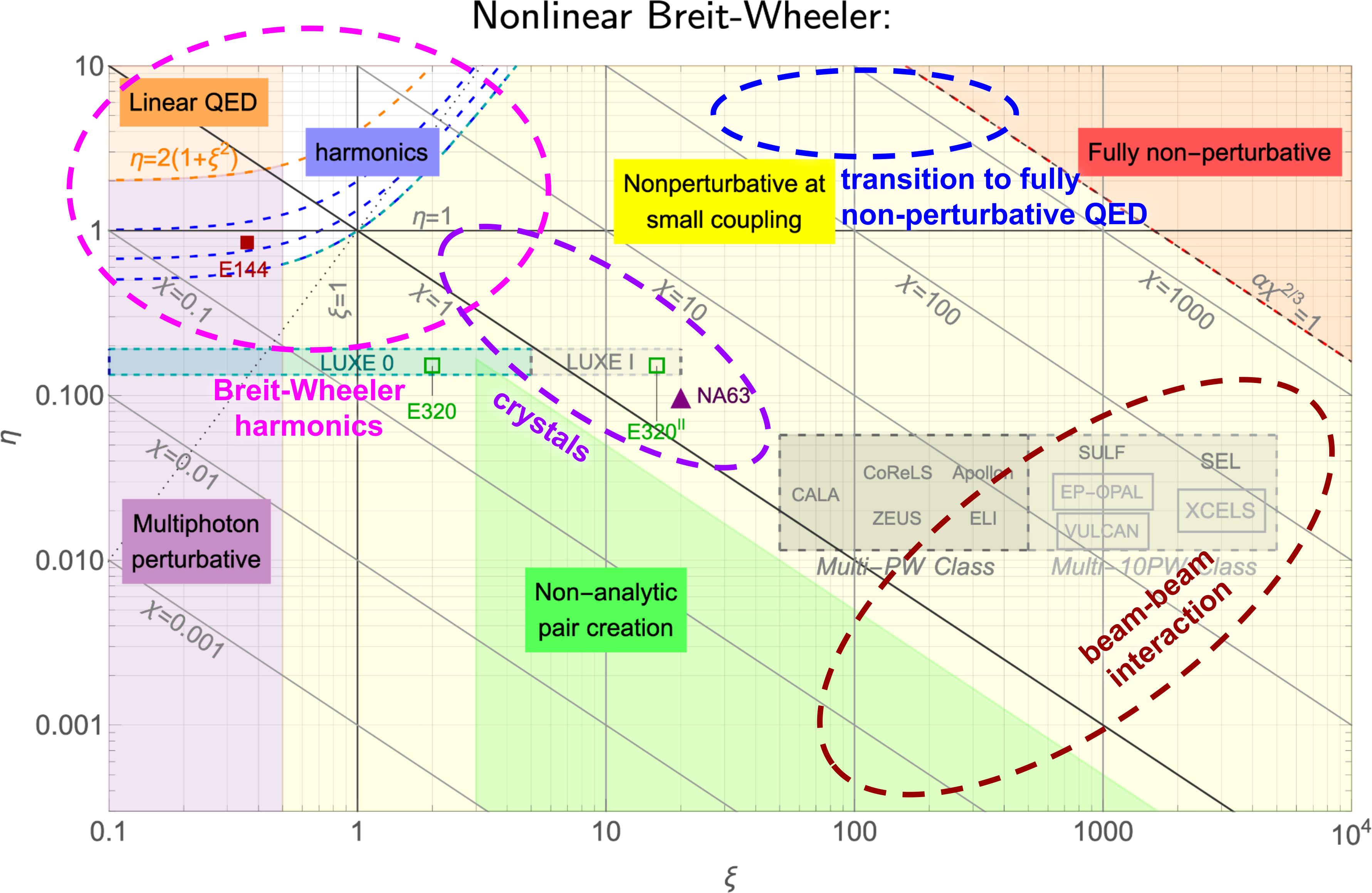
The LUXE experiment and future collider designs are pushing the boundaries of strong-field QED, opening new avenues for exploring fundamental physics.
![The emergence of stable atomic trajectories within a driven optical cavity-analogous to stabilizing matter waves in the dispersive band of an optical lattice-demonstrates how externally applied resonance can transform an initially diffuse atomic distribution into a predictable, fixed-point pattern, mirroring the behavior described by a discrete Floquet map where [latex] f^{\prime}(x) < 1 [/latex] indicates stability.](https://arxiv.org/html/2601.21122v1/x1.png)
Researchers have created a unique matter-wave cavity where quantum effects dominate, leading to the observation of stable trajectories akin to event horizons.
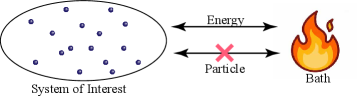
A new framework leverages resource theory to formally define and measure the degree of symmetry breaking, distinguishing between subtle and dramatic deviations from balance.
![The system elucidates black hole evaporation by demonstrating a progression through a Hilbert space structure-initially concentrated within the black hole itself, then dispersing across partially-evaporated subspaces where energy diminishes, and ultimately culminating in a fully-evaporated state characterized by maximal entropy and an exponential increase in the dimensionality of the radiation states, as described by [latex]\ket{\mathcal{H}^{(n)}}[/latex].](https://arxiv.org/html/2601.22077v1/x3.png)
A new analysis explores how coarse-graining techniques can bridge the gap between theoretical predictions of black hole evaporation and the fundamental principles of quantum mechanics.
This review presents a new mathematical framework for understanding how interfaces behave within fluids governed by self-gravity, crucial for modeling phenomena from astrophysical events to phase transitions.
![A study explores how gravitational waves emitted by a rotating black hole can reveal the superposition of orientations in a binary mass system-specifically, the system’s ability to exist as coherent states [latex]|α^{\pm}\rangle[/latex]-by detecting interference when the waves’ coherence is disrupted ([latex]|⟨α^{+}|\alpha^{-}\rangle|\approx 0[/latex]), thus providing a pathway to determine the system’s initial quantum state.](https://arxiv.org/html/2601.21145v1/x2.png)
New research suggests that quantum fluctuations in strong gravitational fields necessitate a full quantum theory of gravity to resolve paradoxes arising from massive object superpositions.
![In [latex] s\pm [/latex] superconductors, a competition between quasiparticle tunneling and Andreev reflection modulates conductance as a function of energy, maintaining finite superconducting gap values across all energies and demonstrating a scaling relationship between conductance, decay rate, and tip-substrate coupling strength.](https://arxiv.org/html/2601.20798v1/Fig5.png)
A new spectroscopic technique allows researchers to map the electronic structure of superconductors by separating Andreev and quasiparticle currents across tunable junctions.