Beyond Einstein: Mapping Neutron Stars to Probe Modified Gravity
![Neutron star parameters-radius, tidal deformability, and compactness-exhibit quantifiable relationships with mass, as determined through a Bayesian framework incorporating astrophysical observations and expressed as 95% confidence intervals for [latex] \text{radius}_{RR} [/latex] (km), Λ, and [latex] M/R [/latex] as functions of mass [latex] M_{\odot} [/latex].](https://arxiv.org/html/2601.16227v1/x4.png)
New research utilizes observations of neutron stars to test alternative theories of gravity, specifically exploring the viability of f(Q) gravity.
New research utilizes observations of neutron stars to test alternative theories of gravity, specifically exploring the viability of f(Q) gravity.
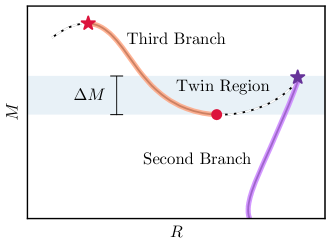
New research explores how observations of ‘twin stars’-pairs of neutron stars with similar masses but differing radii-are refining our understanding of the extreme matter within these cosmic objects.
![The measured cross section of electron-positron annihilation into pion pairs-a fundamental process in particle physics-demonstrates a consistent relationship to the reduced energy [latex]\sqrt{s^{\prime}}[/latex], and notably aligns with, yet refines, previous findings from the 2009 BABAR experiment, suggesting a robust understanding of this interaction.](https://arxiv.org/html/2601.16587v1/x6.png)
The BABAR experiment delivers a high-precision measurement of how electron-positron collisions create pion pairs, refining calculations crucial for understanding fundamental particle properties.
![The study positions four quantum harmonic oscillators - designated QHs11, 44, 22, and 33 - at precisely calculated distances from the origin: QHs11 and 44 initially reside at a distance of [latex]r = R/3[/latex], positioned at polar angles of 0 and π, while QHs22 and 33 are fixed at [latex]r = 2R/3[/latex], also at angles of 0 and π, where [latex]R = \sqrt{2N/\nu}[/latex] defines the scaling factor based on the system’s inherent parameters.](https://arxiv.org/html/2601.16819v1/x2.png)
New research demonstrates a powerful method for simulating and verifying non-Abelian anyon behavior in complex many-body systems, paving the way for advancements in topological quantum computation.
New research connects quantum entanglement, the axial anomaly, and polarization phenomena, offering a framework for understanding non-causal effects in extreme physical environments.
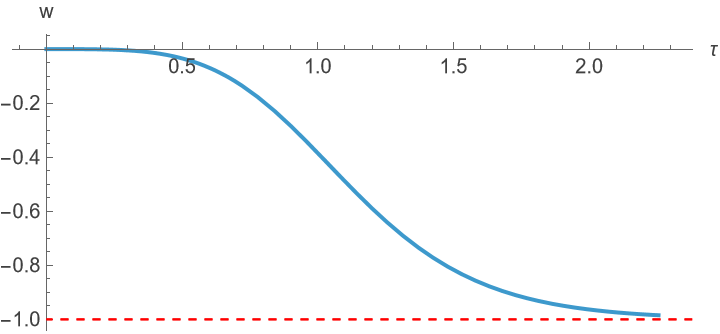
New research applies advanced quantization techniques to k-essence cosmology, offering insights into the universe’s earliest moments and its ultimate destiny.
![Sensitivity projections for detecting dark matter interactions, achieved through comparisons between space- and ground-based clocks, demonstrate that missions like ACES, those operating on the International Space Station, and the proposed FOCOS mission can probe a range of dark matter masses-extending beyond current bounds established by MICROSCOPE, SNG, and BBN-with sensitivity limited by factors such as atmospheric reflection, satellite shielding, and the breakdown of low-momentum approximations at higher masses, as determined by fractional phase and frequency uncertainties of [latex]\delta t / \Delta t = 7 \times 10^{-{17}}[/latex] and stability parameters of [latex]\sigma_{y}(10^{6})[/latex] and [latex]\sigma_{y}(10^{7})[/latex].](https://arxiv.org/html/2601.16259v1/x6.png)
A new approach proposes leveraging the precision of orbiting quantum clocks to detect the elusive influence of ultralight dark matter on the fabric of spacetime.
A new analysis of global quantum strategies reveals a clear pivot from basic research to practical applications and economic development.
![The correlation functions of supCAR(2)(2)-III processes demonstrate a transition in behavior based on shape parameters; when [latex]\alpha + 3 \in (3,4][/latex], these processes exhibit non-oscillatory long-range dependence, but as the shape parameter increases beyond this range, oscillations emerge, indicating a shift in the underlying dynamic characteristics.](https://arxiv.org/html/2601.15796v1/x4.png)
This review introduces supCARMA processes-superpositions of continuous-time autoregressive moving average models driven by Lévy processes-and details their theoretical properties.
This review introduces a powerful, category-theoretic approach to differential objects, connections, and bundles, extending classical concepts to broader mathematical settings.