Smarter Sampling: Adapting to Signals for Efficient Data Capture
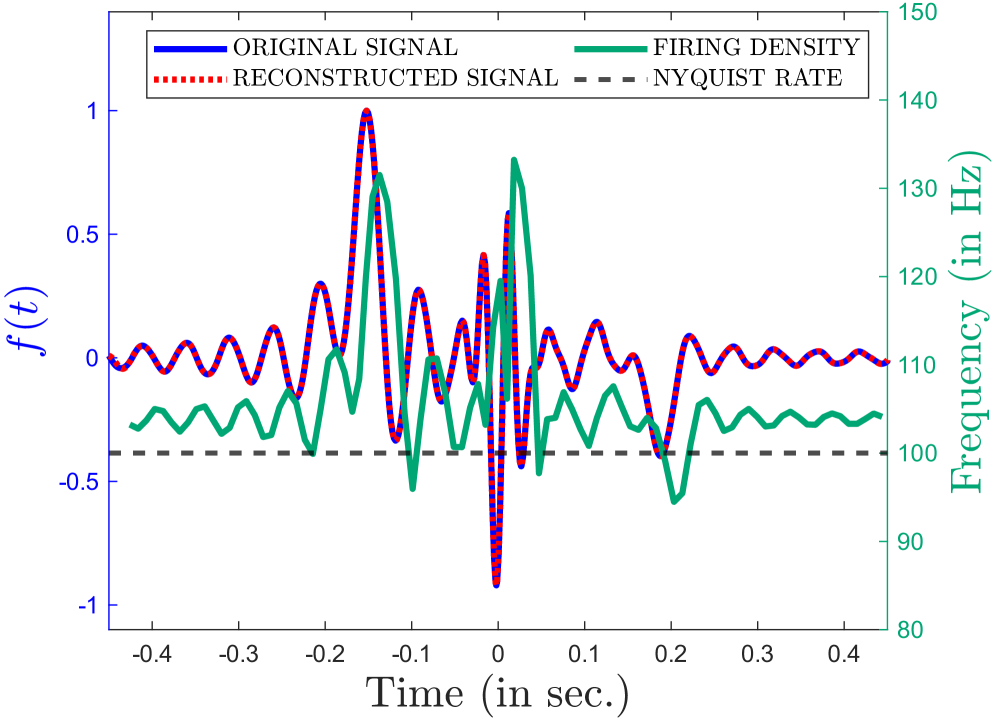
A new framework dynamically adjusts sampling rates based on signal characteristics, potentially overcoming limitations of traditional data acquisition methods.
A new framework dynamically adjusts sampling rates based on signal characteristics, potentially overcoming limitations of traditional data acquisition methods.
New research reveals how deforming conformal field theories via a specific operator smoothly connects them to their Carrollian counterparts, unlocking deeper insights into their underlying structure.
A new generation of neutrino experiments, spearheaded by the ESSnuSB+ project, is poised to probe the fundamental properties of these elusive particles and address some of the biggest mysteries in physics.
A new method allows for the unique determination of nonlinear material behavior within a solid system by analyzing measurements taken at its boundaries.
This review delves into the theory of rank-metric codes, a powerful generalization of traditional Hamming codes with applications in diverse areas of coding theory and cryptography.
![The data demonstrates a successful fit to the Equation of State [latex] (11) [/latex], indicating the model accurately captures the system's thermodynamic behavior under the conditions tested.](https://arxiv.org/html/2601.16051v1/x4.png)
New simulations of the Thirring model reveal a strongly-interacting quantum critical point with scaling exponents that challenge conventional theoretical predictions.
![Nonlinear simulations demonstrate the temporal evolution of massive scalar perturbations, where rescaling the evolved field as [latex]{\Phi\_{lm}}={\lambda^{n}}\phi\_{lm}^{(n)}[/latex] reveals that the [latex](0,0)[/latex] mode arises from the quadratic self-couplings of the linear [latex](1,1)[/latex], [latex](0,0)[/latex], and [latex](2,0)[/latex] modes, and exhibits excellent agreement between intermediate-time analytical predictions and corresponding numerical evolution.](https://arxiv.org/html/2601.16016v1/x14.png)
New research reveals that while massive scalar fields exhibit predictable behavior around black holes, quadratic quasinormal modes may offer a pathway to observe previously hidden nonlinear dynamics.
![The system models interactions between four baryons via a single meson, quantified by a coefficient [latex]N_{mj}^{nk}\phi[/latex], extending a previously established notation to delineate these multi-body relationships.](https://arxiv.org/html/2508.20498v2/x3.png)
New research explores the subtle interactions between hyperons and nucleons, shedding light on the strong force in exotic nuclear systems.
![For Kerr-(A)dS spacetime, the ranges of energy and rotation parameter define regions where the associated bumblebee field remains globally real or transitions to imaginary values, demarcated by critical curves and influenced by the cosmological constant [latex]\lambda=\Lambda m^{2}[/latex], with the dashed line indicating the threshold where the black hole becomes extremal.](https://arxiv.org/html/2601.16037v1/pic4.png)
Researchers have developed a novel technique to generate a family of spacetime solutions within bumblebee gravity, offering insights into how Lorentz symmetry might be broken.
![A pronounced anomalous Hall effect is observed in valley-polarized polaritons, where strain-induced symmetry breaking generates an effective pseudomagnetic field driving a measurable drift velocity of [latex]1.69 \times 10^{5}~\mathrm{m/s}[/latex], as evidenced by the temporal evolution of valley polarization and confirmed by a two-Gaussian fit with a [latex]95\%[/latex] prediction interval.](https://arxiv.org/html/2601.15631v1/x2.png)
New research reveals an unexpected optical response in exciton-polariton systems, opening doors to exceptionally high-speed and tunable valleytronic devices.