Holographic Boundaries Hold Steady Under Scrutiny
New research confirms the consistency of key holographic entropy inequalities, bolstering their potential connection to time-dependent quantum gravity.
New research confirms the consistency of key holographic entropy inequalities, bolstering their potential connection to time-dependent quantum gravity.
New research unveils a supersymmetric solution describing highly excited strings, offering a potential pathway to understanding the quantum nature of black holes without invoking a traditional event horizon.
New research explores how gravity might differentiate between quantum matter states by analyzing the way particles scatter, revealing potential violations of fundamental principles.
![Black hole evaporation proceeds via a beam splitter mechanism coupled with single-mode squeezing for each interaction event, indexed by integer [latex]k[/latex], fundamentally altering the understanding of Hawking radiation.](https://arxiv.org/html/2601.09820v1/x3.png)
New research leverages the principles of quantum optics to create models that explain how information can escape black holes over time.
![The study elucidates dark matter-nucleon scattering and the decay of eta mesons into two pions via a scalar resonance, demonstrating that the coupling strength [latex]g_{u}(g_{\chi})[/latex] - and its effective counterpart [latex]g_{N}[/latex] as defined in equations (3) and (5) respectively - fundamentally governs these interactions.](https://arxiv.org/html/2601.10597v1/x701.png)
Researchers are leveraging meson decays to search for extremely light dark matter candidates, opening a novel window into the universe’s missing mass.
New research suggests that completely separating topological field theories from the influence of gravity is fundamentally impossible, challenging assumptions about global symmetries in quantum gravity.
![The study demonstrates how cavity-mediated interactions sculpt the behavior of two-body wavefunctions, revealing distinct ground states-either spatially extended for repulsive interactions at strengths of [latex]V_0 = 10\varepsilon[/latex] and [latex]V_0 = 100\varepsilon[/latex], or localized for the corresponding attractive cases-as dictated by the second term of Eq. (II.2).](https://arxiv.org/html/2601.10301v1/x1.png)
New simulations reveal how light confinement dramatically alters the behavior of interacting quantum particles, leading to exotic phases and delocalized states.
New research delves into the exotic light-matter interactions arising from broken symmetries in quantum materials, opening doors to advanced metamaterials and quantum devices.
![The distributions of [latex]\pi^+ \pi^-[/latex] and [latex]K_S^0 K_S^0[/latex] pairs are modeled with relativistic Breit-Wigner functions to identify resonance peaks, while a smoothly varying function accounts for residual background, effectively distinguishing signal from noise in the data.](https://arxiv.org/html/2601.09777v1/x6.png)
New results from the ALICE experiment reveal how short-lived particles can illuminate the final moments of heavy-ion collisions and probe the structure of exotic hadrons.
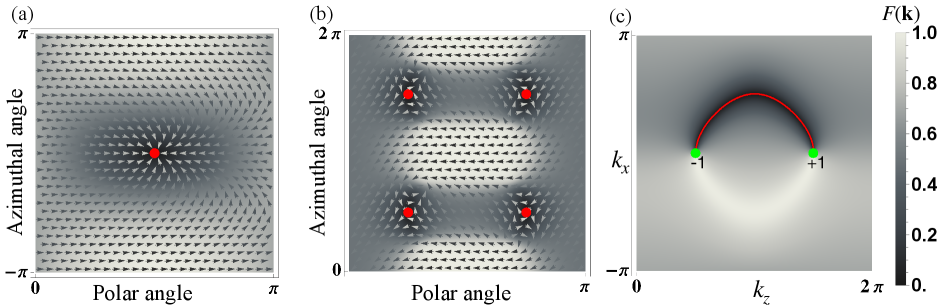
A new spectroscopic technique allows researchers to directly map the geometric and topological properties of materials by analyzing how light interacts with their electronic structure.