Mapping the Universe with Gravitational Wave Shapes
![The study demonstrates that parameter estimation in gravitational wave signals is susceptible to degeneracy, where the injected signal-dependent on both general relativity parameters [latex]\boldsymbol{\theta}_{t}[/latex] and beyond-GR parameters [latex]\boldsymbol{\lambda}_{t}[/latex]-can be misrepresented by a model at the true GR parameters [latex]\boldsymbol{\theta}_{t}[/latex] or a best-fit signal at [latex]\boldsymbol{\theta}_{ML}[/latex], resulting in biased waveforms [latex]\Delta h[/latex] and a measurable residual signal [latex]\Delta h^{\perp}[/latex] distributed across a high-dimensional manifold defined by frequency-bin values [latex](d_{1}, d_{2}, d_{3})[/latex].](https://arxiv.org/html/2602.17524v1/x1.png)
A new geometric approach uses the subtle forms of gravitational waves to rigorously test Einstein’s theory and search for signs of new physics.
A new geometric approach uses the subtle forms of gravitational waves to rigorously test Einstein’s theory and search for signs of new physics.
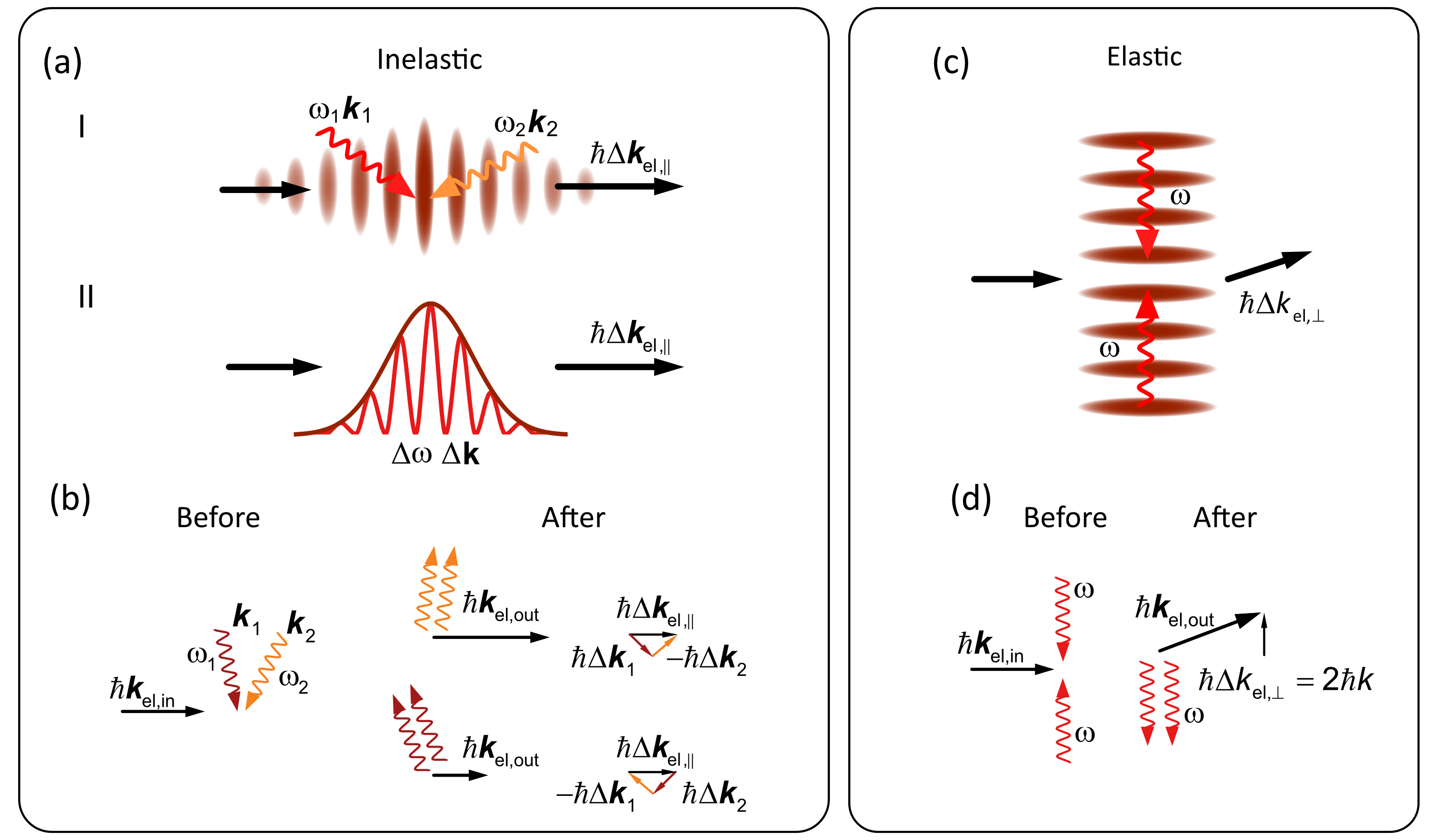
A new era of electron science is emerging, where light is used to sculpt and control electron beams with unprecedented precision.
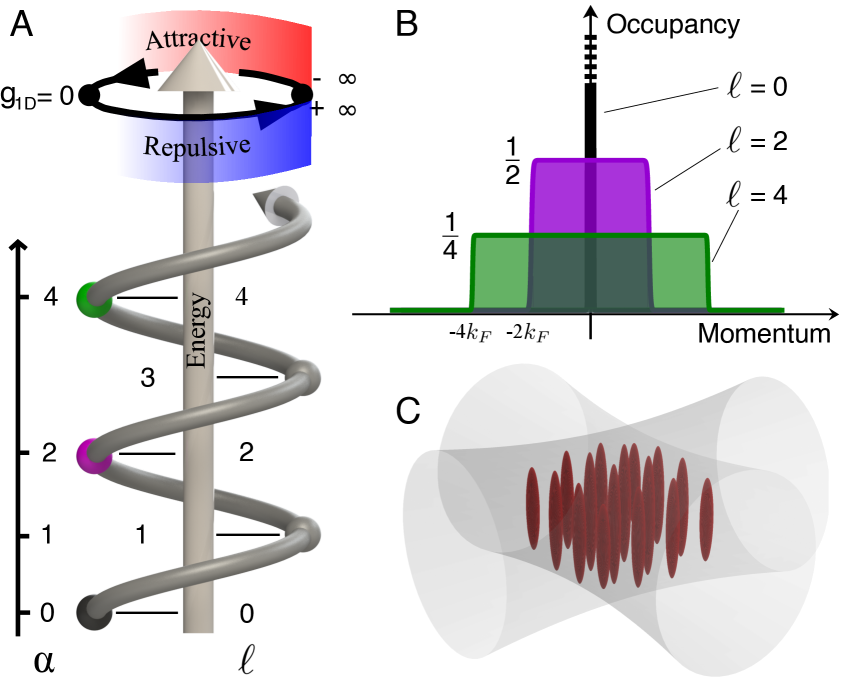
Researchers have experimentally created and observed fractional Fermi seas – a novel quantum state of matter – within a one-dimensional Bose gas, opening new avenues for understanding interacting quantum systems.
![Calculations of particle distribution functions-specifically for muons, photons, and a [latex]Z^{\prime}[/latex] boson, considering transverse and longitudinal polarizations-demonstrate deviations from Standard Model predictions, offering insights into new physics beyond established parameters and factorization scales.](https://arxiv.org/html/2602.16771v1/x1.png)
A future muon collider offers a unique opportunity to indirectly probe new physics by precisely examining the internal structure of particles.
New research explores how fundamental properties of Majorana fields in curved spacetime can be described through geometric and path integral methods.
Precision measurements of photon fusion processes offer a novel pathway to search for subtle deviations from established physics and constrain models extending the Standard Model.
![String configurations in five dimensions reveal distinct behaviors dependent on connectivity, with a turning point coordinate [latex]r_0[/latex] characterizing connected states and a light quark coordinate [latex]r_{\bar{q}}[/latex] defining disconnected configurations at [latex]y=0[/latex] and [latex]y=Y[/latex].](https://arxiv.org/html/2602.16657v1/x2.png)
This review explores how effective string models and spatial Wilson loops can illuminate the complex process of string breaking – the fundamental mechanism behind quark confinement – within Quantum Chromodynamics.
![The path integral formalism, as illustrated by [latex]Eq. (12)[/latex], establishes boundary conditions at [latex]\tau = 0[/latex] through reference bra states, while the inclusion of decoherence-modeled by interactions coupling [latex]\phi_i[/latex] and [latex]\bar{\phi}_i[/latex] at [latex]\tau = 0[/latex]-captures the system’s loss of quantum coherence.](https://arxiv.org/html/2602.16597v1/Fig1.png)
New research demonstrates how entanglement negativity can reveal topological phases even after quantum systems succumb to decoherence.
![The study demonstrates a method for stacking daily modulation data over a sidereal year-366 days-by tracking the rate [latex]R(t)[/latex] against both sidereal time and a shifted variant [latex]\tilde{t}[/latex], revealing that while [latex]R(t)[/latex] fluctuates within a defined envelope throughout the year, specific rates on January 1st and May 16th serve as key reference points for characterizing this temporal modulation.](https://arxiv.org/html/2602.15947v1/x3.png)
New statistical methods promise to sharpen the search for dark matter by optimizing detector alignment and analysis of subtle time-dependent signals.
![The study of heavy-ion collisions at [latex]\sqrt{s_{NN}} = 19.6[/latex] GeV reveals how fluctuations in transverse momentum-measured through observables like [latex]\langle p_T \rangle[/latex], [latex]v_0 = \sigma_{p_T} / \langle p_T \rangle[/latex], [latex]R_{p_T}[/latex], and [latex]r_{p_T}[/latex]-differ for pions, kaons, and protons, suggesting that baryon diffusion-represented by parameters [latex]C_B = 0.0[/latex] and [latex]C_B = 0.5[/latex]-influences particle production in these high-energy events, a phenomenon further corroborated by comparative data from 5-10% centrality measurements.](https://arxiv.org/html/2602.16369v1/x4.png)
New research reveals how analyzing momentum variations in high-energy collisions can provide insights into the behavior of extremely dense baryonic matter.